Introduction
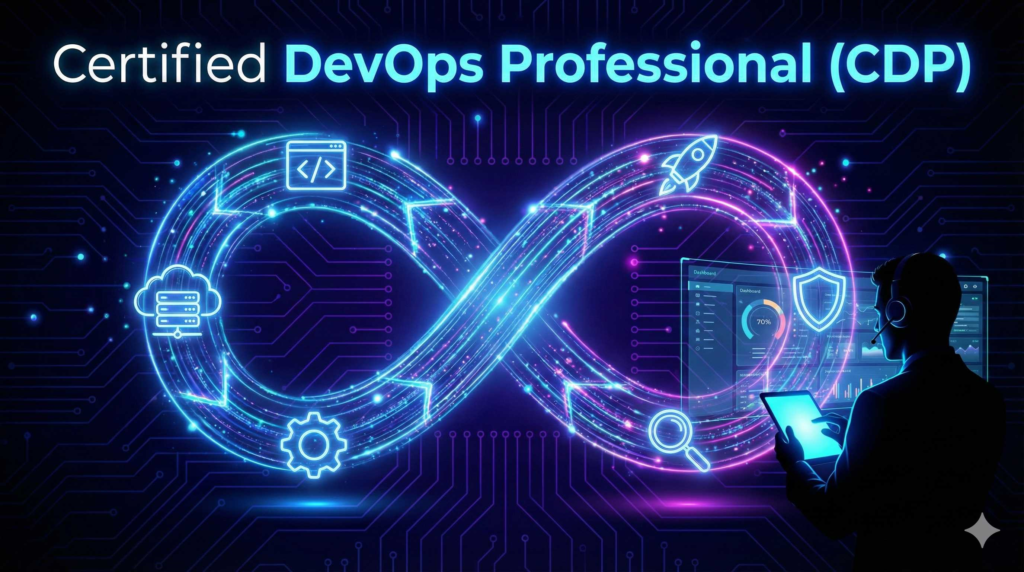
The world of software development and IT operations is rapidly evolving, with companies seeking professionals who can streamline workflows, reduce downtime, and enhance the efficiency of their operations. The Certified DevOps Professional (CDP) certification is one of the most recognized qualifications that enable professionals to master the DevOps culture and practices, bridging the gap between software development and IT operations.
This comprehensive guide will walk you through the details of the Certified DevOps Professional (CDP) certification, its importance, who should take it, the skills you’ll gain, preparation tips, and the career benefits that come with it.
What is Certified DevOps Professional (CDP)?
The Certified DevOps Professional (CDP) certification is a globally recognized credential that showcases a professional’s ability to implement and manage DevOps practices within an organization. DevOps itself is a culture that emphasizes collaboration between software development and IT operations, aiming to streamline processes, enhance efficiency, and ultimately deliver high-quality software faster and more reliably.
The CDP certification covers various aspects of the DevOps lifecycle, including continuous integration and continuous deployment (CI/CD), automation, cloud services, infrastructure as code (IaC), and monitoring. By achieving this certification, professionals demonstrate proficiency in key DevOps tools and techniques that enable seamless integration of development and operations teams, reducing friction and promoting a more agile and collaborative work environment.
This certification validates the expertise needed to work in fast-paced environments where adaptability and automation are crucial. It is designed for individuals who want to gain advanced skills to manage complex DevOps systems, enhance team collaboration, and drive software delivery improvements at scale.
Who Should Take It?
The Certified DevOps Professional (CDP) certification is ideal for a range of IT and engineering professionals who want to advance their careers and deepen their understanding of DevOps practices. The following professionals are particularly suited for this certification:
- DevOps Engineers: These professionals are directly involved in creating and maintaining CI/CD pipelines, managing cloud infrastructure, and automating deployments. The CDP certification helps validate their skills and improve their ability to deliver faster and more reliable services.
- Software Engineers: Engineers working in development who are eager to integrate DevOps practices into their workflow, improve collaboration with operations, and gain hands-on experience with DevOps tools will benefit greatly from this certification.
- Engineering Managers: For those managing development and operations teams, the CDP certification provides valuable insight into how to foster a culture of collaboration, improve processes, and increase the overall efficiency of their team.
- Platform Engineers and Cloud Engineers: Those focused on cloud environments and platform-level infrastructure can benefit from understanding how DevOps principles apply to cloud-native technologies and how to optimize these environments using automation.
- Security Engineers (DevSecOps): With the rise of DevSecOps, security engineers focusing on integrating security into the DevOps pipeline will find this certification particularly useful in aligning security practices with rapid software delivery.
- Other IT Professionals: Individuals working in network operations, system administration, or IT operations who want to expand their knowledge of DevOps practices, including automation and CI/CD, can benefit from the CDP certification.
Skills You’ll Gain
Upon completing the Certified DevOps Professional certification, you will acquire essential skills, including:
- Automation of infrastructure and workflows.
- Continuous Integration/Continuous Deployment (CI/CD) pipelines.
- Version control systems and managing code repositories.
- Collaboration and communication between development and operations teams.
- Monitoring and troubleshooting applications in production environments.
- Infrastructure as Code (IaC) using tools like Terraform and Ansible.
- Security practices within a DevOps environment (DevSecOps).
Real-World Projects You Should Be Able to Do After It
After earning your certification, you should be able to handle real-world projects such as:
- Setting up automated CI/CD pipelines using Jenkins, GitLab CI, or other tools.
- Configuring Infrastructure as Code (IaC) to provision and manage cloud environments.
- Optimizing cloud environments for scalability and cost efficiency.
- Integrating monitoring and logging systems to ensure high availability and performance.
- Implementing automated testing and quality assurance within the DevOps pipeline.
Preparation Plan
7–14 Days:
- Focus on understanding the basic principles of DevOps, including continuous integration, version control, and automation tools.
- Review tutorials on Git, Jenkins, and other foundational DevOps tools.
- Set up a small-scale CI/CD pipeline to get hands-on experience.
30 Days:
- Learn and practice IaC tools like Terraform or Ansible.
- Focus on cloud platforms such as AWS, Azure, or GCP.
- Set up automated testing frameworks within the CI/CD pipeline.
- Participate in DevOps-related forums and Q&A to expand knowledge.
60 Days:
- Deep dive into monitoring, security practices, and scaling production applications.
- Gain a strong understanding of DevOps metrics like deployment frequency, lead time, and MTTR (Mean Time to Recovery).
- Take practice exams and simulate real-world problems for better preparation.
Common Mistakes
When preparing for the Certified DevOps Professional exam, avoid these common pitfalls:
- Ignoring automation tools like Jenkins or GitLab CI during preparation.
- Skipping practical experience with cloud platforms and infrastructure as code.
- Not understanding DevSecOps and security integration within the DevOps pipeline.
- Overcomplicating CI/CD pipelines; keep them simple initially.
- Not using version control systems (e.g., Git) for managing infrastructure code.
Best Next Certification After This
After earning the Certified DevOps Professional (CDP) certification, professionals can consider pursuing advanced certifications that further their expertise and open up new career opportunities. Here are some of the best options:
- Certified Kubernetes Administrator (CKA)
As Kubernetes has become the de facto platform for container orchestration, this certification validates an individual’s ability to deploy, scale, and manage Kubernetes clusters. The CKA builds on DevOps principles, especially for container-based applications, making it a great follow-up certification. - Certified DevSecOps Professional
DevSecOps integrates security into the DevOps pipeline. For professionals who want to specialize in ensuring that security is a core component of the DevOps process, the DevSecOps certification is a perfect next step. - Certified Cloud Security Professional (CCSP)
Cloud security is a growing concern for organizations moving to cloud-based infrastructures. The CCSP certification, offered by (ISC)², focuses on cloud security architecture, governance, and compliance, and is an excellent follow-up for those with a DevOps background. - Leadership and Management Certifications
As a DevOps professional advances in their career, they may transition into leadership roles. Certifications like Certified ScrumMaster (CSM) or Certified Agile Leadership (CAL) can help develop the leadership and management skills required to lead teams and drive transformation within an organization. - Certified Kubernetes Application Developer (CKAD)
This certification is for professionals who want to deepen their expertise in building and deploying applications on Kubernetes. It is an ideal follow-up for CDP holders who are working with Kubernetes or containerized applications.
Choose Your Path: Learning Paths for DevOps Professionals
One of the best aspects of DevOps is its adaptability to different roles and needs within an organization. As a DevOps Professional, you can follow several specialized learning paths, depending on your interests and career goals. Here are six key paths you can choose from:
- DevOps
This is the foundational path for professionals who wish to master the core principles of DevOps, including CI/CD, automation, monitoring, and collaboration between development and operations teams. Professionals who follow this path typically work as DevOps Engineers or Automation Engineers. - DevSecOps
DevSecOps focuses on integrating security into the DevOps pipeline, ensuring that security is not an afterthought but an ongoing practice throughout the software development and delivery lifecycle. This path is ideal for Security Engineers, DevOps Engineers looking to add a security dimension to their skill set, or those aiming for DevSecOps Engineer roles. - SRE (Site Reliability Engineering)
Site Reliability Engineering is an advanced DevOps path that emphasizes the reliability, scalability, and performance of applications in production environments. Professionals in this path often focus on maintaining uptime and system health at scale, with an emphasis on metrics, monitoring, and automation. The SRE path is suitable for professionals seeking to become Site Reliability Engineers or Infrastructure Engineers. - AIOps/MLOps
As artificial intelligence and machine learning become integrated into operations, the AIOps/MLOps path focuses on utilizing AI and ML for automation, monitoring, and predictive analytics in DevOps environments. This path is for Data Engineers, Machine Learning Engineers, or professionals seeking to specialize in AI-driven DevOps. - DataOps
DataOps emphasizes the use of DevOps principles to manage and deliver data pipelines, ensuring that data operations are as efficient and automated as software development. This path is perfect for Data Engineers, DataOps Engineers, or professionals interested in streamlining data-related workflows. - FinOps
FinOps brings financial management and optimization to the cloud, helping organizations manage cloud costs more efficiently. This path is ideal for Cloud Financial Engineers, FinOps Practitioners, or anyone involved in the financial management of cloud infrastructure.
Role → Recommended Certifications
| Role | Recommended Certifications |
|---|---|
| DevOps Engineer | Certified DevOps Professional, CKA |
| SRE | Certified DevOps Professional, CKA |
| Platform Engineer | Certified DevOps Professional, CKA, Terraform |
| Cloud Engineer | Certified DevOps Professional, AWS Certified Solutions Architect |
| Security Engineer | Certified DevSecOps Professional |
| Data Engineer | Certified DevOps Professional, DataOps Professional |
| FinOps Practitioner | Certified DevOps Professional, FinOps Certified Practitioner |
| Engineering Manager | Certified DevOps Professional, Leadership certifications |
FAQs on Certified DevOps Professional
- How difficult is the Certified DevOps Professional exam?
The exam is moderately challenging, requiring both theoretical knowledge and practical experience with DevOps tools and practices. - How much time will I need to prepare for the exam?
Most candidates need 30–60 days of preparation, depending on their prior knowledge and experience. - Are there any prerequisites for the exam?
It is recommended to have a basic understanding of version control, CI/CD, and cloud computing before attempting the exam. - Should I take the DevOps certification exam in sequence?
Yes, starting with a foundational certification, such as a DevOps Foundation certification, can help you build the necessary skills before attempting the professional exam. - How valuable is this certification in the job market?
The Certified DevOps Professional certification is highly valued by companies seeking to implement DevOps principles, and it can significantly boost your career prospects. - What are the career outcomes after earning this certification?
This certification can open doors to roles such as DevOps Engineer, SRE, Platform Engineer, and Cloud Engineer. - Is hands-on experience necessary?
Yes, practical experience with CI/CD tools, cloud platforms, and automation is essential for success in this field. - Can I pursue this certification while working full-time?
Yes, many professionals successfully prepare for the exam while balancing full-time work. - What is the best way to study for the exam?
Combining theoretical learning with hands-on practice is the best approach to preparing for the exam. - How do I register for the exam?
You can register for the exam on the official DevOpsSchool website.
Top Training Institutions Offering Certification Preparation
- DevOpsSchool
DevOpsSchool provides comprehensive training programs and certifications for aspiring DevOps professionals. Their hands-on courses focus on real-world applications of DevOps practices. - Cotocus
Cotocus offers expert-led training sessions for DevOps certifications, focusing on both theoretical knowledge and practical skills. - ScmGalaxy
ScmGalaxy is known for its industry-specific DevOps training programs that cover everything from automation to deployment and security. - BestDevOps
BestDevOps offers specialized courses designed to train professionals for DevOps certifications, focusing on key tools and technologies. - DevSecOpsSchool
This platform focuses on integrating security into DevOps workflows, offering DevSecOps certification programs to complement DevOps practices. - SRESchool
Specializing in Site Reliability Engineering, SRESchool offers training and certifications that align with modern DevOps practices. - AIOpsSchool
AIOpsSchool offers certification courses that focus on integrating AI and machine learning into DevOps processes for enhanced automation. - DataOpsSchool
For professionals looking to specialize in data-driven DevOps, DataOpsSchool offers targeted courses and certifications. - FinOpsSchool
FinOpsSchool offers training focused on financial management in the cloud, making it perfect for professionals interested in FinOps.
Conclusion
The Certified DevOps Professional (CDP) certification is an essential qualification for IT professionals aiming to build expertise in DevOps practices. It not only enhances your career by equipping you with skills for continuous integration, automation, and cloud management but also increases your value within your organization by promoting efficient collaboration and faster software delivery.
Whether you’re a DevOps Engineer, Software Engineer, or an Engineering Manager, the CDP certification gives you the tools and knowledge needed to succeed in the rapidly changing tech landscape. By pursuing this certification, you’ll not only increase your skill set but also open up new career opportunities and pathways for growth. Following this guide and embarking on the learning journey can propel you toward mastery in DevOps and beyond.
FAQs – Certified DevOps Professional (CDP)
1. What is the purpose of the Certified DevOps Professional certification?
This certification is meant to prove that a professional understands how DevOps works in real projects, including automation, continuous delivery, cloud platforms, containers, and operational best practices.
2. Who is the right candidate for this certification?
It is intended for software developers, DevOps practitioners, cloud and platform engineers, reliability engineers, and technical leaders involved in building or running software systems.
3. Can full-time employees prepare for this certification?
Yes. The learning structure fits well with full-time jobs and focuses on skills that are directly useful in day-to-day engineering work.
4. Is prior DevOps experience required before taking CDP?
Formal DevOps experience is not mandatory. However, a basic understanding of operating systems, source control, and application deployment will be helpful.
5. How tough is the Certified DevOps Professional assessment?
The assessment is practical in nature. It evaluates your ability to understand DevOps scenarios and make the right technical decisions, rather than testing theory alone.
6. How much preparation time should I plan for?
The time needed depends on your background:
- Experienced professionals may prepare in a few weeks
- Intermediate learners may need about a month
- Beginners may need up to two months
7. Does this certification focus on specific tools?
While popular tools are discussed, the main emphasis is on DevOps workflows, automation patterns, and system design principles that apply across tools.
8. Is this certification recognized internationally?
Yes. The skills covered are globally relevant and align with DevOps practices used by organizations worldwide.
9. Will this certification support a career shift into DevOps?
Yes. It helps professionals move from development, operations, or testing roles into DevOps and platform engineering positions.
10. Do I need hands-on practice to clear this certification?
Hands-on practice is strongly recommended. Real experience with pipelines, deployments, and monitoring makes preparation much easier.
11. Is this certification useful for technical managers?
Yes. Managers and team leads gain a better understanding of DevOps systems, team workflows, and automation strategies used in modern engineering teams.
12. What should I pursue after earning Certified DevOps Professional?
After completing CDP, you can deepen your expertise in areas such as SRE, DevSecOps, cloud architecture, AIOps, DataOps, FinOps, or progress toward leadership roles.







Leave a Reply
You must be logged in to post a comment.