Introduction
In the rapidly evolving world of software engineering, the speed of delivery has become a primary competitive advantage. However, as teams push code faster than ever, the traditional approach to application security—where a central security team acts as a final roadblock before production—has become a significant bottleneck. This legacy model often leads to friction, delayed releases, and a fragmented understanding of risk.
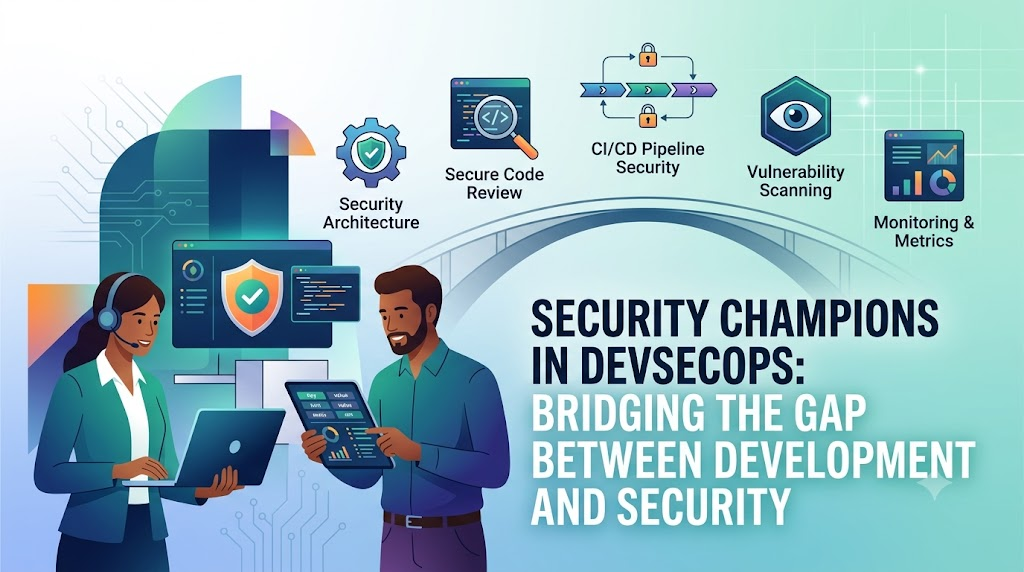
Modern software delivery demands a different approach. This is where the concept of Security Champions in DevSecOps becomes vital. Instead of security being an isolated phase at the end of the lifecycle, it becomes a shared responsibility integrated into every stage of development. By embedding knowledgeable individuals within engineering squads, organizations can bridge the communication gap between developers and security professionals.
For those looking to deepen their expertise in this collaborative environment, DevOpsSchool provides comprehensive resources and training to help teams master these complex workflows. Understanding how to integrate security into the heart of development—and knowing where to find the right training—is the first step toward a mature, resilient, and high-performing engineering culture.
What Are Security Champions in DevSecOps?
At its core, a Security Champion is a developer, engineer, or team member who is embedded within a product or engineering squad and has a keen interest in application security. While they remain part of their original team, they act as the primary point of contact for security-related matters.
Think of a Security Champion as the “security bridge” for the team. They are not necessarily full-time security professionals, but they are the ones who advocate for secure coding practices, help their peers navigate security requirements, and ensure that security is considered long before the final deployment phase. They bring security awareness to the daily “stand-up” meetings and architectural discussions, ensuring that security is treated as a core feature rather than an afterthought.
Why Organizations Need Security Champions
As software architectures grow more complex, the volume of security requirements can easily overwhelm a centralized security team. When security experts are forced to review every line of code for every project across an entire enterprise, they inevitably become a bottleneck.
Organizations need Security Champions for several practical reasons:
- Faster Feedback Loops: Instead of waiting for a manual security review at the end of the sprint, developers get immediate guidance from a peer within their own team.
- Context-Aware Security: Champions understand the specific business logic and technical stack of their applications, allowing them to provide more relevant security advice.
- Reduced Security Debt: By catching vulnerabilities during the design and coding phases, teams spend significantly less time and money on remediation after the product is already in production.
- Scalability: A small security team cannot scale linearly with a large engineering department. Champions allow security knowledge to permeate throughout the organization, effectively scaling the reach of the security team.
Role of Security Champions in DevSecOps
The responsibilities of a Security Champion are balanced between technical oversight and cultural advocacy. They help maintain the velocity of the development team while keeping the security posture intact.
| Responsibility | Purpose |
| Security Awareness | To educate team members on common threats like injection or broken authentication. |
| Secure Coding Guidance | To assist developers in writing code that is inherently secure from the start. |
| Vulnerability Reporting | To act as the first responder for identifying and triaging security issues. |
| Security Collaboration | To facilitate communication between the engineering team and the central security team. |
| Tool Adoption | To champion the use of security scanning tools within the CI/CD pipeline. |
How Security Champions Support Shift-Left Security
“Shift-left” is the practice of moving security testing as far to the left (the beginning) of the software development lifecycle as possible. Security Champions are the primary catalysts for this movement.
In a traditional workflow, code is written, then tested, then secured. In a shift-left model supported by a Security Champion, the workflow looks different:
- Design Phase: The Champion ensures that threat modeling is performed during the design of a new feature.
- Coding Phase: The Champion shares secure coding libraries and prevents common mistakes in real-time.
- Commit Phase: The Champion ensures that automated SAST (Static Application Security Testing) tools are integrated into the CI/CD pipeline.
- Testing Phase: The Champion helps interpret the results of automated scans, distinguishing between critical issues and noise, which keeps the build process moving smoothly.
Security Champions vs Traditional Security Teams
Understanding the difference between these two roles is essential for organizational alignment.
| Traditional Security Team | Security Champions |
| Centralized “Gatekeepers” | Decentralized “Advocates” |
| Often involved late in the cycle | Involved throughout the lifecycle |
| Broad, enterprise-wide focus | Focused on specific products/squads |
| Often viewed as a hurdle | Viewed as a collaborative partner |
| Focus on policy enforcement | Focus on enablement and guidance |
Skills a Good Security Champion Should Have
A successful Security Champion does not need to be a world-class penetration tester. Rather, they need a combination of technical curiosity and soft skills:
- Communication Skills: They must be able to translate complex security risks into understandable terms for developers and project managers.
- Application Security Fundamentals: A solid grasp of the OWASP Top 10 and basic web vulnerabilities is essential.
- Collaboration Mindset: They must prioritize team velocity while advocating for security, rather than acting as a blocker.
- Continuous Learning: Security is a fast-moving field; a good champion is someone who enjoys staying updated on new tools and emerging threat patterns.
Real-World Example: Team Without Security Champions
Imagine a team working on a high-traffic e-commerce platform. They deploy features weekly. Because there are no Security Champions, the team writes code without considering security boundaries.
The security team only reviews the application once a quarter. They find multiple critical vulnerabilities that require a massive code rewrite. The developers are frustrated because they have to pause new feature work to fix old bugs, and the business stakeholders are unhappy because the deployment of key revenue-generating features is delayed by weeks.
Real-World Example: Team Using Security Champions
In contrast, consider a similar team that has designated one of their senior developers as a Security Champion. During the design of a new checkout feature, the Champion identifies a potential data validation flaw.
Because this happens at the start, the team fixes it in an hour. When the code is pushed to the CI/CD pipeline, the automated security tools confirm the fix. The feature is deployed on time, without any emergency hotfixes or late-stage security blocks. The developers feel empowered, and the security team is confident in the team’s output.
Benefits of a Security Champion Program
| Benefit | Impact |
| Faster Security Feedback | Reduces the time between coding and vulnerability detection. |
| Better Collaboration | Breaks down silos between security and development teams. |
| Reduced Vulnerabilities | Fixes issues early, reducing the cost of remediation. |
| Improved Security Culture | Security becomes a shared goal for every engineer. |
| Faster DevSecOps Adoption | Simplifies the cultural transition to automated security workflows. |
Common Mistakes Organizations Make
Building a successful program is challenging. Avoid these common pitfalls:
- Forcing the Role: Never force someone to be a champion. It must be someone with a genuine interest in security.
- Zero Training: Assuming developers already know security best practices without providing resources or mentorship.
- Treating Champions as “Free” Security Guards: If you overload them with security work, they will burn out and stop contributing to their primary development tasks.
- Lack of Management Support: Security culture requires buy-in from leadership. Ensure the time spent by champions on security is recognized.
- Lack of Recognition: If a champion does great work, acknowledge it. It is an additional responsibility that deserves professional credit.
Best Practices for Building a Successful Security Champion Program
To build a program that lasts, follow these steps:
- Provide Dedicated Security Training: Offer access to specialized courses, certifications, or workshops to build their confidence.
- Encourage Peer-to-Peer Collaboration: Create a “Community of Practice” where champions from different teams can share what they have learned.
- Define Clear, Achievable Responsibilities: Start small. Give them manageable tasks like ensuring unit tests include security edge cases.
- Recognize and Reward Contributions: Integrate their role into their performance reviews and career progression.
- Provide Tools and Support: Give them a direct line to the central security team for when they hit a roadblock they cannot solve alone.
Role of Automation in Supporting Security Champions
Security Champions are not expected to do everything manually. Automation is the backbone of their success. By leveraging SAST (Static Application Security Testing) for code analysis, DAST (Dynamic Application Security Testing) for runtime issues, and Software Composition Analysis (SCA) for third-party library risks, champions can automate the “heavy lifting.” Their role is to interpret the automated results and help the team prioritize them, rather than manually scanning every build.
Role of DevOpsSchool in Learning DevSecOps and Security Culture
For teams looking to formalize their approach to security, DevOpsSchool serves as a vital hub for professional development. By focusing on practical, hands-on learning, they help professionals understand how to weave security into existing CI/CD workflows without disrupting the development lifecycle. Through their structured training, engineers can gain the necessary exposure to modern security automation tools and, more importantly, learn how to build the cultural foundation required to make Security Champions successful in any enterprise environment.
Career Importance of DevSecOps and Security Skills
Security is no longer a niche career path; it is becoming a foundational skill for all engineering roles. Whether you are a DevSecOps Engineer, Cloud Security Engineer, or a Site Reliability Engineer (SRE), understanding how to secure software is a high-value competency. The Security Champion program is often the starting point for developers who want to transition into dedicated security or platform engineering roles, providing a clear path for professional growth and increased technical responsibility.
Industries Using Security Champion Programs
Security Champion programs are being adopted across sectors that demand high resilience:
- Banking & Finance: To protect sensitive transaction data and meet strict regulatory requirements.
- Healthcare: To safeguard patient records and comply with privacy standards.
- SaaS Companies: To ensure that rapid feature delivery does not compromise user data.
- E-Commerce: To defend against automated threats and protect customer information.
- Telecom: To manage the security of complex, interconnected network infrastructure.
Future of Security Champions in DevSecOps
The future of this role involves deeper integration with AI-assisted security reviews. As automated tools get better at predicting vulnerabilities, Security Champions will shift their focus from manual review to overseeing these AI-driven systems. We will also see a rise in cloud-native security ownership, where champions are responsible for the security configuration of infrastructure-as-code, ensuring the entire stack—from code to cloud—is hardened.
FAQs (15 Questions)
- What is a Security Champion? A developer or team member who advocates for and oversees security practices within their local development squad.
- Why are they important? They bridge the gap between development and security, reducing bottlenecks and catching vulnerabilities early.
- Do they replace security teams? No, they augment them, acting as the eyes and ears of security within development teams.
- What skills are needed? Good communication, curiosity, and a foundational understanding of application security.
- Can developers become champions? Yes, developers are often the best candidates because they understand the codebase.
- How do they support DevSecOps? By integrating security into the CI/CD pipeline and fostering a “shift-left” mindset.
- What tools do they use? SAST, DAST, SCA, and infrastructure scanning tools.
- Are these programs expensive? The primary cost is time and training, but the long-term ROI is significant due to reduced risk.
- How do you select a champion? Look for team members who are naturally inquisitive about security and have good peer influence.
- How much time should they spend on security? Usually 10%–20% of their time, so they can stay focused on development.
- Do they need to be security experts? No, they just need to know enough to identify common issues and know when to escalate.
- What if the team doesn’t want one? Start with training and show them how security tools can actually make their lives easier by preventing bugs.
- How is success measured? Through improved security metrics, such as fewer production vulnerabilities and faster remediation times.
- Is this for small startups? Yes, it is a great way to embed security culture early as the company scales.
- Does the central security team lose control? No, they gain reach by having trained advocates in every squad.
Final Thoughts
Security is not a final check-box; it is a continuous journey. By empowering Security Champions within your engineering teams, you are doing more than just fixing bugs—you are building a culture where security is understood, respected, and shared. When your developers and security professionals speak the same language, your organization becomes more resilient to threats and faster at delivering value to your customers. Security Champions are the heartbeat of a healthy DevSecOps practice, ensuring that speed and safety are never mutually exclusive.







Leave a Reply
You must be logged in to post a comment.