Introduction
In traditional software development models, security was often treated as a final checkpoint—a hurdle to clear right before a product went live. This approach, however, rarely scales in modern environments where code changes happen daily, if not hourly. To thrive, engineering teams must integrate security directly into their development lifecycle, a methodology known as DevSecOps.
Transitioning to this model requires more than just new tools; it requires a culture of shared responsibility and, most importantly, visibility. Without clear metrics, teams often fly blind, unable to distinguish between genuine security progress and mere activity. This is where DevSecOps KPIs become essential. By tracking the right indicators, organizations can balance rapid innovation with a robust security posture, ensuring that speed does not come at the cost of safety.
For professionals looking to master these practices, resources at DevOpsSchool provide the necessary foundation for understanding how to integrate security automation into CI/CD pipelines. Measuring these outcomes transforms security from a bottleneck into a competitive advantage.
What Are DevSecOps KPIs?
DevSecOps KPIs (Key Performance Indicators) are measurable values that organizations use to track the effectiveness of their security integration within the DevOps lifecycle. Think of them as the dashboard of your engineering health.
If DevOps is about how fast and reliably you can deliver features, DevSecOps KPIs tell you how secure those features are throughout that journey. Instead of guessing if your security measures are working, these metrics provide evidence, allowing teams to make data-driven decisions about where to invest their time and resources.
Why DevSecOps KPIs Matter
Measurement provides clarity. Without it, you are effectively managing by intuition, which is rarely a scalable strategy in complex cloud environments.
- Visibility: You gain a clear picture of where vulnerabilities enter the pipeline.
- Faster Fixes: By pinpointing exactly where issues occur, developers can resolve them before they escalate.
- Better Collaboration: Metrics break down the silos between security and development teams by providing a shared language.
- Risk Reduction: You move from reactive firefighting to proactive prevention, significantly lowering the chance of a major breach.
Imagine a pipeline where every time a security check fails, it is logged and categorized. This data allows the team to see that a specific library is causing 80% of their critical vulnerabilities, allowing them to fix the root cause once rather than patching symptoms repeatedly.
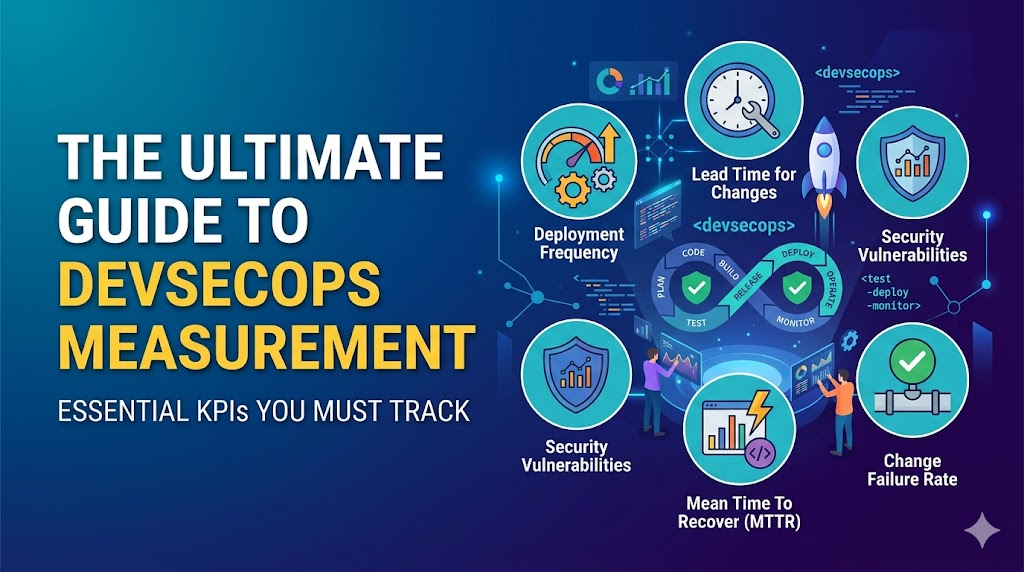
Core DevSecOps KPIs You Must Track
| KPI | Why It Matters |
| Vulnerability Detection Rate | Measures how effectively your scans catch issues early. |
| Mean Time to Remediation (MTTR) | Tracks the speed of your security response. |
| Security Incident Frequency | Identifies recurring patterns in vulnerabilities. |
| Deployment Frequency | Ensures security isn’t slowing down delivery. |
| Failed Deployment Rate | Highlights the relationship between security tests and code stability. |
| Compliance Success Rate | Validates adherence to organizational and industry standards. |
Measuring Vulnerability Detection Rate
This metric tracks how many security flaws are discovered during the development and testing phases compared to those found in production. In an ideal DevSecOps workflow, this rate is high during the build process. When you run automated security scans—such as SAST (Static Application Security Testing)—during the CI/CD pipeline, you are identifying risks while the code is still fresh in the developer’s mind, making it easier and cheaper to fix.
Mean Time to Remediation (MTTR)
MTTR is perhaps the most critical indicator of team health. It calculates the average time elapsed from when a vulnerability is identified to when it is fully patched and verified. A high MTTR suggests that either your triage process is slow, or developers lack the context to fix the issues. Tracking this helps teams identify bottlenecks in their approval or testing workflows.
Security Incident Frequency
This metric tracks the number of security-related events or successful attacks over a period of time. It is not just about the number of incidents, but the type and severity. By analyzing the frequency, you can identify if specific parts of your infrastructure are more prone to attack or if certain configurations are consistently mismanaged, allowing for targeted hardening.
Shift-Left Security Metrics
“Shifting left” means moving security checks earlier in the development lifecycle. The primary metric here is the Percentage of Security Tests Automated in CI/CD. If you are still relying on manual security reviews, you are not truly shifting left. By automating these checks, you reduce the time it takes to get feedback, allowing developers to build security into their daily routine rather than viewing it as a separate gatekeeper.
DevSecOps Automation Metrics
Automation metrics quantify the efficiency of your security tooling. Key indicators include:
- Scan Coverage: The percentage of code repositories or infrastructure-as-code templates being scanned.
- False Positive Rate: The percentage of security alerts that are flagged but turn out to be non-issues. A high false positive rate leads to “alert fatigue,” where developers start ignoring security warnings altogether.
Monitoring and Observability in DevSecOps
Monitoring is about looking at the health of your systems, while observability is about understanding why a state has occurred. In DevSecOps, you should monitor logs from your security tools, firewall logs, and application performance monitoring (APM) tools. For example, if a sudden spike in failed login attempts correlates with a recent code deployment, your observability dashboard allows you to trace that spike back to the specific change, enabling an immediate rollback or fix.
Real-World Example: Team Without KPI Tracking
A mid-sized team releases software every two weeks. They perform a manual security scan once every quarter. Because they don’t track metrics, they are unaware that their third-party dependencies have become highly vulnerable. One day, a breach occurs. Because they have no observability or historical data, they spend weeks trying to locate the source of the leak, ultimately leading to significant downtime and loss of customer trust.
Real-World Example: Team Using DevSecOps KPIs Effectively
Another team automates SAST and DAST scans in every commit. They track their MTTR, which is currently 4 hours. When a critical vulnerability is found in a library, their dashboard immediately alerts the team. Because they have established a culture of security, the developers have the necessary tools to patch the vulnerability and deploy the fix in under 6 hours. Their security posture remains intact, and their delivery speed is unaffected.
Common Mistakes Teams Make While Tracking DevSecOps KPIs
- Tracking too many metrics: Trying to measure everything leads to data overload. Focus on what is actionable.
- Ignoring trends: A single data point means little. Look for improvements or regressions over time.
- Measuring only security: Security must be balanced with delivery speed. If your security KPIs are “perfect” but you can’t ship code, your process is failing the business.
- Lack of automation: Manual tracking is prone to error and quickly becomes outdated.
- Blaming developers: Use metrics to improve the system, not to punish individuals for vulnerabilities.
Best Practices for Measuring DevSecOps Success
- Track meaningful KPIs: Focus on metrics that drive action.
- Automate security monitoring: Use tools that feed data directly into your CI/CD dashboard.
- Review trends regularly: Hold bi-weekly or monthly reviews to discuss KPI performance.
- Encourage collaboration: Ensure that both security and DevOps teams own these metrics.
- Balance speed and security: Ensure that security processes improve the quality of the software, not just satisfy compliance checkboxes.
Role of DevOpsSchool in Learning DevSecOps Measurement
Understanding the theory is only half the battle. At DevOpsSchool, learners gain practical experience in setting up secure pipelines. By exploring the nuances of CI/CD security and learning how to interpret security scan outputs, professionals can bridge the gap between abstract metrics and actual engineering results. Their programs emphasize the hands-on application of automation, ensuring that students understand how to track performance indicators in real-world, high-pressure environments.
Career Importance of Understanding DevSecOps KPIs
For professionals across the IT spectrum, KPI literacy is a significant career booster:
- DevSecOps Engineers: Use metrics to prove the effectiveness of their pipeline hardening.
- Cloud Security Engineers: Utilize data to justify infrastructure investment and risk mitigation strategies.
- SREs: Leverage metrics to ensure that security is not negatively impacting system reliability.
- Engineering Managers: Use KPIs to report the ROI of security initiatives to stakeholders.
Industries Using DevSecOps KPIs
- Banking & Finance: High regulatory pressure necessitates strict compliance and vulnerability tracking.
- Healthcare: Protecting patient data requires constant monitoring of security metrics.
- SaaS Companies: Rapid release cycles demand automated security feedback loops.
- E-Commerce: Monitoring security incidents is vital for maintaining customer trust and uptime.
- Telecom: Managing massive infrastructure requires high-level observability and automated policy enforcement.
- Enterprise IT: Scaling security across thousands of developers requires data-driven governance.
Future of DevSecOps Metrics
The future of DevSecOps measurement lies in intelligence. We are moving toward:
- AI-assisted security analytics: Using machine learning to identify complex patterns that manual rules miss.
- Predictive risk detection: Anticipating potential vulnerabilities before code is even committed.
- Automated compliance: Continuous auditing where systems automatically match against compliance standards.
- Smarter security dashboards: Unified views that provide context-aware insights, linking security alerts to business impact.
FAQs
- What are DevSecOps KPIs? These are performance indicators used to measure the security effectiveness of your DevOps processes.
- Why are DevSecOps metrics important? They provide visibility into security risks and help teams make data-driven improvements to their development lifecycle.
- What is MTTR in DevSecOps? Mean Time to Remediation is the average time taken to fix a vulnerability once it has been discovered.
- How often should KPIs be reviewed? Trends should be reviewed bi-weekly or monthly to identify long-term improvements.
- Can beginners understand DevSecOps metrics? Yes, by starting with foundational metrics like scan coverage and MTTR.
- What tools track DevSecOps KPIs? Tools range from integrated CI/CD plugins to specialized security information and event management (SIEM) systems.
- Does DevSecOps slow delivery? When done correctly with automation, DevSecOps actually speeds up delivery by reducing the need for late-stage security rework.
- Why is shift-left security important? It catches bugs early, where they are cheaper and faster to fix.
- Are these metrics the same as standard DevOps metrics? No, while they share similar goals, DevSecOps metrics focus specifically on risk, vulnerability, and compliance.
- How do I start tracking? Begin with one or two metrics, such as vulnerability detection rate, and expand as your team matures.
- Do I need expensive software? Many open-source tools can provide essential security metrics.
- Should I share these metrics with non-technical stakeholders? Yes, simplified dashboards help communicate the ROI of security efforts to leadership.
- Is manual testing obsolete? No, manual testing is still vital for complex logic checks, but it should be augmented by automated metrics.
- How do I avoid alert fatigue? Focus on tuning your security tools to reduce false positives.
- What is the most important KPI? While it depends on the organization, MTTR is generally considered the best indicator of a mature security process.
Final Thoughts
Success in DevSecOps is not defined by the absence of vulnerabilities, but by how effectively you detect, manage, and remediate them. Security improves through consistent measurement and a willingness to iterate based on data. Small, incremental fixes are far more effective than massive, reactive overhauls. By fostering a culture of collaboration and leveraging continuous monitoring, you strengthen your entire delivery chain. Keep the focus practical, prioritize transparency, and remember that security is a continuous journey, not a final destination.







Leave a Reply
You must be logged in to post a comment.