Introduction
In the current digital economy, software delivery velocity directly dictates market competitiveness, shifting application security from a siloed technical concern into a critical executive business mandate. As deployment cycles shrink from months to hours, traditional end-of-cycle security gates collapse, forcing leadership teams into a costly trade-off between missing market opportunities or releasing features with unmitigated operational risks. By adopting a proactive DevSecOps strategy, modern enterprises systematically integrate automated threat modeling, continuous vulnerability scanning, and compliance tracking into the earliest stages of the development lifecycle, successfully balancing engineering speed with robust risk management. For organizations looking to build the cross-functional competencies required for this cultural and technical alignment, partnering with structured educational frameworks like DevOpsSchool provides the professional training necessary to transform security from an operational bottleneck into a scalable driver of business resilience and customer trust.
What Is DevSecOps?
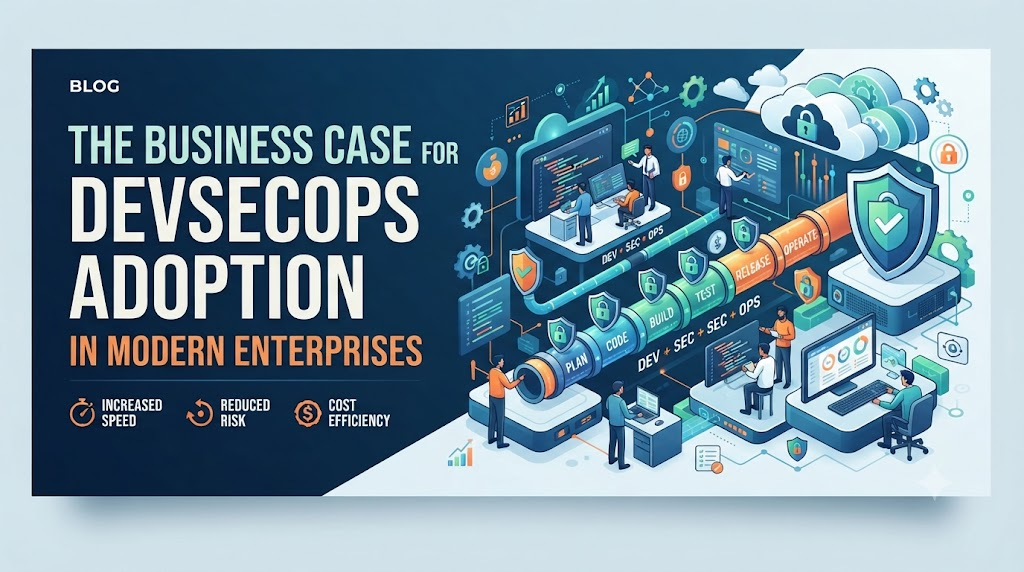
DevSecOps represents the integration of security thinking, tooling, and governance into the traditional Development (Dev) and Operations (Ops) paradigm. At its core, it is a cultural, architectural, and operational philosophy that redefines how software applications are conceived, constructed, tested, and deployed.
[ Plan ] ──> [ Code ] ──> [ Build ] ──> [ Test ] ──> [ Release ] ──> [ Deploy ]
   │            │            │             │              │             │
   └────────────┴────────────┴──────┬──────┴──────────────┴─────────────┘
                                    ▼
                     [ CONTINUOUS SECURITY PLATFORM ]
             (Threat Modeling, SAST, DAST, SCA, Compliance)
Shared Responsibility
In a standard software organization, security sits outside the primary delivery pipeline. DevSecOps dismantles this isolation by establishing security as a shared responsibility across the entire software development lifecycle (SDLC). Developers, system engineers, site reliability engineers (SREs), and security analysts operate under a unified mandate. Developers are empowered with tools to write safer code, operations engineers maintain hardened infrastructure, and security specialists act as strategic advisors who build policies rather than manual roadblocks.
Shift-Left Security
The principle of shifting left means moving security evaluations closer to the point of origin: the developer’s workstation and the initial planning phases. Instead of scanning an application only when it reaches a staging or production environment, security assessments begin during architecture design (threat modeling) and initial code commits. By identifying logical flaws, insecure dependencies, and structural design weaknesses early, the cost and effort required to fix them decrease significantly.
Continuous Security and Automation
DevSecOps replaces point-in-time assessments with continuous security checking. This is achieved by embedding automated scanners and validation guardrails directly into the continuous integration and continuous deployment (CI/CD) pipelines. Every time code is changed, built, or packaged, automated systems inspect the artifacts for vulnerabilities, compliance deviations, and misconfigurations.
Secure Software Delivery
The ultimate objective of a DevSecOps strategy is secure software delivery. This means ensuring that software moves from design to production rapidly without sacrificing the integrity of the application or the underlying infrastructure. It transforms security from a reactive response mechanism into a proactive, predictable step within the engineering lifecycle.
Why Organizations Adopt DevSecOps
The decision to execute a DevSecOps strategy is driven by concrete business realities that impact an organization’s competitive positioning, financial health, and operational stability.
Faster Secure Releases
In a pure DevOps environment, speed is the primary metric. However, speed without validation leads to broken code in production. DevSecOps ensures that speed and stability move in tandem. By automating the verification of security policies, organizations release new features frequently without fear of introducing vulnerabilities that require emergency rollbacks or hotfixes.
Reduced Security Risks
Breaches, data leaks, and unauthorized system access cause severe financial and reputational harm. DevSecOps directly mitigates these risks by reducing the overall volume of vulnerabilities that escape into production. Automated checks flag exposed API keys, insecure dependencies, and cross-site scripting vulnerabilities before code ever reaches an external server.
Better Compliance Readiness
Modern enterprises operate under a complex web of regulatory frameworks, including GDPR, HIPAA, PCI-DSS, and SOC 2. Traditional audit preparation involves weeks of manual log collection, code reviews, and policy documentation. DevSecOps builds compliance tracking directly into the infrastructure. By treating compliance rules as code, organizations generate immutable audit trails automatically, reducing the cost and disruption of regulatory audits.
Improved Customer Trust
Enterprise clients and retail consumers demand strict data protection assurances. A track record of secure, resilient application uptime builds brand equity. Conversely, a single public vulnerability exposure can erode years of customer retention efforts. Proactive security practices signal to the market that client data protection is an organizational priority.
Stronger Operational Resilience
Systems built using DevSecOps principles are inherently more stable. Infrastructure as Code (IaC) files are scanned for misconfigurations before deployment, reducing the likelihood of cloud resource exposures or misconfigured networks. When incidents do occur, automated rollback procedures and clear configuration histories allow operations teams to restore stable states in minutes rather than days.
Improved Collaboration
By breaking down the traditional hostility between speed-oriented developers and risk-averse security professionals, DevSecOps establishes a healthier internal culture. Teams work toward common objectives using shared data dashboards, reducing finger-pointing and alignment gaps during complex software releases.
The Business Value Flow of DevSecOps
To justify investment in a DevSecOps strategy, executive leaders must understand how high-level business goals translate into sustainable corporate growth through technical execution. The value flow operates as a continuous, self-reinforcing chain.
1. Business Goals
The sequence begins with core executive mandates: grow market share, introduce innovative digital products quickly, control operational overhead, and safeguard corporate capital.
2. Secure Development Practices
To fulfill these goals safely, engineering teams adopt secure coding standards, conduct threat modeling sessions before writing features, and use secure component libraries as standard practice.
3. Automated Security Testing
As code flows from developer machines, it enters automated pipelines. Static Application Security Testing (SAST), Dynamic Application Security Testing (DAST), and Software Composition Analysis (SCA) run automatically on every code commit, eliminating manual validation delays.
4. Continuous Compliance
Policy frameworks are embedded directly into the deployment process. Any infrastructure template or container image that violates corporate safety policies or regulatory mandates is automatically rejected before deployment.
5. Risk Reduction
Automated gates dramatically lower the number of critical flaws reaching public infrastructure. This limits the organization’s attack surface and significantly reduces the probability of operational breaches.
6. Operational Efficiency
Because defects are caught early, engineering teams spend less time handling unplanned fire drills, patch management, or emergency code rewrites. Development teams focus on feature creation rather than security debt remediation.
7. Customer Trust
The business consistently delivers reliable, secure, and compliant digital experiences. Clients experience high availability and suffer no disruptive data compromises, reinforcing brand loyalty.
8. Business Resilience
The corporation handles shifting regulatory landscapes and emerging threat vectors smoothly. The infrastructure adapts to new security requirements without requiring complete software redesigns.
9. Sustainable Growth
With reduced operational friction, predictable deployment timelines, and minimal security overhead costs, the enterprise achieves sustainable, long-term digital expansion.
Key Business Benefits
The strategic impact of adopting a DevSecOps strategy can be clearly categorized by examining how targeted technical changes produce measurable organizational improvements.
| Business Benefit | How DevSecOps Contributes | Organizational Impact |
| Risk Reduction | Embeds automated vulnerability scanning (SAST/DAST/SCA) directly into the deployment pipelines. | Fewer critical defects reach production, reducing the likelihood of data breaches and financial penalties. |
| Faster Delivery | Eliminates manual, end-of-cycle security checks by shifting verification to early stages. | Time-to-market for new features decreases, allowing the company to capture competitive advantages quickly. |
| Compliance Readiness | Automates governance monitoring and builds immutable audit logs for every system change. | Audit preparation costs drop, and the enterprise maintains constant readiness for regulatory evaluations. |
| Customer Confidence | Ensures stable, secure applications while protecting user data from public exposures. | Higher customer retention rates, stronger brand equity, and smoother enterprise sales cycles. |
| Cost Optimization | Identifies design flaws and software vulnerabilities early when they are inexpensive to fix. | Drastic reduction in emergency engineering expenses, post-release patches, and operational rework. |
| Operational Efficiency | Replaces manual infrastructure verification with automated, standardized policy checks. | Engineering teams focus on building profitable features rather than managing manual security tickets. |
| Security Visibility | Provides centralized compliance and threat dashboards across all development teams. | Executive leaders gain clear, data-driven insights into the overall risk posture of the enterprise. |
| Business Continuity | Utilizes secure Infrastructure as Code templates to ensure predictable cloud environments. | Faster recovery times during operational anomalies and reduced system downtime. |
Risk Management and Security Resilience
Traditional enterprise risk management often relies on defensive perimeters, assuming that threats can be kept entirely outside the network boundary. Modern cloud environments render this approach obsolete. DevSecOps introduces a framework based on continuous resilience and minimized blast radiuses.
[ Developer Commit ] ──> [ SAST / SCA Check ] ──> [ DAST / Container Scan ] ──> [ Secure Production ]
                              │                            │
                     (Flaw Found: Reject)         (Flaw Found: Reject)
Early Vulnerability Detection
The cost of fixing a software defect scales non-linearly. A design vulnerability identified during initial threat modeling requires only an architectural revision. The same vulnerability found in production requires patch deployment, code refactoring, regression testing, and potential emergency service interruptions. DevSecOps catches configuration mistakes and software bugs early, mitigating financial exposure before the code gains external access.
Security Automation as a Shield
Manual validation cannot scale with modern deployment speeds. Automated security tools run consistently across every branch of code. Software Composition Analysis (SCA) tools scan open-source libraries for known vulnerabilities (CVEs) and license compliance issues instantly. This protects production systems from relying on abandoned or compromised third-party code packages.
Incident Prevention and Remediation Velocity
No system can achieve perfect immunity from threats. Therefore, resilience is measured by how fast an organization identifies and fixes an exploit. When a new zero-day vulnerability is announced globally, a mature DevSecOps organization does not spend weeks manually searching through servers to find where the flawed component lives. Centralized bill-of-materials (BOM) dashboards pinpoint affected systems immediately, and automated CI/CD pipelines build, test, and deploy fixed versions within hours across the enterprise.
Compliance and Governance
For organizations operating in highly regulated fields like healthcare, finance, and defense, compliance is often a massive operational bottleneck. DevSecOps shifts companies away from reactive compliance checkboxes toward continuous governance.
Regulatory Requirements as Code
Instead of relying on written employee playbooks to enforce regulatory rules, DevSecOps translates corporate compliance mandates into automated software rules, known as Policy as Code. For example, if a regulatory standard requires all data stores to be encrypted at rest, this rule is written as a programmatic check within the deployment pipeline. If a cloud configuration script attempts to create an unencrypted database, the pipeline blocks the deployment automatically.
[ Cloud Infrastructure Script ] ──> [ Policy-as-Code Engine ] ──> Approved ──> Deployment
                                                │
                                        (Violates Rule: Blocked)
Audit Readiness Without the Panic
Traditional compliance audits create significant internal stress, forcing engineering groups to halt roadmap progress to compile historical logs and system change records manually. In a DevSecOps structure, every code commit, build approval, security scan outcome, and deployment log is stored in an unalterable, centrally managed system. When auditors request proof of process compliance, the enterprise presents structured, automatically generated dashboards, reducing audit overhead from weeks to hours.
Customer Trust and Brand Protection
A modern digital enterprise’s brand reputation is closely tied to its cybersecurity track record. A single high-profile data leak can lead to customer churn, class-action lawsuits, and long-term erosion of shareholder value.
Secure User Experiences by Design
When security features like authentication protocols, data validation, and session management are designed into the software fabric from day one, end users experience smoother, more reliable performance. Security controls cease to feel like awkward add-ons that break user workflows and instead function as natural, transparent elements of the digital experience.
Transparency as a Competitive Weapon
Modern enterprise buyers expect vendor transparency. Organizations that can confidently share automated security status metrics, proof of continuous pipeline testing, and rapid vulnerability fix turnarounds enjoy a distinct advantage during contract negotiations. Demonstrating proactive DevSecOps strategies shortens vendor security reviews, which frequently stall large business-to-business sales cycles.
Operational Efficiency Through Automation
A common objection to adding security processes is that it slows down development teams. While manual security reviews certainly introduce bottlenecks, automated security testing unlocks higher operational velocity.
Optimizing the CI/CD Pipeline
By integrating lightweight security testing directly into the continuous integration flow, engineers get feedback on their code in real time. Instead of waiting weeks for a dedicated security analyst to review a feature, a developer learns within ten minutes of submitting code whether they have introduced an insecure library or an API authentication flaw.
[ Developer Submits Code ] ──> [ 10-Minute Pipeline Scan ] ──> Feedback Provided Instantly
Eradicating Manual Rework
When security flaws are discovered right before a major launch, the engineering team must pause scheduled feature development to perform emergency code surgery. This manual rework disrupts product roadmaps and lowers team morale. DevSecOps minimizes these emergency interventions, allowing developers to focus on building features that drive corporate revenue.
DevSecOps Metrics and KPIs
To validate the business case for DevSecOps adoption, leadership teams must track objective, quantifiable metrics. These key performance indicators (KPIs) bridge the gap between technical operations and executive oversight.
| Metric | Why It Matters | Business Value |
| Vulnerability Remediation Time | Tracks the average duration between detecting a security flaw and deploying its fix. | Shorter remediation windows reduce the time attackers have to exploit a vulnerability. |
| Security Incident Frequency | Measures the number of production security breaches or critical defects over a given period. | Lower incident rates validate pipeline gates and protect the company from operational downtime. |
| Deployment Frequency | Measures how often the engineering organization safely pushes new code to production. | High frequency proves the business can innovate rapidly without security steps creating bottlenecks. |
| Compliance Success Rate | Tracks the percentage of automated compliance checks passed during pipeline runs. | A high rate indicates consistent adherence to regulatory mandates, lowering audit failure risks. |
| Mean Time to Recovery (MTTR) | Measures the average time required to restore service after a production failure or security incident. | Minimizing MTTR directly limits the financial loss and operational disruption caused by system outages. |
| Security Test Coverage | Monitors the percentage of code repositories systematically integrated into automated scanning. | Higher coverage ensures uniform security baselines across all corporate digital properties. |
Common Adoption Challenges
Transitioning an enterprise to a mature DevSecOps model requires overcoming predictable cultural, organizational, and technological hurdles.
| Challenge | Impact | Recommended Solution |
| Cultural Resistance | Siloed teams protect their traditional workflows, leading to friction and delayed collaboration. | Align incentives across teams. Reward developers for writing secure code, not just shipping fast. |
| Skills Gaps | Developers lack security expertise, while security teams lack modern cloud and coding skills. | Provide structured engineering education through modern training ecosystems like DevOpsSchool. |
| Tool Integration Complexity | Fragmented security tools produce conflicting data, overwhelming engineering teams with false alerts. | Standardize on unified application security platforms that integrate directly into existing IDEs and CI/CD tools. |
| Legacy Systems | Older monolithic architectures lack the APIs and flexibility required for automated pipelines. | Adopt a phased migration strategy. Wrap legacy systems in security layers while building new features with DevSecOps. |
| Compliance Concerns | Risk management teams fear that automation lacks the necessary rigor for complex regulatory oversight. | Include compliance teams in the pipeline design phase to demonstrate how automated rules match regulatory requirements. |
| Limited Security Awareness | General staff members fail to recognize how minor coding practices impact the broader enterprise. | Implement ongoing micro-learning programs and foster internal security champions within development teams. |
Best Practices for Adoption
Successfully scaling a DevSecOps model requires a structured, programmatic approach. Leaders should use the following roadmap checklist to guide their transformation journey.
- Align Security with Core Business Goals
- Define security outcomes in terms of business value, such as risk reduction, faster delivery, and audit readiness.
- Ensure executive leadership publicly supports the security transformation as a key business objective.
- Integrate Security Early (Shift-Left)
- Train development teams to conduct basic threat modeling during initial feature scoping.
- Provide developers with real-time feedback tools directly inside their code editors (IDEs).
- Automate Security Testing Frameworks
- Embed SAST, SCA, and container scanning into the standard commit pipeline.
- Configure automated testing tools to fail builds only on critical or high-severity vulnerabilities to prevent alerting fatigue.
- Strengthen Cross-Team Collaboration
- Embed security engineers directly into development product teams to act as advisors.
- Create shared operational dashboards so development, operations, and security teams view the same health data.
- Measure Performance and Iterate
- Establish baseline metrics for Mean Time to Recovery (MTTR) and vulnerability remediation windows.
- Review KPI trends monthly to pinpoint pipeline blockages or training gaps.
- Commit to Continuous Improvement
- Treat the DevSecOps strategy as an evolving process that adapts to new infrastructure updates.
- Encourage engineering teams to routinely refine security rules to minimize false positives.
Real-World Example: Enterprise Digital Transformation
Initial Security Challenges
A mid-sized financial technology institution handling over two million transactions daily operated on a traditional software delivery structure. Development teams pushed code updates every two weeks. Security reviews, however, were performed manually by an external team right before quarterly major production updates.
This model created severe friction. A standard pre-release review routinely discovered dozens of critical dependencies that were outdated, alongside multiple API authorization design flaws. Fixing these defects right before launch delayed vital product rollbacks by up to twenty days, costing the firm market opportunities and creating significant internal finger-pointing between developers and security engineers.
DevSecOps Roadmap & Automation Implementation
The executive team stepped in to sponsor a phased DevSecOps transformation roadmap. They began by integrating automated Software Composition Analysis (SCA) and Static Application Security Testing (SAST) engines directly into the corporate Git repository platform.
The security team translated their rigid, manual spreadsheets into automated validation rules using a Policy as Code framework. A strict staging policy was established: no development code could be merged into the primary release branch if it contained unresolved critical security flaws.
Business Outcomes and Lessons Learned
Over twelve months, the organization transformed its operational profile:
- Time-to-Market Reduction: The average software release cycle dropped from 90 days to a weekly cadence, as automated pipeline testing eliminated the end-of-cycle review bottleneck.
- Cost Savings: Finding flaws early during the initial code-writing phase lowered remediation costs by an estimated 65%, freeing up engineering resources for revenue-generating feature updates.
- Audit Efficiency: During their annual compliance check, the institution provided automated pipeline logs and policy enforcement records, cutting total audit preparation time from three weeks down to two business days.
The key lesson learned was that tooling alone could not solve the core issue. True progress occurred only after development teams received clear, ongoing education regarding secure coding practices, shifting security from a policing mechanism into an intrinsic engineering standard.
Common Misconceptions
As organizations plan their DevSecOps strategy, they frequently encounter myths that can distort expectations and derail implementation efforts if left uncorrected.
Myth 1: DevSecOps slows down software development
The Reality: While introducing automated checks can initially add minor pipeline execution time, it prevents the massive, unpredictable launch delays caused by discovering severe architectural flaws right before production. Catching bugs early keeps engineering timelines clean and predictable.
Myth 2: Security is exclusively the responsibility of the security team
The Reality: Security specialists cannot oversee millions of lines of rapidly changing code alone. DevSecOps gives developers the tools and knowledge to take ownership of their code’s integrity, while security professionals shift into strategic advisory roles.
Myth 3: Buying more automated tools guarantees a secure environment
The Reality: Simply piling scanners into a pipeline without tuning them creates excessive false positives, leading to developer frustration and alerting fatigue. Tools are only effective when backed by a strong team culture and clear operational processes.
Myth 4: Achieving full compliance means the system is perfectly secure
The Reality: Compliance frameworks establish helpful minimum safety baselines, but they do not account for real-time, evolving attack vectors. A truly resilient system looks beyond checklist compliance to build active, continuous threat modeling and runtime defense strategies.
Myth 5: DevSecOps is a one-time engineering project
The Reality: DevSecOps is a long-term operational commitment. As technology stacks evolve from containers to serverless models, and as software threats grow more sophisticated, security processes must continuously adapt to keep pace.
Future of DevSecOps
The landscape of secure software delivery continues to adapt as emerging technology models change how organizations deploy code.
AI-Assisted Security and Smart Remediation
Artificial intelligence is moving beyond basic code autocomplete tools into automated security analysis. Future pipelines will not just flag structural flaws; they will automatically generate secure code patches for review, significantly shortening remediation windows.
Platform Engineering Integration
Modern enterprises are shifting toward internal developer platforms (IDPs). Security is becoming a core component of these golden paths. Developers use pre-configured, secure infrastructure templates built by platform teams, allowing them to remain compliant by default without needing to configure security settings manually.
Zero Trust Architecture at the App Layer
The assumption that internal traffic is inherently safe is fading. DevSecOps strategies increasingly apply Zero Trust principles down to the microservice level. This ensures that every container, API call, and data transit requires explicit validation and identity checks, regardless of where it sits in the network architecture.
Certifications & Learning Paths
Building the organizational maturity required to sustain a DevSecOps model requires ongoing, structured training. The table below outlines key technical focuses for cross-functional teams looking to upskill within professional development frameworks like the DevOpsSchool learning ecosystem.
| Certification Area | Best For | Skill Level | Business Relevance |
| DevSecOps Engineering | Security Engineers, DevOps Leaders, SREs | Intermediate to Advanced | Establishes the core skills needed to design, automate, and manage secure deployment pipelines across teams. |
| Cloud Security Architecture | Cloud Architects, System Engineers | Advanced | Assures that cloud-native resources, IAM roles, and corporate network boundaries match modern security baselines. |
| Kubernetes & Container Security | Platform Engineers, DevSecOps Specialists | Intermediate to Advanced | Protects runtime environment containers and microservices from orchestration vulnerabilities. |
| Governance and Risk Management | Compliance Managers, IT Directors, CISOs | Enterprise Executive | Bridges the gap between technical pipelines, automated auditing, and complex regulatory frameworks. |
DevSecOps Readiness Checklist
Use this foundational checklist to evaluate your organization’s current operational maturity and guide your DevSecOps transformation steps.
- Assess Security Maturity – Evaluate your current software delivery processes to identify where manual interventions and delivery bottlenecks occur.
- Align Business Objectives – Ensure your security goals directly support key business outcomes, like accelerated feature delivery and reduced risk exposure.
- Modernize CI/CD Pipelines – Integrate automated linting, dependency analysis, and vulnerability scanning directly into your software building flows.
- Automate Security Controls – Convert manual infrastructure and compliance rules into automated Policy as Code scripts.
- Strengthen Governance Protocols – Centralize your logging and pipeline outputs to generate real-time, continuous audit records.
- Measure Key Performance Indicators – Consistently track delivery speed, vulnerability remediation windows, and recovery times to measure ongoing progress.
- ontinuously Improve Systems – Routinely refine your scanning rules to eliminate false alerts and keep pace with emerging infrastructure updates.
FAQs (15 Questions)
1. Why should organizations adopt DevSecOps?
Organizations adopt DevSecOps to break down operational silos and inject security checks directly into the modern development lifecycle. This allows teams to release digital services quickly while reducing security risks, cutting code rework expenses, and ensuring constant compliance readiness.
2. Does DevSecOps slow software delivery?
No. While adding security checks can add minor pipeline execution time, it prevents the unpredictable launch delays caused by discovering severe architectural flaws right before production. Catching bugs early keeps engineering timelines clean and predictable.
3. How does DevSecOps support regulatory compliance?
DevSecOps translates manual compliance rules into automated software code (Policy as Code). These automated rules run consistently within the delivery pipeline, rejecting non-compliant configurations automatically and generating clean, unalterable logs for audit reviews.
4. What business metrics should leaders track?
Executive leaders should monitor high-level indicators like Vulnerability Remediation Time, Security Incident Frequency, Deployment Frequency, and Mean Time to Recovery (MTTR). These metrics provide a clear view of both delivery velocity and risk management health.
5. How can organizations measure transformation success?
Success is demonstrated when deployment frequency increases or holds steady while production security incidents and emergency patches decrease. A declining average time to fix vulnerabilities also indicates a well-optimized process.
6. Is DevSecOps suitable for small organizations?
Yes. Smaller companies benefit significantly because they often lack large, manual security teams. Automating basic checks early allows lean startups to build a secure foundation that scales efficiently as the business grows.
7. What role does automation play?
Automation replaces human bottlenecks with consistent, repeatable validation checks. It scans repositories, checks open-source dependencies, and verifies cloud configurations instantly on every update, allowing security practices to keep pace with rapid development.
8. How should leaders begin adoption?
Leaders should start with a small, low-risk project rather than forcing an overnight corporate overhaul. Focus on building shared workflows between development and security teams, automate initial dependency scanning, and scale those successful practices incrementally.
9. How do we reduce false positives in automated scans?
Reducing false alerts requires continuous pipeline refinement. Security teams must adjust scanning rules to match the application’s actual architecture and filter out irrelevant warnings so developers stay focused on real, critical vulnerabilities.
10. What is the difference between DevOps and DevSecOps?
DevOps focuses primarily on breaking down walls between development and operations teams to optimize software delivery speed and system stability. DevSecOps explicitly introduces security into that shared model, ensuring safety is designed into the application from day one.
11. How can we encourage developers to embrace security?
Shift the focus away from policing toward empowerment. Provide developers with lightweight, real-time feedback tools right inside their code editors, and include security milestones in general engineering performance reviews.
12. Can DevSecOps protect against zero-day exploits?
While no framework guarantees perfect security, DevSecOps significantly improves response speed. Centralized software inventory dashboards allow teams to locate vulnerable components instantly and deploy patches through automated pipelines within hours.
13. What is Software Composition Analysis (SCA)?
SCA tools automatically scan an application’s open-source dependencies and third-party libraries for known security vulnerabilities and licensing conflicts, preventing risky external code from entering production.
14. How does Policy as Code benefit enterprise governance?
Policy as Code converts written corporate governance guidelines into clear, automated configuration checks. This ensures that security rules are applied uniformly across all development teams, removing manual human oversight errors.
15. Is extensive training required for this transformation?
Yes. Because DevSecOps changes core team culture and workflows, structured education is vital. Upskilling teams in modern secure development, automated tool integration, and cloud architecture ensures smooth, long-term organizational adoption.
Final Thoughts
Building a strong business case for DevSecOps adoption requires shifting how an enterprise views cybersecurity. Security should no longer be treated as a reactive cost center or a final hurdle that delays product launches. Instead, it must be embraced as a proactive enabler of operational efficiency, regulatory readiness, and corporate growth.
True DevSecOps transformation is an ongoing journey focused on continuous improvement. By integrating automated guardrails into everyday workflows, breaking down cross-functional team silos, and tracking objective operational metrics, leaders build resilient organizations capable of innovating safely in a complex digital environment.







Leave a Reply
You must be logged in to post a comment.