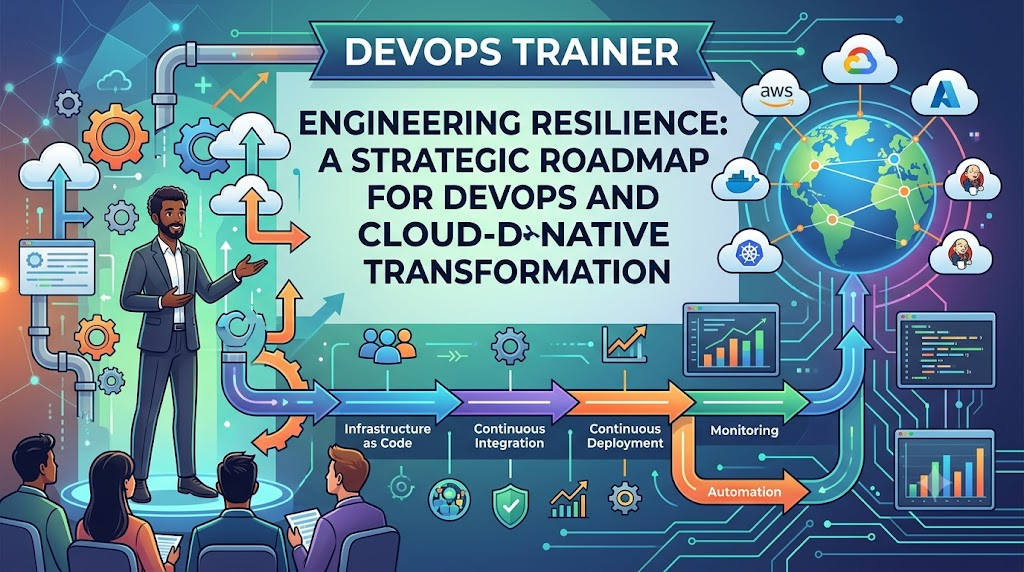
In today’s digital-first economy, the pace of software delivery acts as a primary differentiator between market leaders and those struggling to keep up. While many organizations rush to adopt modern toolsets, true operational excellence is rarely achieved through tools alone. It requires a fundamental shift in how engineering teams collaborate, design, and manage infrastructure. As an experienced practitioner in this field, I focus on helping organizations move beyond superficial tool usage to build sustainable, high-velocity engineering cultures. At Rajesh Kumar , the methodology centers on applying architectural rigor to solve real-world bottlenecks, ensuring that every training initiative results in tangible business outcomes.
Unpacking Enterprise-Scale Challenges
The journey toward a cloud-native architecture often hits a wall when organizations confuse “adoption” with “integration.” The most common hurdle isn’t the technology stack itself; it is the persistence of fragmented workflows and technical debt. When development and operations teams are isolated, manual handovers become the norm, slowing deployment cycles and increasing the risk of production failures.
Furthermore, scaling becomes an issue when infrastructure is treated as an afterthought rather than a first-class citizen of the codebase. Organizations frequently face “complexity drift,” where the sheer volume of microservices, environments, and configurations outpaces the team’s ability to manage them securely and reliably. Solving these challenges requires a systematic approach to automation, standardization, and observability that spans the entire software development lifecycle.
The Strategic Value of Expert Guidance
Attempting a transition to modern delivery models without experienced mentorship is akin to navigating a complex, changing landscape without a map. A professional DevOps Consultant provides the necessary oversight to avoid common traps, such as over-provisioning infrastructure or failing to account for security until the end of the pipeline.
By engaging a specialized DevOps Trainer, companies can significantly compress their transformation timeline. Rather than spending months on a trial-and-error approach, teams gain access to proven patterns and anti-patterns. This corporate training is not just about teaching syntax; it is about imparting the “architectural mindset”—helping engineers understand the trade-offs between speed, cost, and stability, which is essential for making informed decisions in production environments.
Core Competencies for the Modern Engineer
To survive and thrive in today’s technical ecosystem, a professional must cultivate a broad, T-shaped skill set. The modern DevOps professional needs proficiency across several critical domains:
- CI/CD Pipeline Training: Moving beyond simple automation to design pipelines that are secure, versioned, and resilient to failure.
- Infrastructure as Code (IaC): Utilizing Terraform training to ensure that infrastructure is reproducible and immutable.
- Container and Orchestration Mastery: Deep diving into Docker and Kubernetes training to build portable, efficient application architectures.
- Observability: Implementing comprehensive logging, metrics, and tracing to gain deep insights into system performance.
- Automated Security: Embedding guardrails directly into the workflow to minimize risk without hindering velocity.
- Cloud Proficiency: Leveraging native services in AWS or other major clouds to optimize performance and cost.
Orchestration Mastery: Kubernetes for Teams
Kubernetes has cemented itself as the standard for managing distributed applications, but its complexity is a significant barrier to entry for many teams. Enterprise-grade Kubernetes training must move past the basics of creating a deployment. It should focus on cluster lifecycle management, advanced networking concepts, and security policies. The goal is to provide a standardized, secure platform that abstracts the underlying infrastructure complexity from the developers, allowing them to focus on writing code rather than managing orchestration logic.
Implementing Site Reliability Engineering (SRE)
Reliability is a baseline requirement in competitive industries, not a luxury. SRE training shifts the focus from “uptime” to “reliability management.” By utilizing metrics like Service Level Objectives (SLOs) and error budgets, teams can make objective decisions about how much risk a new feature introduces. This framework is vital for organizations that need to balance the push for new features with the critical need for system stability, ultimately creating a more predictable and resilient production environment.
Advancing Security Through DevSecOps
In an era of sophisticated cyber threats, security cannot remain a gatekeeping function performed at the end of the release cycle. DevSecOps training emphasizes “shifting security left,” integrating vulnerability scanning, dependency analysis, and compliance checks into the CI/CD pipeline. This approach empowers developers to own the security of their code, turning security from a bottleneck into a seamless part of the development process.
Platform Engineering and Productivity
Forward-thinking organizations are moving toward Platform Engineering to solve the “cognitive load” problem. By creating an internal developer platform, an organization provides a self-service experience that includes all the necessary tooling, access, and infrastructure templates. A Platform Engineering Consultant helps architects design these systems so that developers have autonomy, while operations teams maintain the essential guardrails and standards necessary for enterprise security.
Consulting as a Catalyst for Change
Engaging an external consultant provides the objective perspective needed to identify inefficiencies that internal teams may have grown accustomed to. A seasoned consultant doesn’t just offer advice; they help execute a roadmap. This includes evaluating the maturity of existing processes, facilitating the adoption of GitOps training to manage configuration changes, and ensuring that the entire organization is aligned on the long-term architectural vision.
Tailored Training Paths for Engineering Roles
A successful training strategy recognizes that different roles require different focuses:
- Software Developers: Emphasis on CI/CD pipeline integration, container workflows, and cloud-native application design.
- Operations Engineers: Focus on deep Kubernetes architecture, automation, and advanced IaC practices.
- Security Teams: Focus on automated compliance, threat modeling, and DevSecOps tooling.
- Architects: Focus on cloud-agnostic design, multi-region strategy, and platform engineering.
- Engineering Leaders: Focus on DevOps metrics, change management, and building high-performance teams.
Practical Steps for Long-Term Success
To sustain a DevOps transformation, organizations should adopt a structured implementation plan:
- Start with Pilot Initiatives: Choose high-impact, low-risk projects to demonstrate the value of new processes before scaling them organization-wide.
- Define Success Metrics: Align on clear goals—such as lead time for changes, deployment frequency, or mean time to recovery (MTTR)—to track progress.
- Invest in Continuous Education: Treat training not as a one-time event, but as a recurring investment in the team’s professional growth.
- Standardize Tooling: Avoid “tool sprawl” by establishing a core stack that is well-supported and documented.
- Foster a Blameless Culture: Encourage post-mortems and knowledge sharing to ensure the organization learns from every incident.
Frequently Asked Questions
How does DevOps corporate training impact developer productivity? By standardizing workflows and removing manual toil through automation, training directly reduces the cognitive load on developers. They spend less time debugging infrastructure and more time building features, which accelerates the entire delivery lifecycle.
What is the best way to transition from traditional operations to SRE? Start by defining the most critical services and implementing SLOs. Once you have a quantitative measure of reliability, you can begin automating the manual tasks that consume the most operational time, effectively shifting from firefighting to proactive engineering.
How does an AWS DevOps Consultant help with cloud cost optimization? Consultants help teams implement Infrastructure as Code (IaC) practices that enforce tagging, resource limits, and auto-scaling policies. They also assist in choosing the right instance types and storage classes, ensuring that the architecture is optimized for both performance and budget.
What is the difference between Platform Engineering and standard DevOps? DevOps is a set of cultural principles and practices. Platform Engineering is the concrete implementation of these principles, creating a distinct, productized Internal Developer Platform (IDP) that developers can use to self-serve resources.
How do we address legacy applications in a modern training program? Training should include modules on “strangler fig” patterns and micro-services refactoring. Teams learn how to encapsulate legacy monoliths within modern containers and slowly migrate functionality to the new platform without disrupting production.
Why is Terraform training critical for multi-cloud strategies? Terraform abstracts the provider-specific nuances of different cloud platforms. It allows a single engineer to manage infrastructure across various clouds using a unified language, reducing the need for deep, specialized knowledge of every single cloud API.
How can Jenkins training be modernized for today’s ephemeral environments? Modern training focuses on using Jenkins pipelines as code, integrating them with containers to ensure that build environments are clean, isolated, and identical every time, which prevents “works on my machine” issues.
What makes a DevOps Trainer in India suitable for global teams? Experienced trainers operating in the global market are adept at facilitating sessions across different time zones and cultural contexts. They bring a deep understanding of diverse engineering challenges, making them effective partners for distributed organizations.
Conclusion
The path to an agile, resilient enterprise is paved with consistent learning and architectural discipline. As organizations move toward increasingly complex cloud-native systems, the role of expert guidance in DevOps, SRE, and platform engineering becomes paramount. By prioritizing hands-on training and strategic consulting, teams can build the capabilities necessary to navigate the challenges of modern infrastructure. Continuous investment in skills—whether through specialized CI/CD pipeline training or broader organizational assessments—is the surest way to foster an environment where technical excellence and business value align.






Leave a Reply
You must be logged in to post a comment.