Introduction
Modern enterprises use many software delivery tools. A typical engineering organization may use GitHub for source code, Jenkins for CI, Kubernetes for deployment, Terraform for infrastructure, and monitoring tools for reliability. Still, many leaders struggle to answer simple questions: How mature are our teams? Where are our delivery risks? Are our CI/CD, DevSecOps, release, and SRE practices improving? This is where a Software Delivery Governance Platform becomes important. Tool adoption alone does not prove maturity. A company may have modern tools but still suffer from weak standards, manual approvals, unclear ownership, poor release visibility, and inconsistent security controls.
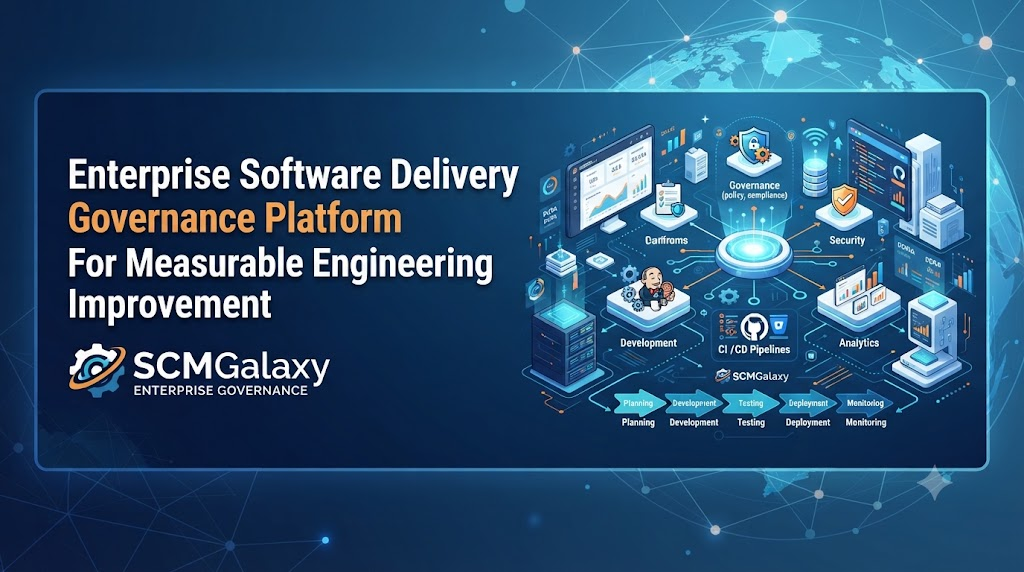
SCMGalaxy OS helps organizations assess, score, govern, and improve software delivery maturity across the full software delivery lifecycle. It supports leaders who want evidence-based engineering governance, not guesswork.
Featured Snippet
What Is a Software Delivery Governance Platform?
A Software Delivery Governance Platform helps organizations assess, measure, and improve engineering maturity across source code, CI/CD, release management, DevSecOps, observability, SRE, configuration management, and AI-assisted development. It gives leaders maturity scores, risks, recommendations, dashboards, and transformation roadmaps.
Understanding Software Delivery Governance
What Is Software Delivery Governance?
In Simple Terms:
Software delivery governance is the structured way an organization controls, measures, and improves how software moves from idea to production.
It covers source code, pipelines, testing, security, infrastructure, releases, incidents, observability, compliance, and engineering standards.
Enterprise Example
A banking company may have 50 product teams using different branching models, CI/CD tools, approval flows, and deployment methods. Governance helps the company create shared standards without blocking team speed.
Why It Matters
Without governance, engineering leaders cannot clearly see risk, maturity, or delivery health. Decisions become opinion-based instead of evidence-based.
Tool Adoption vs Delivery Governance
| Tool Adoption | Delivery Governance |
|---|---|
| Focuses on buying and using tools | Focuses on outcomes and controls |
| Measures usage | Measures maturity |
| Often team-specific | Enterprise-wide standardization |
| May not reduce risk | Identifies and reduces risk |
| Limited executive visibility | Provides dashboards and scorecards |
Key Takeaways
- Tools do not automatically create maturity.
- Governance connects tools, processes, people, and outcomes.
- Mature governance improves visibility, reliability, and security.
- A Software Delivery Governance Platform makes maturity measurable.
Understanding Engineering Maturity
What Is a Maturity Assessment?
In Simple Terms:
A maturity assessment evaluates how well teams follow modern engineering practices. It checks what is standardized, automated, secure, measurable, and continuously improved.
Enterprise Example
A retail company may discover that one team has automated deployments, while another still deploys manually. A Software Delivery Maturity Assessment creates a baseline and shows where improvement is needed.
Why Maturity Measurement Matters
Maturity measurement helps leaders prioritize investment. Instead of saying “we need better DevOps,” they can say, “our CI/CD maturity is weak because deployment approval, rollback, and quality gates are inconsistent.”
Characteristics of High-Maturity Engineering Teams
- Standard source code and branching practices
- Automated build, test, and deployment pipelines
- Security controls built into the SDLC
- Clear release governance and rollback plans
- Strong observability and incident learning
- Measurable SLOs and reliability practices
Common Signs of Low Engineering Maturity
- Manual deployments
- Inconsistent release approvals
- Poor visibility into incidents
- Security checks done late
- Weak configuration control
- No common maturity scorecard
Key Takeaways
- Maturity assessment creates an engineering baseline.
- High maturity means repeatable, secure, and measurable delivery.
- Low maturity often hides operational and business risk.
- Reassessment is required for continuous improvement.
Software Delivery Maturity Assessment
What Is a Software Delivery Maturity Assessment?
In Simple Terms:
A Software Delivery Maturity Assessment reviews how software is planned, coded, built, tested, secured, deployed, monitored, and improved.
Key Assessment Areas
| Area | What to Assess |
| Source Code Management | Branching, reviews, ownership, version control |
| Build Automation | Build consistency, artifact handling, dependency control |
| Deployment Automation | Pipeline maturity, rollback, environment consistency |
| Security Controls | Secrets, scanning, policy checks, compliance evidence |
| Observability | Metrics, logs, traces, dashboards, alert quality |
| Reliability Engineering | SLOs, incident response, postmortems, error budgets |
| Governance Practices | Standards, approvals, auditability, executive visibility |
Maturity Scoring Framework
| Score Band | Maturity Level | Meaning |
| 0–20 | Initial | Ad hoc and mostly manual |
| 21–40 | Developing | Some standards exist but are inconsistent |
| 41–60 | Defined | Processes are documented and partly automated |
| 61–80 | Managed | Practices are measured and governed |
| 81–100 | Optimized | Continuous improvement is embedded |
Enterprise Example
A technology company may score high in source code management but low in observability and release governance. The assessment helps leaders focus on weak areas first.
Key Takeaways
- Software delivery maturity must be measured across the lifecycle.
- Maturity scores help compare teams and projects.
- Low-scoring areas should become roadmap priorities.
- Governance turns assessment results into action.
DevOps Maturity Assessment
What Is DevOps Maturity?
In Simple Terms:
DevOps maturity shows how effectively development, operations, security, and platform teams work together to deliver software faster and safer.
Core DevOps Maturity Areas
- Collaboration and culture
- Automation adoption
- Delivery performance
- Environment consistency
- Continuous feedback
- Continuous improvement
Enterprise Example
A telecom company may have DevOps tools but still operate in silos. Development teams write code, operations teams deploy it, and security teams review it at the end. A DevOps Maturity Assessment shows whether collaboration is real or only tool-based.
Why It Matters
DevOps maturity improves speed, quality, reliability, and accountability. It helps leaders reduce handoffs, improve deployment confidence, and create shared ownership.
Key Takeaways
- DevOps maturity is not only automation.
- Culture and ownership matter as much as tools.
- Mature DevOps teams use feedback loops.
- Continuous improvement is a core maturity signal.
CI/CD Maturity Assessment
Understanding CI/CD Maturity
In Simple Terms:
CI/CD maturity measures how well teams automate build, test, security, deployment, approval, and rollback workflows.
CI/CD Maturity Comparison
| Low Maturity | Medium Maturity | High Maturity |
| Manual builds | Automated builds | Standardized enterprise pipelines |
| Manual testing | Partial test automation | Quality gates built into pipelines |
| Manual deployments | Scripted deployments | Automated, repeatable deployments |
| Unclear rollback | Some rollback steps | Tested rollback and recovery |
| No release metrics | Basic pipeline metrics | Full delivery performance tracking |
Enterprise Example
A SaaS company may deploy weekly but still depend on manual approval and manual rollback. CI/CD Maturity Assessment helps identify pipeline standardization, quality gates, release frequency, and deployment risk.
Why It Matters
CI/CD maturity reduces delivery delays, improves quality, and gives leaders confidence that software can move safely from code to production.
Key Takeaways
- CI/CD maturity is about repeatability and safety.
- Quality gates reduce production risk.
- Standard pipelines improve governance.
- Deployment metrics support executive decisions.
Release Management Maturity Assessment
Release Governance
In Simple Terms:
Release governance ensures software changes are planned, approved, deployed, monitored, and reviewed in a controlled way.
Key Areas
- Change management
- Deployment coordination
- Risk reduction
- Release approval flows
- Rollback planning
- Release reliability metrics
Enterprise Example
A healthcare software provider may need controlled releases due to compliance and patient safety. Release Management Maturity Assessment helps ensure changes are traceable, approved, and auditable.
Why It Matters
Poor release governance can cause outages, failed deployments, compliance issues, and customer impact.
Key Takeaways
- Release governance reduces business risk.
- Change approval should be clear and practical.
- Release metrics show delivery reliability.
- Mature release management balances control and speed.
DevSecOps Maturity Assessment
Security Integration Across the SDLC
In Simple Terms:
DevSecOps maturity measures how deeply security is integrated into planning, coding, building, testing, deployment, and operations.
Key Controls
- Shift-left security
- Secret scanning
- Dependency checks
- Container image scanning
- Policy-as-code
- Compliance automation
- Risk governance
Enterprise Example
A financial services company may run security testing before production only. DevSecOps assessment may recommend earlier scanning, automated policy gates, and better evidence collection.
Why It Matters
Security handled late is expensive and risky. DevSecOps governance helps teams find issues earlier and prove compliance more easily.
Key Takeaways
- DevSecOps maturity improves secure delivery.
- Automation helps reduce manual review delays.
- Compliance evidence should be generated continuously.
- Security governance must be built into pipelines.
Observability and SRE Maturity Assessment
What Is Observability Maturity?
In Simple Terms:
Observability maturity shows how well teams understand system behavior using metrics, logs, traces, alerts, dashboards, incidents, and service-level objectives.
SRE Assessment Framework
| Area | Maturity Question |
| Metrics | Are key service metrics tracked? |
| Logs | Are logs searchable and useful? |
| Traces | Can teams follow requests across services? |
| Alerts | Are alerts actionable or noisy? |
| Incidents | Are incidents reviewed and learned from? |
| SLOs | Are reliability goals defined and measured? |
Enterprise Example
An e-commerce company may have monitoring tools but still face alert fatigue and slow incident response. Observability and SRE Maturity Assessment helps improve signal quality, reliability ownership, and incident learning.
Why It Matters
Better observability improves uptime, customer experience, and operational confidence.
Key Takeaways
- Observability is more than dashboards.
- SRE maturity depends on reliability goals.
- SLOs connect engineering work to user experience.
- Incident learning improves long-term reliability.
Software Configuration Management Platform
Importance of Configuration Governance
In Simple Terms:
Configuration governance controls how application, infrastructure, environment, and deployment configurations are versioned, approved, and audited.
Key Areas
- Infrastructure consistency
- Version control governance
- Environment standardization
- Auditability and traceability
- Configuration compliance
Enterprise Example
A global enterprise may run applications across cloud, Kubernetes, and legacy systems. Without configuration governance, drift can create outages and compliance gaps.
Why It Matters
Configuration mistakes are a common cause of production issues. A Software Configuration Management Platform supports consistency, traceability, and control.
Key Takeaways
- Configuration must be versioned and auditable.
- Infrastructure drift creates hidden risk.
- Standards reduce environment inconsistency.
- Governance improves compliance confidence.
AI Code Governance Platform
Rise of AI-Assisted Software Development
In Simple Terms:
AI-assisted development helps teams write code faster, but it also creates new governance needs around quality, security, licensing, review, and accountability.
Traditional Development vs AI-Assisted Governance
| Traditional Development | AI-Assisted Development Governance |
| Human-written code only | Human and AI-generated code |
| Standard code review | Review includes AI output validation |
| Known coding patterns | Possible unknown or copied patterns |
| Traditional security checks | Extra controls for AI-generated risks |
| Manual policy awareness | AI usage policy and audit trails needed |
Enterprise Example
A software company may allow developers to use AI coding assistants. Without an AI Code Governance Platform, leaders may not know whether generated code follows security, quality, and compliance rules.
Why It Matters
AI can improve productivity, but unmanaged AI code can introduce vulnerabilities, licensing risk, weak design, or inconsistent standards.
Key Takeaways
- AI code requires governance, not fear.
- Human review remains essential.
- Policies must define acceptable AI usage.
- AI governance will become part of software delivery governance.
How SCMGalaxy OS Works
Assessment Framework
SCMGalaxy OS provides structured maturity assessment across key software delivery governance domains. It helps teams evaluate source code management, CI/CD, release management, infrastructure, DevSecOps, observability, SRE, developer experience, and AI development governance.
Maturity Scoring Engine
The platform converts assessment responses into maturity scores. This helps leaders compare projects, teams, domains, and improvement progress.
Risk Identification
SCMGalaxy OS identifies weak controls and highlights delivery risks. This helps organizations focus on issues that may affect security, reliability, compliance, or delivery speed.
Recommendations and Insights
The platform provides practical recommendations based on assessment gaps. Instead of only showing scores, it helps leaders understand what to improve.
Governance Dashboards
Dashboards help executives and engineering leaders see maturity, risks, recommendations, and progress in one place.
Transformation Roadmaps
| Roadmap | Focus |
| 30-Day Roadmap | Quick wins, urgent risks, baseline governance |
| 90-Day Roadmap | Standardization, automation, ownership, metrics |
| 180-Day Roadmap | Optimization, executive dashboards, continuous improvement |
Key Takeaways
- SCMGalaxy OS turns assessment into action.
- Scores help leaders prioritize investment.
- Dashboards support governance visibility.
- Roadmaps guide transformation execution.
Benefits of SCMGalaxy OS
SCMGalaxy OS helps organizations move from tool adoption to measurable software delivery governance.
Key Benefits
- Visibility into engineering health
- Standardized assessments across teams
- Better governance and audit readiness
- Reduced delivery and release risk
- Improved reliability and SRE maturity
- Stronger DevSecOps posture
- Executive decision support
- AI governance readiness
Enterprise Example
A CTO managing 100 engineering teams can use SCMGalaxy OS to compare maturity across business units, identify weak domains, and build a practical improvement roadmap.
Why It Matters
Executives need more than tool reports. They need engineering health scorecards, risk visibility, and measurable improvement plans.
Real-World Enterprise Scenarios
Enterprise DevOps Transformation
Challenge: Teams use different DevOps practices.
Assessment Findings: CI/CD and release maturity vary widely.
Recommendations: Standard pipelines, quality gates, shared metrics.
Expected Outcomes: Better release confidence and reduced manual effort.
Platform Engineering Assessment
Challenge: Platform adoption is uneven.
Assessment Findings: Golden paths exist but are not measured.
Recommendations: Measure adoption, developer experience, and reliability.
Expected Outcomes: Better platform value and team consistency.
Multi-Team Governance Initiative
Challenge: Leadership lacks engineering visibility.
Assessment Findings: No common maturity scorecard.
Recommendations: Standard maturity model and executive dashboard.
Expected Outcomes: Better prioritization and governance control.
Security Modernization Program
Challenge: Security testing happens late.
Assessment Findings: Weak shift-left practices.
Recommendations: DevSecOps controls in CI/CD.
Expected Outcomes: Lower security risk and better compliance evidence.
AI Development Governance Rollout
Challenge: Developers use AI tools without policy.
Assessment Findings: No AI code review standards.
Recommendations: AI usage policy, review controls, compliance checks.
Expected Outcomes: Safer AI-assisted development.
Common Software Delivery Governance Challenges
| Challenge | Practical Solution |
| Tool sprawl | Create standard governance domains |
| Lack of standardization | Define enterprise delivery practices |
| Poor visibility | Use dashboards and scorecards |
| Inconsistent processes | Run repeatable maturity assessments |
| Weak security controls | Integrate DevSecOps checks |
| No measurement framework | Use maturity scoring and roadmaps |
Common Mistakes Organizations Make
Governance Mistake Checklist
- Measuring tools instead of outcomes
- Ignoring engineering culture
- Assessing once and never reassessing
- Treating governance as compliance only
- Lacking executive sponsorship
- Not connecting findings to funded action
- Building dashboards without ownership
Good governance should enable better delivery, not slow teams down.
Building a Software Delivery Transformation Roadmap
| Phase | Focus |
| Assessment Phase | Measure current maturity |
| Prioritization Phase | Rank risks and improvement areas |
| Execution Phase | Implement standards and controls |
| Optimization Phase | Improve automation and reliability |
| Continuous Improvement Phase | Reassess, compare, and refine |
A strong roadmap connects maturity gaps to real engineering work. It should include ownership, timelines, metrics, and executive review.
Future of Software Delivery Governance
Software delivery governance is moving toward continuous maturity measurement. Instead of annual reviews, leaders will expect live engineering intelligence across DevOps, DevSecOps, CI/CD, SRE, configuration, and AI code governance.
Future governance will include AI-powered insights, platform engineering governance, autonomous delivery pipelines, and stronger executive dashboards. The goal is not more control for its own sake. The goal is safer, faster, more reliable software delivery.
Why Organizations Choose SCMGalaxy OS
Organizations choose SCMGalaxy OS because it brings structure to a complex engineering environment. It supports standardized assessments, actionable insights, enterprise governance, transformation roadmaps, AI governance readiness, and cross-discipline assessment coverage.
For CTOs, CIOs, DevOps leaders, SRE teams, security leaders, and transformation consultants, SCMGalaxy OS provides a practical way to evaluate software delivery maturity and move from scattered tools to measurable governance.
FAQ
1. What is a Software Delivery Governance Platform?
It is a platform that helps organizations assess, score, govern, and improve software delivery practices across engineering, DevOps, security, release, SRE, and AI-assisted development.
2. Why do organizations need maturity assessments?
Maturity assessments help leaders understand current strengths, weaknesses, risks, and improvement priorities.
3. What is DevOps Maturity Assessment?
It measures collaboration, automation, delivery performance, cultural maturity, and continuous improvement across DevOps practices.
4. How does CI/CD Maturity Assessment work?
It reviews pipeline standardization, build automation, test coverage, deployment automation, rollback readiness, and release frequency.
5. What is DevSecOps Maturity Assessment?
It measures how well security is integrated into the software delivery lifecycle through automation, policy, scanning, and compliance controls.
6. Why is observability maturity important?
Observability maturity helps teams detect issues faster, understand system behavior, improve incident response, and manage reliability.
7. What is AI Code Governance?
AI Code Governance defines controls for safe, secure, compliant, and accountable use of AI-generated code.
8. How does SCMGalaxy OS generate maturity scores?
It uses structured assessments across governance domains and converts responses into measurable maturity scores.
9. What are 30/90/180-day transformation roadmaps?
They are phased improvement plans that help organizations address short-term risks, medium-term standardization, and long-term optimization.
10. Who should use SCMGalaxy OS?
CTOs, CIOs, VP Engineering, DevOps leaders, SRE teams, platform teams, security leaders, enterprise architects, and consultants.
Final Summary
Software delivery governance is now essential for modern engineering organizations. Tools alone cannot prove maturity. Leaders need structured assessments, maturity scores, risk visibility, governance dashboards, and transformation roadmaps. A Software Delivery Governance Platform helps organizations evaluate DevOps, CI/CD, release management, DevSecOps, observability, SRE, configuration management, and AI code governance in one structured model. SCMGalaxy OS helps enterprises assess engineering maturity, identify risks, generate recommendations, and build practical 30/90/180-day transformation roadmaps. For organizations that want measurable improvement across the software delivery lifecycle, SCMGalaxy OS provides a clear path from tool adoption to governed engineering excellence.






Leave a Reply
You must be logged in to post a comment.