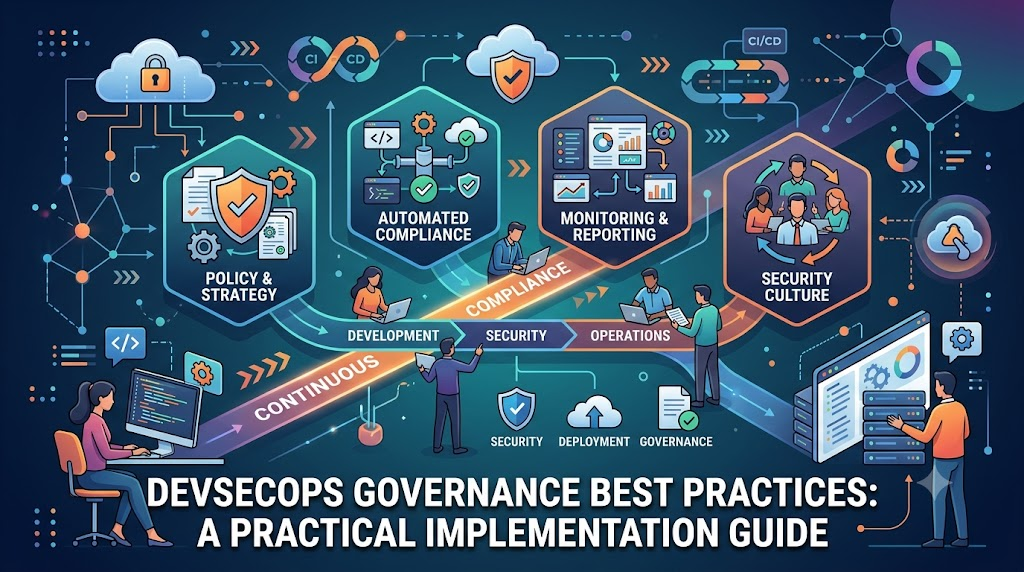
Modern engineering teams must deliver features rapidly without compromising system security, regulatory compliance, or operational accountability. Relying on legacy security models—where security operates as an isolated approval gate or manual checklist right before production—inevitably creates delivery bottlenecks, delays releases, and increases the likelihood of critical vulnerabilities slipping into runtime environments. Establishing DevSecOps governance best practices provides the necessary framework of clear policies, defined team ownership, risk-based controls, Policy as Code, and automated CI/CD guardrails. Rather than slowing teams down with administrative red tape, practical governance empowers developers to ship resilient software faster by making security expectations transparent, automated, and continuously verifiable across the entire development lifecycle.
What Is DevSecOps Governance?
DevSecOps governance is the overarching management framework that aligns software engineering, security operations, platform delivery, and business risk management. It establishes how an organization defines security expectations, verifies that technical controls function as intended, handles deviations, and demonstrates regulatory compliance.
A complete DevSecOps governance program connects several distinct areas:
- Security policies and standards: Defining baseline rules for coding standards, secrets management, third-party software dependencies, cryptography, and cloud infrastructure baselines.
- Roles, responsibilities, and accountability: Clarifying who owns a given control, who remediates vulnerabilities, who evaluates technical trade-offs, and who possesses the organizational authority to accept residual risk.
- Secure development requirements: Embedding threat modeling, security architecture principles, and secure design considerations into initial planning cycles.
- Automated security controls: Implementing automated verification within pipelines to enforce standards systematically and repeatedly.
- Risk assessment and exception management: Establishing structured, transparent processes to document, review, and remediate technical debt and control exceptions.
- Compliance evidence and auditability: Capturing tamper-evident system logs, pipeline traces, code review approvals, and testing records as regular operational artifacts.
- Continuous monitoring and feedback loops: Measuring operational performance, analyzing vulnerability trends, reviewing incidents, and updating policies to meet evolving threats.
Distinguishing Governance, Security Operations, and DevOps
To implement governance effectively, organizations must understand how it interacts with operational domains:
| Dimension | DevOps | Security Operations (SecOps) | DevSecOps Governance |
| Primary Focus | Velocity, deployment reliability, system automation, and cross-functional collaboration. | Threat detection, incident response, active defense, and operational monitoring. | Policies, accountabilities, control criteria, risk appetite, and assurance frameworks. |
| Core Question | “Can we build, test, and release reliable software quickly?” | “Are our active runtime environments being attacked or compromised?” | “Do our development and release workflows meet established risk, security, and regulatory baselines?” |
| Typical Deliverable | CI/CD pipelines, automated build scripts, and infrastructure configurations. | Alerting rules, incident runbooks, triage tickets, and forensic analyses. | Security policies, Policy-as-Code rules, responsibility models, and audit evidence trails. |
Governance defines organizational expectations and decision rights. Technical controls and operational workflows then execute, enforce, and verify those expectations across day-to-day engineering activities.
Why DevSecOps Governance Is Important
Implementing governance across the software delivery lifecycle provides several operational and strategic advantages:
- Consistent security baselines: Establishes predictable security expectations across disparate product teams, technology stacks, and business divisions.
- Earlier risk identification: Surfaces design flaws, configuration errors, and known vulnerabilities early in development, where remediation is substantially faster and less expensive.
- Software supply chain resilience: Provides continuous visibility into third-party libraries, container base images, and open-source packages, mitigating upstream software supply-chain risks.
- Reduced manual overhead: Replaces subjective, ad-hoc spreadsheet assessments and manual sign-offs with codified, automated validations integrated directly into deployment workflows.
- Actionable security visibility: Furnishes security leaders, platform teams, and engineering managers with real-time, data-backed insights into system posture.
- Reliable compliance posture: Automatically captures pipeline artifacts, test outputs, and approval histories, simplifying preparation for internal and external audits.
- Transparent decision-making: Clarifies who owns risk-acceptance decisions, preventing critical security exceptions from lingering unaddressed.
- Deployment confidence: Ensures releases adhere to architectural and security baselines, allowing teams to ship updates without unexpected security regressions.
Governance does not eliminate all operational risks. Software complexity and evolving vulnerabilities mean that no governance framework guarantees absolute security. Furthermore, rigid, poorly calibrated governance controls can obstruct deployment pipelines, frustrate developers, and encourage teams to seek unauthorized workarounds. Sustainable governance balances robust security requirements with engineering usability and deployment velocity.
Core Principles of Effective DevSecOps Governance
Five foundational principles should guide the design and execution of an organization’s security governance program.
1. Security by Design
Security must be treated as an architectural requirement rather than a post-development check. Security by design incorporates threat modeling during initial system planning, reviews trust boundaries during architectural reviews, establishes baseline data classification rules, and selects secure-by-default libraries and design patterns before engineering begins.
2. Shared Responsibility With Clear Accountability
While security is a shared responsibility across engineering, operations, security, and platform teams, shared responsibility must never result in diffused ownership. If everyone is considered responsible for a control, in practice, no one owns it. Every control, pipeline check, vulnerability ticket, and risk acceptance must have an unambiguous, designated owner.
3. Risk-Based Decision-Making
Not all software assets face identical threat environments or carry equivalent business impact. An internal, read-only analytics tool does not require the identical scrutiny or gating structure as an internet-exposed payment processing application. Governance policies must account for data sensitivity, asset criticality, attack surfaces, and threat context, avoiding blunt, uniform enforcement rules that waste engineering effort.
4. Automation and Repeatability
Manual verifications degrade when systems scale. Governance mechanisms should be embedded as automated tests, policy engines, and deterministic pipeline steps. These automated controls must be versioned, tested, instrumented, and monitored with the same engineering rigor applied to production applications.
5. Continuous Improvement
Security governance must remain responsive to changes in system architecture, deployment infrastructure, and the broader threat landscape. Post-incident reviews, audit findings, recurring vulnerability trends, and pipeline telemetry should routinely inform and refine security policies, training programs, and automated checks.
DevSecOps Governance Best Practices
Translating core principles into day-to-day operations requires specific, practical practices across technical architectures, team structures, and deployment pipelines.
1. Establish Clear Security Policies and Standards
An organization must establish foundational baseline standards before enforcing them in software pipelines. Security policies should clearly define rules for:
- Secure coding requirements and memory safety practices.
- Approved sources and vulnerability thresholds for open-source dependencies.
- Management of secrets, cryptographic keys, and application tokens.
- Role-based access control, least privilege, and identity isolation.
- Infrastructure-as-Code (IaC) configuration baselines for cloud resources and orchestrators.
- Vulnerability triage, prioritization, and remediation timelines.
- Minimum testing and validation criteria required for production release.
Policies must be version-controlled, maintained in accessible repositories, and regularly reviewed with input from development and platform teams. Policies should be specific enough to be translated into automated, testable rules, yet flexible enough to accommodate differing application risk profiles through documented exception pathways.
2. Integrate Governance Into the CI/CD Pipeline
Pipelines serve as the primary enforcement and validation mechanism for technical governance. Integrating security controls directly into build and deployment workflows ensures consistent evaluation of every code change:
- Static Application Security Testing (SAST): Scans source code for common weaknesses, insecure API calls, and logic flaws before artifacts are compiled.
- Software Composition Analysis (SCA): Catalogs open-source dependencies, identifies components with known vulnerabilities, and enforces software license compliance.
- Secret Detection: Scans source code, configuration files, and commit histories to prevent credentials, API keys, or private certificates from entering version control.
- Infrastructure-as-Code (IaC) Scanning: Evaluates Terraform, OpenTofu, CloudFormation, or Kubernetes manifests against hardened baseline configurations to intercept misconfigurations before provisioning.
- Container Image Scanning: Analyzes container base layers, system packages, and application binaries for outdated or vulnerable components prior to registry publication.
- Artifact Integrity Checks: Generates and verifies cryptographic signatures and build provenance metadata to ensure built artifacts cannot be modified in transit.
- Dynamic Application Security Testing (DAST): Evaluates running test environments against common operational attack vectors where feasible.
Governance policies must establish clear execution rules for these checks. Not every identified issue warrants breaking a build. Blocking deployments for low-severity or noisy findings leads to alert fatigue and friction. High-severity, high-confidence findings—such as hardcoded production secrets or known exploitable vulnerabilities in exposed components—should fail the pipeline. Lower-severity issues, ambiguous findings, or informational warnings should generate tracked backlog tasks for team triage.
3. Implement Policy as Code
Policy as Code translates written governance documents into declarative, machine-readable logic. By defining security rules as code, organizations can test, version, and execute policies programmatically across multiple delivery systems.
Tools like Open Policy Agent (OPA) and its Rego language, alongside cloud-native admission controllers, enable platform teams to enforce consistent rules across IaC templates, Kubernetes configurations, and deployment pipelines. For example, a policy can programmatically verify that no cloud storage bucket is configured for public access, that every container runs as a non-root user, or that every deployment manifest includes required operational metadata tags.
Code snippet
# Example: OPA Rego rule preventing containers from running as root
package kubernetes.admission

deny[msg] {
    input.request.kind.kind == "Pod"
    container := input.request.object.spec.containers[_]
    not container.securityContext.runAsNonRoot == true
    msg := sprintf("Container '%v' must set securityContext.runAsNonRoot to true.", [container.name])
}
Treating policies as code requires adhering to standard software engineering lifecycles. Policy rules should reside in version control, undergo peer review, execute within automated test suites to prevent unintended breaking changes, and support documented exception handling. Teams must maintain a clear distinction between defining a policy, enforcing it in runtime or build systems, and preserving immutable evidence verifying that the evaluation occurred.
4. Define Roles and Responsibilities
DevSecOps requires unambiguous ownership across the lifecycle. A RACI matrix helps align development, security, platform engineering, and compliance teams:
| Governance Function | Development | Security Architecture | Platform Engineering | Operations / SRE | Compliance / Audit |
| Security Policy Definition | Consulted | Accountable | Consulted | Consulted | Informed |
| CI/CD Pipeline Security Integration | Informed | Consulted | Accountable | Consulted | Informed |
| Code Vulnerability Remediation | Accountable | Consulted | Informed | Informed | Informed |
| Infrastructure Hardening | Informed | Consulted | Accountable | Responsible | Informed |
| Risk Acceptance & Exceptions | Responsible | Consulted | Informed | Informed | Accountable |
| Audit Evidence Collection | Informed | Responsible | Responsible | Responsible | Accountable |
| Production Deployment Sign-off | Responsible | Consulted | Informed | Accountable | Informed |
Legend: Accountable (final decision/ownership), Responsible (completes the task), Consulted (provides input), Informed (kept updated).
Specific allocations vary according to an enterprise’s organizational structure, technical architecture, and regulatory mandates.
5. Apply Risk-Based Vulnerability Management
Vulnerability counts do not inherently reflect operational risk. A vulnerability located in an unused test utility does not pose the same threat as an equivalent vulnerability in an internet-facing endpoint handling sensitive financial data.
Prioritize vulnerabilities using contextual risk factors:
- Exploitability: Is there an active, public exploit available (e.g., tracked via CISA Known Exploited Vulnerabilities or high EPSS scores)?
- Exposure: Is the vulnerable service reachable from the public internet, or is it isolated behind restrictive network boundaries?
- Asset Criticality: Does the underlying system handle regulated, confidential, or business-critical workloads?
- Available Compensating Controls: Are there runtime protections (such as web application firewalls, restrictive egress rules, or least-privilege service accounts) that mitigate exposure?
Organizations should define remediation service-level targets (SLTs) based on risk tiers rather than rigid, universal deadlines. When remediation cannot meet established targets, teams must route the issue through a formal exception process with temporary compensating controls.
6. Secure the Software Supply Chain
Modern applications rely heavily on external open-source libraries, container base images, and managed third-party services. Securing this supply chain requires governance across dependencies, build infrastructure, and artifact distribution:
- Dependency Inventories: Maintain accurate, continuously updated software bills of materials (SBOMs) to track all third-party components and nested dependencies across applications.
- Curated Package Registries: Route external dependencies through internal proxy registries that cache approved packages and scan for vulnerabilities or malicious updates.
- Version Pinning and Controlled Updates: Pin dependency versions and container base images using cryptographic digests rather than mutable tags to prevent unexpected upstream modifications.
- Build Pipeline Integrity: Run pipeline agents in isolated, ephemeral environments with restricted network access to prevent build tampering.
- Action and Plugin Hardening: Review, approve, and pin specific commit SHAs for third-party CI/CD marketplace actions or plugins to prevent pipeline compromise via compromised dependencies.
7. Enforce Identity and Access Management
Identity is a critical security perimeter in cloud-native software delivery. Broad permissions and long-lived credentials introduce significant security risks across build and deployment systems.
Apply least-privilege principles by eliminating static, long-lived API keys, personal access tokens, and cloud credentials from CI/CD systems. Instead, leverage short-lived, workload-identity federation (such as OpenID Connect with cloud IAM) that grants build agents temporary, scoped credentials only for the duration of the deployment step. Maintain separation of duties between entities authorized to write application code and identities permitted to alter production infrastructure configurations.
8. Maintain Compliance and Audit Evidence
Governance bridges the gap between software delivery workflows and formal compliance requirements. Rather than treating compliance as a disruptive, periodic manual audit, teams should design delivery pipelines to capture compliance evidence automatically as software is built and released.
Automated pipelines can systematically record commit hashes, peer review sign-offs, automated test results, vulnerability scan outputs, and deployment authorizations. These artifacts serve as verifiable compliance evidence for industry frameworks:
- NIST SP 800-218 (Secure Software Development Framework – SSDF): Focuses on protecting software, producing well-secured software, responding to vulnerabilities, and securing development environments.
- ISO/IEC 27001: Focuses on establishing, implementing, maintaining, and continually improving an Information Security Management System (ISMS).
- SOC 2 (Trust Services Criteria): Evaluates controls related to security, availability, processing integrity, confidentiality, and privacy over defined evaluation periods.
These frameworks serve distinct purposes and are not interchangeable. Applicability depends on an organization’s industry, geographic jurisdiction, and contractual obligations. DevSecOps automation does not automatically confer certification; it provides the operational discipline and verifiable evidence needed to demonstrate that required controls function consistently over time.
9. Manage Security Exceptions Transparently
In enterprise environments, engineering teams will periodically encounter scenarios where a security control cannot be met immediately without risking service availability or delaying critical business operations. A healthy governance framework must include a formal, transparent exception management process to handle these realities without compromising standards.
A complete security exception record must capture:
- The affected application, repository, or infrastructure asset.
- The specific policy, standard, or control that cannot currently be met.
- The underlying technical and business justification for the exception.
- An objective assessment of the associated risk.
- Documented compensating controls implemented to reduce exposure.
- The accountable business and technical owner approving the risk.
- A firm expiration date and mandatory review milestone.
- A concrete engineering plan to remediate the underlying issue.
Permanent or undocumented security exceptions degrade governance. Without mandatory expiration dates and visible registers, temporary exceptions quickly become unmanaged, forgotten technical debt.
10. Monitor Security Continuously
Security verification must extend beyond the deployment phase into active runtime environments. Production architectures undergo constant change as cloud resources scale, configurations drift, and new vulnerabilities are discovered in previously deployed dependencies.
Continuous monitoring tracks runtime telemetry, changes to cloud infrastructure configurations, network egress anomalies, access policy updates, and newly disclosed common vulnerabilities and exposures (CVEs) affecting deployed containers. Alerts must be routed to appropriate engineering or security response teams based on severity, ensuring notifications contain actionable technical context to prevent alert fatigue.
11. Protect Production Releases With Appropriate Controls
Final release protections ensure that only verified, policy-compliant artifacts reach production environments. Organizations should implement release gates that evaluate artifact integrity, verification check results, and deployment risk:
- Cryptographic Verification: Ensure production clusters only run container images cryptographically signed by verified build pipelines.
- Staged Rollouts: Deploy changes progressively using canary releases, blue-green environments, or feature flags to validate stability and detect unexpected runtime errors before full exposure.
- Rollback Automation: Establish and routinely test automated rollback mechanisms to restore known-good configurations immediately if post-deployment health checks fail.
- Traceable Change Logs: Maintain an auditable link between every running production workload and its originating commit, peer review history, and pipeline build execution.
A passing security scan does not guarantee complete security. Safe deployments rely equally on integration testing, reliable infrastructure configurations, operational monitoring, and rollback readiness.
A Practical DevSecOps Governance Workflow
To illustrate how governance controls operate in daily practice, consider an end-to-end workflow for an application change:
[Requirements & Threat Review]
           │
           ▼
     [Secure Coding]
           │
           ▼
  [Pull Request Review]  ──► Fails: Branch blocked, author notified
           │
           ▼
[CI Build & Pipeline Checks] ──► Fails (Critical): Build fails, feedback returned
           │
           ▼
  [Artifact Validation]   ──► Fails: Image unsigned / unverified, registry rejects
           │
           ▼
[Deployment Policy Check] ──► Fails: Admission controller blocks cluster deploy
           │
           ▼
[Production Deployment]
           │
           ▼
[Continuous Monitoring & Audit Trace Retention]
End-to-End Governance Lifecycle
- Requirements and Threat Assessment: During sprint planning, developers and security champions evaluate planned features to identify data protection requirements and threat boundaries.
- Control: Threat assessment checklist and data classification tagging.
- Owner: Development team with Security Champion consultation.
- Evidence: Documented user story security requirements in the project backlog.
- Failure Action: Features with unassessed security risks cannot proceed to active development.
- Secure Coding and Local Verification: Developers write application code adhering to established coding standards and utilize pre-commit hooks to catch secrets or configuration errors locally.
- Control: Local linting and pre-commit secret detection hooks.
- Owner: Application Developer.
- Evidence: Local execution confirmation (developer workstation).
- Failure Action: Local commit blocked until detected secret or formatting flaw is corrected.
- Pull-Request Review: Code changes are submitted via a pull request requiring mandatory peer review and automated baseline validation.
- Control: Branch protection rules requiring at least one qualified peer approval.
- Owner: Peer Reviewer / Development Lead.
- Evidence: Signed pull request approval history logged in the version control system.
- Failure Action: Merge functionality remains blocked until code review requirements are met.
- CI Build and Automated Security Checks: The automated CI system executes unit tests, SAST analysis, SCA dependency evaluations, and container image scans.
- Control: Automated pipeline gates evaluating findings against defined severity policies.
- Owner: Platform Engineering (pipeline maintenance); Application Team (remediation).
- Evidence: Versioned pipeline logs, test reports, and structured scan artifact results.
- Failure Action: Pipeline fails if critical vulnerabilities or hardcoded credentials are detected.
- Artifact Validation and Signing: Successfully built container images and binaries are signed cryptographically, and an SBOM is generated and attached to the artifact registry.
- Control: Automated artifact signing and provenance attestation generation.
- Owner: Platform Engineering.
- Evidence: Cryptographic signature and verified SBOM stored in the registry.
- Failure Action: Artifact is quarantined and marked untrusted; deployment is prohibited.
- Deployment Policy Validation: Deployment manifests are evaluated by admission controllers (e.g., OPA Gatekeeper) against infrastructure and security rules before applying changes to the cluster.
- Control: Automated Policy-as-Code admission control.
- Owner: Platform / Cloud Security Team.
- Evidence: Admission controller audit logs recording admission decision.
- Failure Action: Cluster rejects the deployment request and returns an informative policy error.
- Risk-Based Production Release: The deployment proceeds using progressive rollout techniques (e.g., canary analysis) while monitoring service health and performance.
- Control: Automated canary analysis and health check verification.
- Owner: Release Engineering / Site Reliability Engineering (SRE).
- Evidence: Deployment telemetry logs and system health records.
- Failure Action: Deployment halts automatically and rolls back to the prior stable release state.
- Continuous Monitoring and Feedback: The running workload is continuously monitored for anomalous behavior, configuration drift, and newly published vulnerabilities in its dependencies.
- Control: Runtime vulnerability scanning and SIEM/log analysis.
- Owner: Security Operations / Platform Operations.
- Evidence: Continuous compliance dashboards, security incident alerts, and audit logs.
- Failure Action: High-priority alerts trigger incident response or automated remediation tickets.
Scenario: Handling a Critical Web Application Vulnerability
Consider a scenario where an engineering team updates an e-commerce web application:
During the CI build stage, the SCA scanner flags a critical, remotely exploitable vulnerability in a third-party image processing library with a public exploit. The automated pipeline policy evaluates the finding against governance rules, detects that the component is exposed to untrusted external input, and halts the build.
The pipeline outputs an actionable error message detailing the affected library, vulnerable version range, CVE identifier, and minimum remediated version. Rather than initiating an unstructured manual review, the developer upgrades the library to the safe version recommended by the scanner and pushes the update. The pipeline reruns, validates that the vulnerability is resolved, completes artifact signing, and proceeds through automated release gates.
If an immediate patch were unavailable and deployment was urgently required to resolve an active production outage, the team would initiate the documented exception process: implement an edge WAF rule restricting the vulnerable endpoint, obtain written approval from the designated risk owner, record a seven-day exception ticket, and schedule remediation as an urgent backlog item.
How to Build a DevSecOps Governance Framework Step by Step
Organizations should build governance incrementally, focusing initial efforts on high-value, foundational controls before expanding into complex automation.
1. Assess Current Security and Delivery Practices
- Purpose: Understand existing workflows, current pipeline capabilities, and historical friction points.
- Expected Outcome: A realistic baseline assessment of security practices across active teams.
- Common Challenge: Overestimating actual team compliance due to reliance on informal, undocumented practices.
2. Identify Critical Applications, Sensitive Data, and Key Risks
- Purpose: Categorize systems based on business impact, regulatory exposure, and threat surface.
- Expected Outcome: A tiered application inventory that guides risk-proportionate security controls.
- Common Challenge: Attempting to classify all systems simultaneously rather than prioritizing critical revenue-generating or customer-facing assets.
3. Define Governance Objectives and Control Owners
- Purpose: Establish clear, measurable governance goals and assign unambiguous accountability for each control.
- Expected Outcome: A documented responsibility matrix (such as a RACI) understood by all stakeholders.
- Common Challenge: Assigning broad responsibilities to entire teams without designating specific accountable roles.
4. Map Applicable Security Standards and Compliance Obligations
- Purpose: Identify external regulatory mandates (e.g., PCI DSS, HIPAA) and internal security policies.
- Expected Outcome: A mapped requirements matrix connecting external compliance demands to internal controls.
- Common Challenge: Treating distinct frameworks as interchangeable checklists rather than harmonizing overlapping controls.
5. Establish Minimum Security Policies
- Purpose: Formulate concise, pragmatic policies for secrets, dependencies, access control, and vulnerability remediation.
- Expected Outcome: Published, version-controlled baseline standards accessible to all engineering teams.
- Common Challenge: Drafting overly dense, academic policies that provide no practical guidance for developers.
6. Integrate Priority Controls Into CI/CD Pipelines
- Purpose: Automate the most impactful checks, such as secret scanning and dependency analysis, within existing pipelines.
- Expected Outcome: Automated, non-disruptive feedback loops integrated into daily development routines.
- Common Challenge: Configuring scanners with default rulesets that generate overwhelming volumes of false positives, eroding developer trust.
7. Introduce Policy Automation and Risk-Based Release Gates
- Purpose: Implement Policy as Code and admission controllers to validate configurations programmatically.
- Expected Outcome: Declarative guardrails preventing unhardened configurations from entering production clusters.
- Common Challenge: Enforcing rigid blocking rules before teams have adequate tooling to test and validate policies locally.
8. Establish Vulnerability and Exception Management Processes
- Purpose: Define structured triage criteria, risk-based prioritization, and a formal, transparent exception workflow.
- Expected Outcome: A consistent mechanism for handling technical debt and temporary deviations without compromising visibility.
- Common Challenge: Allowing security exceptions to function as permanent, unreviewed passes to bypass security standards.
9. Implement Evidence Collection and Security Monitoring
- Purpose: Automate audit artifact capture and extend visibility into runtime environments.
- Expected Outcome: Continuously updated compliance records and active runtime drift/vulnerability detection.
- Common Challenge: Treating evidence collection as a manual, end-of-quarter documentation scramble rather than an automated pipeline byproduct.
10. Measure Performance and Refine Controls
- Purpose: Track governance metrics, solicit engineering feedback, and continuously tune scanners and policies.
- Expected Outcome: A mature, low-friction governance program that adapts to evolving threats and delivery needs.
- Common Challenge: Measuring vanity metrics (such as total scans completed) rather than substantive risk reduction and workflow efficiency.
Metrics for Measuring DevSecOps Governance Effectiveness
Measuring governance requires indicators that reflect actual risk reduction, operational reliability, and workflow health, rather than raw activity volumes.
| Metric | What It Indicates | Practical Interpretation |
| Security policy compliance rate | The percentage of active repositories and delivery pipelines that meet established baseline security requirements. | Indicates whether governance standards are being adopted systematically across all engineering groups. |
| Vulnerability remediation time | The average time required to resolve identified vulnerabilities, tracked by contextual risk tier. | Measures the efficiency of triage and patching workflows for genuine security risks. |
| Open risk exceptions | The total volume of active, approved deviations from standard security baselines. | Highlights accumulated organizational risk and areas requiring architectural remediation. |
| Exception expiry compliance | The proportion of security exceptions reviewed, renewed, or remediated prior to their formal expiration date. | Evaluates whether teams treat exceptions as temporary, managed mitigations or unmonitored exemptions. |
| Pipeline security-check coverage | The percentage of CI/CD pipelines that incorporate required automated checks (e.g., SAST, SCA, secrets). | Identifies unmonitored deployment pathways and blind spots across delivery infrastructure. |
| Secret detection incidents | The frequency of credential or API token exposures detected across version control repositories. | Gauges the effectiveness of local pre-commit hooks, developer training, and secrets hygiene. |
| Audit evidence completeness | The percentage of production deployments that possess complete, automated audit records and approvals. | Reflects readiness for compliance examinations and confirms traceability across production changes. |
| Security-related deployment failures | The frequency of pipeline failures caused by security policy breaches or scanning tool malfunctions. | Helps distinguish between legitimate risk interception and delivery disruption caused by unreliable tooling. |
| Repeat findings | The recurrence rate of previously remediated vulnerability classes or infrastructure misconfigurations. | Indicates whether engineering teams are addressing systemic root causes or applying surface-level patches. |
Metrics should be evaluated in context. A high volume of pipeline failures may indicate healthy gate enforcement, or it may signal misconfigured scanners generating false positives that obstruct delivery. Teams should review governance metrics alongside standard delivery metrics to maintain balance between security assurance and operational velocity.
Common DevSecOps Governance Mistakes
Organizations frequently encounter recurring pitfalls when establishing security governance programs.
- Treating governance as documentation alone: Publishing static security policies without providing the automation, tooling, and infrastructure required to execute them leaves standards unenforced.
- Correction: Convert narrative policies into automated pipeline validations, Policy-as-Code definitions, and standardized platform templates.
- Applying uniform controls regardless of risk: Enforcing identical security controls, testing depth, and release gates on internal tools and mission-critical applications creates unnecessary friction.
- Correction: Establish a tiered application categorization model that adjusts control rigor based on exposure, data sensitivity, and business criticality.
- Failing builds on every low-severity finding: Halting pipelines for minor or informational issues creates alert fatigue, frustrates developers, and incentivizes teams to bypass checks.
- Correction: Configure blocking gates strictly for high-confidence, critical findings (such as verified secrets or known exploitable flaws) while routing lesser issues to backlogs.
- Ignoring false positives and scanner tuning: Accepting default scanner configurations without continuous tuning floods teams with irrelevant alerts, eroding trust in security tooling.
- Correction: Regularly review, tune, and curate scanner rule sets, suppressing irrelevant rules and prioritizing high-signal security checks.
- Leaving control ownership ambiguous: Assuming general “shared responsibility” without defining specific individuals or roles responsible for remediation leads to neglected tasks.
- Correction: Maintain an explicit RACI matrix that specifies ownership for policy maintenance, pipeline tooling, vulnerability patching, and risk acceptance.
- Granting excessive privileges to CI/CD systems: Using persistent, administrative credentials across build pipelines creates an attractive, high-value target for attackers.
- Correction: Implement temporary, least-privilege workload identity federation and restrict pipeline agent access to production environments.
- Allowing undocumented or indefinite exceptions: Permitting teams to bypass security gates informally without structured documentation obscures residual risk.
- Correction: Require a formal, time-bounded exception process that records the assessed risk, compensating controls, accountable approver, and expiration date.
- Relying on manual evidence gathering for audits: Spending weeks manually assembling spreadsheets and screenshots ahead of compliance audits wastes engineering capacity.
- Correction: Design deployment pipelines to generate, sign, and store compliance evidence automatically as an organic output of daily operations.
- Conflating compliance with security: Believing that satisfying a compliance checklist guarantees an application is secure can foster a dangerous, false sense of safety.
- Correction: Focus governance on mitigating practical architectural and operational risks, using compliance frameworks as reference structures rather than definitions of security.
How DevOpsSchool Can Support DevSecOps Learning
Establishing effective DevSecOps governance requires both sound organizational architecture and strong practical competencies across engineering teams. When adopting automated pipelines, Policy as Code, and secure delivery frameworks, organizations often find that upskilling their workforce is essential to bridging the gap between traditional IT operations and modern cloud-native security practices.
DevOpsSchool is an established training and professional development platform that provides structured educational programs in DevOps, DevSecOps, cloud architecture, and container operations. For teams and individuals evaluating professional education options, the platform offers dedicated curricula designed to provide hands-on exposure to CI/CD pipeline automation, automated testing tools, container security platforms, and cloud infrastructure management.
When selecting educational resources or training partners for DevSecOps governance, engineering leaders and practitioners should carefully assess their specific learning objectives:
- Curriculum Depth: Ensure course modules cover core governance principles—such as Software Supply Chain Security, Policy as Code, and vulnerability triage—alongside basic scanning tools.
- Practical Lab Environments: Verify that training includes hands-on experience configuring automated controls within real CI/CD pipelines, container registries, and cloud infrastructure.
- Alignment With Industry Frameworks: Look for educational offerings that help engineers understand established standards, such as the NIST SSDF and cloud-native security architectures.
Evaluating these factors ensures that technical training investments translate into practical skills that support consistent, secure, and efficient delivery workflows across your organization.
Frequently Asked Questions About DevSecOps Governance
What is DevSecOps governance?
DevSecOps governance is the framework of security policies, organizational accountabilities, automated controls, risk-management procedures, and audit assurance mechanisms that ensures software is developed, tested, and delivered securely without unnecessarily impeding engineering velocity.
What are the most important DevSecOps governance best practices?
The most critical practices include establishing clear, version-controlled security standards, embedding automated controls directly into CI/CD pipelines, enforcing Policy as Code, defining explicit ownership across the delivery lifecycle, securing the software supply chain, practicing risk-based vulnerability management, and implementing a formal, time-bounded exception workflow.
How does governance differ from DevSecOps automation?
Governance defines the policies, risk appetite, rules, and accountabilities—the “what” and “why” of organizational security. Automation consists of the technical tools, scripts, and CI/CD mechanisms that execute, verify, and enforce those governance requirements—the “how”—repeatedly and efficiently across development lifecycles.
How can security policies be enforced in a CI/CD pipeline?
Pipelines enforce policies by embedding automated verification tools (such as SAST, SCA, container scanners, and secret detectors) into build and test stages. Build gates evaluate scan results against established policy thresholds, allowing builds to proceed when requirements are met and halting execution when critical, non-compliant conditions or unmitigated risks are encountered.
What is Policy as Code in DevSecOps?
Policy as Code is the practice of writing security, operational, and architectural rules in declarative, machine-readable formats. This enables organizations to version-control policies, test them in automated workflows, and enforce them consistently across infrastructure templates, container configurations, and deployment pipelines using engines like Open Policy Agent.
How does DevSecOps governance support compliance?
Effective governance integrates compliance requirements directly into routine engineering workflows. By capturing pipeline logs, automated test results, peer review histories, and deployment records programmatically, organizations maintain continuous, tamper-evident audit trails that map directly to frameworks like ISO/IEC 27001, SOC 2, and NIST guidelines without manual data-gathering.
How should organizations manage security exceptions?
Exceptions should be handled through a formal, transparent process. Every exception must document the affected asset, the policy involved, the technical justification, an objective risk assessment, temporary compensating controls, the accountable executive approver, a mandatory expiration date, and a remediation plan. Undocumented or permanent exceptions should not be permitted.
Which metrics help measure DevSecOps governance effectiveness?
Meaningful governance metrics include security policy compliance rates across pipelines, risk-prioritized vulnerability remediation timelines, the volume and expiration tracking of active risk exceptions, secret detection incidents, audit evidence completeness, and the recurrence rate of known vulnerabilities.
Final Thoughts
Sustainable DevSecOps governance is not about enforcing rigid barriers or accumulating static compliance paperwork; it is about embedding clear accountability, proactive risk management, and reliable automated guardrails into everyday delivery workflows. By defining explicit control ownership, integrating Policy as Code into CI/CD pipelines, securing the software supply chain, and managing security exceptions transparently, organizations can release software quickly while maintaining a defensible compliance posture. For teams looking to build these capabilities, structured technical training—such as the specialized DevSecOps and cloud delivery programs available through DevOpsSchool—can provide the hands-on expertise needed to bridge cultural and technical gaps. To achieve lasting success, start with your highest-impact risks, automate foundational checks first, and continuously refine your governance framework to support both deployment velocity and system integrity.






Leave a Reply
You must be logged in to post a comment.