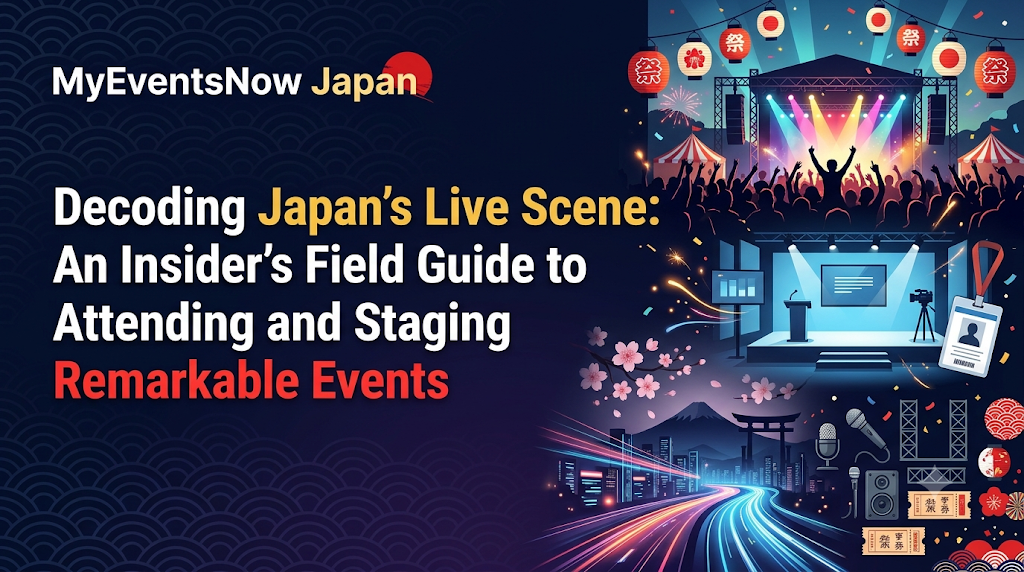
Anyone who has ever stepped into an intimate jazz cellar in Osaka’s Minami district or settled into a standing-room tech showcase in central Tokyo knows the feeling: the room operates like a finely tuned instrument. Start times are observed to the minute, queues wind around corridors with surgical precision, and audiences engage with a level of focused respect rarely seen anywhere else in the world.
Yet for years, getting inside that circle—or trying to build one from scratch—felt like solving a puzzle with missing pieces. Between telephone-verified domestic booking systems, cryptic lottery ballots, and in-person convenience store voucher pickups, the barriers for international participants and overseas-facing creators were steep.
Today, that landscape is undergoing a quiet revolution. Cloud-based ticketing, friction-free registration portals, and globally minded organizers are opening up stages across the country. Whether you are an ambitious host bringing an experiential concept to Japanese soil or an attendee determined to experience the country’s cultural calendar firsthand, here is an unvarnished look at how the modern Japanese live ecosystem truly operates.
The Quiet Operating Rules of Public Gatherings in Japan
To run or attend an event smoothly in Japan, you have to look past the surface excitement and understand the structural dynamics that keep public spaces running without a hitch.
From Terminal Vouchers to Mobile Authentication
For generations, the default gateway to high-demand gatherings across Japan was the chusen—a blind lottery system designed to prevent server crashes and blunt the advantage of scalper bots. Winners had to walk into a neighborhood convenience store (konbini), key an alphanumeric code into a terminal, pay the clerk in cash, and receive a physical paper voucher.
While lotteries still exist for stadium-level concert tours, the physical slip of paper is rapidly becoming an artifact of the past. Major promoters and independent organizers alike have moved decisively toward verified digital passes linked to two-factor mobile authentication. This shift has drastically cleaned up secondary ticket markets, but it has introduced a different operational reality: entry credentials now demand total consistency between your registered mobile device, payment profile, and legal identity.
Space, Decibels, and Urban Etiquette
Japan’s high population density means urban event spaces are governed by meticulous civic covenants:
- Ironclad Hall Curfews: Municipal sound and building rules leave zero margin for error. If an evening session is scheduled to conclude at 8:30 PM, the lights will come up at 8:30 PM, ensuring attendees can disperse comfortably before peak train congestion sets in.
- The Art of the Line: Crowds never casually block pedestrian lanes or storefronts. Venue teams manage the flow using staff equipped with saigo-bi (“end of line”) boards, guiding groups through fire-isolated stairwells or interior corridors.
- Carry-Your-Own Waste Discipline: You will rarely find overflowing waste bins at Japanese venues. In fact, many facilities deliberately provide few public bins, counting on guests to pack out their own empty beverage containers and snack wrappers.
Regional Personalities: Contrasting Tokyo and the Kansai Hub
A common mistake is treating Japan as a single, uniform market. The social tone, audience interaction, and venue footprint vary significantly between the Kanto plains and the Kansai basin.
+--------------------+---------------------------------------+---------------------------------------+
| Strategic Element  | Tokyo & Kanto Plain                   | Kansai (Osaka, Kyoto, Kobe)           |
+--------------------+---------------------------------------+---------------------------------------+
| Physical Venues    | Vertical towers, high-tech complexes, | Waterfront hangars, revitalized mills,|
|                    | subterranean basements, domes         | traditional wooden machiya townhomes  |
+--------------------+---------------------------------------+---------------------------------------+
| Room Chemistry     | Professional, polite, focused,        | Expressive, quick to speak up,        |
|                    | observant, orderly networking         | informal, warm, community-driven      |
+--------------------+---------------------------------------+---------------------------------------+
| Pacing & Protocol  | Strictly procedural, highly curated   | Collaborative, organic, adaptable     |
+--------------------+---------------------------------------+---------------------------------------+
| Calendar Demands   | Relentless corporate expos; packed    | Heavy spring/fall tourism waves;      |
|                    | autumn cultural exhibitions           | vibrant summer riverbank street matsuri|
+--------------------+---------------------------------------+---------------------------------------+
Navigating the Capital’s Vertical Matrix
Gatherings in Tokyo are defined by three-dimensional geography. A morning product reveal might unfold inside an auditorium on the 32nd floor of an urban tower in Toranomon, while an evening developer mixer sits two floors underground in Shibuya.
Because transit complexes like Shinjuku, Shibuya, and Tokyo Station are subterranean labyrinths of their own, standard postal addresses often confuse attendees. Effective organizers always publish exact rail exits and pedestrian waypoints (e.g., “From Exit 4B, walk 120 meters north past the police box”) to prevent early-morning keynotes from starting in front of an empty room.
The Engaging Spirit of Kansai
Board the bullet train west to Osaka, and the atmosphere warms noticeably. Kansai crowds are famously spontaneous; panel sessions feature active audience participation, and post-event networking breaks through social barriers much faster. Venues here frequently celebrate adaptive reuse—such as retrofitted industrial docks in Kitakagaya or open-air plazas along the Nakanoshima waterways.
Cross into neighboring Kyoto, however, and the rules pivot toward historic conservation. Staging a creative workshop or salon in an authentic timber townhouse (machiya) demands profound deference: shoes come off at the threshold, high-decibel speaker rigs are off-limits, and ambient conversation must blend gracefully into quiet residential alleys.
The Host’s Blueprint: Producing Without Friction
Curating an unforgettable gathering in Japan—whether it is a 30-person craft workshop, a corporate symposium, or an indie creator fair—requires thoughtful backstage logistics.
Phase 1: Clearances and Administrative Foundations
Before setting ticket releases or locking marketing collateral, ensure your regulatory baseline is completely covered:
- Food & Beverage Regulations: Pouring alcohol or serving prepared bites requires an administrative review by the local public health bureau (hokenjo). Even giving away complimentary tasting bites can require specific health permits.
- Acoustics & JASRAC Compliance: Purpose-built music halls typically maintain blanket licensing with the Japanese Society for Rights of Authors, Composers and Publishers. However, if you are transforming a warehouse, an indie bookshop, or an art gallery into a temporary event space, you must handle music rights clearances yourself.
- Fire Safety & Marshalling: Municipal fire codes mandate dedicated evacuation routing and on-site staff monitors whenever gatherings push past standard venue capacities.
Phase 2: Building Frictionless Digital Gateways
A confusing or exclusionary sign-up process is the quickest way to kill an event’s momentum. Japanese audiences place an exceptionally high value on clarity, detailed advance disclosures, and reliable host communication.
Make sure your public event listing includes:
- Precise schedules demarcating when doors open (kaijo) and when the presentation starts (kaien).
- Explicit policies detailing luggage storage, camera usage, child attendance, and re-entry options.
- Unambiguous terms regarding cancellations and transfers, which prevents friction at the door.
For organizers trying to connect with both local residents and visiting professionals, partnering with an established event ticketing platform Japan takes the headache out of the process, allowing you to easily handle bilingual registrations, publish clear itineraries, and track audience check-ins through a unified channel.
Phase 3: Flawless On-Site Hospitality (Omotenashi)
On event day, success is determined by the small, thoughtful details of guest experience:
- The “One-Drink” (D-Dai) Standard: In almost every mid-sized performance space and live club in Japan, attendees are required to pay a separate beverage charge (typically 500 to 600 yen in cash or via transit smart cards such as Suica or Pasmo) at the reception counter in exchange for a drink token. Always highlight this in your pre-event communications so international attendees aren’t caught off guard at the turnstile.
- Bilingual Visual Signage: Never assume digital projection alone will guide people. Clear, physical floor signs directing guests to restrooms, charging stations, and cloaks prevent lobby congestion.
- Respect for the Clock: Programs start at the precise minute advertised. Delaying your run of show by even ten minutes to accommodate late arrivals compromises venue union contracts, frustrates sound technicians, and cuts into networking time.
The Attendee’s Handbook: Finding, Securing, and Experiencing Events
Attending live functions in Japan provides an unparalleled window into the culture. A few strategic adjustments to your planning habits will make the experience seamless.
[Target an Event]
       │
       ▼
[Understand the Release Format]
  ├── Lottery Presale (Chusen) vs. General Sale (Ippan)
  └── Registration Prerequisites (Identity Matching & Passports)
       │
       ▼
[Finalize Your Booking]
  ├── Payment Processing (Card, IC, or In-Person Voucher)
  └── Delivery Method (Digital QR / Direct Mobile App Pass)
       │
       ▼
[Logistical Preparation]
  ├── Map the Exact Station Exit and Transit Buffer
  ├── Prepare Door Fees (D-Dai) & Review Bag Policies
  └── Confirm Camera & Social Media Rules
       │
       ▼
[On-Site Experience]
  ├── Line Up by Sequential Number (Seiri-Bango)
  └── Engage with Respect (Pack out trash, honor quiet cues)
Mastering the Drop Windows
Tickets typically move through clear operational tiers:
- Advance Lotteries (Senkou): Often reserved for early newsletter subscribers, community forums, or partners, these allocations give everyone an equal shot regardless of internet connection speed.
- General Public Release (Ippan Hatsubai): Open inventory releases simultaneously on a set morning (frequently Saturdays at 10:00 AM JST). Prime seats often vanish within seconds.
- Official Resale Exchanges (Teika Resale): If you miss out initially, never turn to predatory scalping sites. Reputable productions run internal, face-value exchange boards that permit registered fans to pass tickets directly to waitlisted buyers without markups.
Demystifying the Sequence Number (Seiri-Bango)
When holding a general-admission ticket, you will often spot a prominent numeral labeled seiri-bango. This is not a chair row; it is your precise admission sequence.
Door crews call out ranges in groups (e.g., “Passes 101 through 150 may proceed to the lobby”). If you arrive after your group has already crossed the threshold, you surrender your position and must enter at the tail end of whichever cluster is entering. Arriving 15 to 20 minutes before doors open ensures you secure the entry priority you earned.
Unspoken Room Etiquette
Observing basic social etiquette makes you an immediate favorite among both hosts and fellow guests:
- Assume Cameras Are Restricted: Copyright and portrait rights (shouzouken) are strictly defended in Japan. Unless stage hosts or visible banners specifically state that photography is welcomed, keep phones and recording devices tucked away.
- Preserving Focus: Whether listening to an acoustic folk set or a keynote on artificial intelligence, crowds stay quiet and attentive. Phone calls belong out in the corridor.
- Gift Tables (Present-Bako): If you brought congratulatory tokens or letters for speakers or talent, don’t try to pass them across the stage edge. Look for the dedicated gift table set up near the coat check or front desk.
Timing the Seasons: Operational Pros and Cons Across the Year
Japan’s seasonal shifts dramatically alter attendance dynamics, venue overheads, and local transit patterns.
+------------------+--------------------------------------+------------------------------------+
| Season           | Typical Offerings                    | Strategic Considerations           |
+------------------+--------------------------------------+------------------------------------+
| Spring           | Hanami celebrations, academic forums,| Heavy domestic travel; hotel rate  |
| (March - May)    | major corporate kickoffs             | surges; volatile rain in early Apr |
+------------------+--------------------------------------+------------------------------------+
| Summer           | Traditional matsuri street fairs,    | Heat-safety compliance; typhoon    |
| (June - August)  | music festivals, developer retreats  | disruptions; indoor climate costs  |
+------------------+--------------------------------------+------------------------------------+
| Autumn           | Technology summits, design weeks,    | Peak venue demand; ideal outdoor   |
| (Sept - Nov)     | culinary expos, artistic showcases   | weather; secure rooms a year out   |
+------------------+--------------------------------------+------------------------------------+
| Winter           | Year-end parties (bonenkai),         | Near-total closures over New Year; |
| (Dec - February) | indoor expos, illumination salons    | transport delays in snowy regions  |
+------------------+--------------------------------------+------------------------------------+
Spring Renewal (March to May)
Because Japan’s fiscal and academic calendars reset on April 1st, municipal halls and conference centers fill up rapidly with corporate inductions and university assemblies. Mid-spring also contains the Golden Week holiday corridor, during which long-distance trains and hotel rooms book up months in advance, making regional travel coordination challenging for large delegations.
Summer Endurance (June to August)
Midsummer is the undisputed territory of open-air street festivals (matsuri) and outdoor performance showcases. For hosts, however, this season demands stringent heat countermeasures (netchusho taisaku): shade canopies, cooling stations, and on-site hydration are essential. Planners must also maintain flexible postponement frameworks to accommodate sudden late-summer typhoon fronts.
The Autumn Creative Peak (September to November)
Widely recognized as the prime season for conferences, artistic gatherings, and trade summits. The weather is crisp and stable, allowing organizers to blend indoor discussions with open terrace networking. Competition for prime hall dates in Tokyo and Osaka is fierce; experienced coordinators lock down their venue reservations nine to twelve months ahead of time.
Winter Formality (December to February)
December is completely dominated by year-end gatherings (bonenkai), which fill private dining spaces and banquet halls across the country. Commercial and administrative activity shuts down entirely from roughly December 29 through January 3 for the New Year period (Oshogatsu). Corporate conferences and exhibitions fire back up during the second full week of January.
The Next Era of Community Discovery
For a long time, the biggest barrier separating international participants from the rich Japanese live circuit wasn’t lack of interest—it was technological friction.
Registration portals routinely broke when processing foreign credit cards, forms refused non-Japanese character inputs, and phone verification required domestic SIM cards that short-term visitors could not obtain.
Fortunately, modern discovery hubs are making the space far more welcoming. Forward-looking services like MyEventsNow Japan are actively dismantling those legacy barriers, giving event organizers and attendees an open environment to explore upcoming gatherings, secure tickets, and coordinate registrations without struggling through cumbersome old systems.
For community leaders and businesses, having access to accessible distribution networks means direct access to a wider demographic: bilingual locals, overseas specialists traveling for trade, and independent travelers eager to experience authentic Japanese events beyond conventional tourist corridors.
Tactical Troubleshooting: Solving Real-World Friction
Even with thorough preparation, live events produce unexpected hiccups. Here is how to navigate the most common snags:
For Attendees
Roman Alphabet Name Mismatches
If your booking confirmation forced an approximate Japanese phonetic transcription (katakana), but your identification features Roman alphabet lettering, don’t panic. Bring your passport alongside the physical payment card used during the transaction; door staff at the information desk (sougou annai) will easily verify your reservation manually.
Transit Delays and Missed Door Windows
If a subway signal hold-up causes you to miss your admission call number, proceed directly to the venue team at the entrance. While your early entry slot will be forfeited, staff will seamlessly guide you inside during a natural break in the program or between musical numbers to avoid disturbing other guests.
Mobile Battery Failure at the Entrance
Since mobile digital passes are standard, a drained phone battery can cause sudden panic at the gate. Convenience stores and train stations across Japan feature pay-as-you-go power bank stations (like ChargeSPOT), letting you pick up a portable battery, restore power, and present your pass without delay.
For Hosts
Front-Desk Bottlenecks
If the entrance line begins backing up toward the street, decouple check-in from materials distribution. Scan admission passes at the door threshold to get guests out of the cold, and set up secondary counters inside the lobby to hand out badges, programs, and translation devices.
Multilingual Interpretation Hurdles
Renting traditional interpretation booths and physical transceiver headsets can quickly break an independent budget. For mid-sized summits, consider web-based streaming platforms that allow interpreters to broadcast their audio directly to attendees’ smartphones, letting guests listen via their own personal earbuds.
The Art of the Shared Space
The charm of Japan’s live events lies in a quiet paradox: the very rules, structure, and punctuality that might initially feel rigid are the exact elements that create an effortless, high-trust environment once the doors swing open. When organizers treat attendees with transparency and attendees repay the room with consideration, the logistics fade into the background. What remains is the raw experience itself—a vibrant, immersive connection to people, ideas, and culture that stays with you long after the final applause.









Leave a Reply
You must be logged in to post a comment.