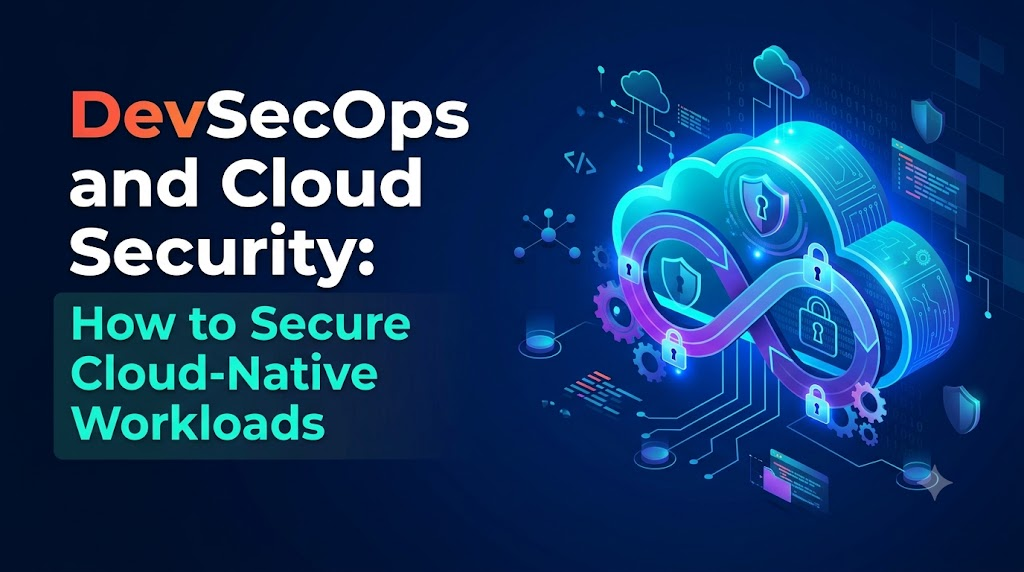
Modern engineering teams rely on cloud platforms to accelerate software delivery, but rapid deployment cycles frequently introduce critical vulnerabilities, including exposed credentials, insecure container images, vulnerable dependencies, and Infrastructure as Code (IaC) misconfigurations. Traditional security models—relying on manual sign-offs and delayed pre-production audits—inevitably create friction and deployment bottlenecks. DevSecOps resolves this challenge by integrating automated security controls, declarative policy-as-code guardrails, secret detection, and continuous observability directly into standard developer workflows and CI/CD pipelines. By shifting security left and embedding shared responsibility throughout the software delivery lifecycle, organizations build consistent, scalable cloud security without compromising delivery velocity.
What Is DevSecOps?
DevSecOps (Development, Security, and Operations) is an engineering practice and cultural model that builds security controls and shared accountability into every phase of the software delivery lifecycle—from initial design and coding to building, testing, deployment, and ongoing operations.
DevSecOps builds on DevOps core principles—automation, rapid iteration, version-controlled infrastructure, and cross-functional feedback loops—and extends them by treating security requirements as first-class delivery deliverables:
- Cross-Functional Collaboration: Security professionals transition from isolated gatekeepers into technical enablers. They collaborate directly with software engineers, SREs, and platform architects to build automated guardrails, reference templates, and actionable feedback channels.
- Shift-Left Security: By evaluating system architecture, scanning code, and checking configurations during the earliest stages of development, teams detect and remediate vulnerabilities before code reaches production environments.
- Automated Security Verification: Security policies run automatically within local developer environments (via git hooks and IDE plugins) and CI/CD pipelines, providing fast feedback on every pull request.
- Policy-as-Code Integration: Security baselines, compliance boundaries, and infrastructure guardrails are written in declarative code, version-controlled, tested, and automatically enforced.
- Continuous Feedback and Telemetry: Runtime events, threat intelligence, and vulnerability scan results continuously route back into engineering issue trackers, keeping backlog priorities transparent.
- Shared Responsibility: Development teams take pride in writing secure code, platform teams build hardened platforms, and security engineers guide threat modeling, review critical risks, and verify compliance baselines.
DevSecOps does not mean replacing human engineering judgment with automated pipeline scripts. While automation rapidly flags known Common Vulnerabilities and Exposures (CVEs) and syntax misconfigurations, critical capabilities—including architectural threat modeling, business-logic validation, context-aware risk analysis, and incident response—still require experienced human oversight.
What Is Cloud Security?
Cloud security comprises the technologies, protocols, operational processes, and governance controls designed to protect cloud-hosted applications, infrastructure, identities, data stores, and networked services from unauthorized access, compromise, data loss, and operational downtime.
Effective cloud security spans nine core functional domains:
- Identity and Access Management (IAM): Enforcing role-based access control (RBAC), fine-grained resource policies, multi-factor authentication (MFA), temporary security tokens, and identity federation across human operators and automated services.
- Data Protection and Cryptography: Implementing robust data classification, encryption in transit (TLS 1.3), encryption at rest (using managed Key Management Services with customer-managed keys), and secure data disposal across storage, memory, and database layers.
- Network and Perimeter Security: Managing Virtual Private Clouds (VPCs), micro-segmentation, private subnets, security group rules, Web Application Firewalls (WAF), Distributed Denial-of-Service (DDoS) mitigation, and egress filtering.
- Infrastructure and Configuration Security: Ensuring cloud-native services (such as object stores, virtual machines, serverless functions, and managed databases) match hardened baselines and avoid insecure defaults.
- Application and API Security: Defending web applications and APIs against input injection, broken object-level authorization (BOLA), session tampering, and emerging application risks identified in the OWASP Top 10.
- Container and Kubernetes Security: Hardening container base images, restricting Linux capabilities, configuring non-root execution contexts, and enforcing Kubernetes admission controls.
- Logging, Monitoring, and Threat Detection: Ingesting control-plane audit logs, network flow logs, and runtime telemetry into centralized Security Information and Event Management (SIEM) systems to detect anomalies and unauthorized activities.
- Compliance and Governance: Evaluating cloud configurations against regulatory frameworks such as ISO/IEC 27001, SOC 2, HIPAA, and PCI-DSS through automated configuration assessments and auditable change records.
- Backup, Disaster Recovery, and Incident Response: Maintaining immutable, off-site data backups, regularly testing automated recovery procedures, and establishing defined playbooks for containment, eradication, and post-incident reviews.
The Cloud Shared Responsibility Model
Understanding cloud security requires understanding the Shared Responsibility Model. Cloud service providers (such as AWS, Azure, and GCP) do not handle the end-to-end security of client deployments. Instead, security responsibilities are divided based on the chosen deployment architecture:
| Cloud Service Model | Cloud Service Provider (CSP) Responsibility | Customer Organization Responsibility |
| Infrastructure as a Service (IaaS) (e.g., AWS EC2, Azure VMs, GCP Compute Engine) | Physical data centers, host hardware, hypervisor layer, physical networking, environmental controls. | Guest operating systems, network configuration, security groups, patch management, IAM, application code, data encryption, and logging. |
| Containers / Managed Kubernetes (e.g., AWS EKS, Azure AKS, GCP GKE) | Physical hardware, virtualization, and underlying Kubernetes control plane infrastructure (API server, etcd). | Worker node OS (unless using managed serverless nodes like Fargate), cluster RBAC, pod security configurations, network policies, container images, application logic, and secrets. |
| Platform as a Service (PaaS) (e.g., AWS Elastic Beanstalk, Azure App Service) | Physical infrastructure, network virtualization, OS provisioning, platform middleware, and runtime patches. | Application source code, third-party libraries, database schemas, application IAM permissions, customer data, and API configurations. |
| Software as a Service (SaaS) (e.g., Microsoft 365, Salesforce) | Complete infrastructure, platform maintenance, application code, high availability, and foundational software patching. | User identity management, multi-factor authentication, tenant-level data classification, client endpoint hygiene, and access control policies. |
The cloud provider secures the security of the cloud (the underlying hardware, facilities, and core hypervisors). The customer secures what is put in the cloud (identities, access policies, resource configurations, application vulnerabilities, and data).
Assuming a cloud provider automatically secures customer workloads is one of the most common causes of preventable cloud security incidents.
How DevSecOps Supports Cloud Security
DevSecOps connects developer tooling with cloud infrastructure operations. By embedding defensive guardrails directly into the pipelines that build and provision cloud assets, teams protect applications throughout their operational life.
+-----------------------------------------------------------------------------------------------------+
|                                    Continuous Security Governance                                   |
|               (Identity Federation, Least Privilege, Audit Logging, Policy-as-Code)                |
+-----------------------------------------------------------------------------------------------------+
        |                                                                                    ^
        v                                                                                    |
  [ 1. CODE ] --------> [ 2. BUILD ] --------> [ 3. TEST ] --------> [ 4. DEPLOY ] --------> [ 5. RUN ]
  - IDE Linting         - Dependency Scan      - DAST / IAST         - Cloud Admission       - Runtime EDR
  - Pre-commit Hooks      (SCA / SBOM)         - Container Scanning    Controller Checks     - Cloud Auditing
  - Secret Scanners     - SAST Analysis        - Dynamic API Tests   - Verified Deployment     (CSPM / CWPP)
  - Threat Modeling     - Artifact Signing     - IaC Validation        Signatures            - SIEM / Logging
1. Detecting Vulnerabilities Earlier
Fixing a vulnerability discovered in production requires out-of-band hotfixes, emergency rollbacks, and potential incident triage. DevSecOps prevents these production disruptions by identifying architectural flaws and software defects during the design and development phases.
When developers write code, static analysis engines and pre-commit hooks scan the source files for insecure coding practices, such as:
- Unsanitized SQL parameters leading to injection attacks.
- Insecure deserialization of untrusted payloads.
- Cross-Site Scripting (XSS) exposures in front-end microservices.
- Hardcoded test accounts or fallback bypasses.
Concurrently, Software Composition Analysis (SCA) analyzes the application’s software bill of materials (SBOM). If a developer imports a package with known vulnerabilities, the SCA tool flags the issue in the local terminal or pull request review. This gives engineers the context they need to update the library before that dependency links into downstream container builds.
2. Securing CI/CD Pipelines
The CI/CD pipeline is the critical delivery pathway for modern software; compromise of the pipeline can lead directly to production compromise. Securing this automated boundary requires multi-layered checks:
- Static Application Security Testing (SAST): Scans application source code inside the build runner to flag structural security defects against rulesets like OWASP and CWE.
- Software Composition Analysis (SCA): Verifies third-party libraries against national vulnerability databases, flags end-of-life runtimes, and alerts on restrictive open-source licenses.
- Pipeline Integrity Checks: Securing the pipeline runners themselves through isolated build environments, pinned dependency hashes, immutable pipeline definitions, and cryptographically signed build outputs.
- Risk-Based Deployment Gates: Establishing automated thresholds that flag or fail builds containing unmitigated Critical or High CVEs with known public exploit vectors, while allowing low-risk informational findings to pass with automated tickets created for tracking.
3. Preventing Cloud Misconfigurations
Cloud misconfigurations—such as open Amazon S3 buckets, unrestricted 0.0.0.0/0 inbound security group rules on SSH/RDP ports, disabled audit logs, and unencrypted block storage volumes—remain the primary cause of cloud-native data breaches.
Terraform
# Insecure Infrastructure as Code (Terraform) Example
resource "aws_s3_bucket" "financial_records" {
  bucket = "company-internal-financial-records"
}

# The bucket defaults to public reads unless explicit private policies are defined.
# A DevSecOps IaC scanner flags this block during the pull request:
# [HIGH] S3 bucket allows public access / lacks explicit public access block.
By defining cloud infrastructure with Infrastructure as Code (IaC) tools like HashiCorp Terraform, OpenTofu, AWS CloudFormation, or Azure Bicep, security teams can scan infrastructure definitions before provisioning. Static IaC scanners parse declarative templates to verify that:
- Storage buckets have public access blocks enabled.
- Databases are isolated in private subnets with encryption-at-rest enabled.
- Network interfaces omit wildcard inbound firewall permissions.
- Logging frameworks (such as AWS CloudTrail, Azure Monitor, or GCP Cloud Audit Logs) are active.
Detecting misconfigurations in source code prevents insecure resources from ever being deployed to live cloud accounts.
4. Protecting Secrets and Credentials
Hardcoded credentials represent an immediate, catastrophic cloud risk. Automated public scanning bots continuously index version-control repositories for API keys, cloud provider secrets, and private SSH keys, often attempting exploitation within minutes of an accidental push.
DevSecOps counters this risk by eliminating static credentials across the development lifecycle:
- Pre-commit and In-Pipeline Secret Detection: Fast pattern-matching tools (such as Gitleaks) analyze commits and history for high-entropy strings, known token prefixes, and private key structures.
- Managed Secret Vaults: Applications retrieve runtime configuration parameters dynamically from managed secrets managers (such as HashiCorp Vault, AWS Secrets Manager, or Azure Key Vault) using cryptographic identities rather than embedded configurations.
- Workload Identity Federation: Cloud runners and Kubernetes pods use short-lived, cryptographically signed OIDC tokens to authenticate against cloud APIs, removing the need for long-lived, static access keys.
- Revocation and Rotation Workflows: If a credential is inadvertently committed, teams rotate or revoke the token immediately. Simply deleting the file or pushing a commit that removes the line does not purge the key from the Git history.
5. Strengthening Container and Kubernetes Security
Containers provide lightweight portability, but misconfigured base layers and container runtimes can expose underlying host systems. DevSecOps enforces defensive layers across the container lifecycle:
- Minimal Base Images: Applications build on minimal, hardened base layers—such as distroless or lightweight Alpine images—which strips out package managers, shell interpreters, and unnecessary utilities, reducing the attack surface.
- Automated Image Scanning: Container registries automatically scan layers upon push, blocking the deployment of images that contain known system-level vulnerabilities.
- Image Provenance and Cryptographic Signing: Tools like Sigstore/Cosign sign container artifacts after verification. Downstream Kubernetes clusters reject unsigned container digests.
- Kubernetes Hardening: Pod Security Standards, restrictive Kubernetes RBAC profiles, and admission controllers prevent pods from running as root, mounting the host filesystem, or using privileged kernel modules.
Scanning alone cannot stop every runtime threat. It must be paired with operational controls, such as read-only root filesystems, resource limits, and network policies that limit lateral movement.
6. Improving Identity and Access Management
Identity is the primary security boundary in cloud computing. In traditional operational environments, developers were often granted broad administrative permissions to simplify troubleshooting. DevSecOps helps teams implement precise, scalable access models:
- Least-Privilege RBAC: Development, operations, and pipeline automation accounts receive only the specific permissions needed for their assigned tasks.
- Ephemeral Credentials: Long-lived developer access keys are replaced with short-lived session tokens generated through identity providers via MFA.
- Scoped Automation Accounts: CI/CD runners use scoped roles limited to specific resource namespaces and deployment actions, preventing a compromised pipeline runner from altering organizational security baselines.
- Continuous IAM Evaluation: Automated posture engines regularly review deployed IAM policies to identify and revoke inactive roles, excessive wildcard permissions (
*), and stale access paths.
7. Automating Compliance and Policy Enforcement
Manual compliance reviews—assembling screenshots, configurations, and change spreadsheets days before an external audit—are slow, resource-intensive, and prone to error. DevSecOps modernizes compliance by using Policy-as-Code.
Code snippet
# Open Policy Agent (OPA) Example: Enforce Cloud Storage Encryption
package cloud.storage

default allow = false

# Allow deployment only if encryption at rest is explicitly enabled
allow {
    input.resource_type == "aws_s3_bucket"
    input.attributes.server_side_encryption_configuration[_].rule[_].apply_server_side_encryption_by_default.sse_algorithm == "aws:kms"
}
- Declarative Policy Frameworks: Using policy engines like Open Policy Agent (OPA) or Kyverno, compliance boundaries are written into version-controlled rules that evaluate IaC templates and runtime clusters.
- Automated Evidence Collection: Pipelines log test executions, vulnerability scans, commit IDs, and approval chains, creating a verifiable audit trail for frameworks like SOC 2, ISO/IEC 27001, and NIST CSF.
- Continuous Compliance Auditing: If an engineer alters a resource out-of-band via the cloud console, continuous configuration auditors detect the drift and alert administrators or automatically revert the change.
Automated policy checks streamline audits and ensure consistent controls, but they do not replace formal compliance reviews or guarantee regulatory certification on their own.
8. Enabling Continuous Monitoring and Faster Response
Pre-deployment checks cannot predict zero-day vulnerabilities, novel runtime attacks, or targeted compromises. DevSecOps bridges the gap between pre-deployment prevention and post-deployment runtime protection.
- Centralized Telemetry: Control-plane audit trails (AWS CloudTrail, Azure Activity Log, GCP Cloud Audit Logs), VPC flow records, application metrics, and system logs stream into centralized observability tools and SIEM platforms.
- Cloud Security Posture Management (CSPM): Continuous scanners assess active cloud infrastructure configurations against baseline security benchmarks (like CIS Benchmarks).
- Cloud Workload Protection (CWPP): Runtime agents and eBPF sensors monitor host kernels, containers, and serverless runtimes for anomalous executions, unauthorized file updates, or outbound connections to untrusted command-and-control addresses.
- Automated Incident Feedback: When a production security alert triggers, the incident feeds into development issue backlogs. The engineering team can then write regression tests, deploy a pipeline patch, and prevent similar issues in the future.
A Practical DevSecOps Workflow for Securing Cloud Applications
A successful DevSecOps practice distributes security controls systematically across every phase of the cloud delivery lifecycle.
+------------+------------------------------------------------------+---------------------------------------------------------+
| Stage      | Primary Security Activity                            | Focus Areas                                             |
+------------+------------------------------------------------------+---------------------------------------------------------+
| 1. Plan    | Threat Modeling, Risk Assessment                     | Architectural design, trust boundaries, data flows      |
| 2. Code    | Static Scanning, Secret Checks, Peer Review          | Local linting, git pre-commit hooks, input validation   |
| 3. Build   | SCA Scanning, SAST Rules, Dependency Lock            | Third-party packages, SBOM generation, build integrity  |
| 4. Test    | Dynamic Testing, API Checks, Container Validation    | DAST verification, business logic, container layers     |
| 5. Deploy  | Admission Checks, Infrastructure Validation, OIDC    | IaC verification, signed artifacts, least privilege    |
| 6. Run     | Telemetry Analysis, Threat Hunting, Drift Detection  | SIEM ingestion, kernel monitoring, automated feedback   |
+------------+------------------------------------------------------+---------------------------------------------------------+
Complete Delivery Lifecycle Stages
- Plan: Teams conduct lightweight threat-modeling sessions to analyze proposed architectures, identify trust boundaries, review sensitive data flows, and define security acceptances before writing code.
- Code: Developers write business logic using secure coding standards. Integrated development environment (IDE) plugins and Git pre-commit hooks scan for hardcoded secrets and known insecure patterns before code is pushed to remote branches.
- Build: Centralized CI runners compile the software, generate a software bill of materials (SBOM), run Software Composition Analysis (SCA) to flag vulnerable third-party libraries, and execute SAST engines.
- Test: Applications deploy into ephemeral test environments where Dynamic Application Security Testing (DAST) and API security suites test running interfaces against authentication bypasses, data-exposure bugs, and functional security flaws.
- Provision: Infrastructure as Code (IaC) definitions pass through static analysis engines and policy-as-code validations to ensure cloud network, database, and storage configurations meet internal security baselines.
- Package: Container images are assembled using minimal base layers. Container vulnerability scanners evaluate base packages, application layers, and runtime configurations. Approved artifacts are cryptographically signed and stored in a private container registry.
- Deploy: The cloud platform or Kubernetes admission controller verifies the cryptographic signature of the deployment package, checks that target environment configurations are intact, and applies changes via scoped service accounts using temporary identity credentials.
- Monitor: Observability systems, SIEM engines, and runtime protection platforms continuously track application health, analyze control-plane audit logs, and monitor container execution for anomalous behavior.
- Respond: Security operations, platform teams, and developers triage production findings, patch root causes in source code, update automated tests, and deploy fixes through the same CI/CD pipeline.
Cloud Delivery Pipeline Security Controls
| Delivery Stage | Security Activity | Example Tools or Controls | Expected Outcome |
| Plan | Threat Modeling & Architecture Review | OWASP Threat Dragon, STRIDE Matrix, Architecture Checklists | Identification of security risks, trust boundaries, and mitigation plans prior to coding. |
| Code | Secret Detection & IDE Security Linting | Gitleaks, SonarLint, Pre-commit Hooks | Prevention of hardcoded API keys, tokens, and basic syntax security defects from entering Git. |
| Build | SAST & Software Composition Analysis (SCA) | SonarQube, Semgrep, Snyk Open Source, OWASP Dependency-Check | Identification of vulnerable open-source dependencies and structural source-code vulnerabilities. |
| Test | Dynamic & API Security Testing | OWASP ZAP, Postman Security Tests | Detection of runtime configuration issues, insecure headers, and API authentication flaws. |
| Provision | Infrastructure as Code (IaC) Scanning | Checkov, Trivy, tfsec | Detection and blocking of cloud resource misconfigurations in Terraform, Bicep, or CloudFormation. |
| Package | Container Image Vulnerability Scanning | Trivy, AWS ECR Scanning, Azure Container Registry Tasks | Identification of operating system package vulnerabilities and verification of unprivileged user runtimes. |
| Deploy | Policy Enforcement & Artifact Verification | Kyverno, OPA Gatekeeper, Sigstore/Cosign | Enforcement of deployment rules; prevention of unsigned or non-compliant containers from running in clusters. |
| Monitor | CSPM & Centralized Audit Logging | Cloud native audit trails (CloudTrail), Datadog Cloud Security, Wazuh | Real-time visibility into infrastructure drift, unauthorized access attempts, and control-plane changes. |
| Respond | Automated Incident Alerting & Triage | PagerDuty, Jira Automation, Runbooks | Rapid routing of runtime security findings back to engineering teams for root-cause patching. |
Important DevSecOps Tools for Cloud Security
Tool selection should align with your organization’s tech stack, cloud environments, and risk model. The following categories provide a structured look at the modern DevSecOps tooling ecosystem.
1. Source-Code Security (SAST)
- Examples: Semgrep, SonarQube.
- What it detects: Structural source-code defects, unsanitized user inputs, buffer overflows, insecure cryptographic calls, and logic flaws matching known vulnerability signatures.
- Workflow placement: Local developer pre-commit hooks and early CI pipeline build stages.
- Limitations: Lacks runtime context; can generate false positives by flagging patterns that are neutralized elsewhere in the call chain.
- Remediation: Requires developers to review code, patch identified flaws, or adjust rule configurations to filter out non-exploitable patterns.
2. Dependency & Software Composition Analysis (SCA)
- Examples: Snyk, OWASP Dependency-Check.
- What it detects: Direct and transitive open-source dependencies with known CVEs, outdated packages, unmaintained libraries, and license non-compliance.
- Workflow placement: CI build phase when application dependencies are downloaded and resolved.
- Limitations: Identifies the presence of a vulnerable library, but cannot always verify whether the vulnerable function is actually called by the application.
- Remediation: Upgrading dependencies to secure patch versions, applying vendor patches, or swapping unmaintained packages.
3. Secret Detection
- Examples: Gitleaks, TruffleHog.
- What it detects: High-entropy strings, API tokens, private cryptographic keys, cloud IAM credentials, and connection strings committed to Git repositories or build logs.
- Workflow placement: Git pre-commit hooks, pull request validation, and continuous background repository scanning.
- Limitations: Cannot determine if an identified token is active, expired, or an intentional mock value in a test file without custom regex filters or verification checks.
- Remediation: Immediate revocation and rotation of exposed credentials, followed by git history cleanup.
4. Infrastructure as Code (IaC) Scanning
- Examples: Checkov, Trivy.
- What it detects: Cloud misconfigurations declared in Terraform, OpenTofu, CloudFormation, Kubernetes manifests, and Helm charts (such as open storage buckets, missing encryption, or wide-open ingress rules).
- Workflow placement: Pull request validation and infrastructure pipeline provisioning stages.
- Limitations: Scans only the static definitions in code; cannot evaluate dynamic state modifications made out-of-band via the cloud management console.
- Remediation: Updating IaC configuration code to match security baselines before applying infrastructure updates.
5. Container Image Security
- Examples: Trivy, AWS ECR Scanning, Azure Defender for Containers.
- What it detects: Known CVEs within container base operating system packages, vulnerable system runtimes, and containers configured to execute as root.
- Workflow placement: Post-container build, pre-registry push, and continuous registry storage scanning.
- Limitations: A clean scan does not guarantee runtime security; zero-day exploits, fileless attacks, and runtime misconfigurations bypass static image scans.
- Remediation: Updating base images to minimal or patched releases, removing unnecessary utility packages, and enforcing non-root user execution contexts.
6. Kubernetes Policy and Security
- Examples: Kyverno, OPA Gatekeeper, kube-bench.
- What it detects: Non-compliant cluster deployments, missing CPU/memory limits, containers requesting host network access or root privileges, and cluster drift away from CIS Kubernetes Benchmarks.
- Workflow placement: Cluster admission control pipelines, continuous cluster governance loops, and platform deployment jobs.
- Limitations: Misconfigured admission rules can inadvertently block legitimate cluster deployments or cause control-plane latency.
- Remediation: Adjusting Kubernetes deployment manifests, defining policy exceptions with expiration dates, and applying CIS-recommended cluster hardening steps.
7. Cloud Security Posture Management (CSPM)
- Examples: Native cloud tools (AWS Security Hub, Microsoft Defender for Cloud, Google Cloud Security Command Center), Wiz, Prisma Cloud.
- What it detects: Active runtime cloud misconfigurations, resource drift, exposed control plane endpoints, insecure network architectures, and cross-account compliance gaps.
- Workflow placement: Continuously running across cloud environments, monitoring live assets post-deployment.
- Limitations: Often surfaces a large volume of alerts; without risk-based prioritization, teams can experience severe alert fatigue.
- Remediation: Updating IaC source repositories to remediate root causes, or applying automated configuration rollbacks for critical exposures.
8. Monitoring, Audit Logging, and SIEM
- Examples: AWS CloudTrail, Datadog Cloud Security Management, Splunk, Elastic Security.
- What it detects: Unauthorized API calls, unexpected privilege escalations, suspicious network connections, anomalous container executions, and multi-stage security incidents.
- Workflow placement: Live operational environments, continuously ingesting control-plane, infrastructure, and application logs.
- Limitations: Operates downstream as a detection control; it alerts teams to threats and compromises that have already occurred rather than preventing them at deployment.
- Remediation: Incident triage, automated containment (such as isolating nodes or revoking sessions), and writing post-incident pipeline guardrails to prevent future occurrences.
DevSecOps Cloud Security Examples in Real-World Scenarios
Scenario 1: Preventing an Insecure Cloud Storage Configuration
A software engineer updates an internal microservice, using Terraform to add a cloud storage bucket for user profile exports. The engineer writes the resource block without explicitly configuring private access blocks or encryption keys:
Terraform
resource "aws_s3_bucket" "export_store" {
  bucket = "user-analytics-export-store"
}
- The DevSecOps Control: As the engineer opens a pull request, the CI/CD pipeline triggers an Infrastructure as Code scanner (such as Checkov). The scanner evaluates the template against the company’s security baseline and flags the configuration:
Failed: CKV_AWS_54: "Ensure S3 bucket has public policy block enabled" Failed: CKV_AWS_19: "Ensure all data stored in the S3 bucket is securely encrypted at rest" - Outcome: The pipeline blocks the merge request and provides links to approved internal Terraform configuration modules. The engineer adds the necessary encryption and access blocks directly in code.
- Real-World Context: The misconfiguration is resolved in the pull request before live cloud resources are ever provisioned. The effectiveness of this check depends on the team’s policy coverage and whether pipeline checks are configured to block builds rather than merely emit informational warnings.
Scenario 2: Triaging a Vulnerable Container Image Before Release
An engineering team prepares to deploy a new release of a customer-facing API. During the container build, an automated image scanner flags a vulnerability:
CVE-2024-XXXX | High | libssl3 | Installed: 3.0.2-0ubuntu1.12 | Fixed in: 3.0.2-0ubuntu1.15
- The DevSecOps Control: Rather than automatically halting the deployment and causing an outage, the team applies a risk-based review:
- Exploitability: Does the container expose the vulnerable OpenSSL function directly to external untrusted inputs?
- Environment: Is this container deploying to an isolated internal staging network, or a public edge network?
- Fix Availability: Is a patched upstream base image available?
- Outcome: Because a patched version of the base image is available upstream, the engineer updates the
Dockerfilebase image tag to the latest release, rebuilding the container with clean dependencies in under an hour. - Real-World Context: Vulnerability severity scores (CVSS) provide helpful initial guidance, but they do not account for environmental context. DevSecOps teams combine automated scanning with risk-based analysis to address critical vulnerabilities without unnecessarily halting safe releases.
Scenario 3: Mitigating an Exposed Cloud Credential
During late-night troubleshooting, a developer temporarily pastes a cloud provider programmatic access key (containing an AKIA... prefix) into a local test script. The developer accidentally stages the script and pushes the commit to an enterprise Git repository.
- The DevSecOps Control:
- A secret-detection scanner (such as Gitleaks or TruffleHog) running on the Git server intercepts the commit payload, flags the access key structure, blocks the push, and alerts the security operations team.
- If the push had succeeded to a remote repository, an automated webhook triggers a key-revocation workflow via cloud security automation.
- Outcome: The cloud provider IAM system invalidates the exposed key within minutes, preventing unauthorized use. Security operations reviews the audit logs (e.g., CloudTrail) for that key ID to confirm it was not exploited before invalidation. The developer is guided through generating a short-lived session token instead.
- Real-World Context: Deleting the sensitive commit or pushing a follow-up commit that removes the line does not secure the secret—it remains in Git history. Real-world DevSecOps workflows prioritize immediate key revocation, audit log review, and transition to short-lived identity federation.
DevSecOps and Cloud Security Best Practices
Building an effective DevSecOps program requires balancing automated tooling, clear architecture, and practical engineering habits:
- Integrate Security Early: Run linters, secret scanners, and policy checks locally in IDEs and pre-commit hooks to give developers instant feedback before code is pushed to shared branches.
- Implement Least-Privilege IAM Everywhere: Enforce fine-grained role-based access for human operators and CI/CD service accounts alike. Keep CI/CD deployment roles scoped to the specific environments they manage.
- Transition to Ephemeral Secrets: Replace static access keys with dynamic, short-lived credentials using OIDC-based workload identity federation for build runners and runtime clusters.
- Scan Infrastructure as Code Before Provisioning: Treat infrastructure files with the same rigor as application source code. Validate all Terraform, Bicep, and Kubernetes templates against security baselines before applying changes.
- Curate and Minimize Container Base Images: Build production containers from hardened, minimal base images (such as Alpine or distroless images) to reduce the system attack surface and limit patch overhead.
- Establish Clear Risk-Based Pipeline Gates: Configure CI/CD pipelines to fail only on actionable, high-confidence security findings (e.g., critical CVEs with known exploit paths or clear configuration errors) to avoid blocking builds on low-risk informational warnings.
- Keep Dependencies and Runtimes Current: Schedule regular dependency updates into ongoing sprint cycles rather than deferring maintenance until a major zero-day forces an emergency migration.
- Centralize Audit Logs and Security Telemetry: Ingest control-plane audit logs, network flow records, and system telemetry into a centralized, immutable SIEM platform to support incident investigations.
- Define Clear Ownership for Remediation: Make sure every security scan finding maps to a specific owning team’s backlog. Findings without clear owners are rarely remediated.
- Document Formal Exception and Rollback Processes: Establish clear, audited exception workflows for when emergency business hotfixes need to bypass pipeline blocks, complete with expiration dates and required sign-offs.
- Regularly Test Disaster Recovery and Backups: Regularly test data restoration from isolated, immutable backups, and conduct incident response game days to validate team playbooks under realistic conditions.
- Train Engineers on Practical Security: Provide continuous, hands-on secure-coding education relevant to the organization’s specific stack, cloud services, and common vulnerability patterns.
Organizations should prioritize these practices based on their specific threat models, architectures, and available resources, rather than attempting to adopt every tool simultaneously.
Common Challenges When Implementing DevSecOps for Cloud Security
Adopting DevSecOps involves cultural, operational, and technical changes. Understanding common pitfalls helps teams implement controls smoothly.
1. Alert Fatigue and High False-Positive Rates
- The Challenge: Running off-the-shelf scanners with default configurations often bombards developers with hundreds of low-priority or non-exploitable warnings. Developers quickly learn to ignore scan results, defeating the purpose of the tools.
- Mitigation Strategy: Tune scanning rulesets to focus on your application’s actual context. Start by enforcing failure gates only for Critical vulnerabilities that have public exploit vectors, while routing informational findings to a shared backlog for phased review.
2. Pipeline Performance Bottlenecks
- The Challenge: Adding heavy security scans into the CI/CD pipeline can turn a 5-minute build into a 45-minute wait, frustrating developers and tempting teams to bypass security checks entirely.
- Mitigation Strategy: Decouple pipeline checks based on speed. Run fast checks (secret detection, linting, light SAST) directly in the commit path. Move long-running tasks (full container scans, deep DAST, complex dynamic analysis) to asynchronous pipelines, nightly jobs, or staging deployments.
3. Security Skills Gaps in Development Teams
- The Challenge: Developers are rarely trained in secure system design or cloud architecture, while security teams often lack hands-on experience with modern software engineering practices.
- Mitigation Strategy: Establish a “Security Champions” program by embedding interested developers within security cross-training initiatives. Provide hands-on workshops using real codebases to teach teams how vulnerabilities are introduced, identified, and remediated.
4. Legacy Applications and Inconsistent Cloud Footprints
- The Challenge: Older monolithic applications and manually provisioned cloud resources (“ClickOps”) lack automated pipelines and Infrastructure as Code definitions, making uniform policy enforcement difficult.
- Mitigation Strategy: Avoid attempting full retrospective automation at once. Apply modern DevSecOps standards strictly to all new services and infrastructure changes first. Gradually bring existing cloud resources under IaC management using import tools, prioritizing internet-facing and business-critical systems.
5. Tool Sprawl and Fragmented Findings
- The Challenge: Deploying disconnected tools for SAST, SCA, container scanning, CSPM, and IaC analysis scatters security findings across multiple disconnected dashboards, making it difficult to prioritize remediation.
- Mitigation Strategy: Consolidate scan findings into an Application Security Posture Management (ASPM) platform or route them directly into the engineering team’s primary issue tracker (such as Jira or GitHub Issues) via automated APIs, providing a single source of truth.
6. Misaligned Team Priorities (Velocity vs. Security)
- The Challenge: Development teams are measured on feature velocity and release dates, while security teams are evaluated on compliance checklists and zero incidents. This creates friction whenever a security check delays a release.
- Mitigation Strategy: Align shared objectives by making system security, reliability, and code quality core shared performance metrics. Engineering managers should allocate dedicated capacity in every sprint for technical debt, security patching, and pipeline improvements.
7. Unclear Vulnerability Ownership
- The Challenge: Scanners flag vulnerabilities in shared base images, shared network infrastructure, or transitive dependencies, but no single team takes responsibility for patching them.
- Mitigation Strategy: Establish clear ownership documentation across all services, repositories, and infrastructure layers. Define clear Service Level Objectives (SLOs) for remediating vulnerabilities based on severity (e.g., Critical: 7 days, High: 30 days).
8. Over-Reliance on Automated Scanning
- The Challenge: Teams assume that a “green pipeline” means the application is completely secure, overlooking business-logic flaws, architectural blind spots, and runtime access abuses that automated scanners cannot detect.
- Mitigation Strategy: Combine automated scanning with periodic manual threat-modeling sessions, targeted code reviews of sensitive modules (such as authentication and payment paths), and regular third-party penetration testing.
9. Multi-Cloud Policy Inconsistencies
- The Challenge: Managing workloads across multiple cloud providers (such as AWS and Azure) often results in fragmented, provider-specific security policies and configurations.
- Mitigation Strategy: Use cloud-agnostic policy-as-code and configuration scanning frameworks (such as Open Policy Agent, Checkov, or Trivy) to define unified security baselines that apply consistently across all environments.
Measuring DevSecOps Effectiveness in Cloud Security
To verify that security investments are improving your organization’s security posture, track objective, trend-based metrics over time.
- Mean Time to Remediate (MTTR) Vulnerabilities: Tracks the average time it takes from identifying a vulnerability to verifying its fix in production. A healthy DevSecOps program steadily decreases MTTR for Critical and High issues.
- Pre-Deployment vs. Post-Deployment Detection Ratio: Measures the percentage of vulnerabilities caught during development and build phases compared to those discovered in production by CSPM or runtime monitoring. A maturing program catches a growing majority of defects before release.
- Recurring Misconfiguration Rate: Tracks how often the same infrastructure misconfigurations (such as open security groups or unencrypted buckets) reappear in pull requests. A downward trend indicates that secure IaC templates and engineering practices are taking hold.
- Repository and Pipeline Coverage: The percentage of active codebases and infrastructure repositories with integrated secret scanning, SAST, and IaC validations.
- Secret Detection and Revocation Speed: Measures how quickly committed secrets are caught, revoked, and rotated.
- Policy Exception Frequency and Duration: Tracks how many pipeline bypasses are requested, who approved them, and whether exceptions are remediated within their agreed grace periods.
- Asset Observability Coverage: The percentage of active cloud resources, containers, and serverless invocations feeding audit logs into centralized security monitoring platforms.
Metrics should be evaluated in context. For example, a spike in detected vulnerabilities often reflects improved scanning visibility rather than declining code quality. Avoid relying on a single metric as definitive proof of security.
How DevOpsSchool Can Support DevSecOps Learning
Transitioning to DevSecOps requires engineering teams to master a broad set of skills across software delivery, infrastructure automation, container orchestration, and defensive security. For professionals and teams looking to build these capabilities, structured educational resources can help accelerate the learning curve.
DevOpsSchool provides practical training programs, community forums, and educational tutorials focused on DevOps, cloud architecture, and modern delivery pipelines. Engineers, security specialists, and IT managers can review their educational materials to assess whether current course offerings align with their professional development and team training goals.
When evaluating external technical training, we encourage learners to review:
- Syllabus Depth: Confirm that coursework covers modern secure development principles, automated CI/CD security controls, Infrastructure as Code validation, and container security rather than just high-level overviews.
- Hands-on Labs: Ensure training includes realistic exercises where students can configure automated pipelines, scan IaC files, integrate policy-as-code checks, and remediate realistic cloud vulnerabilities.
- Cloud Platform Relevance: Verify that training scenarios use mainstream cloud environments (such as AWS, Azure, or GCP) and standard industry tooling (such as Docker, Kubernetes, Terraform, and Open Policy Agent).
- Instructor Experience: Check the professional background of the trainers, ensuring they have practical, hands-on experience building and securing enterprise delivery pipelines.
- Prerequisites and Pace: Make sure the course’s technical requirements match your current foundation in Linux administration, basic scripting, Git, and cloud infrastructure.
Review course syllabi, verify prerequisites, and evaluate current training options directly at DevOpsSchool to find programs that match your team’s cloud security goals.
Frequently Asked Questions About DevSecOps and Cloud Security
1. How does DevSecOps improve cloud security?
DevSecOps improves cloud security by integrating automated vulnerability checks, secret scanning, Infrastructure as Code validation, and policy enforcement directly into software delivery pipelines. This enables teams to identify and fix security flaws before resources are provisioned, reducing misconfigurations and production vulnerabilities while maintaining deployment speed.
2. What is the difference between DevOps and DevSecOps?
DevOps focuses on breaking down silos between development and operations teams to improve delivery velocity, deployment frequency, and system reliability. DevSecOps builds upon this model by making security a shared responsibility across both teams, embedding automated security controls, compliance validations, and feedback loops throughout the entire delivery cycle.
3. Why is DevSecOps important for cloud-native applications?
Cloud-native applications rely on dynamic, ephemeral components—such as microservices, auto-scaling containers, and serverless functions—provisioned through automated code. Traditional manual, perimeter-based security reviews cannot keep pace with this speed and scale. DevSecOps embeds automated guardrails directly into the pipelines that build and run these workloads, keeping security consistent as systems change.
4. What role does automation play in cloud security?
Automation provides consistent, repeatable security evaluations across every code change and deployment. It scans source code, checks third-party dependencies for CVEs, verifies cloud configurations, and enforces compliance policies at scale. This allows human engineers to focus on higher-level architectural decisions, threat modeling, and complex incident triage.
5. How does Infrastructure as Code scanning help prevent cloud misconfigurations?
Infrastructure as Code (IaC) scanning parses declarative configuration files (such as Terraform, Bicep, or CloudFormation templates) for security defects before they are applied to cloud environments. It flags issues like unencrypted storage, publicly exposed ports, and missing audit logs in the pull request, preventing insecure resources from ever being deployed.
6. Which DevSecOps tools are useful for cloud security?
Useful tools include source code analyzers (Semgrep, SonarQube), dependency scanners (Snyk, OWASP Dependency-Check), secret detectors (Gitleaks, TruffleHog), IaC scanners (Checkov, Trivy), container scanners (Trivy), Kubernetes admission controllers (Kyverno, OPA Gatekeeper), and cloud posture managers (CSPM solutions).
7. How does DevSecOps secure CI/CD pipelines?
DevSecOps secures pipelines by implementing least-privilege permissions on build runners, using short-lived credentials via workload identity federation, isolating build environments, pinning dependencies, scanning build scripts for vulnerabilities, and signing deployment artifacts to ensure integrity.
8. What is shift-left security?
Shift-left security is the practice of moving security evaluations, testing, and architecture reviews earlier in the software development lifecycle. By addressing vulnerabilities during the coding, building, and testing phases, teams can remediate issues faster and more cost-effectively than fixing them in production.
9. How does DevSecOps help protect Kubernetes environments?
DevSecOps protects Kubernetes by scanning container images for vulnerabilities, minimizing base image footprints, signing images to ensure provenance, validating manifests against security standards, and enforcing runtime admission policies using tools like Kyverno or OPA Gatekeeper.
10. Can DevSecOps prevent all cloud security breaches?
No. DevSecOps reduces vulnerabilities and configuration errors, but it cannot prevent all security incidents. A complete security strategy combines pipeline prevention with operational controls, such as network segmentation, runtime monitoring, least-privilege IAM, robust incident response plans, and employee training.
11. How does DevSecOps support cloud compliance?
DevSecOps supports compliance by codifying regulatory requirements into version-controlled Policy-as-Code checks. Pipelines automatically evaluate systems against these policies and generate auditable logs, commit records, and scan reports, simplifying evidence collection for frameworks like SOC 2, ISO 27001, and PCI-DSS.
12. What is the shared responsibility model in cloud security?
The shared responsibility model defines the division of security obligations between a cloud service provider (CSP) and the customer. The CSP is responsible for the security of the cloud (physical infrastructure, hardware, and hypervisors). The customer is responsible for security in the cloud (identities, access policies, data encryption, application code, and resource configurations).
13. How should teams prioritize vulnerabilities found in cloud environments?
Teams should prioritize vulnerabilities using a risk-based approach that considers more than just the raw CVSS score. Prioritization should weigh whether the vulnerable code path is actually executed, whether a public exploit exists, whether the component is internet-facing, and the sensitivity of the connected data.
14. Can small organizations implement DevSecOps practices?
Yes. Small teams can begin with lightweight, open-source tools: adding secret detection to pre-commit hooks, turning on basic SCA scans in GitHub Actions or GitLab CI, and scanning Terraform templates with open-source tools. DevSecOps is an incremental process of continuous improvement, not an all-or-nothing investment.
15. What skills are needed for a cloud-focused DevSecOps role?
A cloud-focused DevSecOps professional needs foundational skills in Linux administration, software development or scripting (e.g., Python, Bash, Go), CI/CD pipeline automation, Infrastructure as Code, container orchestration (Docker, Kubernetes), cloud platform architecture, and defensive security fundamentals (threat modeling, vulnerability management, and IAM).
Conclusion
Effective cloud security is not a one-time gate or a single automated scanner, but a continuous engineering discipline that combines shift-left testing, sound architectural design, least-privilege identity management, and real-time runtime monitoring. By implementing DevSecOps practices, organizations transform security from a late-stage release bottleneck into an automated operational safeguard that identifies vulnerabilities and misconfigurations before they reach production. To strengthen your cloud defense today, review your current CI/CD pipeline, identify a key security gap—such as unvalidated IaC templates or uninspected pull requests—and explore practical, hands-on training resources at DevOpsSchool to build your team’s DevSecOps expertise.







Leave a Reply
You must be logged in to post a comment.