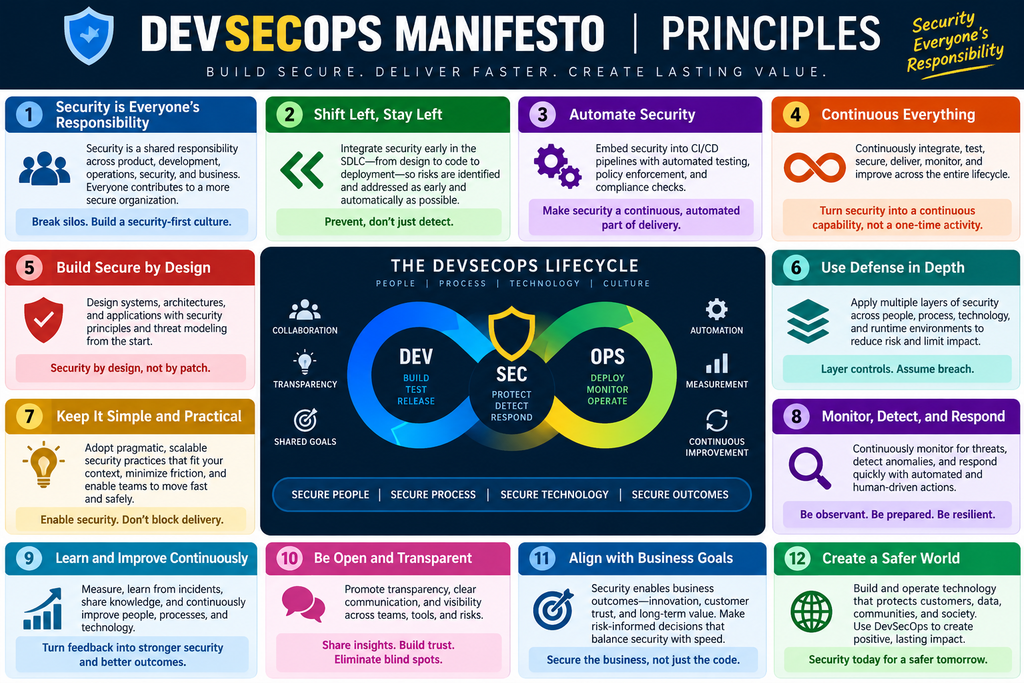
Complete Reference Tutorial — From Principles to Production Implementation
Version: 1.0
Updated: September 2026
Level: Beginner → Intermediate → Advanced
Audience: Developers, DevOps Engineers, SREs, Security Engineers, Platform Engineers, Architects, Engineering Managers, Compliance Teams
1. What Is DevSecOps?
DevSecOps means integrating security into the entire software development and delivery lifecycle rather than treating security as a separate activity performed immediately before production.
At a simple level:
DevSecOps
    =
Development
    +
Security
    +
Operations
But this definition is incomplete.
DevSecOps is really about changing:
Security as a Gate
        ↓
Security as an Engineering Capability
Instead of:
Develop → Test → Deploy → SECURITY REVIEW → Productionwe build security throughout the lifecycle:
Plan
 ↓
Design
 ↓
Code
 ↓
Build
 ↓
Test
 ↓
Release
 ↓
Deploy
 ↓
Operate
 ↓
Monitor
 ↓
Respond

Security exists throughout ↑
The original DevSecOps Manifesto centers on Security as Code, collaboration, automation, continuous feedback, proactive monitoring, exploit-based testing, and making security services consumable by engineering teams.
2. Why Was DevSecOps Needed?
Traditional security organizations often operated separately from development teams.
A common historical model looked like this:
Developer
   │
   ▼
Application Development
   │
   ▼
QA
   │
   ▼
Release Candidate
   │
   ▼
Security Team
   │
   ├── Vulnerability scan
   ├── Penetration test
   ├── Compliance review
   └── Security approval
   │
   ▼
Production
This created several problems.
Problem 1 — Security discovered issues too late
Imagine discovering an architectural authentication flaw two days before release.
Fixing it might require:
Architecture Change
      ↓
Code Changes
      ↓
Database Changes
      ↓
New Tests
      ↓
New Deployment
The later a fundamental security problem is discovered, the more disruptive remediation becomes.
Problem 2 — Security became a bottleneck
Development teams increasingly moved toward:
Agile
+
CI/CD
+
Cloud
+
Containers
+
Microservices
+
Infrastructure as Code
They could potentially deploy dozens or hundreds of times per day.
A security process based primarily on:
Tickets
Documents
Manual approvals
Spreadsheets
Periodic scans
could not scale at the same rate.
Problem 3 — Security teams became known as the team that says “No”
The conversation might look like:
Developer:
Can we deploy this?

Security:
No.

Developer:
Why?

Security:
Security policy.

Developer:
What do we need to change?

Security:
See this 120-page document.
That creates friction rather than better security.
The early DevSecOps principles explicitly argued that security needs to scale alongside continuous innovation rather than primarily operating as a gatekeeper.
3. The Fundamental DevSecOps Transformation
The DevSecOps transformation can be summarized like this:
| Traditional Security | DevSecOps |
|---|---|
| Security team owns security | Everyone contributes to security |
| Security review near release | Security throughout SDLC |
| Manual checks | Automated controls where practical |
| Documents | Machine-readable policy |
| Tickets | APIs and self-service |
| Periodic scans | Continuous testing |
| Vulnerability reports | Actionable remediation |
| Security gatekeeper | Security engineering partner |
| Reactive incident handling | Continuous detection |
| Compliance evidence gathered manually | Evidence generated continuously |
| Infrastructure configured manually | Infrastructure as Code |
| Secrets manually distributed | Automated secrets management |
4. What Is the DevSecOps Manifesto?
The DevSecOps Manifesto describes a different operating model for security practitioners.
Its core philosophy is that security should work in a way developers and operations teams can actually consume.
The manifesto emphasizes ideas including:
- Security as Code
- iterative improvement
- security services exposed through APIs
- developer-focused security feedback
- collaboration instead of isolated security ownership
- practical exploit testing
- continuous monitoring
- shared threat intelligence
- operationalized compliance
The official manifesto describes the goal as creating security capabilities that help teams move forward rather than merely producing reports or blocking deployments.
5. The Nine DevSecOps Manifesto Values
The manifesto describes nine broad preferences.
Rather than memorizing the wording, understand the engineering philosophy behind each one.
Principle 1 — Enable Teams Instead of Automatically Blocking Them
Traditional mindset
Request
  ↓
Security Review
  ↓
NO
DevSecOps mindset
Request
  ↓
Understand Risk
  ↓
Provide Safe Pattern
  ↓
Automate Controls
  ↓
Enable Delivery
Security’s job is not to make risk disappear.
That is impossible.
The objective is to:
Understand Risk
      +
Reduce Risk
      +
Make Risk Visible
      +
Enable Business
Example
A development team asks:
Can our application upload files to S3?
A gatekeeper answer might be:
No public S3 access allowed.A DevSecOps answer could instead define:
Application
    │
    ▼
IAM Role
    │
    ├── PutObject
    ├── GetObject
    └── DeleteObject
    │
    ▼
Specific S3 Prefix
Combined with:
Block Public Access
Encryption
Access Logging
Least Privilege
No static AWS keys
Security has enabled the use case while reducing risk.
6. Principle 2 — Use Evidence Instead of Fear
Poor security communication sounds like:
"This is dangerous."

"This could be hacked."

"This is insecure."

"We can't allow this."
DevSecOps asks:
What is the threat?
What is the likelihood?
What is the impact?
What evidence exists?
Which control reduces the risk?
What residual risk remains?
Example
Suppose an internet-facing service has a vulnerability.
Instead of saying:
CRITICAL vulnerability!
Stop everything!
evaluate:
CVSS severity
       +
Internet exposure
       +
Exploitability
       +
Exploit availability
       +
Privileges required
       +
Affected asset value
       +
Existing compensating controls
Risk prioritization therefore becomes:
Technical Severity
        ×
Exploitability
        ×
Exposure
        ×
Business Impact
rather than:
Scanner Severity = Business Priority7. Principle 3 — Security Through Collaboration
Security requirements should not exist exclusively inside a security department.
DevSecOps creates collaboration among:
Developers
    +
Platform Engineering
    +
DevOps
    +
SRE
    +
Security
    +
Architecture
    +
Product
    +
Compliance
Security Champion Model
One useful implementation is:
                 Security Team
                      │
             ┌────────┼────────┐
             │        │        │
             ▼        ▼        ▼
          Team A    Team B    Team C
             │        │        │
         Security  Security  Security
         Champion  Champion  Champion
Security champions do not replace security engineers.
They create security expertise closer to development.
8. Principle 4 — Make Security Consumable
One of the strongest ideas in the manifesto is that security should become something developers can consume easily.
Traditional model:
Developer
   ↓
Security Ticket
   ↓
Wait
   ↓
Security Engineer
   ↓
Manual Configuration
DevSecOps model:
Developer
   ↓
Self-Service Platform
   ↓
Approved Security Pattern
   ↓
API / Pipeline / Template
   ↓
Secure Resource
Example: Secure Infrastructure Module
Instead of telling developers:
Configure S3 securely.
Create:
secure-s3-modulethat automatically enables:
✓ Block Public Access
✓ Encryption
✓ TLS enforcement
✓ Logging
✓ Standard tags
✓ IAM guardrails
Developer usage:
module "application_bucket" {
  source = "./modules/secure-s3"

  bucket_name = "application-data"
}
Security becomes:
Reusable
Repeatable
Automated
Consistent
Self-Service
This is a major example of Security as Code.
9. Principle 5 — Connect Security to Business Risk
Finding vulnerabilities is not itself the end goal.
Suppose a scanner finds:
Application A: 100 vulnerabilities
Application B: 5 vulnerabilities
Which should be fixed first?
You cannot know from those numbers alone.
Application A might be:
Internal
No sensitive data
No internet exposure
Strong compensating controls
Application B might be:
Internet-facing
Payment system
Customer PII
Privileged backend access
So security prioritization should consider context.
Better Risk Model
Risk
 =
Technical Severity
 ×
Exploitability
 ×
Exposure
 ×
Asset Criticality
 ×
Business Impact
The objective is not:
Make Scanner Dashboard GreenThe objective is:
Reduce Meaningful Business Risk10. Principle 6 — Test Whether Defenses Actually Work
Automated scanners are valuable.
But:
Scanner Result ≠ Proof of SecurityDevSecOps therefore complements scanning with offensive and defensive security testing.
Red Team
Red teams simulate attackers.
They ask:
Can we compromise this system?Activities may include:
Exploitation
Privilege escalation
Credential abuse
Lateral movement
Cloud attack paths
Application attacks
Social engineering where authorized
Blue Team
Blue teams focus on defense.
They ask:
Can we detect and stop the attack?Purple Team
Purple teaming brings both together:
Red Team
   │
 Attack
   │
   ▼
Blue Team
   │
 Detect
   │
   ▼
Improve Detection
   │
   ▼
Retest
The key question becomes:
Do our controls actually work against realistic attacks?
11. Principle 7 — Continuous Security Monitoring
Traditional security:
Attack
  ↓
Something breaks
  ↓
Someone notices
  ↓
Security investigates
DevSecOps:
Telemetry
   ↓
Continuous Detection
   ↓
Correlation
   ↓
Alert
   ↓
Investigation
   ↓
Automated / Human Response
Sources may include:
Application Logs
Cloud Audit Logs
Kubernetes Audit Logs
Identity Events
WAF Logs
Network Flows
Endpoint Security
Runtime Detection
Database Audit Logs
CI/CD Audit Logs
Security doesn’t end at deployment.
12. Principle 8 — Share Threat Intelligence
Security knowledge loses value when isolated.
Imagine Security discovers:
Attackers are scanning /admin/debug
using a newly observed technique.
That information should feed:
Security
   │
   ├── Developers
   ├── SRE
   ├── SOC
   ├── Platform Team
   ├── Incident Response
   └── Detection Engineering
The knowledge may produce:
New WAF Rule
New Detection
New Unit Test
New Security Test
New Coding Standard
New Threat Model
This creates a feedback loop.
13. Principle 9 — Compliance as an Operational Capability
Traditional compliance frequently looks like:
Audit Coming
    ↓
Collect Screenshots
    ↓
Collect Documents
    ↓
Collect Spreadsheets
    ↓
Interview Teams
    ↓
Submit Evidence
DevSecOps aims for:
Infrastructure
     ↓
Policy as Code
     ↓
Automated Controls
     ↓
Continuous Evidence
     ↓
Compliance Dashboard
Example
Compliance requirement:
S3 buckets must not be public.Instead of checking annually:
Terraform Policy
       +
Cloud Configuration Monitoring
       +
Automated Alert
Now compliance becomes continuous.
14. Security as Code
Security as Code is one of the foundational concepts behind DevSecOps.
The basic idea is:
If something can be expressed
as machine-readable policy,
automate it.
Examples:
Infrastructure as Code
Policy as Code
Compliance as Code
Detection as Code
Configuration as Code
Pipeline as Code
Security Tests as Code
15. Infrastructure as Code
Instead of manually creating infrastructure:
Engineer
   ↓
AWS Console
   ↓
Click
Click
Click
use:
Terraform
CloudFormation
Pulumi
CDK
Example:
resource "aws_s3_bucket_public_access_block" "example" {
  bucket = aws_s3_bucket.example.id

  block_public_acls       = true
  block_public_policy     = true
  ignore_public_acls      = true
  restrict_public_buckets = true
}
Now the security configuration is:
Version Controlled
Reviewable
Testable
Repeatable
Auditable
16. Policy as Code
Security policies can also become executable rules.
Conceptually:
Terraform
   ↓
Policy Engine
   ↓
Is configuration allowed?
   │
   ├── YES → Continue
   │
   └── NO  → Stop / Warn
Example policy:
IF
    S3 bucket is public
THEN
    Reject deployment
Other examples:
Database must be encrypted.

Production resources require specific tags.

Security groups cannot expose SSH globally.

Containers cannot run privileged.

Kubernetes workloads cannot use host networking.

Critical images must come from approved registries.
17. Security in the Entire SDLC
A mature DevSecOps program spreads controls throughout the lifecycle.
flowchart LR
    A[Plan] --> B[Design]
    B --> C[Code]
    C --> D[Build]
    D --> E[Test]
    E --> F[Release]
    F --> G[Deploy]
    G --> H[Operate]
    H --> I[Monitor]
    I --> A
Security surrounds every stage.
18. Plan Stage
Security activities include:
Security requirements
Data classification
Risk assessment
Compliance requirements
Abuse-case identification
Questions:
What data are we processing?

What regulations apply?

What happens if this system is compromised?

Who should have access?
19. Design Stage
Perform:
Threat Modeling
Architecture Security Review
Trust Boundary Identification
Authentication Design
Authorization Design
Encryption Design
A simplified threat model:
Internet
   │
   ▼
[ Load Balancer ]
   │
   ▼
[ Application ]
   │
   ├─────────► [ Database ]
   │
   └─────────► [ External API ]
Ask:
Where are trust boundaries?

Where does authentication happen?

Where can privilege escalation occur?

What if the external API is compromised?

Can one tenant access another tenant's data?
20. Code Stage
Typical controls:
Secure coding standards
IDE security feedback
Secret detection
SAST
Peer review
Dependency policy
Examples of vulnerabilities to detect early:
SQL injection
Command injection
Path traversal
Hard-coded credentials
Weak cryptography
Unsafe deserialization
Authorization failures
21. Build Stage
Typical controls:
Software Composition Analysis
Dependency vulnerability scanning
SBOM generation
Artifact signing
Container image scanning
Build provenance
Supply-chain security becomes extremely important here.
A modern application may contain:
Your Code                 15%
Open Source Dependencies  70%
Runtime / Base Image      15%
The exact proportions vary, but the lesson is simple:
You must secure software you didn’t write too.
NIST’s SSDF specifically includes protecting software components from tampering and unauthorized access as one of its major practice groups.
22. Test Stage
Security testing may include:
SAST
DAST
IAST
API Security Testing
Fuzz Testing
Container Scanning
Infrastructure Scanning
Penetration Testing
OWASP’s current DevSecOps guidance explicitly covers techniques including SAST, DAST, IAST, SCA, infrastructure scanning and container scanning.
23. Deploy Stage
Typical controls:
Policy as Code
Admission Controls
Image Verification
Secure Configuration Validation
Least-Privilege IAM
Secrets Injection
Environment Protection
Example Kubernetes deployment path:
Container Image
     ↓
Registry
     ↓
Image Scan
     ↓
Signature Verification
     ↓
Admission Policy
     ↓
Kubernetes
24. Operate Stage
Security activities include:
Patch management
Secrets rotation
Certificate rotation
IAM review
Runtime protection
Configuration monitoring
Vulnerability management
25. Monitor Stage
Security monitoring may include:
SIEM
Cloud Security Monitoring
Application Security Monitoring
Runtime Detection
Endpoint Detection
Network Detection
Anomaly Detection
The important concept is:
Prevent
   +
Detect
   +
Respond
Prevention alone will never be enough.
26. Shift Left
You will frequently hear DevSecOps associated with:
Shift Left.
Imagine the SDLC as:
LEFT                                      RIGHT

Plan → Design → Code → Build → Test → Deploy → Operate
Historically, security often happened toward the right.
Shift Left means performing security earlier:
Plan
 │
 ├── Security Requirements

Design
 │
 ├── Threat Modeling

Code
 │
 ├── SAST
 └── Secret Detection

Build
 │
 ├── SCA
 └── Container Scanning
OWASP describes early detection as a central objective of its DevSecOps guidance.
27. Shift Right
DevSecOps does not mean:
Shift Left = EverythingSome problems can only be discovered in real environments.
Shift Right includes:
Runtime Monitoring
Attack Detection
Incident Response
Chaos Engineering
Penetration Testing
Production Telemetry
Threat Hunting
28. The Better Model: Shift Everywhere
Modern DevSecOps is better thought of as:
              SECURITY

Plan
 ↓
Design
 ↓
Code
 ↓
Build
 ↓
Test
 ↓
Deploy
 ↓
Operate
 ↓
Monitor

              SECURITY
Or:
Security EverywhereOWASP’s current project description similarly describes its direction as moving beyond only shift-left toward security throughout the lifecycle.
29. Example DevSecOps CI/CD Pipeline
Consider this workflow:
flowchart TD
    A[Developer Commit] --> B[Secret Scan]
    B --> C[SAST]
    C --> D[Unit Tests]
    D --> E[SCA]
    E --> F[Build Container]
    F --> G[Container Scan]
    G --> H[Generate SBOM]
    H --> I[Push Artifact]
    I --> J[Deploy Test]
    J --> K[DAST/API Tests]
    K --> L[Policy Check]
    L --> M[Deploy Production]
    M --> N[Runtime Monitoring]
    N --> O[Detection and Response]
30. A More Detailed Security Pipeline
Developer
   │
   ▼
Git Commit
   │
   ├── Secret Detection
   │
   ▼
Pull Request
   │
   ├── Peer Review
   ├── SAST
   ├── Dependency Scan
   ├── IaC Scan
   │
   ▼
Build
   │
   ├── Reproducible Build
   ├── SBOM
   ├── Artifact Signing
   │
   ▼
Container Registry
   │
   ├── Image Scan
   ├── Signature
   │
   ▼
Test Environment
   │
   ├── DAST
   ├── API Testing
   ├── Integration Tests
   │
   ▼
Deployment
   │
   ├── Policy as Code
   ├── Admission Control
   │
   ▼
Production
   │
   ├── Runtime Security
   ├── Logs
   ├── Metrics
   ├── Traces
   ├── Threat Detection
   │
   ▼
SIEM / Detection
   │
   ▼
Incident Response
31. Security Gates: Use Them Carefully
DevSecOps does not mean:
Block every pipeline for every vulnerability.That quickly becomes unusable.
Instead define risk-based policies.
Example:
| Finding | Possible Action |
|---|---|
| Critical exploitable vulnerability | Block |
| Critical secret exposure | Block |
| Critical IaC misconfiguration | Block |
| High vulnerability with known exploit | Block/exception |
| Medium vulnerability | Warn + remediation SLA |
| Low vulnerability | Track |
| Informational | Report |
The exact thresholds depend on business risk.
32. False Positives Matter
Imagine every deployment produces:
350 security warningsbut engineers discover that:
320 are irrelevant
20 are duplicates
8 aren't exploitable
2 require action
Developers eventually learn:
Security Alert = NoiseThis is dangerous.
A successful DevSecOps program optimizes:
Signal
──────
Noise
not just:
Number of Scanners33. Secrets Management
Bad:
AWS_ACCESS_KEY_ID: AKIA...
AWS_SECRET_ACCESS_KEY: abc123...
Better:
Application
    │
    ▼
Workload Identity
    │
    ▼
Cloud IAM
or:
Application
    │
    ▼
Secrets Manager
    │
    ▼
Short-lived credential
DevSecOps prefers:
Short-lived credentials
       over
Long-lived credentials

Identity federation
       over
Static access keys

Automated rotation
       over
Manual rotation
34. Cloud DevSecOps Example
Suppose the platform uses:
GitHub
Terraform
AWS
EKS
Docker
Kubernetes
Datadog
A DevSecOps architecture might look like:
Developer
   │
   ▼
GitHub
   │
   ├── Secret Scan
   ├── SAST
   ├── Dependency Scan
   │
   ▼
Terraform
   │
   ├── IaC Scan
   ├── Policy as Code
   │
   ▼
AWS
   │
   ▼
EKS
   │
   ├── Admission Policy
   ├── RBAC
   ├── Network Policies
   ├── Workload Identity
   │
   ▼
Application
   │
   ▼
Datadog / Security Monitoring
This demonstrates the manifesto better than simply buying a “DevSecOps tool.”
35. DevSecOps Is Not a Tool
This is one of the most important lessons.
DevSecOps is not:
SonarQube
Snyk
Trivy
Checkov
Wiz
GitHub Advanced Security
Datadog
Vault
Those may support DevSecOps.
But:
DevSecOps ≠ Security ToolDevSecOps is:
Culture
+
People
+
Process
+
Automation
+
Architecture
+
Security Engineering
+
Continuous Feedback
36. DevSecOps Is Not Just “Shift Left”
Another common misunderstanding:
DevSecOps = Add SAST to CI/CDNo.
That would only address one piece.
A mature program covers:
Design Security
Application Security
Cloud Security
Infrastructure Security
Identity
Supply Chain Security
Container Security
Runtime Security
Detection
Incident Response
Compliance
37. DevSecOps Is Not “Developers Own Everything”
Another dangerous interpretation is:
Security is everyone's responsibility

therefore

Security Team isn't needed.
Wrong.
Shared responsibility means specialists still exist.
For example:
Developers
Own:
Secure coding
Dependency remediation
Application fixes
Platform/DevOps
Own:
Secure pipeline
Infrastructure controls
Platform guardrails
Security
Own or lead:
Threat modeling
Security standards
Detection strategy
Security architecture
Offensive testing
Incident response
Risk governance
38. Shared Responsibility Model
flowchart TD
    A[Security] --> E[Shared DevSecOps Responsibility]
    B[Development] --> E
    C[Platform / DevOps] --> E
    D[SRE / Operations] --> E
    E --> F[Secure Product]
39. Developer Experience Matters
Imagine requiring developers to execute:
15 security tools
8 manual commands
5 websites
4 approval tickets
before every deployment.
Security technically exists.
But DevSecOps has failed.
Good security should ideally feel like:
git push
   ↓
Automated Checks
   ↓
Clear Feedback
   ↓
Fix
   ↓
Continue
The best security controls often disappear into the engineering platform.
40. Golden Paths
Platform engineering can provide secure Golden Paths.
For example:
Create New Microservice
          ↓
Approved Template
          ↓
Repository
          +
CI/CD
          +
Logging
          +
Monitoring
          +
IAM
          +
Secrets
          +
Security Scanning
          +
Infrastructure
Developers start secure by default.
This is much more scalable than telling every development team to reinvent security.
41. Secure by Default
Suppose engineers can choose:
Option A: Secure
Option B: Insecure
Eventually somebody will choose B.
Better:
Default Platform
      =
Secure Configuration
Exceptions then become explicit.
This complements the broader Secure by Design approach promoted by security agencies such as CISA, where security properties are incorporated into the product architecture rather than treated only as downstream controls.
42. DevSecOps and NIST SSDF
The DevSecOps Manifesto is a philosophy.
NIST’s Secure Software Development Framework provides a more structured secure-development framework.
NIST SSDF organizes its current final framework into four groups:
PO — Prepare the Organization

PS — Protect the Software

PW — Produce Well-Secured Software

RV — Respond to Vulnerabilities
A useful mapping is:
DevSecOps Manifesto
        ↓
Culture / Philosophy

NIST SSDF
        ↓
Secure Development Practices

OWASP
        ↓
Application / Pipeline Guidance

CI/CD + Cloud Platform
        ↓
Technical Implementation
As of September 2026, NIST lists SSDF 1.1 as final while SSDF 1.2 is represented by the December 2025 initial public draft.
43. DevSecOps Metrics
Never measure DevSecOps only by:
Number of vulnerabilities found.Finding more vulnerabilities may simply mean you deployed more scanners.
Useful metrics include:
Vulnerability Metrics
Mean Time to Remediate
Critical Vulnerability Age
Known Exploited Vulnerabilities
Reopened Vulnerabilities
Risk Acceptance Age
Pipeline Metrics
Security Scan Duration
False Positive Rate
Pipeline Security Failure Rate
Security Test Coverage
Detection Metrics
Mean Time to Detect
Mean Time to Respond
Detection Coverage
False Positive Rate
Engineering Metrics
Percentage of repositories scanned
Percentage generating SBOM
Percentage of signed artifacts
Percentage using approved pipelines
44. Avoid Bad Metrics
Bad metric:
We found 7,000 vulnerabilities.It tells us almost nothing.
Better:
99% of internet-facing critical vulnerabilities
are remediated within the defined SLA.
Even better:
Known exploitable vulnerabilities affecting
internet-facing Tier-1 systems remain unresolved: 0
Metrics should lead to decisions.
45. DevSecOps Maturity Model
A simple maturity model can help organizations understand their current state.
Level 0 — Reactive
Security after deployment
Manual reviews
Little automation
Incident-driven changes
Level 1 — Basic
SAST
Dependency scanning
Container scanning
Basic secrets management
Level 2 — Integrated
Security inside CI/CD
IaC scanning
Automated policies
Threat modeling
Centralized logging
Level 3 — Managed
Risk-based security gates
SBOM
Artifact signing
Security champions
Runtime detection
Automated compliance
Level 4 — Optimized
Secure golden paths
Continuous security validation
Attack-path analysis
Purple teaming
Security metrics tied to business risk
Automated remediation
Continuous feedback
46. Anti-Patterns
Anti-pattern 1
Install 12 scanners
=
DevSecOps
No.
Anti-pattern 2
Block everything.Developers will eventually bypass security.
Anti-pattern 3
Security owns every security problem.Doesn’t scale.
Anti-pattern 4
Developers own all security.Also doesn’t scale.
Anti-pattern 5
Pass compliance audit
=
Secure
Compliance and security overlap, but they are not identical.
Anti-pattern 6
Shift Left
=
Ignore production security
Production remains where real attackers operate.
47. A Practical DevSecOps Operating Model
A strong program can be represented as six layers:
┌─────────────────────────────────────┐
│        SECURITY CULTURE             │
├─────────────────────────────────────┤
│        SECURE DESIGN                │
├─────────────────────────────────────┤
│        SECURE DEVELOPMENT           │
├─────────────────────────────────────┤
│        SECURE CI/CD                 │
├─────────────────────────────────────┤
│        SECURE PLATFORM              │
├─────────────────────────────────────┤
│   RUNTIME SECURITY & RESPONSE       │
└─────────────────────────────────────┘
All six are important.
48. Recommended Implementation Roadmap
Do not start with 30 tools.
Start with risk.
Phase 1 — Foundation
Establish:
Asset inventory
Security ownership
Security standards
Data classification
Threat modeling
Secrets management
Logging
Phase 2 — Secure Development
Introduce:
Secure coding training
SAST
SCA
Secret scanning
Code review rules
Phase 3 — Secure Infrastructure
Introduce:
Infrastructure as Code
IaC scanning
Cloud configuration controls
Least privilege
Network segmentation
Phase 4 — Secure Supply Chain
Introduce:
SBOM
Artifact integrity
Dependency governance
Image signing
Build provenance
Approved registries
Phase 5 — Runtime Security
Introduce:
Continuous monitoring
Runtime detection
Cloud threat detection
SIEM
Incident response
Phase 6 — Continuous Improvement
Introduce:
Purple teaming
Threat intelligence
Automated remediation
Security metrics
Security champions
Continuous compliance
49. A 90-Day Starter Plan
Days 1–30
Understand current state.
Inventory applications
Inventory pipelines
Inventory secrets
Identify critical assets
Identify internet-facing services
Define vulnerability severity policy
Enable centralized logging
Days 31–60
Automate high-value security controls.
Secret scanning
SAST
SCA
Container scanning
IaC scanning
Basic policy checks
Days 61–90
Improve operational security.
Threat modeling
Security champions
Runtime monitoring
Response playbooks
Risk-based pipeline gates
Security dashboards
Do not attempt complete maturity in 90 days.
Build the feedback loop first.
50. The DevSecOps Feedback Loop
A mature DevSecOps organization continuously learns.
flowchart LR
    A[Build] --> B[Test]
    B --> C[Deploy]
    C --> D[Monitor]
    D --> E[Detect]
    E --> F[Learn]
    F --> G[Improve Controls]
    G --> A
For example:
Production Attack
      ↓
Detection
      ↓
Incident Analysis
      ↓
Root Cause
      ↓
New Secure Coding Rule
      ↓
New SAST Rule
      ↓
New Unit Test
      ↓
New WAF Detection
      ↓
Developer Training
The incident produces engineering improvement.
51. The DevSecOps Infinite Loop
Conceptually:
              PLAN
           ↗        ↘
       MONITOR      CODE
         ↑            ↓
       OPERATE      BUILD
         ↑            ↓
        DEPLOY ← TEST
Security participates throughout.
The goal is not:
Secure ReleaseThe goal is:
Continuous Secure Delivery52. How the Manifesto Changes the Security Engineer’s Role
Traditional:
Security Engineer
      =
Reviewer
Gatekeeper
Auditor
DevSecOps:
Security Engineer
      =
Security Developer
Security Architect
Platform Contributor
Risk Advisor
Detection Engineer
Automation Engineer
Security Coach
Security moves closer to engineering.
53. How It Changes the Developer’s Role
Developers are no longer expected simply to:
Write feature
→
Send it to security.
They participate in:
Secure design
Secure coding
Dependency management
Security remediation
Threat modeling
Security testing
But the platform should make these responsibilities practical.
54. How It Changes DevOps / Platform Engineering
DevOps and platform teams become extremely important in DevSecOps because they own many control points:
CI/CD
Infrastructure as Code
Cloud IAM
Kubernetes
Secrets
Artifact Registries
Deployment Platforms
Observability
A security team may define a policy.
Platform engineering often turns that policy into:
Code
+
Automation
+
Guardrails
55. Example Transformation
Before DevSecOps
Developer commits code

↓ 3 weeks

Security scan

↓ 200 vulnerabilities

PDF report

↓ Ticket

Developer fixes

↓ Rescan

Release delayed
After DevSecOps
Developer opens PR
        ↓
Secret Scan
        ↓
SAST
        ↓
SCA
        ↓
IaC Scan
        ↓
Developer receives feedback
        ↓
Fixes before merge
        ↓
Container Scan
        ↓
Deploy Test
        ↓
DAST
        ↓
Risk Policy
        ↓
Production
        ↓
Runtime Monitoring
This captures the practical meaning of the manifesto.
56. DevSecOps Decision Framework
For every security control, ask:
1. What risk are we addressing?
Threat?
Asset?
Impact?
2. Where should we detect it?
IDE?
PR?
Build?
Deployment?
Runtime?
3. Can it be automated?
Yes → Automate

No → Define human process
4. Should it block delivery?
Risk-based decision5. Who owns remediation?
Explicit owner6. How will we measure effectiveness?
Metric57. DevSecOps Reference Architecture
                       ┌─────────────────────┐
                       │   Developer IDE     │
                       │ Secure Coding       │
                       └─────────┬───────────┘
                                 │
                                 ▼
                       ┌─────────────────────┐
                       │   Source Control    │
                       │ Secret Detection    │
                       │ Code Review         │
                       └─────────┬───────────┘
                                 │
                                 ▼
                       ┌─────────────────────┐
                       │       CI            │
                       │ SAST / SCA / IaC    │
                       │ Unit Tests          │
                       └─────────┬───────────┘
                                 │
                                 ▼
                       ┌─────────────────────┐
                       │ Artifact Registry   │
                       │ Scan / Sign / SBOM  │
                       └─────────┬───────────┘
                                 │
                                 ▼
                       ┌─────────────────────┐
                       │       CD            │
                       │ Policy as Code      │
                       │ Approval Rules      │
                       └─────────┬───────────┘
                                 │
                                 ▼
                       ┌─────────────────────┐
                       │ Runtime Platform    │
                       │ Cloud / Kubernetes  │
                       └─────────┬───────────┘
                                 │
                                 ▼
                       ┌─────────────────────┐
                       │ Security Monitoring │
                       │ SIEM / Detection    │
                       └─────────┬───────────┘
                                 │
                                 ▼
                       ┌─────────────────────┐
                       │ Incident Response   │
                       └─────────┬───────────┘
                                 │
                                 └────► Feedback to Engineering
58. DevSecOps Checklist
Planning
- Security requirements identified
- Compliance requirements identified
- Data classified
- System criticality defined
Design
- Threat modeling performed
- Authentication reviewed
- Authorization reviewed
- Trust boundaries identified
- Encryption architecture defined
Code
- Secure coding standards
- Peer review
- Secret scanning
- SAST
- Dependency scanning
Build
- Reproducible/controlled build
- Container scanning
- SBOM generated
- Artifact integrity protected
Test
- Security tests
- API tests
- DAST where appropriate
- Infrastructure validation
Deployment
- Policy as Code
- Secure configuration
- Least privilege
- Secure secrets injection
Runtime
- Logs centralized
- Alerts configured
- Runtime security
- Vulnerability management
Response
- Incident response plan
- Security ownership
- Playbooks
- Root-cause process
- Feedback into engineering
59. Ten Questions Every DevSecOps Engineer Should Ask
- What are our most critical assets?
- Where are our trust boundaries?
- How could an attacker compromise this system?
- Which security problems can we prevent automatically?
- Which security problems can we detect automatically?
- What should actually block deployment?
- How quickly can developers understand and fix findings?
- What happens when prevention fails?
- How will we detect an attack in production?
- How does what we learn in production improve development?
If your DevSecOps program can answer these questions clearly, it is probably moving in the right direction.
60. The Most Important Concept
DevSecOps is sometimes explained as:
Put Security into DevOps.A stronger definition is:
DevSecOps is an engineering operating model in which security becomes a shared, automated, measurable and continuously improving capability embedded throughout software design, development, delivery and operation.
The DevSecOps Manifesto therefore represents a transition:
FROM

Security Teams
Manually Inspecting
Software Created by Others

               ↓

TO

Engineering Teams
Building Security
Into the System
61. One Diagram to Remember Everything
                         DEVSECOPS

                            │
          ┌─────────────────┼─────────────────┐
          │                 │                 │
        PEOPLE            PROCESS          TECHNOLOGY
          │                 │                 │
   Collaboration       Secure SDLC        Automation
   Shared Ownership    Threat Modeling    CI/CD Security
   Security Champion   Risk Management    Security as Code
          │                 │                 │
          └─────────────────┼─────────────────┘
                            │
                            ▼
                     SECURITY EVERYWHERE
                            │
          ┌─────────────────┼─────────────────┐
          │                 │                 │
      SHIFT LEFT       SECURE DELIVERY    SHIFT RIGHT
          │                 │                 │
      Design           CI/CD Controls      Monitoring
      Code             Policy as Code      Detection
      Dependencies     Supply Chain        Response
          │                 │                 │
          └─────────────────┼─────────────────┘
                            │
                            ▼
                 CONTINUOUS FEEDBACK
                            │
                            ▼
                    CONTINUOUS IMPROVEMENT
62. Final Mental Model
Remember these ten ideas:
1. Security is everyone's responsibility.

2. Security starts before coding.

3. Automate repeatable security controls.

4. Treat security configuration as code.

5. Give developers fast, actionable feedback.

6. Prioritize actual risk rather than scanner counts.

7. Make secure behavior the easiest behavior.

8. Security continues after deployment.

9. Learn continuously from attacks and incidents.

10. Security should enable engineering rather than
    simply acting as a release gate.
And the entire DevSecOps Manifesto can be reduced to one transformation:
          OLD WORLD

Development → Operations → Security

                 ↓

             DEVSECOPS

┌──────────────────────────────────────┐
│ Development + Security + Operations │
│                                      │
│     collaborate continuously         │
│     automate continuously            │
│     test continuously                │
│     monitor continuously             │
│     learn continuously               │
└──────────────────────────────────────┘
63. Reference Framework
For further study, use these together:
| Resource | Purpose |
|---|---|
| DevSecOps Manifesto | Philosophy and culture |
| OWASP DevSecOps Guideline | Practical DevSecOps implementation |
| OWASP SAMM | Software security maturity |
| NIST SSDF | Secure software-development practices |
| OWASP ASVS | Application security requirements |
| OWASP Top 10 | Common application risks |
| MITRE ATT&CK | Adversary techniques |
| CIS Benchmarks | Secure configuration guidance |
| SLSA | Software supply-chain integrity |
OWASP’s DevSecOps project specifically aims to help organizations build secure pipelines and integrate security testing into normal development and delivery processes.
NIST SSDF complements this by providing a structured set of secure software-development practices intended to integrate with existing SDLC models rather than requiring organizations to replace their development methodology.
64. Final Takeaway
The DevSecOps Manifesto is not primarily about adding more security tools.
It is about changing how security operates.
Not:

"We need security approval before production."


Instead:

"How do we engineer security into the way
software is designed, built, deployed,
operated and continuously improved?"
That is the heart of DevSecOps.
Security becomes part of engineering rather than something engineering goes through.




Leave a Reply
You must be logged in to post a comment.