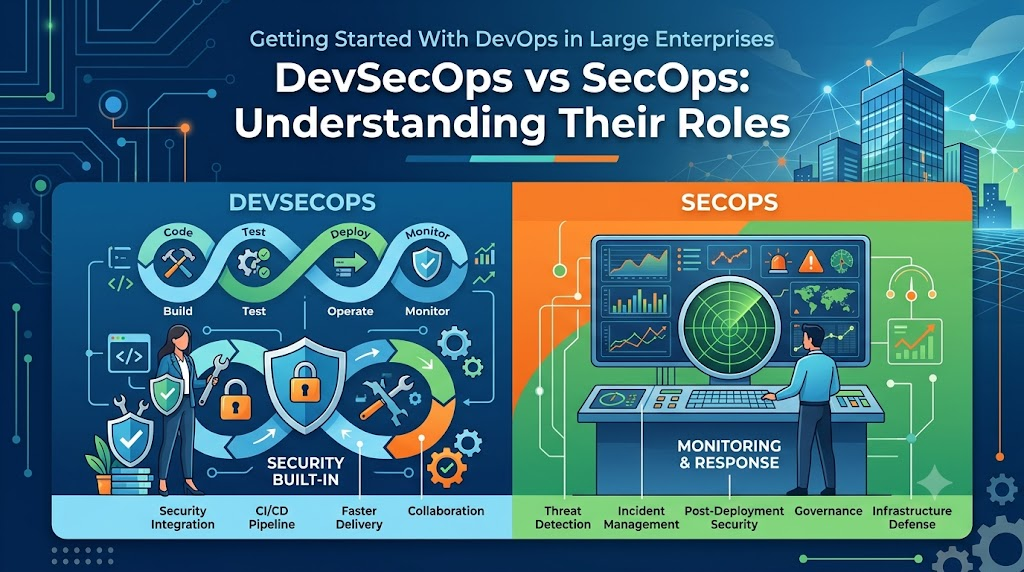
Security is no longer something organizations can afford to address only after an application has been developed or a security alert has appeared. Modern engineering teams need security throughout the software lifecycle, while security teams need strong operational processes for detecting, investigating, and responding to threats.
This is where DevSecOps and SecOps come into the picture.
The two terms are closely related, but they solve different problems. DevSecOps focuses on building security into software development and delivery, while SecOps focuses on operational security monitoring, detection, investigation, and response.
A mature organization generally does not choose one over the other. Instead, DevSecOps and SecOps work together across different parts of the technology and security lifecycle.
DevSecOps vs SecOps at a Glance
| Area | DevSecOps | SecOps |
|---|---|---|
| Full form | Development, Security and Operations | Security Operations |
| Primary focus | Secure software development and delivery | Security monitoring and incident response |
| Main environment | SDLC, CI/CD, cloud and application platforms | Security operations, infrastructure, endpoints, networks and cloud |
| Main objective | Prevent vulnerabilities from reaching production | Detect and respond to security threats |
| Typical teams | Developers, DevOps, security engineers, platform teams | SOC analysts, incident responders, threat hunters, security engineers |
| Security approach | Shift-left and continuous security | Continuous detection and response |
| Common activities | SAST, DAST, SCA, IaC scanning, container scanning | SIEM monitoring, EDR, alert triage, threat hunting, incident response |
| Primary question | “Can we build and deploy this securely?” | “Are we under attack, and what should we do?” |
| Typical outcome | More secure applications and infrastructure | Faster detection, investigation and containment |
| Time orientation | Before and throughout deployment | During and after security events, plus continuous monitoring |
The important point is that DevSecOps is not a replacement for SecOps, and SecOps is not a replacement for DevSecOps.
They overlap, but their responsibilities are different.
What Is DevSecOps?
DevSecOps integrates security practices into the DevOps lifecycle.
Traditional development models often treated security as a separate phase. Developers built the application, operations deployed it, and security teams reviewed it later.
That approach creates a predictable problem: vulnerabilities can be discovered late, when fixing them is more expensive and disruptive.
DevSecOps changes the workflow by making security a shared responsibility across development, operations, and security teams.
A simplified DevSecOps lifecycle looks like this:
Plan
  ↓
Code
  ↓
Build
  ↓
Test
  ↓
Security Validation
  ↓
Package
  ↓
Deploy
  ↓
Operate
  ↓
Monitor
  ↓
Feedback
  ↺
Security controls can be introduced throughout this lifecycle instead of waiting for a final security review.
What Does DevSecOps Actually Do?
DevSecOps can include activities such as:
- Secure coding practices
- Source-code security analysis
- Dependency and software composition analysis
- Secret detection
- Container image scanning
- Infrastructure-as-Code scanning
- Dynamic application security testing
- API security testing
- Cloud configuration checks
- Vulnerability management
- Security gates in CI/CD pipelines
- Software supply-chain security
- Security testing before production
- Security monitoring after deployment
For example, suppose a developer adds a vulnerable third-party library to an application.
A DevSecOps pipeline might identify that dependency during the build process and prevent the release from progressing until the issue is reviewed.
The objective is not simply to generate a security report. The objective is to find and address security problems as close as practical to where they are introduced.
What Is SecOps?
SecOps, short for Security Operations, is the operational side of cybersecurity.
SecOps teams are responsible for continuously watching an organization’s technology environment for suspicious activity and responding when threats are identified.
A typical SecOps workflow looks like:
Security Events
      ↓
Collection
      ↓
Detection
      ↓
Alert Triage
      ↓
Investigation
      ↓
Containment
      ↓
Eradication / Remediation
      ↓
Recovery
      ↓
Lessons Learned
SecOps commonly operates through or alongside a Security Operations Center (SOC).
The exact structure varies between organizations, but responsibilities often include:
- Security monitoring
- Alert investigation
- Incident response
- Threat detection
- Threat hunting
- Endpoint monitoring
- Network monitoring
- Identity monitoring
- Log analysis
- SIEM management
- EDR/XDR operations
- Vulnerability response
- Security automation
- Forensics and investigation
- Security incident documentation
The Main Difference Between DevSecOps and SecOps
The easiest way to understand the difference is to look at where each discipline operates in the security lifecycle.
DevSecOps asks:
How can we prevent security weaknesses from being introduced or deployed?
SecOps asks:
How can we detect, investigate and respond when suspicious activity occurs?
Consider an application deployed to the cloud.
DevSecOps might:
- Scan its source code.
- Check third-party dependencies.
- Scan the container image.
- Validate Kubernetes or Terraform configurations.
- Check for exposed secrets.
- Apply security controls to the CI/CD pipeline.
- Validate the deployment before production.
SecOps might:
- Monitor authentication activity.
- Detect unusual access patterns.
- Investigate suspicious API calls.
- Analyze endpoint alerts.
- Correlate logs in a SIEM.
- Contain compromised workloads.
- Investigate the incident.
- Coordinate recovery.
Both protect the same organization, but they approach security from different operational positions.
DevSecOps and SecOps Are Complementary
It is tempting to think of security as a linear process:
DevSecOps → Deploy → SecOpsReal environments are more circular.
A production incident discovered by SecOps can provide information that improves DevSecOps controls.
For example:
Developer
   ↓
DevSecOps Security Controls
   ↓
CI/CD
   ↓
Production
   ↓
SecOps Monitoring
   ↓
Security Incident
   ↓
Root Cause Analysis
   ↓
New Security Control
   ↓
DevSecOps Pipeline
Suppose SecOps discovers that an application is repeatedly receiving malicious requests through a particular API endpoint.
The response should not necessarily stop at blocking the immediate attack.
The organization may also:
- improve API security testing,
- add a new detection rule,
- update application security requirements,
- improve authentication controls,
- add automated tests,
- change deployment policies,
- improve logging.
This feedback loop is one of the strongest ways to connect DevSecOps and SecOps.
Key Responsibilities of DevSecOps
1. Secure the Development Lifecycle
Security requirements should be considered during planning and design, not only after code has been written.
Teams can perform:
- Threat modeling
- Security architecture reviews
- Secure design reviews
- Abuse-case analysis
- Security acceptance criteria
The earlier a serious design flaw is discovered, the easier it generally is to address.
2. Secure Source Code
Security tooling can inspect source code for potentially dangerous patterns.
Examples include:
- Injection vulnerabilities
- Unsafe authentication logic
- Improper input validation
- Hard-coded credentials
- Insecure cryptographic usage
- Authorization mistakes
This is commonly associated with Static Application Security Testing (SAST).
3. Secure Dependencies
Modern applications rarely consist entirely of internally written code.
They depend on:
- Open-source libraries
- Frameworks
- Container images
- Package managers
- Cloud services
- Build tools
Software Composition Analysis (SCA) can help identify known vulnerabilities in dependencies.
However, simply installing an SCA scanner is not enough. Teams also need a sensible process for determining which findings actually require action.
4. Secure Infrastructure
DevSecOps increasingly extends beyond application source code.
Infrastructure definitions such as Terraform, Kubernetes manifests and cloud configuration can introduce security weaknesses.
Security checks can identify issues such as:
- Excessive permissions
- Publicly exposed resources
- Insecure storage configurations
- Weak network rules
- Missing encryption
- Unsafe container configurations
5. Secure the CI/CD Pipeline
The pipeline itself is part of the organization’s attack surface.
A secure pipeline should consider:
- Build permissions
- Secrets
- Credentials
- Artifact integrity
- Dependency sources
- Runner security
- Access control
- Audit logging
- Pipeline isolation
A highly secure application deployed through a compromised build pipeline is still a serious security risk.
Key Responsibilities of SecOps
1. Continuous Monitoring
SecOps collects and analyzes security-relevant telemetry from systems such as:
- Servers
- Endpoints
- Cloud platforms
- Applications
- Firewalls
- Identity providers
- Network devices
- SaaS platforms
- Containers and workloads
The goal is to create enough visibility to detect meaningful threats.
2. Alert Detection and Triage
Security systems can generate large numbers of alerts.
The challenge is not simply creating more alerts.
The real challenge is determining:
Which alerts represent meaningful risk?
SecOps teams typically prioritize alerts according to factors such as:
- Severity
- Asset importance
- User identity
- Attack indicators
- Business impact
- Confidence of detection
- Context from other events
3. Incident Response
When an actual incident is confirmed, SecOps may coordinate:
- Investigation
- Containment
- Evidence collection
- Credential revocation
- Host isolation
- Malicious process termination
- Network blocking
- Eradication
- Recovery
- Post-incident analysis
The exact response depends heavily on the incident.
A compromised developer laptop and a compromised production database should not be handled in exactly the same way.
4. Threat Hunting
Not every attack produces a reliable automated alert.
Threat hunting involves proactively searching available telemetry for suspicious behavior that existing detections may have missed.
This requires understanding:
- Attack techniques
- Normal system behavior
- Identity activity
- Network patterns
- Endpoint behavior
- Cloud activity
- Application telemetry
Threat hunting is therefore different from simply waiting for alerts.
Where Do DevSecOps and SecOps Overlap?
There is considerable overlap between the two disciplines.
| Capability | DevSecOps | SecOps |
|---|---|---|
| Vulnerability management | ✓ | ✓ |
| Cloud security | ✓ | ✓ |
| Application security | ✓ | Sometimes |
| Security monitoring | Sometimes | ✓ |
| Incident response | Sometimes | ✓ |
| Threat detection | Sometimes | ✓ |
| Secure CI/CD | ✓ | Usually supporting role |
| Security automation | ✓ | ✓ |
| Logging | ✓ | ✓ |
| Threat modeling | ✓ | Sometimes |
| Security testing | ✓ | Sometimes |
| Threat hunting | Usually no | ✓ |
The exact boundary depends on the organization’s structure.
A smaller company may have one security engineering team performing responsibilities that would be separated into DevSecOps and SecOps teams at a large enterprise.
DevSecOps vs SecOps: Tools
The tools are not fixed categories. A mature security program often shares data and automation across both areas.
DevSecOps Tool Categories
Common categories include:
- SAST
- DAST
- SCA
- Secret scanning
- Container scanning
- IaC security scanning
- API security testing
- Kubernetes security
- Cloud security posture management
- Software supply-chain security tools
Examples might include tools such as:
- Semgrep
- SonarQube
- Snyk
- Trivy
- Checkov
- OWASP ZAP
The specific choice should depend on the technology stack and the organization’s requirements rather than tool popularity alone.
SecOps Tool Categories
SecOps commonly works with:
- SIEM
- EDR
- XDR
- SOAR
- Network detection tools
- Threat intelligence platforms
- Vulnerability management platforms
- Identity security tools
- Cloud security monitoring platforms
Examples include:
- Microsoft Sentinel
- Splunk
- Elastic Security
- Microsoft Defender
- CrowdStrike
- Palo Alto Networks security platforms
Again, the tool is only one component. Poor detection engineering, excessive alert noise or insufficient operational ownership can undermine an otherwise capable security platform.
A Practical Example
Imagine a company operates an e-commerce application using:
- Git
- CI/CD
- Docker
- Kubernetes
- Public cloud infrastructure
- Managed databases
- Centralized logging
A customer-facing API has been developed and is ready for release.
DevSecOps Perspective
Before deployment, the pipeline could:
- Scan source code.
- Scan dependencies.
- Detect exposed secrets.
- Scan the Docker image.
- Check Kubernetes manifests.
- Run security tests.
- Validate deployment configuration.
- Require review for critical findings.
- Deploy using controlled credentials.
The goal is to reduce the probability that a known security weakness reaches production.
SecOps Perspective
After deployment, SecOps could:
- Monitor authentication events.
- Monitor API behavior.
- Detect suspicious network activity.
- Correlate cloud and application logs.
- Investigate unusual administrator actions.
- Detect possible account compromise.
- Isolate affected workloads if necessary.
- Coordinate incident response.
The goal is to identify and respond to threats that actually occur in the running environment.
What Happens When DevSecOps and SecOps Work in Isolation?
This is where many organizations struggle.
Problem 1: DevSecOps Finds Vulnerabilities but Nobody Prioritizes Them
A pipeline may produce hundreds of security findings.
If developers receive a massive report without context, many findings will be ignored.
A better approach is to prioritize findings using factors such as:
- Exploitability
- Asset exposure
- Business criticality
- Reachability
- Runtime context
- Availability of a fix
Problem 2: SecOps Detects an Attack but Development Never Learns From It
Suppose SecOps detects exploitation of an application vulnerability.
If the incident is simply closed after remediation, the organization loses an opportunity.
The detection should feed back into engineering.
Possible improvements include:
- New security tests
- New CI/CD checks
- Better application logging
- Improved authentication
- New detection rules
- Updated threat models
Problem 3: Security Creates Controls That Developers Cannot Operate
A security control that blocks every deployment can create resistance from engineering teams.
Security controls need to be:
- Risk-based
- Explainable
- Automatable
- Maintainable
- Appropriate to the application
A critical production vulnerability may justify a release block.
A low-risk informational finding usually should not.
Shift Left Does Not Mean “Only Shift Left”
One common misunderstanding is that DevSecOps makes production monitoring less important.
That is incorrect.
No matter how strong pre-production testing becomes, production systems remain exposed to:
- Zero-day vulnerabilities
- Misconfigurations
- Credential theft
- Insider threats
- Supply-chain compromise
- Newly discovered attack techniques
- Operational mistakes
- Previously unknown attack paths
This is why preventive security and detective security must coexist.
A useful model is:
             PREVENT
                │
                ▼
        DevSecOps Controls
                │
                ▼
             DEPLOY
                │
                ▼
          PRODUCTION
                │
                ▼
             DETECT
                │
                ▼
         SecOps Monitoring
                │
                ▼
            RESPOND
                │
                ▼
          LEARN / IMPROVE
                │
                └──────────► DevSecOps
This is more realistic than treating security as a single stage.
DevSecOps vs SecOps: Which One Should an Organization Choose?
For most organizations, the answer is both.
The better question is:
Where should each capability sit, and how should information move between them?
A software-heavy organization with weak application security may need to strengthen DevSecOps first.
An organization experiencing frequent security incidents or lacking centralized monitoring may need to strengthen SecOps first.
A mature enterprise generally needs both.
When DevSecOps Is the Bigger Priority
DevSecOps should receive strong attention when:
- Software is released frequently.
- Development teams manage their own deployments.
- Cloud infrastructure changes rapidly.
- Open-source dependencies are heavily used.
- Security defects are discovered late.
- CI/CD pipelines lack security controls.
- Infrastructure is defined as code.
- Security reviews are slowing releases.
- Developers lack actionable security feedback.
The goal should not be “scan everything.”
The goal should be to make secure engineering part of the normal development workflow.
When SecOps Is the Bigger Priority
SecOps becomes especially important when:
- The organization has a large production environment.
- Security telemetry is fragmented.
- Alerts are not investigated consistently.
- Incident response is slow.
- There is limited visibility into endpoint or cloud activity.
- Security incidents are discovered by external parties.
- The organization needs continuous monitoring.
- Regulatory or business requirements demand stronger detection and response capabilities.
In these environments, the organization needs operational visibility and a reliable response process.
How DevSecOps and SecOps Should Work Together
A strong operating model creates explicit feedback loops.
1. Share Security Findings
DevSecOps should make relevant application and infrastructure findings available to security operations.
2. Share Production Intelligence
SecOps should provide development and platform teams with useful information about:
- Attack patterns
- Exploited vulnerabilities
- Suspicious behavior
- Detection gaps
- Incident root causes
3. Automate Where the Risk Justifies It
Examples include:
- Automatically opening security tickets
- Automatically enriching alerts
- Blocking known malicious artifacts
- Isolating compromised endpoints
- Preventing deployment of critical known vulnerabilities
- Rotating exposed credentials
Automation should be controlled carefully. Automatically blocking legitimate production activity can create its own operational incident.
4. Establish Shared Ownership
Security should not become an isolated department that simply says “no.”
Likewise, engineering should not treat security findings as someone else’s problem.
The strongest model creates shared responsibility while keeping accountability clear.
Metrics That Actually Matter
Counting security tools or the number of vulnerabilities found does not tell you whether the program is effective.
More useful DevSecOps metrics can include:
- Percentage of repositories covered by security testing
- Critical vulnerabilities reaching production
- Time to remediate high-risk vulnerabilities
- Percentage of secrets detected before deployment
- Security findings by severity and age
- Percentage of infrastructure covered by policy checks
Useful SecOps metrics can include:
- Mean Time to Detect (MTTD)
- Mean Time to Respond (MTTR)
- Alert investigation time
- Detection coverage
- False-positive rate
- Incident containment time
- Number of recurring incident types
- Percentage of incidents with documented root-cause analysis
Even these metrics need context.
For example, reducing alert volume is not necessarily an improvement if important detections were simply disabled.
Common Mistakes
Treating DevSecOps as a Security Scanner
Adding a scanner to a CI/CD pipeline does not automatically create DevSecOps.
DevSecOps also involves:
- Ownership
- Security requirements
- Developer workflows
- Risk-based policies
- Remediation processes
- Secure architecture
- Feedback loops
Treating SecOps as an Alert-Handling Team
A mature SecOps function is more than responding to notifications.
It also requires:
- Detection engineering
- Threat intelligence
- Investigation
- Threat hunting
- Incident learning
- Automation
- Continuous improvement
Blocking Every Security Finding
Not every vulnerability deserves the same response.
Security teams should distinguish between:
- Critical exploitable issues
- High-risk weaknesses
- Medium-risk findings
- Low-risk findings
- False positives
- Accepted risks
Risk-based decisions are more sustainable than treating every scanner result equally.
Ignoring Production Context
A vulnerability in an isolated development system is not necessarily equivalent to the same vulnerability in an internet-facing production service containing sensitive business data.
Risk depends on context.
Using Too Many Tools
More tools can create:
- Duplicate findings
- Alert fatigue
- Integration complexity
- Licensing costs
- Maintenance overhead
- Conflicting results
A smaller, well-integrated security toolchain is often more effective than a large collection of poorly connected products.
A Practical Maturity Model
Organizations can think about DevSecOps and SecOps maturity in stages.
Stage 1 — Reactive
Security is mostly handled after problems are discovered.
Stage 2 — Basic Controls
Some vulnerability scanning and security monitoring exist, but processes are inconsistent.
Stage 3 — Integrated
Security controls become part of CI/CD, while SecOps has centralized monitoring and incident processes.
Stage 4 — Risk-Based
Security findings are prioritized according to exploitability, business impact and operational context.
Stage 5 — Continuous Security
DevSecOps and SecOps continuously exchange information, automate appropriate controls and improve security based on real production intelligence.
The goal is not simply to reach the highest number of tools or security checks. The goal is to create a system that reduces meaningful risk without making engineering and operations unnecessarily difficult.
Final Recommendation
DevSecOps and SecOps should not be viewed as competing approaches.
DevSecOps is primarily about building and delivering software securely. SecOps is primarily about protecting and operating the environment when software and infrastructure are running.
A useful way to remember the distinction is:
DevSecOps helps prevent security problems from being introduced. SecOps helps detect and respond to security problems that make it through.
The strongest security programs connect both.
DevSecOps should feed security-relevant information into production operations, while SecOps should feed real-world attack intelligence back into development and delivery.
That creates a continuous security loop:
Secure Design
     ↓
Secure Development
     ↓
Secure Build
     ↓
Secure Deployment
     ↓
Production Monitoring
     ↓
Detection
     ↓
Response
     ↓
Root Cause Analysis
     ↓
Security Improvements
     ↺
That feedback loop is ultimately more valuable than the distinction between the two labels.
If an organization can prevent common vulnerabilities, detect abnormal behavior quickly, respond effectively, and continuously learn from incidents, it has the foundation of a mature security operating model.









Leave a Reply
You must be logged in to post a comment.