Introduction
In the current landscape of rapid software delivery, the tension between development speed and security integrity is a defining challenge for every engineering organization. For years, the industry relied on traditional application security models—often characterized by gated releases and manual security reviews—to protect against threats. However, as organizations embrace cloud-native development, microservices, and continuous delivery, these legacy models have become significant bottlenecks.
The emergence of DevSecOps represents a fundamental shift. It is not merely a tool-centric change but a cultural and procedural evolution that integrates security practices throughout the entire Software Development Life Cycle (SDLC). This guide explores the architectural differences between traditional security and DevSecOps, outlines why the former struggles to scale, and provides a blueprint for integrating security into modern CI/CD pipelines.
Traditional Application Security Models
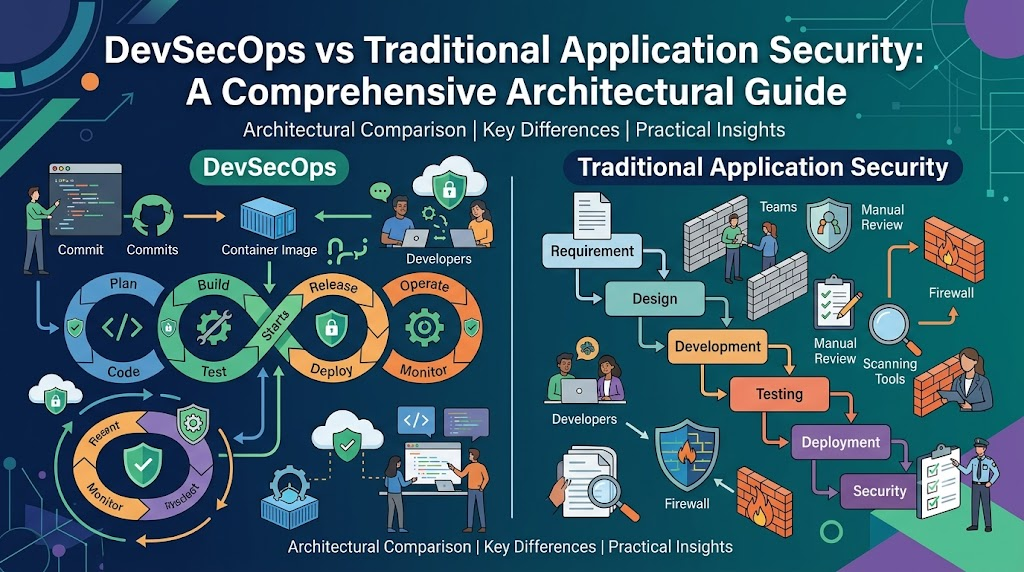
Traditional application security is built on the premise that security is a distinct, final phase of the development process. In this model, security is often treated as a “gatekeeper” function that occurs only after the application code is feature-complete and shortly before deployment.
Characteristics of Traditional Security
- Sequential Development: Security is the final hurdle in a Waterfall methodology.
- Centralized Responsibility: A dedicated security team holds the responsibility for identifying and remediating vulnerabilities.
- Manual Reviews: Security testing often involves manual penetration testing or extensive code audits that occur once per release cycle.
- Perimeter Defense: The focus is primarily on hardening the environment around the application rather than hardening the application code itself.
- Delayed Feedback: Developers often receive security feedback weeks or months after the code was written, creating a massive context-switch penalty.
What is DevSecOps?
DevSecOps is the practice of integrating security testing, compliance, and risk management into every stage of the software delivery process. It moves away from the “security as a barrier” mindset and adopts “security as code.”
In a DevSecOps model, security becomes a shared responsibility. Developers, DevOps engineers, and security professionals collaborate to ensure that security controls are automated, observable, and continuously applied. It acknowledges that in a high-velocity environment, the only way to maintain security is through automation and early detection.
DevSecOps vs Traditional Security: Comparison Table
| Feature | Traditional Security | DevSecOps |
| Security Phase | End of SDLC (Gated) | Throughout the entire SDLC |
| Responsibility | Dedicated Security Team | Shared (Developers + Security + Ops) |
| Feedback Loop | Delayed (Weeks/Months) | Instant (Real-time) |
| Primary Method | Manual Testing / Audits | Automated Testing (SAST, DAST, SCA) |
| Infrastructure | Static / Perimeter-focused | Infrastructure as Code (IaC) / Ephemeral |
| Focus | Compliance / Checkbox | Risk Management / Continuous Assurance |
| Bottleneck | High (Security Review) | Low (Automated Guardrails) |
Why Traditional Security Fails in Modern CI/CD Environments
The failure of traditional security in modern enterprises stems from the misalignment of velocity. CI/CD pipelines are designed to move code from commit to production in hours or even minutes. Traditional security models, which require days or weeks for comprehensive reviews, force one of two negative outcomes:
- Security Bypass: Engineering teams ignore security protocols to meet release deadlines, leading to technical debt and vulnerabilities.
- Deployment Stagnation: Security teams block deployments, creating a “us vs. them” culture that stifles innovation and slows time-to-market.
Furthermore, traditional models struggle with the complexity of cloud-native infrastructure. When applications consist of hundreds of microservices and ephemeral containers, static perimeter defenses are insufficient. You cannot manually audit code that changes multiple times a day.
How DevSecOps Works in CI/CD
DevSecOps integrates security into the pipeline by turning security policies into executable code. The pipeline serves as the enforcer.
The Integration Workflow
- Commit Stage (IDE/Pre-commit): Linters and secrets detection run locally.
- Build Stage: Dependency scanning (SCA) occurs to check for vulnerable libraries.
- Test Stage: Static Analysis (SAST) runs on the source code to identify structural vulnerabilities.
- Deployment Stage: Dynamic Analysis (DAST) tests the running application in a staging environment.
- Monitoring Stage: Runtime protection and log analysis identify anomalies in production.
Shift-Left Security Concept
“Shift-left” is the core philosophy of DevSecOps. It refers to the practice of performing security testing earlier in the software development lifecycle. By moving security “left” (earlier in the timeline), organizations can identify and remediate vulnerabilities when they are cheapest and easiest to fix—during the coding phase.
- Cost Efficiency: Fixing a vulnerability during the design or coding phase costs a fraction of fixing it after production deployment.
- Developer Empowerment: By providing developers with tools that surface security issues directly in their IDE, you empower them to write secure code from the start, rather than waiting for an external audit.
DevSecOps Tools and Their Roles
A successful DevSecOps strategy relies on a balanced toolchain. These tools automate the verification process:
- SAST (Static Application Security Testing): Analyzes source code or binaries without executing the program. It identifies coding patterns that lead to vulnerabilities like SQL injection or buffer overflows.
- DAST (Dynamic Application Security Testing): Interacts with the running application to find vulnerabilities that only appear during execution, such as authentication issues or server configuration flaws.
- SCA (Software Composition Analysis): Scans third-party open-source libraries and dependencies for known vulnerabilities (CVEs) and license compliance issues.
- IaC Scanning: Scans Infrastructure as Code (Terraform, CloudFormation) for misconfigurations (e.g., open S3 buckets, excessive IAM permissions).
- Secret Management: Automatically scans code repositories for hardcoded API keys, passwords, and tokens before they are pushed to the server.
Real-World Examples
Case 1: The Failure – Late-Stage Discovery
A global e-commerce firm relied on a traditional six-month release cycle. During a final penetration test, two weeks before the holiday season launch, a critical SQL injection vulnerability was discovered. Because the architecture was tightly coupled, the security team had to force a code freeze for three weeks to refactor the database layer. The resulting delay caused a significant loss of projected revenue and missed market timing.
Case 2: The Success – Automated Pipeline Enforcement
A cloud-native fintech startup integrated SCA and SAST into their GitLab CI pipeline. When a developer attempted to commit code containing an outdated, vulnerable logging library, the build pipeline automatically failed and provided the developer with a remediation ticket and an updated library version. The vulnerability was caught and fixed within 10 minutes of commit, preventing the code from ever reaching the main branch.
Challenges in DevSecOps Adoption
Adopting DevSecOps is not without hurdles. Organizations often face:
- Cultural Resistance: Moving from a siloed mindset to a collaborative one requires significant change management. Developers may view security as a hindrance, and security teams may struggle to relinquish control.
- Tool Sprawl: Implementing too many tools without proper orchestration leads to alert fatigue. Security engineers become overwhelmed by false positives.
- Legacy Systems: Older, monolithic applications are difficult to retrofit into automated pipelines designed for cloud-native apps.
- Skill Gaps: DevOps engineers may lack deep security knowledge, and security professionals may lack automation and coding skills.
Best Practices for Secure Application Delivery
- Define Security Policies as Code: Automate compliance checks so that policy enforcement is consistent and transparent.
- Start Small: Do not attempt to automate everything at once. Begin by implementing SCA and secret detection, then move to SAST and DAST.
- Prioritize Education: Invest in security training for developers. When developers understand why a vulnerability is dangerous, they are more likely to prevent it proactively.
- Manage False Positives: Tune your security tools to minimize noise. A tool that flags too many non-issues will eventually be ignored by engineering teams.
- Immutable Infrastructure: Use containers and serverless technologies to treat infrastructure as ephemeral, making it easier to patch and redeploy rather than modifying live servers.
Future of Application Security
The future of application security lies in Intelligence-Driven Security. As we move forward, expect:
- AI-Enhanced Remediation: Tools that don’t just find vulnerabilities but suggest the specific code changes required to fix them.
- Adaptive Security: Systems that adjust their defensive posture based on real-time threat intelligence and traffic patterns.
- Security Observability: Deeper integration between security telemetry and general observability platforms, allowing for a unified view of application health and security status.
FAQs
- Does DevSecOps eliminate the need for manual penetration testing?No. Automated testing is excellent for finding known vulnerability patterns and coding errors, but manual penetration testing is still essential for discovering complex logic flaws that automated tools miss.
- What is the first step in starting a DevSecOps transformation?Begin by establishing visibility. You cannot secure what you cannot see. Start by cataloging your applications, dependencies, and deployment pipelines.
- How do we handle “False Positives” in automated security scans?Establish a tuning process. Review alerts regularly, suppress noise, and work with vendors to improve the precision of your tool’s detection algorithms.
- Is DevSecOps suitable for highly regulated industries like healthcare or banking?Yes, it is highly recommended. Automation provides a superior audit trail compared to manual processes, making it easier to demonstrate compliance to regulators.
- Who should lead the DevSecOps initiative?It should be a cross-functional effort. Ideally, it is championed by engineering leadership (CTO/VP of Engineering) with strong partnership from Security and DevOps leads.
- How does DevSecOps handle third-party library dependencies?Through Software Composition Analysis (SCA) tools integrated into the CI/CD pipeline, which automatically check new dependencies against databases of known vulnerabilities.
- Do I need to be a developer to work in DevSecOps?While you don’t need to be a full-stack developer, you must understand code and automation. Scripting (Python, Bash, Go) and understanding how CI/CD pipelines function is a requirement.
- Can DevSecOps be applied to legacy on-premise applications?Yes, though it is more challenging. You can apply automated scanning to the codebase even if the infrastructure itself is not cloud-native.
- What is the difference between DevSecOps and DevSecOps Engineering?DevSecOps is a culture and a methodology. DevSecOps Engineering is the specific technical role focused on building the pipelines, tools, and automation platforms that enable that methodology.
- How often should security scans run?Ideally, at every commit (SAST) and at every build (SCA). Dynamic scans can be run on a scheduled basis or during staging deployments to avoid slowing down the CI loop.
- Does DevSecOps cost more than traditional security?Initial costs are higher due to tooling and training, but the long-term ROI is significantly higher due to reduced remediation costs, fewer production outages, and faster deployment cycles.
- What is the most common mistake organizations make when starting DevSecOps?Trying to “boil the ocean” by implementing too many security tools at once without first establishing a culture of collaboration.
- How do I measure the success of a DevSecOps program?Track metrics such as Mean Time to Remediate (MTTR) vulnerabilities, deployment frequency, change failure rate, and the percentage of security tests automated.
Final Thoughts
Transitioning from traditional application security to DevSecOps is a journey, not a destination. It requires breaking down walls between teams, embracing automation, and viewing security as an essential component of quality rather than a roadblock to speed. By shifting security left, you not only protect your organization from increasingly sophisticated threats but also enable your engineering teams to deliver high-quality software with confidence and speed.
Start by identifying the biggest bottleneck in your current release process, automate one security check, and build from there. The objective is continuous improvement, one pipeline at a time.




Leave a Reply
You must be logged in to post a comment.