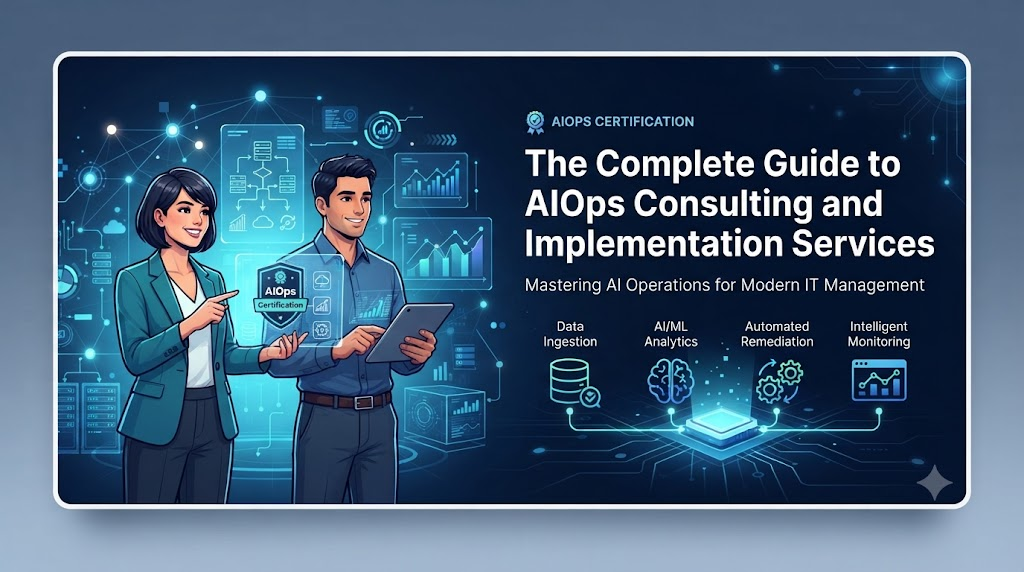
Introduction
Modern IT operations are buckling under the weight of hyper-scale complexity. In today’s cloud-native landscape, microservices, Kubernetes clusters, and ephemeral containers generate logs, metrics, and traces at a volume that human eyes can no longer process effectively.
Imagine an organization operating a massive distributed architecture. Their SRE teams are flooded with over 10,000 alerts every single day. The “war room” is permanently active, yet they struggle to identify the root cause of service degradations for hours. This isn’t a failure of talent; it is a failure of the operational paradigm. This is exactly where Artificial Intelligence for IT Operations (AIOps) transforms the landscape.
AIOps moves teams from reactive firefighting to proactive, automated resilience. For those looking to master these skills or organizations seeking to implement them, AIOpsSchool provides the structured training, certification, and consulting expertise required to navigate this shift.
Featured Snippet: What Is AIOps?
AIOps (Artificial Intelligence for IT Operations) is the application of machine learning, data science, and advanced analytics to IT operations data. It automates the detection of anomalies, correlates disparate events to identify root causes, and predicts potential failures, allowing teams to move from reactive troubleshooting to intelligent, automated incident management.
Understanding AIOps
In Simple Terms
Think of AIOps as the “autopilot” for your IT infrastructure. Instead of engineers manually checking dashboards, algorithms continuously analyze the “heartbeat” of your systems, automatically filtering out noise and flagging real issues.
Real-World Example
An e-commerce platform experiences a latency spike during a high-traffic sale. Traditional monitoring alerts on 50 different microservices simultaneously. AIOps intelligently correlates these 50 alerts into one single incident: a failing load balancer, saving the team hours of manual investigation.
Why It Matters
AIOps eliminates alert fatigue and drastically reduces Mean Time to Resolution (MTTR). It allows engineering teams to focus on building features rather than debugging recurring, low-impact issues.
Key Takeaways
- AIOps centralizes data across silos.
- It filters signal from noise automatically.
- It enables predictive rather than reactive operations.
| Traditional Operations | AIOps-Driven Operations |
| Manual incident response | Automated incident remediation |
| Static threshold monitoring | Dynamic, ML-based alerting |
| Siloed data views | Unified observability platform |
| Reactive troubleshooting | Predictive and proactive maintenance |
Why AIOps Skills Are Becoming Essential
In Simple Terms
As systems grow, the cost of human error and the time required for manual analysis become unsustainable. Organizations are prioritizing AIOps skills because they represent the only way to manage modern, massive-scale systems without linear headcount growth.
Real-World Example
A cloud engineer manages 500 Kubernetes nodes. Without AIOps, they spend 40% of their time manually analyzing logs. With AIOps skills, they build automated pipelines that analyze log patterns, identifying a resource leak in minutes instead of days.
Why It Matters
AIOps proficiency is the bridge between a traditional DevOps role and a strategic SRE or Platform Engineering leadership position. It creates highly efficient, autonomous operational environments.
Key Takeaways
- Cloud-native growth demands automation.
- Reliability engineering requires advanced data insights.
- AIOps is a core competency for modern SRE roles.
AIOps Certification Explained
In Simple Terms
An AIOps certification is a structured validation of your ability to design, implement, and manage AI-driven operational systems. It proves you can move beyond tool usage to strategic implementation.
Real-World Example
An IT manager wants to hire a lead for their observability transformation. They prioritize candidates with a recognized AIOps certification because it guarantees a baseline understanding of event correlation, predictive analytics, and automation workflows.
Why It Matters
Certification provides credibility in a crowded market. It signals to employers that you possess the specialized knowledge to solve complex operational challenges, not just use a specific software interface.
Key Takeaways
- Validates technical expertise in AI for Ops.
- Distinguishes engineers in competitive job markets.
- Provides a structured framework for learning complex concepts.
AIOps Training and Courses
In Simple Terms
AIOps training teaches you how to train machines to understand IT data. It’s about learning the “how” behind event correlation, predictive maintenance, and intelligent monitoring.
Real-World Example
A DevOps team struggles with a messy monitoring stack. After taking an AIOps course, they successfully implement intelligent alerting, reducing their daily on-call pages by 70%.
Why It Matters
Without formal training, teams often use advanced AIOps tools incorrectly, leading to “alert bias” or, worse, missed critical outages. Structured learning ensures best practices from day one.
Key Takeaways
- Covers essential ML fundamentals for IT.
- Teaches effective event correlation strategies.
- Focuses on practical incident automation.
AIOps Engineer Career Roadmap
In Simple Terms
This is your path from being an infrastructure operator to an AI-driven systems architect. It starts with mastering data collection and ends with building self-healing systems.
Real-World Example
A Junior SRE starts by learning Linux and Python. They move to intermediate levels (Kubernetes/Monitoring), then pursue AIOps certification to advance into a Senior Architect role, overseeing enterprise-wide automation.
Why It Matters
Having a clear roadmap prevents “tool hopping” and ensures you are building a stackable, valuable skill set that keeps you relevant for the next decade.
Key Takeaways
- Start with Linux and Networking foundations.
- Deepen expertise in Kubernetes and Observability.
- Specialize in Python for automation and data manipulation.
| Level | Skills | Outcome |
| Beginner | Linux, Scripting, Basic Monitoring | Operational Proficiency |
| Intermediate | Kubernetes, OpenTelemetry, API Integration | Observability Specialist |
| Advanced | AI/ML Algorithms, Incident Automation, Strategy | AIOps Architect |
AI Observability
In Simple Terms
If monitoring tells you that something is broken, observability tells you why it is broken. AI Observability applies intelligence to that “why,” automatically connecting the dots between logs, metrics, and traces.
Real-World Example
During a deployment, user traffic drops. AI Observability instantly identifies that a specific database query latency increased, correlating it directly to a code commit in a specific microservice.
Why It Matters
Modern systems are too distributed for manual debugging. AI Observability provides the visibility required to maintain SLAs in complex, multi-cloud environments.
Key Takeaways
- Observability goes beyond simple “up/down” status.
- It requires high-cardinality data ingestion.
- OpenTelemetry is the backbone of modern observability.
| Monitoring | Observability |
| Focused on known unknowns | Explores unknown unknowns |
| Dashboard-based visualization | Context-rich debugging |
| Reactive alerting | Proactive exploration |
AIOps for SRE and DevOps Engineers
In Simple Terms
AIOps acts as a force multiplier for SREs. It removes the drudgery of alert management, allowing teams to focus on engineering reliability and automating systems.
Real-World Example
An SRE team creates an AIOps pipeline that triggers an automatic rollback of a canary deployment the moment it detects a specific error signature, preventing a total outage.
Why It Matters
AIOps allows SREs to manage 10x more infrastructure with the same team size, directly supporting scaling goals and developer productivity.
Key Takeaways
- Significantly reduces alert fatigue.
- Supports Continuous Delivery via automated rollbacks.
- Strengthens incident response and post-mortem accuracy.
Enterprise AIOps Consulting
In Simple Terms
Consulting helps organizations avoid the “tooling trap”—buying expensive software without a plan. It provides the strategy to align technology with specific business reliability goals.
Real-World Example
A large telecom provider struggles with fragmented monitoring data. AIOps consultants help them consolidate their data lake, implement a unified AIOps strategy, and define success metrics, resulting in a 40% reduction in downtime.
Why It Matters
AIOps is a process, not just a product. Consulting ensures you get ROI on your investment by aligning tools with your unique operational maturity.
Key Takeaways
- Avoids vendor-specific pitfalls.
- Customizes strategy to operational maturity.
- Accelerates organizational change management.
AIOps Implementation Services
In Simple Terms
This is the “how-to” phase. Implementation services turn the strategy into a working, automated reality through structured phases: Assessment -> Design -> Tool Selection -> Integration -> Optimization.
Real-World Example
A startup moves from “ad-hoc” monitoring to a fully integrated AIOps stack. Implementation services manage the integration of their legacy databases with their new cloud-native observability platform.
Why It Matters
Proper implementation prevents data silos and ensures that the AI models are fed high-quality, clean data—the secret to effective AIOps.
Key Takeaways
- Focuses on the entire lifecycle, not just deployment.
- Ensures clean data pipeline integration.
- Provides continuous improvement loops.
Real-World Enterprise Use Cases
Banking
- Challenge: Fraud detection delays and transaction failures.
- Solution: Predictive AIOps models analyzing transaction logs in real-time.
- Business Outcome: Millions in savings through prevented outages and reduced fraud.
Healthcare
- Challenge: Downtime in critical patient management systems.
- Solution: Intelligent anomaly detection ensuring 99.999% uptime.
- Business Outcome: Improved patient care and compliance.
SaaS
- Challenge: Alert storms from thousands of concurrent users.
- Solution: Automatic event correlation across global regions.
- Business Outcome: Faster MTTR, leading to higher customer retention.
Benefits of AIOps Adoption
In Simple Terms
AIOps helps businesses make more money by losing less time. It turns IT from a cost center into a reliability engine.
Real-World Example
A retail giant uses AIOps to predict capacity needs during Black Friday, automatically scaling resources before traffic hits, preventing revenue loss.
Why It Matters
In the digital economy, downtime is lost revenue. AIOps provides a direct, measurable financial impact on the organization’s bottom line.
Key Takeaways
- Drastic reduction in MTTR.
- Lower operational costs through automation.
- Enhanced customer experience via stability.
Common Challenges in AIOps Adoption
In Simple Terms
Many teams try to “boil the ocean.” They try to automate everything at once, use messy data, or ignore the people side of change.
Real-World Example
An organization buys an expensive AIOps tool but feeds it poor-quality, inconsistent data from different departments. The AI generates useless insights.
Why It Matters
Understanding challenges allows you to pivot. Success is usually 20% technology and 80% data and culture.
Key Takeaways
- Fix data hygiene before fixing tools.
- Address cultural resistance to automation.
- Start small with high-impact use cases.
Common Mistakes Professionals Make
Checklist:
- Tooling First: Prioritizing software over problem identification.
- Ignoring Data: Neglecting the quality and context of logs/metrics.
- Siloing: Failing to break down team barriers.
- Static Thresholds: Relying on old-school alerting methods.
- Lack of Strategy: Treating AIOps as a project rather than a capability.
Future of AIOps
In Simple Terms
The future is “Self-Healing Infrastructure.” We are moving toward systems that not only detect and notify but automatically fix issues without human intervention.
Real-World Example
A future-state server cluster detects a failing memory module, automatically migrates workloads, signals for replacement, and updates the ticket—all before a human wakes up.
Why It Matters
This is the end goal of all SRE and DevOps work. It allows engineers to focus on product innovation while the system manages itself.
Key Takeaways
- Greater move toward autonomous operations.
- Predictive maintenance becomes the standard.
- AI-powered observability becomes ubiquitous.
Why Learn with AIOpsSchool
Learning AIOps requires more than just reading documentation. It demands real-world, industry-tested experience. At AIOpsSchool, we focus on the practical application of AI in IT environments. Whether you are an SRE, DevOps professional, or a manager, our programs are designed to bridge the gap between theory and execution. We provide the certification, training, and strategic consulting needed to lead in the age of intelligent operations.
FAQ Section
1. What is AIOps Certification?
It is a professional credential that validates your knowledge in applying machine learning and data analytics to IT operations, proving you can architect and manage AI-driven systems.
2. Who should learn AIOps?
DevOps engineers, SREs, Cloud engineers, IT managers, and Monitoring specialists who want to automate workflows and improve system reliability.
3. What skills are required for AIOps Engineers?
You need a mix of Linux, networking, cloud platforms (AWS/Azure/GCP), Kubernetes, scripting (Python), data analysis, and observability fundamentals.
4. How does AIOps help DevOps teams?
It reduces the manual toil of alert management, identifies root causes faster, and enables continuous improvement through automated, data-driven feedback loops.
5. What is AI Observability?
It is the practice of using AI to analyze complex telemetry data (logs, metrics, traces) to gain deep, contextual insights into system health and performance.
6. What is OpenTelemetry?
OpenTelemetry is an open-source framework that standardizes the collection, generation, and export of telemetry data, serving as the foundation for modern observability.
7. How long does it take to learn AIOps?
It depends on your background. With foundational IT knowledge, a structured certification course can take 3–6 months to master the core concepts and implementation strategies.
8. What are AIOps Implementation Services?
These are expert-led engagements that guide organizations through the assessment, tool selection, integration, and optimization of their AIOps strategy.
9. Is AIOps a good career choice?
Yes. As systems grow in complexity, the demand for professionals who can bridge the gap between AI and infrastructure operations is skyrocketing.
10. What is the future of AIOps?
The future lies in autonomous, self-healing infrastructure where AI proactively detects, resolves, and optimizes system performance without human intervention.
Final Summary
The complexity of modern IT infrastructure has outpaced traditional manual operational methods. AIOps is not just a trend; it is the inevitable evolution of IT management. By mastering AIOps, you move from being an operator to an architect of resilient, self-healing systems. Whether through formal certification, targeted training, or enterprise-level consulting, investing in these skills provides immense career growth and operational value.
The path to intelligent, autonomous operations begins with a solid understanding of data, observability, and automation. We encourage you to explore the programs and expert guidance available at AIOpsSchool to start your journey toward becoming a leader in the next generation of AI-powered operations.



Leave a Reply
You must be logged in to post a comment.