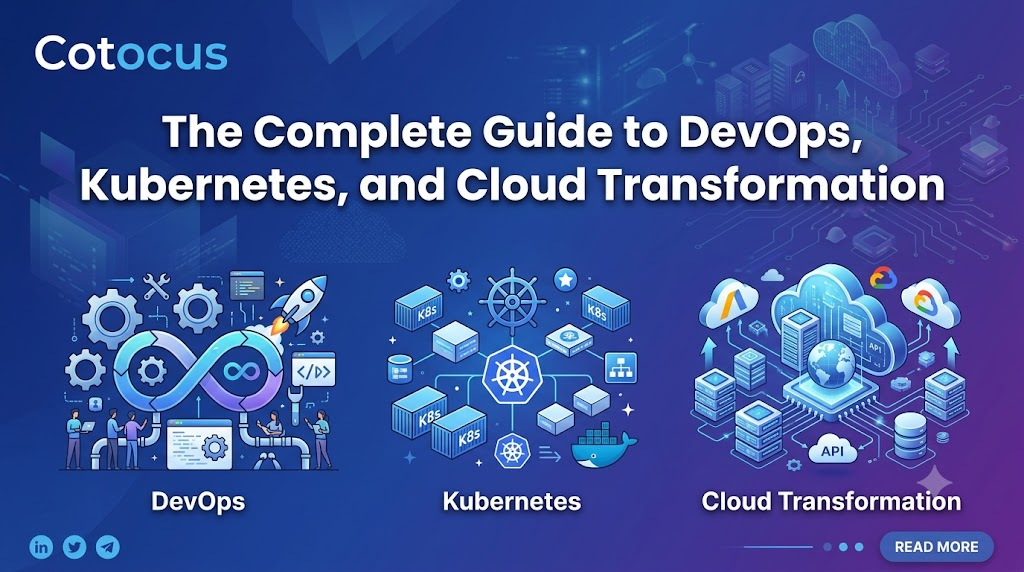
The modern enterprise landscape is defined by the relentless pace of change and the imperative to deliver high-quality digital experiences. To remain competitive, organizations must transition from rigid, legacy operational models toward agile, automated, and secure delivery ecosystems. This journey is rarely a solitary endeavor; it requires a blend of rigorous methodology, advanced technical architecture, and a commitment to cultural evolution. At Cotocus , we help organizations navigate these complex transformations by bridging the gap between current operational states and the desired future of high-velocity engineering.
Enterprise Challenges Driving Modernization
Legacy infrastructure often acts as a significant anchor, limiting an organization’s ability to respond to market shifts. Many enterprises find themselves trapped in silos, where development and operations teams operate with conflicting priorities, leading to deployment bottlenecks and slow time-to-market.
Operational complexity is another critical hurdle. As organizations adopt microservices and distributed systems, the overhead of managing these environments manually becomes unsustainable. Security concerns also loom large, as traditional, perimeter-based security models struggle to keep pace with rapid, cloud-native release cycles. Compounding these issues is a pervasive skill gap, where internal teams are tasked with mastering new paradigms—such as container orchestration or infrastructure-as-code—without the benefit of structured guidance or time for deep-skill acquisition.
Why Organizations Need Experienced Consulting Partners
The complexity of digital transformation means that common pitfalls, such as misaligned architecture or fragmented tool adoption, can cause significant delays and wasted investment. An experienced consulting partner provides the roadmap to mitigate these risks.
By leveraging proven frameworks, consultants help accelerate adoption cycles and ensure that technology investments are tied directly to business outcomes. More importantly, effective partnerships focus on knowledge transfer. Rather than simply executing tasks, a transformation advisor empowers internal teams, ensuring that the organization is capable of maintaining and evolving its new capabilities long after the initial engagement concludes.
Characteristics of a Mature DevOps Consulting Company
A high-performing partner is identified by more than just technical certification; it requires a deep-seated commitment to engineering excellence. A mature partner utilizes robust assessment methodologies to understand the unique constraints of an organization before proposing solutions.
They possess architecture expertise that transcends specific vendor tools, focusing instead on interoperability and scalability. Crucially, they emphasize governance frameworks—ensuring that automation does not lead to chaos—and maintain a rigorous approach to documentation and knowledge sharing. This ensures that the transformation is sustainable and ingrained within the organization’s DNA.
Understanding DevOps Consulting Services
DevOps is the foundational layer of modern delivery. Consulting services in this space focus on the elimination of manual toil through the implementation of robust CI/CD pipelines. This includes defining clear release management strategies that allow for frequent, low-risk deployments.
Operational optimization is achieved through a combination of enhanced monitoring and observability practices. By moving away from reactive firefighting toward proactive system management, teams can identify bottlenecks before they impact end-users. The goal is to create a seamless flow of value from code commit to production deployment.
Cloud Consulting and Migration Services
Migrating to the cloud is a strategic move that extends far beyond a simple “lift and shift” of virtual machines. Effective cloud consulting begins with cloud readiness assessments, which evaluate workload suitability and modernization potential.
Migration planning must account for hybrid environments, ensuring that connectivity, data consistency, and security are maintained throughout the transition. Modernization strategies, such as refactoring legacy monoliths for cloud-native execution, are essential for realizing true cost optimization and performance benefits. A well-executed migration balances technical debt reduction with long-term operational efficiency.
Kubernetes Consulting Services
As the industry standard for container orchestration, Kubernetes offers immense power but introduces significant management complexity. Kubernetes consulting services focus on platform standardization, ensuring that cluster operations are consistent, repeatable, and secure.
Workload modernization involves mapping legacy applications to containerized environments and establishing production-readiness practices, such as proper resource limits, networking policies, and automated health checks. By treating the Kubernetes platform as a product, organizations can provide a stable foundation for their application teams to deploy code with confidence.
SRE Consulting Services
Site Reliability Engineering (SRE) bridges the gap between development and operations by applying engineering principles to operational challenges. SRE consulting services prioritize the definition of Service-Level Objectives (SLOs) and error budgets, which provide a quantitative framework for balancing reliability with innovation.
Incident response processes are refined to minimize mean time to recovery (MTTR), while observability initiatives provide deep insights into system performance. The objective of SRE is not merely to keep systems running, but to build resilient, self-healing platforms that scale alongside the business.
DevSecOps Consulting Services
Security can no longer be an afterthought or a final gateway in the software lifecycle. DevSecOps consulting integrates security into the delivery pipeline, transforming it into a continuous process rather than a static checkpoint.
This involves implementing policy-as-code, automating compliance audits, and ensuring that security scanning—both static and dynamic—is embedded within the CI/CD flow. By fostering a “security-first” culture, organizations can reduce vulnerabilities while maintaining the high velocity required by modern digital businesses.
GitOps and Platform Engineering Consulting
GitOps introduces a declarative approach to infrastructure management, where the desired state of the system is version-controlled and automatically reconciled. This reduces configuration drift and simplifies disaster recovery.
Platform engineering takes this a step further by treating infrastructure as a self-service product. By building internal developer platforms, organizations can hide the complexity of underlying infrastructure, allowing developers to focus on feature delivery. Standardized engineering workflows and developer experience (DevEx) improvements are core components of this approach.
AIOps, MLOps, and DataOps Consulting Services
Intelligent automation is the next frontier for operational efficiency. AIOps leverages machine learning to analyze vast streams of operational data, identifying patterns and anomalies that humans might overlook.
MLOps addresses the unique challenges of the machine learning lifecycle, from data preparation to model deployment and monitoring. Similarly, DataOps optimizes data pipelines, ensuring that data is reliable, timely, and accessible. Together, these practices enable data-driven decision-making and automate the complex processes required to manage modern data ecosystems.
Corporate Training for Engineering Teams
Technology is only as effective as the people who operate it. Corporate training must be practical and immersive, moving beyond slide-based presentations to hands-on, lab-driven workshops.
Customized learning paths allow teams to develop specific competencies—such as Kubernetes administration, CI/CD pipeline optimization, or secure coding—that are directly relevant to their project work. Continuous capability development programs ensure that as the technology landscape evolves, the internal team’s skill set remains sharp and adaptable.
Selecting the Right Consulting Partner
When evaluating a partner, prioritize technical depth over marketing rhetoric. Look for a track record of successful implementations and specific expertise in the domains relevant to your transformation goals.
Assess their approach to knowledge transfer; an ideal partner should be actively working to make themselves obsolete by empowering your internal teams. Consider their engagement model—whether they offer deep, project-based collaboration or long-term advisory support—and ensure it aligns with your internal culture and long-term vision for autonomy.
Recommended Learning and Adoption Paths by Role
- Developers: Focus on containerization fundamentals, CI/CD pipeline integration, and adopting infrastructure-as-code patterns.
- DevOps Engineers: Prioritize advanced Kubernetes operations, platform engineering concepts, and automated security integration.
- Platform Teams: Emphasize developer experience, self-service infrastructure design, and system observability.
- Security Professionals: Focus on policy-as-code, automated compliance, and threat modeling in distributed environments.
- Operations Teams: Transition toward SRE principles, focusing on SLO-driven reliability and incident management.
- Architects: Focus on modular system design, service mesh integration, and distributed system patterns.
- Engineering Leaders: Prioritize cultural transformation, team topology design, and aligning technical metrics with business value.
Industry-Specific Section for Financial Services
In the financial services sector, the dual pressures of extreme regulatory compliance and the need for rapid fintech innovation create a unique operational environment. Modernization here requires a granular approach to data governance and a rigid commitment to security, without sacrificing deployment speed. By adopting GitOps and automated compliance, financial institutions can maintain auditability while scaling their digital services to meet modern consumer demands.
Frequently Asked Questions
How long does a typical DevOps transformation take? Transformation is a continuous journey rather than a finite project. While initial improvements in pipeline velocity can be realized within months, long-term cultural and operational maturity typically evolves over several years.
What is the difference between DevOps and SRE? DevOps focuses on the cultural and collaborative bridge between dev and ops. SRE is a specific implementation of DevOps principles that uses software engineering to solve operational problems and manage reliability.
Why is cloud migration so difficult? Most difficulties arise from treating cloud migration as a technical exercise rather than a process of re-architecting applications to be cloud-native. Without adapting to distributed system patterns, organizations often recreate legacy problems in a new environment.
How does DevSecOps improve security? It shifts security “left,” integrating automated checks into every phase of the pipeline. This allows for early detection of vulnerabilities and ensures that security policies are consistently applied through code.
What is the role of a Platform Engineer? A platform engineer builds the internal tools and abstractions that allow developers to self-service their infrastructure needs, effectively treating the platform as a product for the engineering organization.
How do we ensure knowledge transfer occurs? Effective consulting requires embedding experts within your teams to engage in pair programming, code reviews, and architectural decision-making, ensuring internal staff learn through active participation.
Can AIOps really reduce operational noise? Yes, by using machine learning to filter out routine alerts and correlate disparate data points, AIOps helps teams focus only on meaningful incidents, significantly reducing cognitive load.
What is the benefit of Kubernetes over traditional virtualization? Kubernetes provides declarative management of containerized applications, enabling superior resource utilization, automated scaling, and consistent deployment patterns across diverse infrastructure environments.
Final Thoughts
The path to enterprise modernization is multifaceted, requiring a balanced investment in technology, process, and people. By focusing on practical implementation, fostering a culture of continuous learning, and partnering with experienced advisors, organizations can build the robust engineering capabilities necessary for long-term success. The goal is to create a sustainable ecosystem where innovation is routine, reliability is built-in, and the team is empowered to solve the challenges of tomorrow with confidence.




Leave a Reply
You must be logged in to post a comment.