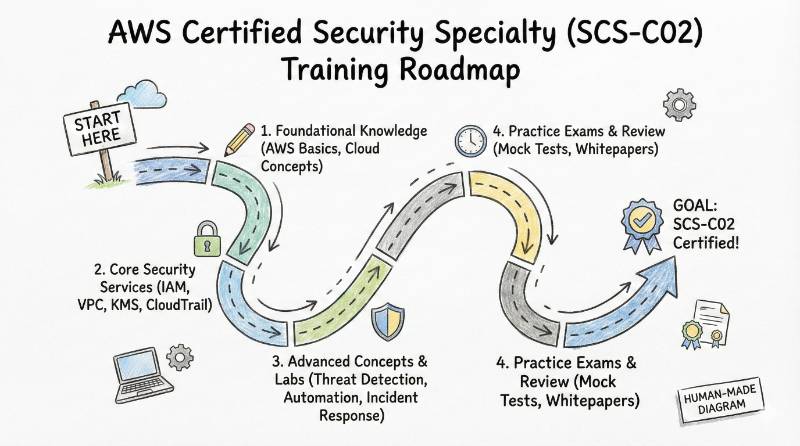
In the modern era of cloud-native development, the boundary between “features” and “security” has completely dissolved. We no longer build a system and then “secure” it; we build secure systems by design. If you are an engineer or a manager operating in the cloud today, you are already in the business of risk management.
Having seen the evolution of infrastructure from physical data centers to serverless architectures, one thing has become clear: specialized knowledge is the only currency that lasts. The AWS Certified Security – Specialty (SCS-C02) is not just another badge. It is a rigorous validation of your ability to defend complex cloud environments against sophisticated threats.
This guide provides a comprehensive breakdown of the training, the career impact, and the tactical steps required to achieve this elite status.
Why This Certification is Your Career Bedrock
Most cloud outages or data leaks aren’t caused by sophisticated external hacks—they are caused by simple misconfigurations. A missed “S3 Block Public Access” setting or an overly permissive IAM role can be catastrophic.
For working engineers and software developers, moving into the “Security Specialty” domain transforms you from a generalist into a high-value specialist. For managers, it provides the technical vocabulary needed to lead teams in a world governed by compliance and regulatory pressure.
Training for the SCS-C02 forces you to look under the hood of AWS. You stop treating the cloud as a black box and start understanding the granular flow of permissions, encryption, and traffic.
The Certification Landscape
Before diving into the specifics, let’s look at where this certification sits within the broader ecosystem of professional development.
AWS Certification Reference Table
| Track | Level | Who it’s for | Prerequisites | Skills Covered | Recommended Order |
| Security Specialty | Specialty (Advanced) | Security Engineers, SREs, Cloud Architects | Strong AWS Foundations (Associate level) | IAM, KMS, Incident Response, Logging, Network Security | After Solutions Architect Associate |
| Solutions Architect | Professional | Lead Architects, CTOs | Broad AWS Expertise | Complex Multi-tier Design, Migration, Cost Optimization | After Security Specialty |
| DevOps Engineer | Professional | DevOps Engineers, SREs | Automation & CI/CD Skills | Deployment Pipelines, Monitoring, Event-driven Scaling | After Security Specialty |
Mastering the AWS Certified Security – Specialty (SCS-C02)
To succeed in this exam, you must shift your mindset from “How do I make it work?” to “How do I make it resilient and unexploitable?”
What it is
The SCS-C02 is a specialized certification that focuses on the deep-dive implementation of security controls on AWS. While the Associate exams tell you what GuardDuty is, this exam asks you how to automate a response when GuardDuty detects a Trojan in a private subnet. It covers five key domains: Threat Detection and Incident Response, Security Logging and Monitoring, Infrastructure Security, Identity and Access Management, and Data Protection.
Who should take it
This training is tailored for individuals who already have their “boots on the ground” in the cloud.
- Working Engineers: If you are building pipelines or deploying infrastructure, you need to know how to bake security into your code.
- Security Engineers: If you are transitioning from on-prem security to the cloud, this is your primary conversion tool.
- Software Developers: Understanding how IAM and KMS work will help you write more secure, cloud-native applications.
- IT Managers: To lead effectively, you must understand the shared responsibility model and the tools available to protect company assets.
Skills you’ll gain
The curriculum for the SCS-C02 is designed to build a “Security-First” engineering mindset.
- Granular Identity Control: You will master the logic of IAM policies, including Service Control Policies (SCPs), Permissions Boundaries, and Cross-account access.
- Encryption at Scale: Deep knowledge of the AWS Key Management Service (KMS). You’ll learn how to manage keys, handle rotation, and implement “envelope encryption.”
- Advanced Networking: Beyond basic VPCs, you will learn to implement AWS WAF, Shield for DDoS protection, and Network Firewall for deep packet inspection.
- Automated Compliance: Using AWS Config and Security Hub to ensure your infrastructure stays compliant with standards like PCI-DSS or SOC2 automatically.
- Forensics and Response: Learning how to use CloudTrail and VPC Flow Logs to reconstruct a security event and automate isolation.
Real-world projects you should be able to do after it
The value of this training is realized when you can solve high-stakes business problems.
- Zero-Trust Infrastructure: Building an environment where every request is verified, regardless of where it comes from, using VPC Endpoints and strict IAM.
- Centralized Security Governance: Setting up a “Security Account” in AWS Organizations where all logs from 100+ accounts are streamed, analyzed, and stored for auditing.
- Automated Patch Management: Creating a system using Systems Manager (SSM) to automatically scan and patch vulnerabilities in EC2 instances without downtime.
- Secure Secret Management: Implementing AWS Secrets Manager to rotate database credentials every 30 days without human intervention.
Preparation plan (7–14 days / 30 days / 60 days)
The “Fast Track” (7–14 Days)
- Ideal for: Engineers with 3+ years of daily AWS Security experience.
- Strategy: Skip the “what is S3” intros. Focus 100% on Whitepapers and FAQs for KMS, IAM, and GuardDuty. Spend your time in the “Exam Readiness” digital courses and take high-quality practice exams to identify knowledge gaps.
The “Standard” Plan (30 Days)
- Ideal for: Cloud Engineers or Developers with general AWS knowledge.
- Strategy: Spend weeks 1-2 on a comprehensive video course. Weeks 3-4 should be hands-on labs—building VPCs, configuring KMS, and setting up logging. Dedicate the final 5 days to “Exam Logic”—learning how AWS asks tricky questions.
The “Deep Learning” Plan (60 Days)
- Ideal for: Those new to specialized security or coming from an on-prem background.
- Strategy: Month 1: Fundamentals. Learn every service mentioned in the exam guide through documentation and videos. Month 2: Implementation. Build projects. Break things and fix them. Use the final 10 days for intensive practice testing and reading the “AWS Security Best Practices” guide.
Common mistakes
I have mentored many who failed on their first attempt. They usually fall into these traps:
- Over-reliance on the Console: The exam often shows CLI commands or JSON policies. If you only know where to click, you will struggle.
- Misunderstanding IAM Policy Logic: Many fail to understand how an “Explicit Deny” in an SCP overrides an “Allow” in an IAM policy.
- Ignoring the “Small” Services: People study S3 and EC2 but ignore CloudFront security, AWS WAF, or Macie. In a Specialty exam, everything counts.
- Rushing the Questions: AWS questions are designed to be “distractors.” One word—like “most cost-effective” vs. “most secure”—can change the entire correct answer.
Best next certification after this
Once you have conquered the Security Specialty, where do you go?
- Same Track: Achieve the Solutions Architect – Professional to master the big picture.
- Cross-Track: Go for the Advanced Networking – Specialty to become a master of the “pipes” that carry your data.
- Leadership: Consider the DevOps Engineer – Professional to prove you can automate the security you just learned.
Choose Your Path: 6 Specialized Learning Tracks
Security is the thread that runs through every modern engineering discipline.
- DevOps Path: Focuses on “Infrastructure as Code” (Terraform/CloudFormation) and ensuring that your automation tools (Jenkins/CodePipeline) don’t become security liabilities.
- DevSecOps Path: This is the direct application of the SCS-C02. It’s about integrating security into every phase of the pipeline, from code commit to production.
- SRE (Site Reliability Engineering) Path: Focuses on the intersection of security and uptime. You learn that a DDoS attack is both a security breach and a reliability failure.
- AIOps / MLOps Path: Focuses on securing the data pipelines used for training models. You’ll learn how to keep your training data in S3 private and encrypted.
- DataOps Path: This is about data governance. You will use the skills from SCS-C02 to manage access to data lakes and ensure data privacy compliance.
- FinOps Path: A surprising link. By mastering security, you prevent “hidden costs” like data exfiltration or rogue resources that drive up your AWS bill.
Role → Recommended Certifications Mapping
| Role | Core Mission | Recommended Certs |
| DevOps Engineer | Automation & Speed | DevOps Pro + Security Specialty |
| SRE | Availability & Resilience | SysOps Associate + Security Specialty |
| Platform Engineer | Internal Developer Tools | Solutions Architect Pro + Security Specialty |
| Cloud Engineer | Infrastructure Build | Solutions Architect Associate + Security Specialty |
| Security Engineer | Threat Defense | Security Specialty (Must-have) + Networking Specialty |
| Data Engineer | Data Flow | Data Analytics + Security Specialty |
| FinOps Practitioner | Cost Management | Cloud Practitioner + Security Specialty (Foundation) |
| Engineering Manager | Strategy & Leadership | Solutions Architect Associate + Security Specialty |
Top Institutions for Certification Training
To clear the SCS-C02, you need structured guidance. Here are the top providers in the industry:
- DevOpsSchool: A leader in hands-on, instructor-led training. They focus on the practical application of AWS services, ensuring you can actually perform the tasks on the job, not just pass the exam.
- Cotocus: Known for their specialized consulting-driven training models. They bring real-world scenario experience to their classroom sessions, which is vital for specialty exams.
- Scmgalaxy: A great resource for those looking for a community-driven learning approach with deep dives into configuration management and security.
- BestDevOps: Focuses on high-quality, curated content for professionals looking to accelerate their careers through DevOps and Security certifications.
- DevSecOpsSchool: Highly specialized for those specifically wanting to merge security with development workflows.
- SREschool: Excellent for learning how security affects large-scale system reliability and incident management.
- AIOpsschool / DataOpsschool: These are the go-to places for securing data-heavy workloads and modern AI pipelines.
- FinOpsschool: Provides the unique perspective of how cloud security impacts the bottom line and financial governance.
Frequently Asked Questions (General)
- How much does the SCS-C02 exam cost? The exam fee is $300 USD.
- What is the passing score? You need a minimum of 750 out of 1000.
- Are there labs in the exam? AWS occasionally includes hands-on labs in the exam, so you must be comfortable using the management console to build solutions.
- Is this exam harder than the Solutions Architect Professional? They are different. The Professional exam is about “breadth” (wide knowledge), while the Security Specialty is about “depth” (very detailed knowledge of a specific area).
- How many questions are on the exam? Usually 65 questions, including multiple-choice and multiple-response.
- Can I take the exam from home? Yes, AWS offers online proctoring via Pearson VUE.
- Do I get a digital badge? Yes, you will receive a verifiable digital badge via Credly.
- What happens if I fail? You can retake it after 14 days, but you must pay the fee again.
- Is the C02 version very different from C01? Yes, it includes newer services like AWS Network Firewall, Macie, and Security Hub more prominently.
- Do I need to be a coder? You need to understand JSON and basic scripting logic, but you don’t need to be a full-stack developer.
- How long should I study? On average, 80-120 hours of focused study is recommended.
- Is this certification worth it in 2025/2026? Absolutely. Security is the highest-demand skill in the cloud market today.
Specific SCS-C02 Training FAQs
- Which AWS service should I study the most? IAM is the most important. It touches every other service and is heavily tested.
- How much networking is on the security exam? A lot. You must understand VPC Peering, Transit Gateways, and how to secure them.
- What is the focus of “Data Protection”? It focuses heavily on KMS, S3 encryption, and Secrets Manager.
- Does the exam cover non-AWS security tools? No, the focus is strictly on AWS-native tools and how they integrate with third-party concepts.
- Is logging a big part of the exam? Yes. You need to know the difference between CloudTrail (API calls), CloudWatch (performance/logs), and VPC Flow Logs (network traffic).
- Will I be tested on Incident Response? Yes, specifically how to automate the isolation of an infected instance.
- How deep is the IAM coverage? Very deep. You must know policy evaluation logic perfectly.
- Are whitepapers really necessary? Yes. Reading the “AWS Well-Architected Framework – Security Pillar” is non-negotiable.
Conclusion
Securing the cloud is a continuous journey, not a destination. The AWS Certified Security – Specialty (SCS-C02) serves as your roadmap for that journey. By undertaking this training, you are doing more than just studying for a test; you are elevating your professional standard to meet the demands of an increasingly complex digital world. This certification proves that you have the technical discipline to protect data, the architectural foresight to prevent breaches, and the tactical skills to respond when things go wrong. Whether you are an engineer in India or a manager leading a global team, the expertise gained here will serve as the most stable foundation for your career growth. The path is challenging, but the view from the top—as a certified security expert—is worth every hour of effort.



Leave a Reply
You must be logged in to post a comment.