Introduction
When a major enterprise halts a critical software release right before deployment due to a manual security audit discovering a severe SQL injection vulnerability alongside hardcoded cloud credentials, it exemplifies the costly friction of traditional software delivery. While DevOps traditionally focuses on accelerating release velocity, cybersecurity teams have historically acted as external quality gates at the absolute end of the lifecycle, creating operational bottlenecks and expensive remediation fire drills. To resolve this tension, organizations are shifting from DevOps to DevSecOps, an architecture that natively integrates automated security controls into every phase of software creation. However, successfully embedding these capabilities requires more than just installing standalone scanners; it demands a structured, step-by-step roadmap to assess current operational states, eliminate systemic tracking gaps, and scale risk reduction across teams. This evolutionary roadmap is defined by the DevSecOps Maturity Model, a framework that empowers engineering leaders to transform reactive security metrics into a continuous, self-healing, and fully compliant delivery pipeline, utilizing specialized training and certification programs from ecosystems like DevOpsSchool to build cross-functional workforce alignment.
What Is the DevSecOps Maturity Model?
The DevSecOps Maturity Model is a comprehensive structural framework designed to evaluate, guide, and improve how security practices are embedded within an organization’s software development and operational pipelines. Rather than viewing security as a static binary target (where a system is either secure or insecure), this model views security adoption as an evolutionary process that matures alongside engineering culture, toolchain automation, and system architecture.
At its core, the model serves three distinct purposes:
- Assessment: Evaluating an organization’s current ability to develop, test, deploy, and operate software securely.
- Gap Analysis: Identifying specific systemic vulnerabilities, cultural blockers, and technological deficiencies within the existing software delivery workflows.
- Strategic Roadmap: Providing a step-by-step path toward continuous security improvements without sacrificing the deployment speed achieved through DevOps methodologies.
In a traditional DevOps model, the primary objectives are deployment frequency, lead time for changes, and service availability. The DevSecOps Maturity Model expands these objectives by ensuring that security considerations are treated with identical operational importance. Continuous security improvement within this framework means that every pipeline iteration, structural configuration change, and application deployment automatically undergoes multi-layered security checks, creating a predictable path toward risk reduction.
Why Organizations Need a DevSecOps Maturity Model
Without a structured security maturity model, large-scale engineering initiatives frequently suffer from fragmentation, misaligned incentives, and inefficient tool deployment. Organizations need a formalized DevSecOps Maturity Model to solve several critical enterprise operational challenges.
Consistent Security Practices
In large organizations with dozens of distributed product teams, security practices without a central framework can become highly siloed. One team might use advanced static code analysis tools within their workflows, while another team relies on manual code reviews prior to production releases. A maturity model establishes standard engineering baselines, ensuring that every software product adheres to identical compliance guidelines regardless of the team developing it.
Concrete Risk Reduction
Vulnerabilities discovered in production are exponentially more expensive to remediate than those identified during the design or coding phases. A maturity model gives engineering leaders a path to shift security checks earlier in the timeline, dramatically reducing the overall attack surface and minimizing the window of exposure for critical vulnerabilities.
Regulatory and Compliance Alignment
Modern enterprises must adhere to stringent regulatory mandates, including PCI-DSS, HIPAA, GDPR, and SOC 2. Instead of treating compliance as a stressful annual audit event characterized by manual log gathering, a mature DevSecOps model integrates compliance checks directly into the continuous delivery framework. This creates an immutable audit trail of every code change, test execution, and deployment verification.
Optimized Tool and Workflow Automation
Many enterprises buy expensive application security testing tools only to see them become shelfware because they generate high volumes of false positives that overwhelm development teams. A maturity model guides organizations through integrating these tools progressively, ensuring that automated checks are fine-tuned, actionable, and seamlessly integrated into developer environments before being enforced as build-failing gates.
Understanding Security Across the Software Development Lifecycle (SDLC)
To build an automated application security program, security must be integrated directly into every stage of the traditional software development lifecycle. The following breakdown shows how security practices map across the complete delivery pipeline:
[ Planning ] -> Threat Modeling & Architecture Reviews
     │
[ Development ] -> IDE Linters & Pre-Commit Hook Scanning
     │
[ Testing ] -> Automated SAST, SCA, & DAST Quality Gates
     │
[ Deployment ] -> IaC Scanning & Secure Secrets Injection
     │
[ Operations ] -> GitOps Reconciliation & Admission Controls
     │
[ Monitoring ] -> Runtime Protection & Continuous Observability
1. Planning Stage
Security begins before a single line of code is written. During the planning stage, engineering teams perform comprehensive threat modeling exercises to map out architectural components, data boundaries, trust zones, and potential attack vectors. By defining security non-negotiables and identifying potential risks during the initial design phase, teams eliminate architectural flaws that would be difficult or costly to rewrite later.
2. Development Stage
As developers actively write code within their local Integrated Development Environments (IDEs), security checks operate as immediate assistants. Local IDE linters, secure coding plugins, and pre-commit hooks scan the source files in real time. This architecture blocks common security flaws, such as hardcoded API keys or vulnerable library imports, before the code ever leaves the developer’s workstation or is pushed to a remote version control system.
3. Testing Stage
Once code is pushed to a repository and initiates a pull request, automated CI/CD pipelines trigger multi-layered application security testing suites. This stage includes Static Application Security Testing (SAST) to inspect raw source code for structural design patterns, and Software Composition Analysis (SCA) to inventory and evaluate open-source third-party dependencies against public vulnerability databases. Dynamic testing tools simulate real-world attacks against deployed staging applications to identify runtime weaknesses.
4. Deployment Stage
During deployment, the focus shifts to ensuring the underlying environment configuration is secure. Infrastructure as Code (IaC) templates (such as Terraform files, CloudFormation templates, and Ansible playbooks) are scanned for security misconfigurations, such as unrestricted ingress rules or unencrypted storage buckets. Secure secrets management systems inject API keys, database credentials, and certificates directly into the running application container at runtime, keeping sensitive data out of the application source code or build logs.
5. Operations Stage
Once the application is live in a production environment, operational security is maintained using GitOps architectures and infrastructure state enforcement mechanisms. Automated configuration management and reconciliation loops continuously audit the live cloud ecosystem against the version-controlled state repository. This design blocks configuration drift and ensures that manual, unapproved modifications to production assets are blocked or immediately overwritten.
6. Monitoring Stage
The final stage establishes continuous operational visibility through the deployment of runtime application self-protection tools, eBPF-based container monitoring agents, and centralized log aggregation systems. Security Information and Event Management (SIEM) platforms analyze system telemetry, network packet traffic, and application logs in real time. This allows the system to detect anomalous behaviors, trigger real-world incident response mitigation actions, and feedback operational data into the planning phase for the next development sprint.
Stages of the DevSecOps Maturity Model
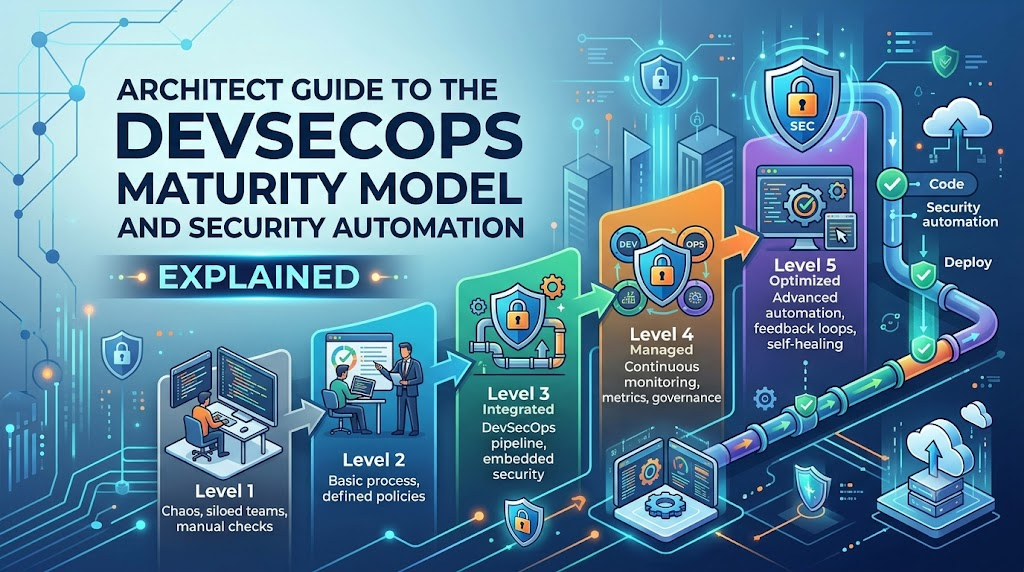
The progression toward an optimized security posture is divided into five distinct maturity levels. The table below outlines the core characteristics and operational readiness associated with each level of maturity.
| Maturity Level | Characteristics | Organization Readiness |
| Level 1: Initial | Reactive operations, completely manual audits, undocumented processes, high vulnerability rates. | Low operational readiness. Security is viewed as an external bottleneck. |
| Level 2: Managed | Documented security policies, basic scheduled tooling scans, recurring manual code reviews. | Basic readiness. Teams collaborate on security issues but lack workflow integration. |
| Level 3: Defined | Automated SAST/SCA gates, secure SDLC patterns, unified pipeline integration across teams. | Moderate readiness. Security is standard across development workflows. |
| Level 4: Automated | Continuous compliance verification, IaC validation, automated secret management, automated policy gates. | High enterprise readiness. Infrastructure and code are systematically scanned and gated. |
| Level 5: Optimized | AI-driven threat prediction, zero-trust architecture, continuous runtime policy enforcement, engineering security culture. | Elite readiness. Security is fully continuous, self-healing, and tied to business metrics. |
Level 1: Initial Security
At Level 1, the organization’s security posture is entirely reactive. There are no automated security checks embedded within the continuous deployment engine. Instead, security is treated as an external checklist completed right before a production release.
Characteristics and Common Challenges
- Completely Manual Audits: Security evaluations rely entirely on security analysts manually inspecting lines of code or running occasional standalone infrastructure scanners.
- Ad-Hoc Remediation: Vulnerabilities are handled as unexpected production bugs, resulting in emergency fire drills that disrupt planned engineering timelines.
- No Pipeline Integration: The engineering team’s CI/CD pipelines focus entirely on code compilation, unit testing, and asset deployment, with no integrated security feedback loops.
Real-World Enterprise Example
Consider an early-stage enterprise software team operating without standardized security protocols. Developers merge code directly into the main repository branch, and the build server deploys the resulting artifact directly to a public cloud instance.
The security team eventually runs an external vulnerability scan right before a major quarterly client delivery, identifying dozens of critical security vulnerabilities within the active operating system packages. The engineering team is forced to halt all feature work for weeks to manually patch the base application servers, missing their commercial delivery date.
Level 2: Managed Security
At Level 2, organizations begin documenting security expectations and standardizing operational practices across engineering teams. While automated validation remains limited, the company establishes formal processes to manage vulnerability remediation.
Characteristics and System Enhancements
- Formal Security Policies: The company defines clear security standards, detailing acceptable software libraries, cryptographic requirements, and target patching timelines.
- Scheduled Tool Scans: Security teams run scheduled scans against major code repositories and active staging environments every week or month, rather than waiting for formal release cycles.
- Improved Collaboration: Developers and security engineers meet regularly to review vulnerability reports and prioritize remediation tickets based on business risk.
Enterprise Operational Example
An enterprise organization sets up a central vulnerability tracking portal. While developers still build and test software without automated security gates in their immediate pipelines, a security engineer triggers an application scan every Friday evening.
On Monday morning, the generated security findings are parsed into internal Jira tickets and assigned to development leads. While this provides a clearer view of security risks, developers are still forced to fix bugs written days or weeks prior, slowing down context switches.
Level 3: Defined DevSecOps
Level 3 marks the transition to a true secure software development lifecycle. Security validation moves from a periodic scheduled audit to a standard, non-negotiable step within the automated continuous delivery engine.
Workflow Integration and Characteristics
- Mandatory Quality Gates: SAST and SCA scans run automatically on every pull request. If a developer introduces a known vulnerability that exceeds the defined risk threshold, the CI pipeline automatically fails the build, preventing the code from being merged.
- Centralized Vulnerability Management: Discovered security vulnerabilities are automatically consolidated into a single tracking dashboard, eliminating fragmented reports across different tools.
- Cross-Functional Engineering Roles: Development teams appoint dedicated “Security Champions”—developers who undergo advanced security training to advocate for secure coding practices directly within their product squads.
[Developer Commits Code]
          │
          ▼
[CI Pipeline Triggered]
          │
    ┌─────┴─────┐
    ▼           ▼
[SAST Scan]  [SCA Scan]
    │           │
    └─────┬─────┘
          ▼
[Evaluate Quality Gates]
    │
    ├─► Fails Gate ──► [Block PR & Notify Developer]
    │
    └─► Passes Gate ─► [Allow Merge to Main Branch]
Real-World Workflow Example
An enterprise team configures their pipeline engine so that every code commit triggers a background analysis pass. If a developer attempts to use an open-source library containing a known remote code execution vulnerability, the build gate blocks the pull request, posts the exact CVE data into the code review thread, and guides the developer toward a secure, patched version of the library.
Level 4: Automated Security
At Level 4, automation expands beyond application code scanning to encompass the entire operational platform, including cloud resources, delivery pipelines, and underlying systems.
Advanced Architectural Controls
- Infrastructure as Code (IaC) Validation: Declarative infrastructure templates are analyzed for security configuration errors before any real-world cloud resources are provisioned.
- Dynamic Application Security Testing (DAST): Automated pipelines launch ephemeral instances of the application and use dynamic scanning tools to simulate real-world attacks against active web endpoints.
- Automated Secrets Management: Applications do not store passwords or API keys. Instead, they retrieve short-lived cryptographic credentials at runtime from a secure, audited enterprise secret store.
Core Tool Integrations
- SonarQube: Embedded within build pipelines to analyze structural code layout, identify maintainability issues, and enforce precise quality gates for application code security.
- Trivy: Used within build steps to scan base container operating system layers, package dependencies, and misconfigured infrastructure templates for known vulnerabilities.
- Checkov: Operates as a static analysis engine for Infrastructure as Code, evaluating cloud resource templates against security compliance baselines.
- OWASP ZAP: Integrated into post-deployment testing environments to execute automated web application security scans against active staging application instances.
Enterprise Practical Example
An enterprise financial platform leverages an automated GitOps engine. When a cloud architect modifies a Terraform configuration file to expand an AWS security group, the pull request triggers a Checkov validation step.
If the tool detects that a port is exposed to the public internet without an explicit business justification, the pipeline aborts the deployment before the cloud infrastructure can be modified, protecting the production perimeter.
Level 5: Optimized Security
Level 5 represents the highest tier of the DevSecOps Maturity Model. Here, security is a continuous, self-improving, and core element of the corporate culture.
Elite Operational Capabilities
- Predictive Threat Intelligence: The system ingests streaming security data and uses machine learning models to detect subtle behavioral anomalies, neutralizing potential zero-day exploits before traditional signatures are published.
- Continuous Runtime Policy Enforcement: Security compliance is monitored constantly across active production clusters, with automated remediation routines to resolve infrastructure drift instantly.
- Proactive Blameless Culture: Security engineering teams pivot away from manual enforcement to focus on building self-service internal developer platforms, secure-by-default foundational libraries, and continuous automated guardrails.
Enterprise Transformation Example
A global retail platform handles hundreds of thousands of concurrent container deployments using an optimized DevSecOps framework. An advanced runtime security layer monitors kernel system calls across production Kubernetes nodes.
If a container exhibits unexpected behavior—such as attempting to run an unauthorized shell process—the platform immediately terminates the affected container pod, isolates the node, alerts the response center, and adjusts edge firewall policies automatically, maintaining complete application availability.
Shift-Left Security
Shift-Left security describes the architectural practice of moving security validation earlier in the software development lifecycle. In traditional engineering models, security evaluations occur to the far right of the delivery timeline, long after the application has been designed, coded, and compiled. Shifting left ensures that security feedback loop mechanics occur as close as possible to the initial design phase.
Traditional:  [ Design ] ──► [ Code ] ──► [ Build ] ──► [ Deploy ] ──► [ SECURITY AUDIT ]
Shift-Left:   [ Design ] ──► [ Code ] ──► [ Build ] ──► [ Deploy ]
                 ▲              ▲            ▲
                 │              │            │
          (Threat Modeling) (IDE Linters) (SAST/SCA Gates)
By executing automated checks directly within the developer workspace or pull request lifecycle, teams identify vulnerabilities when the code context is still fresh in the programmer’s mind. The primary operational mechanisms of Shift-Left security include:
- Secure Coding Guidelines: Providing developers with ongoing training resources, framework-specific design patterns, and linting configurations.
- IDE Security Plugins: Running real-world security analysis directly within code editors to flag insecure methods or dangerous API calls during development.
- Automated Dependency Checks: Evaluating third-party open-source components during the local design phase, preventing unapproved open-source licenses or vulnerable dependencies from entering the repository.
Shift-Right Security
While Shift-Left security focuses on preventive measures during development, Shift-Right security addresses operational safety after code has been deployed to live production environments. Even a thoroughly scanned application can encounter real-world unexpected threats, configuration changes, or zero-day security vulnerabilities that bypass compile-time detection checks.
Shift-Right practices focus on continuous observability, containment strategies, and threat detection, including:
- Runtime Application Self-Protection (RASP): Security agents running inside the application execution environment to block malicious requests in real time.
- Extended Detection and Response (XDR): Deploying lightweight monitoring agents across operating systems to detect unauthorized processes, malicious lateral file movements, or strange network requests.
- Automated Chaos Engineering and Penetration Testing: Injecting simulated failures, configuration errors, and network attacks directly into production environments to validate system resilience.
Security Automation in CI/CD
Integrating security directly into continuous integration and continuous deployment pipelines eliminates manual evaluation bottlenecks, turning security validation into a fast, repeatable step.
                  ┌──────────────────────────────┐
                  │ Source Code Push Trigger CI  │
                  └──────────────┬───────────────┘
                                 │
         ┌───────────────────────┼───────────────────────┐
         ▼                       ▼                       ▼
┌─────────────────┐     ┌─────────────────┐     ┌─────────────────┐
│    SAST Scan    │     │    SCA Scan     │     │ Secrets Scan    │
│  (Source Code)  │     │ (Dependencies)  │     │ (API Keys/Cert) │
└────────┬────────┘     └────────┬────────┘     └────────┬────────┘
         │                       │                       │
         └───────────────────────┼───────────────────────┘
                                 │
                                 ▼
                    ┌─────────────────────────┐
                    │ Build Application Image │
                    └────────────┬────────────┘
                                 │
                                 ▼
                    ┌─────────────────────────┐
                    │  Container Image Scan   │
                    │  (Base OS Packages)     │
                    └────────────┬────────────┘
                                 │
                                 ▼
                    ┌─────────────────────────┐
                    │   Deploy Ephemeral UI   │
                    └────────────┬────────────┘
                                 │
                                 ▼
                    ┌─────────────────────────┐
                    │        DAST Scan        │
                    │    (Runtime Attacks)    │
                    └─────────────────────────┘
A comprehensive security pipeline includes several core automated scanning stages:
Static Application Security Testing (SAST)
SAST tools scan the raw source code repository without executing the code. They analyze control-flow graphs, data-flow vectors, and system configurations to catch common structural issues, including cross-site scripting (XSS), insecure deserialization patterns, and cryptographic misconfigurations.
Dynamic Application Security Testing (DAST)
DAST tools evaluate the application from the outside in while it is running in a staging or testing environment. They simulate malicious web payloads, SQL injections, and brute-force authentication attacks to identify exposed endpoints and infrastructure vulnerabilities.
Software Composition Analysis (SCA)
SCA solutions inventory open-source libraries used within the application stack. They compare the project’s dependency manifest against public vulnerability databases to surface outdated components and flag restrictive open-source licenses that pose legal compliance risks.
Container Scanning
Container scanning utilities analyze container image layers during the final build phase. They identify vulnerable software packages within the base operating system image and flag insecure default user accounts (such as containers configured to run as root).
Secrets Detection
Secrets detection tools scan the entire git commit history to detect accidentally exposed API keys, private encryption certificates, cloud provider credentials, and database connection strings before they are pushed to remote repositories.
Infrastructure as Code Security
The rise of cloud-native development means infrastructure is frequently declared as software text files via tools like Terraform, OpenTofu, CloudFormation, or Ansible. While this approach provides massive operational scalability, a single configuration error in an IaC template can instantly expose entire global cloud networks to the public internet.
Modern IaC security practices systematically scan configuration declarations before real-world infrastructure is provisioned, focusing on several key areas:
- Network Isolation Boundaries: Confirming that virtual firewalls, subnet routing paths, and security group controls enforce strict least-privilege access rules.
- Storage Encryption Controls: Enforcing global rules requiring all object storage buckets, managed databases, and block storage volumes to use strong encryption keys.
- Identity Management Guardrails: Ensuring that Cloud IAM policies do not grant broad wildcard permissions to administrative workloads.
Kubernetes Security in the Maturity Model
Kubernetes serves as the standard runtime platform for containerized enterprise software applications. Due to its architectural complexity, securing a cluster requires layered defense controls across the orchestration plane.
       [ Kubernetes API Server ]
                   │
  (Mutating / Validating Webhooks) ──► Enforces Pod Security Standards
                   │
                   ▼
       [ Worker Node Lifecycle ]
                   │
    ┌──────────────┴──────────────┐
    ▼                             ▼
[RBAC Least-Privilege]   [Network Policies]
(User/Service Account)    (Default Deny Egress/Ingress)
A mature container orchestration framework requires specific security controls:
Pod Security Standards
Implementing admission controllers to evaluate container runtime requirements before they start up. These validation rules block containers that require root privileges, prevent access to the host node’s filesystem, and require drop-capabilities for unneeded Linux system functions.
Role-Based Access Control (RBAC)
Enforcing strict least-privilege rules across cluster access controls. Service accounts, developer credentials, and internal controllers are explicitly restricted to the minimum required resource access scopes, and wide cluster-admin permissions are blocked.
Network Policies
Configuring explicit network policies to restrict internal pod-to-pod communications. By implementing a default-deny rule across all namespace topologies, teams ensure that compromised application containers cannot move laterally across the internal cloud environment.
Measuring DevSecOps Maturity
Organizations cannot improve what they do not systematically measure. Tracking clear engineering metrics allows leaders to gauge the efficiency of their DevSecOps implementation and demonstrate real business value.
| Metric | Purpose | Business Value |
| Vulnerability Resolution Time | Tracks the average calendar duration required to patch an identified security issue. | Minimizes the overall window of vulnerability exposure. |
| Deployment Frequency | Measures how often the system successfully ships production application updates. | Demonstrates that security checks do not slow down business delivery velocity. |
| Compliance Score | Tracks the percentage of active resources that perfectly match defined compliance baselines. | Provides audit readiness and reduces regulatory fine exposure. |
| Mean Time to Detect (MTTD) | Calculates how long a runtime anomaly exists in production before security teams catch it. | Identifies blind spots in live operational monitoring infrastructure. |
| Mean Time to Respond (MTTR) | Tracks the time needed to fully remediate a production incident after it is detected. | Limits the operational impact and blast radius of active production exploits. |
| Security Test Coverage | Measures the percentage of active repositories with integrated automated security testing gates. | Eliminates untracked engineering assets across organization environments. |
Real-World DevSecOps Maturity Journey
Transforming an enterprise security model does not happen overnight. It requires an iterative, step-by-step roadmap to steadily build capabilities without overwhelming development workflows.
Step 1: Document Policies & Setup Code Repositories
                 │
                 ▼
Step 2: Add IDE Security Linters & Pre-Commit Hooks
                 │
                 ▼
Step 3: Integrate Automated SAST & SCA Gates into CI Pipelines
                 │
                 ▼
Step 4: Build Container Scan Checkpoints & IaC Validation
                 │
                 ▼
Step 5: Deploy Automated DAST Tools in Staging Environments
                 │
                 ▼
Step 6: Enforce Runtime Policy Controls & Continuous Compliance Tracking
Step 1: Baseline Establishment
Document existing application assets, group target repositories, and define baseline corporate security policies. Ensure engineers have access to uniform secure coding frameworks.
Step 2: Developer Enablement
Deploy security plugins directly into developer workspaces and local environments. Configure pre-commit hook scanning engines to catch structural code issues and exposed credentials before changes are committed to the codebase.
Step 3: Pipeline Integration
Embed SAST and SCA validation checks into central version control servers. Configure pipelines to evaluate code on every pull request, initially running in non-blocking warning mode to establish baseline metrics.
Step 4: Infrastructure Control
Introduce automated validation for Infrastructure as Code blueprints and container image layers. Integrate automated secret management engines to clean up configuration variables.
Step 5: Dynamic Verification
Introduce automated dynamic testing frameworks into deployment pipelines. Run these automated web application vulnerability checks against active staging environments before production deployments.
Step 6: Continuous Evolution
Transition the active production environment to a zero-trust architecture. Deploy continuous configuration compliance checkers and feed operational monitoring metrics back into the initial design planning phase.
Benefits of a Mature DevSecOps Program
Investing in a comprehensive DevSecOps Maturity Model yields significant business advantages across multiple operational areas:
- Minimized Engineering Costs: Resolving security bugs early in development is far more cost-effective than attempting to refactor application systems after a live production breach.
- Faster Enterprise Releases: Automated security testing gates eliminate the friction of manual pre-release code reviews, allowing software releases to move swiftly through pipelines.
- Simplified Regulatory Auditing: Continuous compliance tracking engines automatically generate an immutable audit trail of all code history and operational changes, simplifying verification processes.
- Protected Brand Reputation: Preventing public security incidents preserves customer data integrity and maintains long-term trust in market platforms.
Common Challenges and Solutions
Transitioning to an automated DevSecOps culture often introduces cultural friction and tool friction. Below are common enterprise challenges along with practical strategies for success.
1. Resistance to Change
Developers may view newly introduced security tools as barriers that slow down their feature delivery velocity.
- Solution: Embed security tools directly into existing developer interfaces (such as pull request feedback sections) and provide clear, actionable remediation examples.
2. High Volumes of False Positives
Out-of-the-box application scanners can generate noisy, inaccurate alerts, causing alert fatigue and leading developers to ignore findings.
- Solution: Fine-tune scanning rule configurations initially to flag only high-severity, high-confidence issues, and continuously refine filters based on feedback.
3. Skill Deficiencies across Teams
Development teams may lack deep cybersecurity training, while traditional security engineers may not be fluent in automated infrastructure pipelines.
- Solution: Establish specialized training pathways, sponsor cross-functional workshops, and partner with training providers like DevOpsSchool to bridge engineering skill gaps.
4. Legacy Applications
Monolithic legacy codebases often do not fit easily into modern cloud-native containerized scanning frameworks.
- Solution: Isolate legacy systems using secure network parameters, focus scans on newly updated components, and prioritize incremental refactoring for high-risk modules.
Best Practices for Improving DevSecOps Maturity
To accelerate adoption and ensure long-term success with the DevSecOps Maturity Model, engineering organizations should follow these core implementation strategies:
- Treat Security Configurations as Core Code: Manage all infrastructure definitions, validation policies, and container configurations within standard version control systems.
- Empower Security Champions: Select and train dedicated engineers within individual development squads to bridge the gap between product groups and security teams.
- Start with Minimal Enforcement: Introduce newly integrated pipeline scanning steps in warning-only mode to establish reliable baselines before turning them into build-failing gates.
- Provide Clear Remediation Context: Ensure automated security warnings include clear architectural descriptions, secure code examples, and explicit upgrade instructions.
- Focus on Continuous Learning: Build a blame-free post-mortem culture that treats security discoveries as opportunities to improve automated checks and system documentation.
DevOps vs DevSecOps Maturity
While DevOps and DevSecOps share core technical methodologies, they maintain distinct operational focuses and strategic goals.
| Feature | DevOps Maturity | DevSecOps Maturity |
| Primary Objective | Maximizing software delivery speed and infrastructure availability metrics. | Balancing fast feature delivery velocity with continuous risk reduction. |
| Security Ownership | Managed by external security teams at the end of delivery cycles. | Owned jointly across all engineering, development, and operations squads. |
| Automation Focus | Targeted at application compilation, functional testing, and infrastructure deployment. | Focused on code scanning, open-source dependency validation, and cloud configuration guardrails. |
| Compliance Strategy | Validated via manual documentation during periodic audit events. | Verified continuously via automated checks embedded in live pipelines. |
| Operational Risk | Evaluated primarily around code quality and system performance metrics. | Evaluated continuously against changing threat surfaces and configurations. |
Popular Tools Supporting DevSecOps Maturity
Building an automated application security program requires assembling a cohesive toolchain tailored to your specific tech stack and deployment architecture.
| Tool | Purpose | Difficulty | Best Use Case |
| SonarQube | Comprehensive code quality and static application security testing. | Medium | Continuous pull request static code verification. |
| Trivy | Multi-target container image, package vulnerability, and IaC scanning. | Easy | Cloud-native base container image build step analysis. |
| Checkov | Static infrastructure configuration analysis engine. | Easy | Terraform blueprint validation prior to cloud resource deployment. |
| OWASP ZAP | Dynamic application vulnerability testing for active endpoints. | Hard | Automated vulnerability validation within active staging environments. |
| HashiCorp Vault | Centralized secrets distribution, storage, and engine management. | Hard | Microservice configuration credential injection at runtime. |
| Open Policy Agent | Unified policy enforcement framework across cloud stacks. | Hard | Declarative Kubernetes API request validation and controls. |
Industries Benefiting from DevSecOps Maturity
While every modern enterprise relying on digital software delivery benefits from security automation, specific regulated sectors face critical compliance mandates that make a structured maturity framework essential.
Banking and Finance
Financial institutions handle highly sensitive transactional histories and personal identity profiles, requiring alignment with strict PCI-DSS and SOC 2 requirements. A mature DevSecOps architecture ensures data encryption controls and access auditing are deeply integrated into pipelines, protecting infrastructure against external threats and data exposure.
Healthcare Services
Medical platforms handle protected health information (PHI) governed by strict regulatory frameworks like HIPAA. Implementing continuous compliance scanning within automated delivery pipelines allows healthcare organizations to deploy updates quickly while ensuring sensitive data configurations remain secure.
E-Commerce and Retail
Global digital storefronts process massive numbers of credit card transactions daily and experience highly variable traffic demands. Automated container scanning, early dependency validation, and live perimeter threat monitoring help e-commerce operators maintain fast, continuous user experiences while minimizing data breach risks.
Career Opportunities
The widespread adoption of the DevSecOps Maturity Model has generated substantial industry demand for specialized cloud and security professionals who possess hybrid engineering skills.
                  ┌─────────────────────────────┐
                  │       Core Security Skills  │
                  │  (Threat Analysis / Crypto) │
                  └──────────────┬──────────────┘
                                 │
         ┌───────────────────────┼───────────────────────┐
         ▼                       ▼                       ▼
┌─────────────────┐     ┌─────────────────┐     ┌─────────────────┐
│  DevSecOps Eng  │     │ Cloud Security  │     │ AppSec Engineer │
│  (CI/CD Security│     │  (IAM / Network │     │  (Code Review / │
│   Automation)   │     │   Topology)     │     │   Remediation)  │
└─────────────────┘     └─────────────────┘     └─────────────────┘
Key professional roles within modern secure engineering ecosystems include:
DevSecOps Engineer
Specialists focused on embedding automated security tools, setting up pipeline quality gates, and managing secret distribution workflows within continuous integration and continuous delivery toolchains.
Cloud Security Architect
Senior professionals responsible for designing resilient cloud landing zones, mapping identity boundaries, and establishing enterprise-wide configuration compliance frameworks.
Application Security Engineer
Subject matter experts who partner directly with development squads to perform deep source code reviews, analyze complex application threats, and resolve architectural vulnerabilities.
Career Requirements and Growth
Succeeding in this competitive job market requires a deep understanding of Linux system architectures, experience configuring cloud network configurations, hands-on familiarity with pipeline automation tools, and strong communication skills to bridge technical team divides.
Certifications & Learning Paths
Validating your engineering expertise through structured learning programs and professional certifications is an excellent way to stand out in the competitive DevSecOps landscape. Educational organizations like DevOpsSchool offer specialized training tracks designed to take professionals from foundational concepts to advanced production security implementations.
| Certification | Best For | Skill Level | Focus Area |
| DevSecOps Certified Professional | Pipeline engineers and DevOps specialists. | Intermediate | Toolchain automation, SAST/DACS setup, and pipeline gate design. |
| Certified Kubernetes Security Specialist (CKS) | System administrators and platform architects. | Advanced | Cluster admission validation, container execution protection, and network isolation. |
| AWS Certified Security Specialty | Enterprise cloud infrastructure engineers. | Advanced | Cloud infrastructure configuration, IAM management, and data encryption. |
| Certified Secure Software Lifecycle Professional (CSSLP) | Software developers and team managers. | Advanced | Threat modeling, secure system design principles, and software validation. |
Common Beginner Mistakes
When starting a DevSecOps transformation journey, technical teams often encounter common pitfalls. Use the checklist below to identify and avoid these frequent early mistakes:
- Treating Security as an Afterthought: Postponing security validation until right before a production release, which recreates traditional bottleneck friction.
- Enforcing Too Many Blocking Rules Too Fast: Turning on high-severity pipeline gates overnight without giving developers adequate time to fix baseline issues, leading to broken pipelines.
- Neglecting Fundamental Linux Security: Focusing heavily on advanced scanning tools while leaving basic operating system configurations unpatched or running containers with unnecessary root privileges.
- Ignoring Base Container Image Vulnerabilities: Scanning application code carefully while failing to check the underlying operating system layers within base images.
- Accepting Vulnerability Blind Spots: Allowing development squads to bypass automated pipeline gates without a formal, audited risk-exception review process.
Future of the DevSecOps Maturity Model
As enterprise environments continue to grow in scale and complexity, the frameworks used to measure and deploy security automation are evolving accordingly.
AI-Driven Vulnerability Remediation
Future pipeline validation utilities will go beyond merely identifying security flaws. They will leverage trained machine learning engines to automatically generate precise, context-aware code patches that developers can review and merge with a single click.
Zero-Trust Architecture Enforcement
The industry is moving away from traditional perimeter security toward a strict Zero-Trust approach. Future iterations of the maturity model will require continuous, identity-based cryptographic validation for every service interaction, database query, and network request within the cloud ecosystem.
Platform Engineering and Secure-by-Default Guardrails
Rather than forcing individual development squads to configure complex security tools from scratch, organizations are increasingly leveraging internal developer platforms. These platforms provide pre-configured, secure-by-default templates and automated environments, embedding compliant architectures naturally within standard developer workflows.
FAQs (15 Questions)
1. What is the DevSecOps Maturity Model?
It is a structured evolutionary framework used by engineering organizations to assess, guide, and continuously improve how security practices are embedded within software development pipelines and infrastructure operations.
2. Why should an organization adopt a security maturity model?
A maturity model replaces ad-hoc security patches with a standardized roadmap. This helps organizations reduce operational risk, maintain regulatory compliance, eliminate deployment bottlenecks, and optimize tool investments.
3. How do DevOps and DevSecOps differ regarding maturity frameworks?
DevOps maturity focuses primarily on velocity, deployment frequency, and service uptime. DevSecOps maturity integrates risk mitigation, continuous compliance, and automated pipeline security checks alongside those delivery metrics.
4. What is Shift-Left security?
Shift-Left security is the practice of moving security validation checks earlier in the software development lifecycle—such as during the planning, coding, and code review phases—rather than treating it as a final audit step.
5. What is Shift-Right security?
Shift-Right security focuses on operational safety after software is deployed to production. This includes runtime threat monitoring, observability logging, chaos engineering, and automated incident response mitigation.
6. What are the common assessment stages of the model?
The model consists of five levels: Level 1 (Initial, entirely manual/reactive), Level 2 (Managed, documented policies/periodic scans), Level 3 (Defined, automated pipeline gates), Level 4 (Automated, continuous infrastructure compliance), and Level 5 (Optimized, self-healing architectures/predictive security).
7. What does SAST do in a continuous delivery pipeline?
Static Application Security Testing (SAST) tools scan raw application source code text repositories without executing the program. They look for structural flaws, insecure design patterns, and common vulnerability vectors.
8. How does SCA protect software pipelines?
Software Composition Analysis (SCA) solutions inventory third-party open-source dependencies used within applications. They check components against public databases to identify known vulnerabilities and flag licensing non-compliance.
9. What is the purpose of DAST?
Dynamic Application Security Testing (DAST) tools analyze running web applications from the outside in. They simulate active external attacks to identify runtime configuration weaknesses, authentication flaws, and exposed endpoints.
10. How do you prevent hardcoded keys from entering git repositories?
Organizations can deploy secrets detection engines (such as GitGuardian or TruffleHog) as pre-commit hooks or pipeline steps to scan the git commit history and block code pushes that contain credentials.
11. What is Infrastructure as Code (IaC) scanning?
IaC scanning involves evaluating configuration templates (like Terraform or CloudFormation blueprints) using static analysis engines before real cloud resources are provisioned. This catches misconfigurations like publicly exposed ports or unencrypted storage.
12. How do admission controllers help protect Kubernetes clusters?
Admission controllers evaluate requests sent to the Kubernetes API server. They can block deployment requests that violate defined security profiles, such as containers requesting root access or lacking strict network policies.
13. What metrics are most useful for tracking DevSecOps performance?
Key metrics include Vulnerability Resolution Time, Deployment Frequency, Compliance Scores, Mean Time to Detect (MTTD), Mean Time to Respond (MTTR), and overall Security Test Coverage.
14. What are the main challenges when adopting a maturity model?
The most frequent enterprise challenges include developer cultural resistance, alert fatigue from scanner false positives, technical skill gaps across engineering teams, and accommodating legacy applications.
15. How can platforms like DevOpsSchool assist with adoption?
DevOpsSchool provides comprehensive educational bootcamps, corporate training courses, and professional certification tracks. These programs give development and security teams the practical, hands-on skills required to implement automated security architectures successfully.
Final Thoughts
Adopting the DevSecOps Maturity Model is an ongoing journey of continuous organizational refinement rather than a single technical project. True security maturity cannot be achieved simply by purchasing expensive validation scanners or adding non-negotiable compliance rules that slow down development velocity. Real success comes from building a collaborative culture where developers, operations engineers, and security specialists share responsibility for software quality and resilience.
By using a structured maturity framework, engineering organizations can steadily shift security checks leftward into code editors and rightward into active runtime monitoring environments. This approach allows companies to safeguard their operational platforms, protect sensitive consumer data, and accelerate feature delivery with confidence.








Leave a Reply
You must be logged in to post a comment.