Introduction
The software development landscape has fundamentally shifted. Gone are the days of long, monolithic release cycles where security testing was a final gatekeeper, a hurdle teams jumped over just before production. Agile methodology brought us the speed and flexibility we needed to stay competitive, delivering value to customers in weekly or bi-weekly sprints. However, this velocity often created a friction point: security.
In the rush to deploy features, security testing often fell behind. Developers felt that security slowed them down, and security teams felt that developers were ignoring risks to meet sprint deadlines. This is where the cultural and technical philosophy of DevSecOps enters the picture. It is not just about adding tools; it is about embedding security into the DNA of the Agile workflow.
At DevOpsSchool, we have spent years guiding engineering teams through this transformation. We have seen firsthand that security does not need to be the enemy of speed. In fact, when integrated correctly, it becomes a catalyst for higher quality and more resilient code. In this guide, we will explore how DevSecOps aligns security with Agile teams, ensuring you can ship fast without sacrificing the safety of your users or your infrastructure.
Why Security Becomes Difficult in Agile Teams
Agile is designed for change, iteration, and speed. A typical Scrum team operates in two-week sprints. In this environment, the goal is “done”—meaning tested, integrated, and ready to deploy. Security, conversely, is often viewed as a “check-box” process that requires deep, time-consuming analysis.
When a team is focused on hitting velocity targets in a sprint, they view a security review as a bottleneck. Imagine a team halfway through a sprint, refactoring a payment gateway. If a security team mandates a three-day manual penetration test before the code can be merged, the sprint goal is at risk. This disconnect leads to the “security debt” phenomenon, where teams defer security checks to the end of the project, often leading to costly remediation cycles that derail future sprints. The core issue is not the lack of security talent, but the lack of alignment between the Agile cadence and the security verification process.
What Is DevSecOps in Agile Environments?
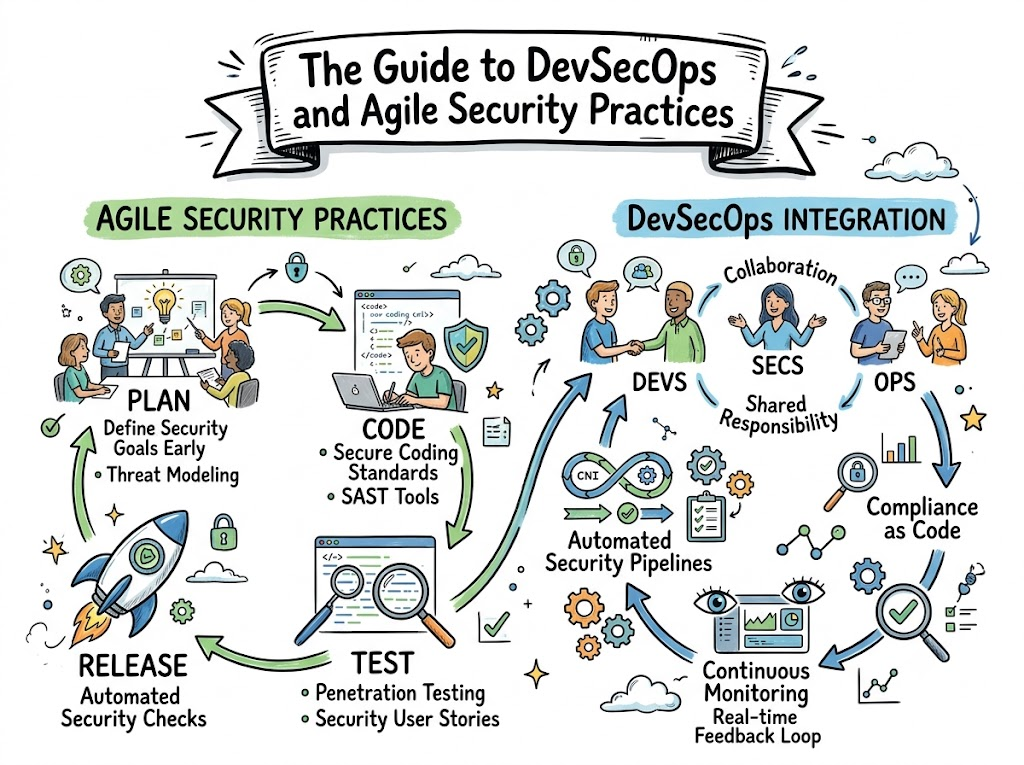
Think of DevSecOps as the “Security as Code” equivalent of DevOps. In a traditional environment, security is a perimeter—a wall around the application. In an Agile DevSecOps environment, security is a thread woven through every piece of the fabric.
It is a shared responsibility model. It means the developer, the QA engineer, and the security architect are all looking at the same risks during the sprint planning, not just at the end. If you are a developer, security is now part of your “definition of done.” It is not about becoming a cybersecurity expert overnight; it is about understanding how the code you write impacts the overall security posture of the product.
Agile vs Traditional Security Approaches
| Traditional Security | DevSecOps Security |
| Security is a final gatekeeper | Security is a continuous, integrated process |
| Manual testing at the end of the SDLC | Automated testing throughout the CI/CD pipeline |
| Security is the responsibility of a separate team | Shared responsibility across all team members |
| High friction, slow deployment speeds | Low friction, enables rapid and secure delivery |
| Feedback loop occurs post-release | Real-time feedback provided during development |
How DevSecOps Aligns Security With Agile Teams
Alignment happens when you stop treating security as a separate phase and start treating it as a functional requirement.
Shift-Left Security
The concept of “shifting left” simply means moving security activities to the beginning of the development lifecycle. Instead of waiting for a completed build to test for vulnerabilities, you test the code as it is being written. This fits perfectly with Agile sprints.
Security in Every Sprint
During sprint planning, the team should identify potential security risks associated with the user stories being tackled. If a story involves handling user data, the security requirement—such as encryption at rest or input validation—is included in the acceptance criteria.
Automation in CI/CD
By integrating security scanning tools directly into the CI/CD pipeline, the build fails automatically if a vulnerability is detected. This provides instant feedback to the developer, allowing them to fix the issue while the code is fresh in their minds, rather than weeks later after a security audit.
Role of Shift-Left Security in Agile
Shift-left security is the practice of developer-centric defense. In a typical Agile team, a developer might write a module that interacts with an API. With shift-left practices, their IDE (Integrated Development Environment) is configured with plugins that highlight vulnerable dependencies or insecure coding patterns in real-time.
Example:
During a sprint, a developer includes an open-source library that has a known vulnerability. Without shift-left, this might pass QA and reach production. With shift-left, the CI/CD pipeline runs a Software Composition Analysis (SCA) scan. The build breaks, and the developer receives an immediate notification explaining that the library is outdated and provides a link to the secure version. The fix happens in minutes, not months.
How Security Fits Into Agile Sprints
Integrating security is a linear process that maps directly to the Scrum framework:
- Sprint Planning: Security engineers or leads participate to flag high-risk stories. They define security acceptance criteria.
- Development: Developers use pre-configured, secure coding templates and local linting tools to catch common flaws.
- CI/CD Pipeline: As code is committed, automated security tests (SAST/DAST) run. If the tests fail, the build stops.
- Vulnerability Review: If an issue is found, it is treated as a bug in the sprint backlog. It is prioritized like any other functional bug.
- Release Readiness: The final release candidate has already been verified for security throughout the sprint, eliminating the “big security audit” delay.
Role of Automation in Agile Security
Automation is the engine that makes DevSecOps possible. Without it, you cannot keep pace with Agile delivery.
| Automation Area | Benefit |
| Code Scanning (SAST) | Detects vulnerabilities in source code during development |
| Dependency Scanning (SCA) | Identifies insecure third-party libraries |
| Secrets Detection | Prevents hardcoded credentials from reaching repositories |
| Compliance Checks | Automatically validates configuration against industry standards |
| Runtime Monitoring | Monitors applications for anomalies after deployment |
Real-World Example: Agile Team Without DevSecOps
Consider a team working on an e-commerce platform. They aim for two-week releases. In their current process, security audits occur once a quarter. During the latest audit, the security team discovers that the login module, written three months ago, is vulnerable to SQL injection.
Because the developers have moved on to new features, they must stop their current sprint to patch the old code. This creates “context switching,” slows down the roadmap, causes frustration, and results in a delayed release. The security team is seen as the “blocker,” and the developers are seen as “reckless.”
Real-World Example: Agile Team With DevSecOps
Now, take the same team, but they have adopted DevSecOps. During the sprint when the login module was created, the CI/CD pipeline ran an automated SAST scan. The scan detected the SQL injection flaw immediately.
The developer received a red alert in their dashboard within five minutes of committing the code. They fixed the parameterized query before even merging the code. The build passed, and the feature moved forward. No audit was required, no sprint was derailed, and the code remained secure from day one.
Common Challenges in Aligning Security With Agile
Even with the best intentions, you will face hurdles:
- Resistance to Change: Developers may view security tools as “noise” or “gatekeeping.” Focus on tuning the tools to reduce false positives.
- The “Alert Fatigue” Problem: If your tools report hundreds of minor vulnerabilities, your team will stop paying attention. Prioritize critical and high vulnerabilities first.
- Skill Gaps: Developers are not security experts. Invest in training rather than expecting them to know everything.
- Tooling Complexity: Too many tools can slow down the build. Choose integrated solutions that provide a unified view.
Best Practices for Agile + DevSecOps Alignment
- Start Small: Don’t try to automate everything at once. Begin with dependency scanning, which is usually the easiest to implement.
- Train the Team: Security is a skill set. Host brown-bag sessions at your office or take structured courses at DevOpsSchool.
- Include Security in Planning: If you don’t talk about security during the sprint planning meeting, it won’t get done.
- Make Security Bugs Visible: Put security bugs in the same backlog as feature bugs. Use the same tools (Jira, Trello, etc.) to track them.
- Encourage Collaboration: Create a culture where developers can ask the security team questions without fear of criticism.
Role of DevOpsSchool in Learning DevSecOps for Agile Teams
Mastering the intersection of security and Agile requires hands-on experience with modern CI/CD stacks and security tools. DevOpsSchool provides the necessary practical training to bridge this gap. We focus on real-world scenarios—such as configuring automated pipelines, learning to interpret vulnerability reports, and understanding how to implement infrastructure as code (IaC) securely. Whether you are an individual developer or leading an entire transformation for your organization, our ecosystem provides the mentorship and technical exposure needed to build high-performance, secure Agile teams.
Career Importance of DevSecOps Agile Skills
The market demand for professionals who understand both Agile workflows and security automation is at an all-time high. Companies are no longer looking for developers who only write code; they want engineers who understand secure architecture.
- DevSecOps Engineer: Bridges the gap between development, operations, and security.
- Security Engineer: Transitions from a “checker” to an “enabler” who writes automation scripts.
- DevOps Engineer: Increasingly tasked with embedding security policies into CI/CD pipelines.
- SRE (Site Reliability Engineer): Security is a core component of system reliability.
These skills are future-proofing your career. Understanding how to align these domains puts you in the top tier of candidates for modern tech roles.
Industries Using Agile + DevSecOps
DevSecOps is not limited to tech startups. It is the standard for high-stakes industries:
- Banking & Finance: Handling sensitive transactions requires rigorous, automated security checks.
- Healthcare: Compliance (HIPAA, GDPR) is non-negotiable; automation ensures these standards are met continuously.
- SaaS Platforms: Fast feature delivery combined with high availability demands secure, automated pipelines.
- E-Commerce: Protecting user data and preventing downtime are vital for revenue.
- Telecom & Government Systems: Infrastructure resilience depends on the secure management of complex, cloud-native environments.
Future of Agile Security With DevSecOps
The future lies in AI-powered security. Soon, we will see tools that don’t just find vulnerabilities but suggest the exact code fix. Policy as Code will also become standard, where security compliance rules are written in code and enforced automatically across entire infrastructures. The goal is a “self-healing” architecture where the system detects an anomaly and automatically reconfigures itself to a secure state without manual intervention.
FAQs
- What is the core definition of DevSecOps in Agile?
It is the integration of security practices into the Agile software development lifecycle, ensuring security is a shared responsibility rather than an afterthought. - Why does Agile struggle with security?
Agile prioritizes speed and iteration; traditional security often requires manual, slow checks that disrupt the flow. - What is the “shift-left” philosophy?
Moving security testing, design, and considerations to the earliest stages of the development cycle. - Does DevSecOps slow down Agile teams?
Initially, it requires effort to set up automation. However, long-term, it speeds up delivery by reducing the time spent fixing vulnerabilities after release. - Can developers handle security tasks?
Yes, with the right training, toolsets, and culture, developers are the first and most effective line of defense. - What are the essential tools for DevSecOps?
Tools vary, but generally include SAST (Static Analysis), SCA (Software Composition Analysis), DAST (Dynamic Analysis), and container security scanners. - Is DevSecOps only for large enterprises?
No, it is for any team that wants to build reliable, secure software, regardless of size. - How do I start with DevSecOps if I am a beginner?
Start by learning the basics of CI/CD, then add a simple security scanning tool to your pipeline. - What is the biggest mistake teams make when starting?
Trying to automate everything at once and overwhelming the team with alerts. - Do I need to hire a security expert for every Agile team?
It is better to have a security champion—a developer who is trained in security—embedded within the team. - How do I deal with “alert fatigue”?
Prioritize vulnerabilities by risk level and focus on fixing the most critical issues first. - Is infrastructure security part of DevSecOps?
Yes, it is often called “DevSecOps for Infrastructure” or “Security as Code.” - How does DevSecOps improve product quality?
By catching bugs and vulnerabilities early, the final product is more stable, compliant, and reliable. - What should be in a security checklist for a sprint?
Input validation, secure authentication, dependency management, and compliance checks. - How does DevSecOps help with compliance?
It provides an automated audit trail, proving that security checks were performed on every release.
Final Thoughts
Security and Agile are not enemies. They are two sides of the same coin: delivering high-quality value to the customer. When you align your Agile teams with DevSecOps principles, you remove the friction that slows down development and replace it with a continuous, automated feedback loop.
This transition requires patience, training, and a shift in mindset. It isn’t about blaming developers for bugs; it’s about empowering them to write secure code. As you begin this journey, remember that the goal is progress, not perfection. Automate the small things, educate your team, and build a culture where security is a natural part of every sprint.







Leave a Reply
You must be logged in to post a comment.