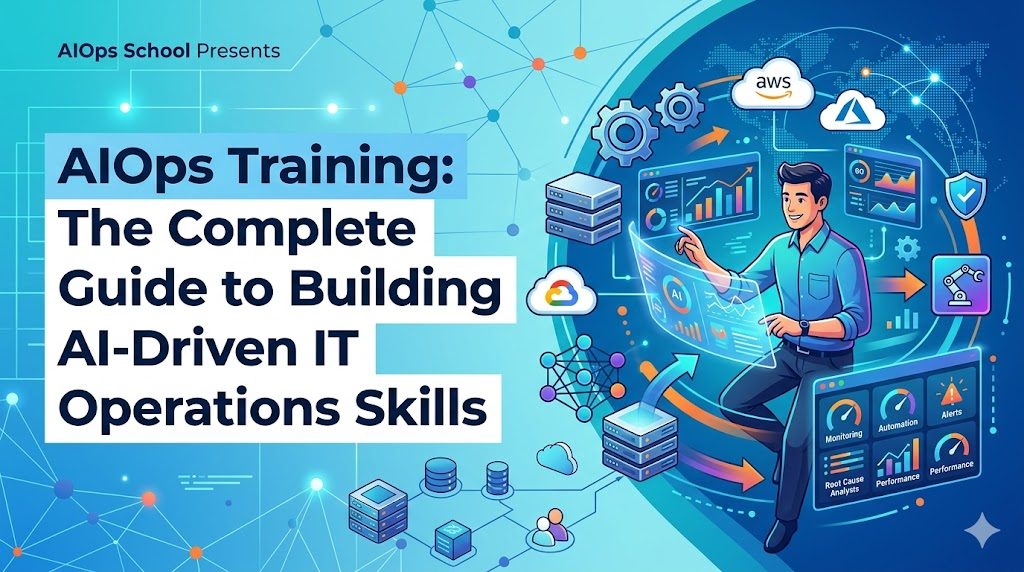
The modern digital ecosystem is no longer just “complex”—it is hyper-connected, ephemeral, and generating data at a volume that human operators can no longer manage manually. For DevOps engineers, SREs, and IT operations teams, the days of staring at static dashboards or manually parsing through thousands of logs are over. If you are still relying on traditional reactive monitoring, you are fighting a losing battle against alert fatigue and fragmented observability. Enter Artificial Intelligence for IT Operations (AIOps).
As organizations pivot toward AI-driven infrastructure, the demand for skilled professionals who can bridge the gap between IT operations and data science is skyrocketing. Whether you are an experienced system administrator looking to future-proof your career or a DevOps engineer seeking to master the next wave of automation, structured AIOps training is the critical step to unlocking your potential.
What is AIOps?
AIOps, or Artificial Intelligence for IT Operations, is the application of machine learning, big data, and advanced analytics to automate and improve IT operations processes. It isn’t just a tool; it is a discipline.
Historically, IT operations relied on rules-based monitoring. If X happened, alert Y. While effective for simple environments, this approach fails in the cloud-native, microservices-heavy world where dependency mapping is fluid. AIOps shifts the paradigm from reactive monitoring to proactive intelligence.
The evolution of IT operations has followed a clear trajectory:
- Manual Management: Direct human intervention for every incident.
- Basic Monitoring: Threshold-based alerts (e.g., CPU > 80%).
- Observability: Understanding the why behind system state using logs, metrics, and traces.
- AIOps: Leveraging AI models to ingest observability data, identify patterns, predict failures, and automate remediation.
Unlike traditional monitoring, which tells you that something is broken, AIOps tells you why it is broken, what impact it will have, and, in many cases, how to fix it before users notice.
Why AIOps Matters in Modern IT Operations
In an enterprise environment, the “noise” is the primary enemy. When a microservice fails, it can trigger a cascade of hundreds of alerts, burying the actual root cause under a mountain of symptoms. AIOps changes this narrative by providing:
- Incident Intelligence: Context-aware incident analysis that cuts through the noise.
- Noise Reduction: Clustering related events to reduce alert fatigue by up to 90%.
- Event Correlation: Connecting disparate logs and metrics from different services to identify a single causal thread.
- Predictive Analytics: Identifying performance degradation before it becomes an outage.
- Capacity Planning: Using historical usage data to forecast future infrastructure needs.
- Root Cause Analysis: Automating the “detective work” that previously took engineers hours.
- Auto-remediation: Triggering automated scripts to restart services, scale clusters, or roll back faulty deployments without human intervention.
- Faster MTTR: Drastically reducing Mean Time to Repair by focusing human attention where it is needed most.
- Improved Reliability: Shifting from “firefighting” to “fire prevention.”
Who Should Take an AIOps Training Program?
AIOps is not limited to data scientists or AI researchers. It is fundamentally an operations-first discipline. If your daily work involves maintaining system uptime and velocity, this skillset is for you.
- DevOps Engineers: To integrate automated observability into CI/CD pipelines.
- SREs (Site Reliability Engineers): To leverage predictive analytics for SLO/SLI management.
- Platform Engineers: To build self-healing, automated cloud infrastructure.
- Cloud Architects: To design scalable, observable systems.
- Monitoring Specialists: To evolve legacy monitoring into intelligent observability stacks.
- IT Managers: To understand the strategic value and ROI of AI-driven operations.
- NOC Teams: To move from manual alert triage to proactive incident response.
- ML Engineers: To apply machine learning models specifically to IT telemetry data.
What Will You Learn in an AIOps Course?
A comprehensive AIOps course covers the full lifecycle of AI-driven operations. Whether you are learning from a basic AIOps tutorial or a deep-dive certification program, the curriculum should cover these core modules:
- Module 1: AIOps Fundamentals: Defining the scope, maturity models, and the “why” behind the shift.
- Module 2: Observability: Moving beyond monitoring to full-stack visibility.
- Module 3: Metrics: High-cardinality data ingestion and time-series analysis.
- Module 4: Logs: Pattern recognition and log aggregation at scale.
- Module 5: Tracing: Distributed tracing and identifying latency bottlenecks.
- Module 6: Event Correlation: Clustering and suppression algorithms.
- Module 7: Anomaly Detection: Statistical vs. ML-based detection of abnormal system behavior.
- Module 8: ML for Operations: Introduction to Supervised, Unsupervised, and Reinforcement Learning in an IT context.
- Module 9: Incident Intelligence: Automating ticket prioritization and severity assignment.
- Module 10: Auto-remediation: Integrating AI with infrastructure-as-code (IaC) tools.
- Module 11: OpenTelemetry: Standardizing data collection for heterogeneous environments.
- Module 12: Enterprise AIOps Architecture: Scaling AI from a single team to a global organizational strategy.
Top AIOps Tools You Should Know
To implement AIOps effectively, you must understand the tool landscape. No single tool is a “silver bullet,” but understanding the strengths of these platforms is essential for any AIOps professional.
| Tool | AI Capabilities | Event Correlation | Automation | Ease of Adoption |
| Splunk | Advanced ML (ITSI) | Excellent | High | Moderate |
| Dynatrace | Davis AI (Causal) | Native (Deep) | High | High |
| Datadog | Watchdog (Predictive) | Strong | Moderate | Very High |
| Prometheus | Minimal (via Exporters) | Low | Low | Moderate |
| Grafana | Moderate (Loki/Mimir) | Moderate | Low | High |
| Elastic Stack | ML Nodes | Strong | Moderate | Moderate |
| Moogsoft | Algorithms (Entropy) | Very High | High | Moderate |
| BigPanda | Topology-aware | High | Moderate | Moderate |
| New Relic | Applied Intelligence | Strong | Moderate | High |
Benefits of Earning an AIOps Certification
In a competitive job market, an AIOps certification serves as a signal of competence. It validates that you haven’t just read about the concepts—you have practiced them in labs, understood the trade-offs, and are ready to apply them in production.
- Career Advancement: Transitioning into higher-paying roles like Observability Architect.
- Higher Salary Potential: AIOps skills are currently a premium niche; demand significantly outstrips supply.
- Enterprise Demand: Companies are desperate for professionals who can lower their cloud costs and MTTR through automation.
- Practical Validation: Hands-on experience with tools like OpenTelemetry and ML pipelines sets you apart from theoretical learners.
- Competitive Advantage: You become the person in the room who can bridge the gap between “the server is down” and “the AI auto-remediated the service because it detected a memory leak.”
Why Choose AIOps School for AIOps Training?
When you choose AIOps School, you are not just watching videos; you are engaging in a hands-on, career-focused learning journey. We understand that IT operations is a craft learned through practice, not through theory alone.
Here is why thousands of professionals globally choose our platform:
- Hands-on Labs: Don’t just learn about anomaly detection—build it. Our labs allow you to deploy real monitoring stacks and test your models against simulated production outages.
- Project-Based Learning: Every AIOps course is designed around real-world scenarios. You will build projects that demonstrate your ability to correlate events, reduce noise, and implement auto-remediation.
- Certification Pathways: We offer a structured progression from Foundation to Architect level. Whether you are starting your journey or looking to master enterprise architecture, our tracks guide you every step of the way.
- Global Learner Community: Connect with thousands of peers in 50+ countries. Share knowledge, debug issues, and network with professionals facing the same challenges you are.
- Expert-Led Sessions: Our curriculum is built by industry practitioners who have implemented AIOps in global enterprises, ensuring you learn “what works” rather than just “what sounds good in a textbook.”
- Career Acceleration: Our alumni report significant salary increases and successful transitions into SRE and AIOps roles. We provide the credentials and the portfolio-building opportunities that hiring managers actually look for.
Career Opportunities After Completing an AIOps Certification
Completing an AIOps certification opens doors to some of the most sought-after roles in the IT industry. As organizations mature, these roles are becoming standard:
- AIOps Engineer: Focuses on implementing and maintaining the AIOps platform and data pipelines.
- SRE (Site Reliability Engineer): Uses AIOps to maintain SLOs and automate manual toil.
- Observability Engineer: Specializes in instrumenting systems and managing data telemetry.
- Platform Engineer: Designs and manages the internal developer platforms that support AI-driven deployments.
- Cloud Reliability Engineer: Ensures the health and performance of cloud-native infrastructure using predictive tools.
- Incident Response Engineer: Uses AI to speed up the triage and resolution of critical production incidents.
- DevOps Architect: Integrates AIOps into the CI/CD pipeline to enable continuous delivery with safety.
- AI Operations Specialist: Focuses specifically on the lifecycle of ML models running within the IT operations stack.
Frequently Asked Questions (FAQ)
1. What exactly is AIOps Training?
AIOps training is a structured educational path that teaches you how to combine big data, machine learning, and IT operations to create self-healing, intelligent systems. It moves beyond standard IT training by focusing on automation, predictive analytics, and noise reduction.
2. Is AIOps difficult to learn?
While it involves complex concepts like machine learning and distributed tracing, a structured AIOps course breaks these down into manageable modules. If you have a background in DevOps or System Administration, you already have the foundational knowledge required to excel.
3. Which AIOps tools are most widely used?
The “best” tool depends on your infrastructure. Splunk, Dynatrace, Datadog, and New Relic are industry leaders. However, understanding the underlying concepts of event correlation and data ingestion is more important than knowing one specific tool.
4. Is an AIOps Certification worth it?
Yes. In an era where “AI” is a buzzword, certification proves you have the practical, vendor-agnostic skills to actually implement and maintain AIOps solutions, making you highly valuable to employers.
5. How long does it take to complete an AIOps Course?
Depending on the track (Foundation vs. Architect), courses can range from 30 to 45 days, typically requiring 10-15 hours of study per week. Our programs are designed to be flexible for working professionals.
6. Can DevOps Engineers transition into AIOps?
Absolutely. DevOps engineers are arguably the best candidates for AIOps roles because they already understand CI/CD, infrastructure-as-code, and the pains of manual operations. AIOps is a natural progression.
7. What prerequisites are needed?
For the Foundation level, a basic understanding of IT operations, Linux, and standard monitoring practices is recommended. For Architect tracks, familiarity with cloud architecture (AWS/Azure/GCP) is preferred.
8. Are hands-on labs important?
Crucial. AIOps is a technical discipline. You cannot learn to detect anomalies or configure event correlation merely by reading; you must configure the stack and observe how it behaves under stress.
9. What industries use AIOps?
AIOps is used across every sector that relies on digital infrastructure, including Finance, Healthcare, E-commerce, Telecommunications, and SaaS companies. Any industry with a high volume of IT traffic benefits from AIOps.
10. What is the future of AIOps?
The future is autonomous IT. We are moving toward systems that do not just alert humans, but self-correct autonomously, with humans only intervening for high-level policy decisions and architectural design.
Conclusion
The complexity of modern IT is not going to decrease. As cloud environments continue to scale, the gap between the amount of data we generate and our ability to process it will widen. Relying on traditional human-led operations is becoming a liability, not a strategy. AIOps offers a way out. It provides the tools and the methodology to reclaim control, eliminate toil, and focus your energy on innovation rather than firefighting. Whether you are looking to advance your career or simply become more efficient in your current role, investing in AIOps training is one of the most effective ways to ensure your skill set remains relevant for the next decade of digital evolution.
Are you ready to stop fighting the noise and start mastering the future of IT? Explore our certification tracks and join thousands of professionals at AIOps School today.






Leave a Reply
You must be logged in to post a comment.