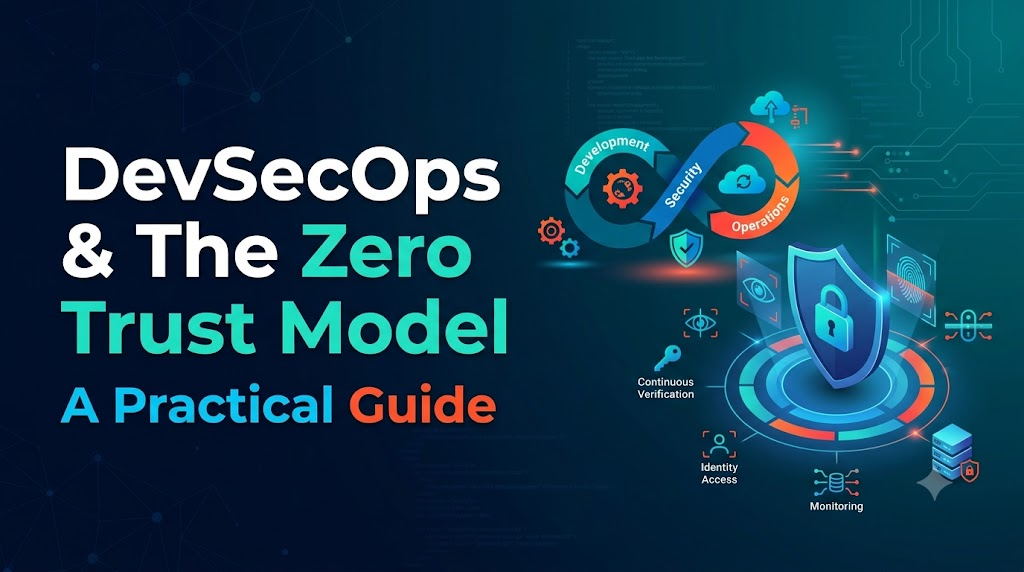
Introduction — Why DevSecOps Needs Zero Trust
Modern software delivery operates in an environment with no static perimeter. Applications no longer sit behind a single corporate firewall on monolithic servers. Instead, development teams deploy distributed microservices to multi-tenant cloud platforms, pull open-source packages from global repositories, consume managed SaaS APIs, and rely on automated continuous integration and continuous delivery (CI/CD) pipelines to release code multiple times a day.
While this operational agility has transformed software velocity, it has expanded the attack surface. Modern delivery chains introduce complex security risks:
- CI/CD build agents frequently run with excessive administrative privileges.
- Shared secrets and static API tokens linger unrotated in configuration files or pipeline environment variables.
- Third-party open-source dependencies introduce indirect supply chain vulnerabilities.
- Ephemeral cloud workloads communicate across broad, flat internal networks without explicit re-authentication.
Historically, organizations relied on a “castle-and-moat” security approach: once a user or machine authenticated to the internal network (often via VPN), that entity was implicitly trusted. If an attacker stole a developer’s credentials, breached an exposed staging runner, or compromised an external dependency, they could pivot laterally across production clusters and source-code repositories without resistance.
Traditional perimeter defense is insufficient for modern software delivery. Security teams require two complementary paradigms: DevSecOps and the Zero Trust security model. DevSecOps ensures security is systematically integrated into every phase of software development, rather than tacked on as an afterthought. Zero Trust eliminates implicit trust at every interaction point, establishing that every user, service, pipeline runner, and deployment target must be continuously authenticated, strictly authorized, and explicitly verified.
By integrating the Zero Trust architecture into DevSecOps security practices, engineering teams can build resilient software delivery lifecycles (SDLC) where compromised credentials or build systems do not escalate into catastrophic system-wide breaches.
What Is DevSecOps?
DevSecOps is the cultural, architectural, and technical practice of integrating security objectives directly into the development (Dev), security (Sec), and operations (Ops) lifecycle. Rather than positioning security as a gatekeeper conducting manual assessments at the end of a release cycle, DevSecOps establishes security as a shared responsibility across the entire engineering organization.
Key Pillars of DevSecOps
- Shift-Left Security: Security checks move earlier in the software development lifecycle. Developers receive feedback on security flaws while writing code in their local environments or opening pull requests, significantly reducing remediation costs and deployment bottlenecks.
- Automated Security Controls: Manual code reviews and periodic vulnerability assessments cannot scale with modern deployment schedules. DevSecOps embeds automated scanning tools directly into the CI/CD pipeline.
- Vulnerability and Dependency Management: Modern applications are composed of up to 80–90% open-source software. DevSecOps continuously inventories, evaluates, and patches third-party libraries, container base images, and external packages.
- Shared Collaboration and Culture: Security teams act as enablers rather than blockers. They define organizational security policies as automated rules, providing developers with self-service tooling and clear guidance.
Practical Example: Automated Scanning in a CI/CD Pipeline
In a standard DevSecOps pipeline, security scanning is automated at the pull request stage. For instance, when an engineer pushes code to a Git repository, the pipeline triggers a sequence of automated checks:
[ Developer Commit ]
       │
       ▼
[ SAST Scan ] ───────► (Checks custom source code for OWASP Top 10 flaws)
       │
       ▼
[ SCA Scan ] ────────► (Scans third-party dependencies for known CVEs)
       │
       ▼
[ Secret Scan ] ─────► (Detects hardcoded API keys, tokens, or private certificates)
       │
       ▼
[ Policy Gate ] ─────► (Blocks the build if Critical/High flaws are present)
If an engineer inadvertently hardcodes an AWS access key or introduces an npm library with a critical Remote Code Execution (RCE) vulnerability, the pipeline fails automatically. The scan produces an actionable report directly within the developer’s pull request interface, allowing rapid remediation before code merges into the release branch.
What Is the Zero Trust Model?
The Zero Trust security model is a strategic security framework founded on the principle: “Never trust, always verify.” Under Zero Trust, an organization grants no implicit trust to assets or user accounts based solely on their physical or network location (such as being inside a corporate intranet) or asset ownership.
The foundational standard for this model is NIST Special Publication 800-207 (Zero Trust Architecture). NIST defines Zero Trust as an enterprise cybersecurity architecture based on Zero Trust principles, designed to prevent unauthorized access to data and services while making access control enforcement as granular as possible.
Core Zero Trust Principles (NIST SP 800-207)
- Verify Explicitly: Always authenticate and authorize based on all available data points—including user identity, location, device health, service or workload context, data classification, and anomalies.
- Use Least Privilege Access: Limit user and machine access with Just-In-Time (JIT) and Just-Enough-Access (JEA) models, risk-based adaptive policies, and data protection mechanisms to protect both data and operational productivity.
- Assume Breach: Operate under the assumption that an attacker has already gained access to internal environments. Minimize the “blast radius” by segmenting access by network, user, devices, and application awareness. Encrypt all sessions end-to-end, enforce continuous monitoring, and use automated threat detection.
Zero Trust is not a single tool, commercial SKU, or turn-key product. It is a comprehensive architecture and operational philosophy. Implementing Zero Trust requires coordinating identity providers, endpoint compliance engines, network policy enforcement, data access controls, and runtime observability systems.
DevSecOps vs. Zero Trust
While DevSecOps and Zero Trust are frequently discussed together in cloud security, they address distinct operational dimensions:
| Aspect | DevSecOps | Zero Trust |
| Main Focus | Integrating security throughout the software delivery lifecycle | Enforcing secure, explicitly verified access across all resources |
| Primary Objective | Reduce vulnerabilities and security defects across software design, build, and deployment | Eliminate implicit trust, restrict unauthorized access, and minimize lateral movement (blast radius) |
| Scope | Source code, dependencies, build runners, deployment pipelines, test environments, and runtime operations | Identities (human and machine), devices, workloads, network microsegments, APIs, and data |
| Common Practices | Automated code scanning (SAST/DAST/SCA), secure coding guidelines, container scanning, infrastructure as code testing | Mutual TLS (mTLS), least privilege RBAC, short-lived tokens, OpenID Connect (OIDC) workload federation, microsegmentation |
| Typical Outcome | Resilient, vulnerability-tested software artifacts delivered at high velocity | Granular access control, strict isolation between systems, and reduced blast radius during security incidents |
These two disciplines are complementary. DevSecOps addresses how software is built and shipped, whereas Zero Trust governs how entities, systems, and components access resources and communicate.
Why DevSecOps and Zero Trust Work Better Together
A common security anti-pattern is applying DevSecOps practices within an environment that maintains implicit network trust. In this scenario, an organization may run thorough automated scans on their application code, yet their CI/CD build runner holds static, permanent cloud administrative credentials and resides on an unsegmented production network. If that build runner is compromised, the scanning tools provide zero protection against infrastructure takeover.
Conversely, applying Zero Trust principles to runtime infrastructure without DevSecOps creates blind spots. An organization might require strict mutual TLS and multi-factor authentication (MFA) to access a database, but if the development team deploys an untested application artifact containing an unpatched remote code execution vulnerability, the workload can still be exploited.
Synergies of Combining Both Frameworks
When integrated, DevSecOps and Zero Trust reinforce modern engineering environments:
- Protecting Source-Code Repositories: Enforcing MFA, hardware security keys, and cryptographic commit signing (GPG/SSH) ensures only verified developers push code to protected branches.
- Securing Automation Identities: Build runners and deployment agents stop using permanent, high-privilege API keys, replacing them with federated, short-lived tokens.
- Securing the Software Supply Chain: Software Bills of Materials (SBOMs) and cryptographic provenance attestations (such as Sigstore/Cosign) verify that deployed binaries match the exact, verified code produced by the pipeline.
- Granular Cloud Workload Permissions: Workloads run with narrowly scoped cloud IAM roles rather than broad root or administrative access.
- Reducing Blast Radius: Microsegmentation prevents a compromised web container from accessing internal databases, orchestration control planes, or sibling workloads.
Real-World Scenario: The Compromised CI/CD Credential
Consider a real-world scenario demonstrating how these frameworks interact:
[ Attacker Breaches Pipeline Runner ]
                   │
    ┌──────────────┴──────────────┐
    ▼                             ▼
Traditional Pipeline Setup     Zero Trust + DevSecOps Setup
─────────────────────────     ────────────────────────────
• Permanent AWS Admin Key     • Short-lived OIDC Token (15-min TTL)
• Unrestricted IP access      • Scoped strictly to S3 deployment bucket
• Full lateral movement       • Network segmented from production VPC
                              • Deployment artifact rejected without Cosign signature
─────────────────────────     ────────────────────────────
RESULT: Total Cloud Takeover   RESULT: Blast Radius Contained to Build Cache
- Without Zero Trust: The pipeline runner stores a static
AWS_ACCESS_KEY_IDandAWS_SECRET_ACCESS_KEYin environment variables with broad permissions (AdministratorAccess). An attacker exploits a vulnerable third-party GitHub Action or dependency script, extracts the credentials, and achieves complete control of the AWS account from an external IP address. - With Zero Trust in DevSecOps: The runner uses OpenID Connect (OIDC) identity federation to assume an IAM role dynamically. The role grants only
s3:PutObjectpermissions to a specific deployment staging bucket, expires after 15 minutes, and restricts requests using IAM condition keys matching the repository name, branch, and runner identity. The attacker extracts a token that expires almost immediately and cannot be used to modify infrastructure, read database contents, or move laterally across the network.
Core Zero Trust Principles in DevSecOps
Integrating Zero Trust into DevSecOps requires implementing concrete controls across six core architectural pillars:
       ┌────────────────────────────────────────────────────────┐
       │             CORE ZERO TRUST ARCHITECTURE               │
       └───────────────────────────┬────────────────────────────┘
                                   │
   ┌────────────────┬──────────────┼──────────────┬────────────────┐
   ▼                ▼              ▼              ▼                ▼
[ Identity ]    [ Least ]     [ Workload ]   [ Continuous ]  [ Segmentation ]
Verification    Privilege      Identities     Verification      & Monitoring
   (MFA/SSO)      (RBAC)      (OIDC/Vault)   (Policy Gates)    (eBPF/Logging)
1. Identity Verification
Identity is the primary security perimeter. In a Zero Trust DevSecOps pipeline, every entity—human developer, automated script, build runner, or deployed container—must establish its identity explicitly.
- Humans: Mandatory Multi-Factor Authentication (MFA) backed by FIDO2/WebAuthn hardware keys for access to version control systems (e.g., GitHub, GitLab), cloud consoles, and artifact repositories. Single Sign-On (SSO) ties access to centralized corporate identity providers.
- Machines: Deprecate static, shared service accounts. Automation runners authenticate via contextual metadata (e.g., cryptographic proof of repository origin, workflow run ID, and organization identity).
2. Least Privilege Access
Entities must operate with only the minimum permissions necessary to complete their specific function, for only the required duration.
- Repository Controls: Developers do not have push access directly to production or release branches. All changes require signed commits, peer code reviews, and passing automated status checks.
- Separation of Duties: The CI system that compiles code and runs unit tests must not possess the deployment keys required to push code to production environments. Continuous delivery components must be isolated from continuous integration environments.
- Periodic Access Reviews: Automated audits systematically revoke unused entitlements, stale API tokens, and dormant accounts.
3. Workload Identity and Secrets Management
Hardcoded credentials inside source repositories, container images, or configuration files are critical security liabilities.
- Workload Identity Federation: Modern cloud environments support federating CI/CD runners directly with cloud IAM through OIDC. Runners exchange an ephemeral, cryptographically signed JWT token for short-lived cloud credentials, completely eliminating static credentials.
- Centralized Secrets Vaults: Secrets that cannot be federated (such as legacy database passwords or third-party SaaS tokens) must reside in dedicated, centralized secrets managers (e.g., HashiCorp Vault, AWS Secrets Manager). Applications inject secrets into memory at runtime via short-lived leases with strict access auditing.
4. Continuous Verification
Authentication cannot be treated as a single, one-time check at the boundary. DevSecOps workflows require continuous validation of state and posture:
- CI/CD pipelines evaluate policy continuously: Has the base container image been modified? Has a new vulnerability been published for an existing package since the build started?
- In runtime, admission controllers (e.g., Kubernetes Validating Webhooks) inspect every deployed resource before allowing it to start, blocking any image that lacks a valid signature from an authorized build pipeline.
5. Segmentation and Resource Protection
Flat network topologies allow compromised assets to attack adjacent workloads unimpeded.
- Microsegmentation: Containerized applications in platforms like Kubernetes should use Network Policies to enforce default-deny rules on both ingress and egress network traffic. A frontend microservice should only be physically capable of reaching the backend API service, not the underlying database or adjacent cluster namespaces.
- Isolated Build Environments: CI/CD runners should operate in ephemeral, isolated environments (such as temporary virtual machines or short-lived container pods) that are discarded immediately after the job finishes. This prevents cross-build data leakage and persistent runner compromises.
6. Security Monitoring and Auditability
You cannot secure what you cannot observe. A Zero Trust architecture requires comprehensive, tamper-evident telemetry:
- Every pipeline execution, pull request approval, credential issuance, and API request must generate structured audit logs.
- Workload telemetry at runtime (captured via eBPF-based tooling or platform audit logs) monitors for anomalous system behavior—such as unexpected process spawning, container breakout attempts, or unauthorized outbound network connections.
Implementing Zero Trust Across the DevSecOps Lifecycle
Applying Zero Trust principles across the Software Development Lifecycle requires embedding targeted controls at every stage:
[ Plan ] ──► [ Code ] ──► [ Build ] ──► [ Test ] ──► [ Deploy ] ──► [ Runtime ]
1. Planning Phase
- Threat Modeling: Map data flows, trust boundaries, and potential attack paths before writing code.
- Security Requirements: Define identity models, secret storage requirements, and least-privilege boundary definitions during backlog grooming.
2. Coding Phase
- Protected Source Control: Enforce branch protection rules, require two-person code reviews, and mandate cryptographically signed commits using developer GPG or SSH keys.
- Pre-Commit Hooks & IDE Scanners: Run lightweight secret detection (e.g., detect-secrets, Gitleaks) and Static Application Security Testing (SAST) in local development environments to catch issues before code leaves the engineer’s workstation.
3. Building Phase
- Isolated Build Runners: Run builds inside single-use, ephemeral virtual machines or containers with no access to external networks unless explicitly required for downloading dependencies.
- Software Bill of Materials (SBOM): Generate automated SBOMs (in SPDX or CycloneDX formats) to capture an exact inventory of all direct and transitive dependencies used during the build.
- Dependency Pinning & Scanning: Use package lockfiles with cryptographic checksum verification to prevent dependency confusion and typosquatting attacks.
4. Testing Phase
- Dynamic & Interactive Testing: Execute Dynamic Application Security Testing (DAST) and Interactive Application Security Testing (IAST) in strictly segmented staging environments.
- Policy-as-Code Validation: Run automated configuration testing against Infrastructure as Code (IaC) templates (Terraform, CloudFormation, Kubernetes manifests) to ensure resources comply with least-privilege policies before provisioning.
5. Deployment Phase
- Cryptographic Provenance & Signing: Sign compiled artifacts and container images using tools like Sigstore/Cosign. The signature confirms the artifact was produced by an authorized CI pipeline and has not been altered.
- Deployment-Specific Workload Identities: Use short-lived, environment-scoped identities for deployment operators (e.g., GitOps engines like ArgoCD). The deployment agent receives write access only to the specific deployment target, never cluster-wide administrative rights.
6. Runtime Phase
- Admission Control Enforcement: Kubernetes admission controllers verify image signatures, provenance attestations, and compliance postures before workloads schedule on nodes.
- Runtime Threat Detection: Use behavioral analysis tools (e.g., Falco) to flag policy violations, such as a web server opening an interactive shell or writing to a read-only root filesystem.
- Mutual TLS (mTLS): Enforce strict service-to-service encryption and cryptographic identity validation using a service mesh (e.g., Istio, Linkerd) so microservices verify each other independently of the network path.
Summary: DevSecOps Lifecycle Mapped to Zero Trust Controls
| SDLC Phase | DevSecOps Practice | Zero Trust Control Applied |
| Plan | Threat modeling and architecture review | Define trust boundaries, external interfaces, and data classifications |
| Code | Secret detection, IDE linting, peer reviews | Commit signing (GPG), hardware MFA for repository access, branch protection |
| Build | SCA scanning, SAST, SBOM generation | Ephemeral isolated runners, read-only caches, package hash verification |
| Test | Policy validation, DAST, IaC scanning | Automated policy-as-code enforcement, segmented test environments |
| Deploy | GitOps releases, artifact attestation | Cryptographic image signing (Cosign), short-lived OIDC deployment tokens |
| Runtime | Behavioral monitoring, vulnerability management | Mutual TLS (mTLS), default-deny network policies, admission control validation |
Tools That Support DevSecOps and Zero Trust
Implementing this model relies on specialized tools that integrate across identity, automation, and infrastructure layers. No single tool delivers a complete Zero Trust architecture; rather, each tool handles a distinct control plane.
       ┌────────────────────────────────────────────────────────┐
       │             DEVSECOPS & ZERO TRUST TOOLCHAIN           │
       └───────────────────────────┬────────────────────────────┘
                                   │
   ┌────────────────┬──────────────┼──────────────┬────────────────┐
   ▼                ▼              ▼              ▼                ▼
[ Identity & ]   [ Code & ]     [ Supply ]     [ Policy as ]  [ Runtime & ]
  Secrets         IaC Scanners    Chain          Code          Observability
(Vault, OIDC)   (Semgrep,       (Cosign,        (OPA,          (Falco,
                 Checkov)        Trivy)          Kyverno)       Prometheus)
Core Tool Categories and Capabilities
- Identity & Access Management (IAM) Platforms: Centralize enterprise identity, enforce adaptive MFA, and manage role-based or attribute-based access controls across cloud and developer portals (e.g., Okta, Microsoft Entra ID, AWS IAM).
- Secrets Management Systems: Eliminate static credentials by generating ephemeral, audited secrets and managing dynamic database access (e.g., HashiCorp Vault, AWS Secrets Manager, CyberArk).
- Static Application Security Testing (SAST): Parse application source code without executing it to identify security vulnerabilities, insecure design patterns, and injection vectors (e.g., Semgrep, SonarQube).
- Software Composition Analysis (SCA): Inspect open-source packages and dependencies for known Common Vulnerabilities and Exposures (CVEs) and license compliance issues (e.g., Snyk Open Source, OWASP Dependency-Check).
- Infrastructure as Code (IaC) Security: Scan declarative configuration files (Terraform, Bicep, Ansible, Helm) to prevent insecure infrastructure misconfigurations like publicly exposed cloud storage or unencrypted volumes (e.g., Checkov, tfsec, Trivy).
- Container Image Scanning & Supply Chain Verification: Detect vulnerabilities in container base OS layers, generate SBOMs, and verify cryptographic signatures before deployment (e.g., Trivy, Sigstore Cosign, Grype).
- Policy as Code (PaC) Engines: Decouple security policy from underlying platform implementations by codifying policies into declarative languages that can be tested in CI and enforced at deployment admission (e.g., Open Policy Agent/Styra, Kyverno).
- Runtime Observability & Security Monitoring: Collect kernel-level system call telemetry, monitor microservice interactions, and detect anomalies across cloud-native environments (e.g., Falco, Sysdig, Prometheus, Grafana Loki).
Tool Category Comparison
| Tool Category | Main Security Purpose | Example Use Case |
| Identity & Secrets | Eliminate static credentials and verify identities | Using HashiCorp Vault to issue 15-minute dynamic database credentials to microservices |
| Source Code Analysis (SAST) | Identify insecure code flaws before deployment | Using Semgrep in a GitHub Actions workflow to detect SQL injection patterns |
| IaC Security | Identify cloud misconfigurations during pull requests | Using Checkov to block a Terraform plan that creates an unencrypted S3 bucket |
| Container & Supply Chain | Ensure image integrity and vulnerability tracking | Using Trivy to scan Dockerfiles and Cosign to cryptographically sign release images |
| Policy as Code | Enforce unified rules across CI, IaC, and Kubernetes | Using Open Policy Agent (OPA) to deny containers running as the root user |
| Runtime Detection | Monitor system events and block suspicious operations | Using Falco to trigger alerts if an unexpected shell spawns inside a production container |
A Step-by-Step Zero Trust Implementation Roadmap
Transitioning to a Zero Trust DevSecOps posture is an incremental journey. Organizations that attempt to lock down all systems simultaneously risk breaking existing build processes and introducing developer fatigue. A phased, risk-based roadmap ensures sustainable adoption:
[ Phase 1 ] ──► [ Phase 2 ] ──► [ Phase 3 ] ──► [ Phase 4 ] ──► [ Phase 5 ] ──► [ Phase 6 ]
  Assess &        Harden         Secure         Policy as       Continuous       Audit &
 Inventory       Identities      CI/CD            Code          Visibility       Iterate
Phase 1: Assess and Inventory the Environment
- Compile a comprehensive catalog of all repositories, CI/CD runners, cloud resources, external dependencies, and service accounts.
- Identify sensitive workloads, production data stores, and critical software delivery paths.
- Map existing trust assumptions: Where do static keys live? Which systems allow unrestricted lateral network access?
Phase 2: Strengthen Identity Controls
- Enforce phishing-resistant multi-factor authentication across all developer tooling, version control platforms, and cloud portals.
- Replace permanent developer cloud admin access with temporary, just-in-time privilege escalation models.
- Inventory service accounts and identify opportunities to transition from static API keys to workload identity federation (OIDC).
Phase 3: Secure the CI/CD Pipeline
- Isolate CI/CD build agents into single-use, ephemeral environments.
- Eliminate static cloud provider credentials from CI pipeline configuration variables.
- Implement pre-commit hooks and automated scanning (SAST, SCA, secrets detection) as mandatory status checks in version control.
Phase 4: Introduce Policy as Code
- Codify organizational compliance standards into declarative policy rules using tools like Open Policy Agent or Kyverno.
- Integrate policy evaluations into the pull request process to provide automated feedback on infrastructure templates.
- Deploy admission controllers in Kubernetes to enforce policy gates at deployment time.
Phase 5: Improve Runtime Visibility and Segmentation
- Implement default-deny network segmentation policies for all production container namespaces and cloud VPCs.
- Enable mutual TLS (mTLS) between microservices to authenticate service-to-service communication.
- Centralize pipeline logs, cloud access audits, and runtime security events into a centralized security information system.
Phase 6: Review, Test, and Continuously Improve
- Conduct automated vulnerability scans and periodic access reviews.
- Execute simulated breach exercises (red team/purple team) to evaluate whether a compromised runner can move laterally.
- Refine automated policies based on developer feedback and operational metrics.
Practical Example — A Secure Zero Trust CI/CD Pipeline
The following end-to-end scenario illustrates how Zero Trust principles operate within an automated deployment workflow:
[ Developer ]
      │ (1. Authenticates with FIDO2 MFA; pushes GPG-signed commit)
      ▼
[ Version Control: GitHub ]
      │ (2. Triggers isolated, ephemeral runner)
      ▼
[ Ephemeral Runner ]
      │ (3. SAST, SCA, and Secret scans complete successfully)
      │ (4. Compiles binary and builds container image)
      ▼
[ OIDC Identity Exchange ]
      │ (5. Runner exchanges temporary GitHub JWT for short-lived AWS IAM token)
      ▼
[ Image Registry & Signing ]
      │ (6. Pushes image to Amazon ECR; signs artifact digest with Cosign)
      ▼
[ Kubernetes Admission Controller ]
      │ (7. Validates Cosign signature and verifies policy compliance)
      ▼
[ Production Cluster ] (8. Deploys container with mTLS, read-only root, and scoped IAM)
Workflow Walkthrough
- Developer Authentication & Code Submission:An engineer logs into the enterprise Git platform using Single Sign-On protected by a hardware security key (FIDO2). They submit a pull request containing a feature change. The commit is cryptographically signed with their local SSH/GPG key, confirming author authenticity.
- Triggering the Isolated Runner:The pull request triggers a workflow on an ephemeral GitHub Actions runner hosted within a private virtual network. The runner is created dynamically for this job and destroyed upon completion.
- Automated Security Gates:The pipeline executes automated testing:
- Semgrep scans the application code for common software flaws.
- Trivy reviews dependencies against the National Vulnerability Database (NVD).
- Gitleaks verifies no secrets were included in the commit.If any check identifies a high-severity issue, the pipeline halts immediately.
- Building and Documenting Artifacts:The application is compiled into a container image. During the build, an automated task generates a comprehensive Software Bill of Materials (SBOM) in CycloneDX format, recording the exact package versions compiled into the binary.
- Workload Identity Federation (No Static Keys):The runner requires access to Amazon Elastic Container Registry (ECR) to publish the image. Instead of using static AWS credentials stored in repository secrets, the runner requests an OpenID Connect (OIDC) token from GitHub. It presents this cryptographically signed JSON Web Token to AWS Security Token Service (STS) using the
sts:AssumeRoleWithWebIdentityAPI call. AWS validates the token signature, confirms that the repository name and workflow match configured trust policies, and issues a temporary IAM credential valid for 15 minutes. - Cryptographic Signing and Registry Publication:Using the short-lived credentials, the runner pushes the container image to ECR. The runner invokes Sigstore Cosign to sign the image digest using a keyless workflow. The cryptographic signature and the SBOM attestation are stored alongside the image in the registry.
- Admission Control Validation:The deployment process notifies the production Kubernetes cluster via a GitOps operator (such as ArgoCD). Before any container starts, an in-cluster admission controller (such as Kyverno or OPA Gatekeeper) intercepts the deployment request. The admission controller:
- Verifies the container image has a valid signature produced by the approved CI/CD workflow.
- Confirms the vulnerability scan contains zero unapproved Critical CVEs.
- Rejects the deployment if the pod definition requests root privileges or host network access.
- Runtime Protection:The verified pod launches inside an isolated Kubernetes namespace governed by strict Network Policies. Mutual TLS encrypts all pod-to-pod traffic, and the application assumes a narrowly scoped AWS IAM Role for Service Accounts (IRSA) allowing access only to its specific DynamoDB table.
Note: This workflow is an illustrative architectural scenario showing how modern tools interact under Zero Trust principles, not a rigid blueprint that fits every environment.
Common Challenges and How to Overcome Them
Implementing Zero Trust across DevSecOps pipelines introduces real-world technical and organizational hurdles. Engineering leadership must recognize and plan for these challenges:
1. Legacy Systems and Hardcoded Technical Debt
- Challenge: Older enterprise applications and legacy build servers often depend on static configurations, shared service accounts, or hardcoded database passwords that do not support modern OIDC or SSO federation.
- Solution: Adopt a phased migration strategy. Place legacy systems behind identity-aware proxies, use secrets management tools (e.g., HashiCorp Vault) to inject dynamic credentials at the perimeter, and prioritize mission-critical services for refactoring.
2. Excessive Permissions and Configuration Drift
- Challenge: Development teams frequently assign broad permissions (e.g.,
AdministratorAccessor cluster-admin) during initial setup to avoid access-related blockers, and these permissions remain indefinitely in production. - Solution: Implement automated access profiling tools (such as AWS IAM Access Analyzer) to observe actual resource usage over 30–60 days. Replace over-permissive policies with least-privilege policies tailored strictly to observed behavior, and introduce automated Slack/chat-based Just-In-Time access workflows for temporary elevations.
3. Developer Friction and Operational Bottlenecks
- Challenge: If security controls add significant friction—such as failing builds on minor issues, demanding frequent manual approvals, or slowing down pipeline execution times—developers will seek workarounds, degrading collaboration.
- Solution: Design security controls as an internal developer platform service. Run intensive security scans asynchronously on pull requests rather than blocking basic development branches. Provide clear, automated remediation instructions directly within the developer’s pull request interface.
4. Alert Fatigue and High False-Positive Rates
- Challenge: Poorly tuned SAST and dependency scanners can flag hundreds of theoretical or non-exploitable vulnerabilities, overwhelming engineering teams.
- Solution: Implement contextual analysis. Prioritize remediation using the Exploit Prediction Scoring System (EPSS) and CISA’s Known Exploited Vulnerabilities (KEV) catalog. Configure scanners to fail builds only on high-confidence, exploitable flaws directly impacting the attack surface.
5. Tool Sprawl and Operational Complexity
- Challenge: Adopting disparate standalone tools for SAST, SCA, container scanning, cloud posture management, and secrets management creates fragmented data silos and administrative overhead.
- Solution: Prioritize modular platforms that support open standards (such as Open Policy Agent and SARIF reporting formats). Consolidate reporting into unified developer portals or security dashboards to provide a single source of truth.
Best Practices Checklist
Use this actionable checklist to evaluate your organization’s alignment with Zero Trust DevSecOps principles:
Identity & Access Controls
- Multi-Factor Authentication (phishing-resistant FIDO2/WebAuthn preferred) is enforced across all version control, CI/CD, and cloud platforms.
- Static cloud access keys have been eliminated from CI/CD runner settings in favor of OIDC workload identity federation.
- Developers operate without permanent administrative permissions in production cloud environments.
- Access control policies adhere to least-privilege principles and undergo scheduled quarterly audits.
Pipeline & Source Code Security
- Version control branches require signed commits, peer reviews, and passing automated status gates prior to merging.
- Automated secret detection tools run as pre-commit hooks and as blocking gates in CI pipelines.
- Build runners execute in ephemeral, isolated environments that terminate immediately after job completion.
- Software Bills of Materials (SBOMs) are generated automatically for all release artifacts.
Artifact Integrity & Deployment Controls
- Release artifacts and container images are cryptographically signed during the build phase.
- Kubernetes admission controllers block unsigned images or containers configured to run with root privileges.
- Production deployments are automated via GitOps or dedicated continuous delivery agents with restricted environment access.
Infrastructure & Runtime Security
- Infrastructure as Code templates are scanned for policy violations before provisioning cloud infrastructure.
- Cloud workloads and container pods operate under default-deny network segmentation policies.
- Microservices communicate using mutual TLS (mTLS) for mutual authentication and encryption.
- Runtime system calls and audit logs are continuously analyzed for anomalous or unauthorized activity.
How to Measure Success
Measuring the success of a Zero Trust DevSecOps initiative requires tracking actionable operational metrics rather than vanity indicators. The following metrics evaluate technical risk reduction, pipeline security, and organizational efficiency:
┌─────────────────────────────────┬─────────────────────────────────┐
│     SECURITY & POSTURE METRICS  │    ENGINEERING & VELOCITY METRICS│
├─────────────────────────────────┼─────────────────────────────────┤
│ • Static Credential Count       │ • Mean Time to Remediate (MTTR) │
│ • Artifact Signature Coverage   │ • Vulnerability Fix Rate        │
│ • Excessive Permission Reductions│ • Unresolved Policy Exceptions  │
└─────────────────────────────────┴─────────────────────────────────┘
- Static Credential Reduction:
- What to measure: The total count of long-lived, static API keys and service account credentials stored across CI/CD settings and codebases.
- Objective: Drive this metric toward zero by migrating to workload identity federation (OIDC) and dynamic secrets.
- Artifact Signature and Provenance Coverage:
- What to measure: The percentage of production container images and deployment artifacts that possess a cryptographically verified signature and SBOM attestation.
- Objective: Achieve 100% verification for all production release candidates.
- Mean Time to Remediate (MTTR) High-Severity Vulnerabilities:
- What to measure: The average number of days elapsed between the detection of a critical vulnerability (in code or dependencies) and the deployment of a validated patch.
- Objective: Continuously decrease MTTR by shifting security feedback left into developer pull requests.
- Least Privilege Coverage & Entitlement Reduction:
- What to measure: The number of overly permissive cloud IAM roles (such as wildcard
*permissions) identified and scoped down to specific actions. - Objective: Demonstrate a steady decrease in over-privileged roles and unused entitlements across the enterprise.
- What to measure: The number of overly permissive cloud IAM roles (such as wildcard
- Policy Violation Rates in Pre-Production vs. Production:
- What to measure: The number of policy compliance violations detected early in IaC pull request scans versus those detected after deployment in live environments.
- Objective: Shift policy violations left, catching the vast majority during the build and test phases.
- Number and Age of Policy Exceptions:
- What to measure: Active security exceptions granted to bypass scanning gates or least-privilege policies, along with their age.
- Objective: Maintain minimal active exceptions, with mandatory expiration dates and documented remediation roadmaps.
Context Note: Metrics must be evaluated within your organization’s specific operational context. Achieving low numbers on vulnerability reports does not independently prove an application is secure if scanning coverage is incomplete or underlying assets remain uninventoried.
Hands-On Projects for Learning DevSecOps and Zero Trust
Practical, hands-on implementation is the most effective way to understand how Zero Trust and DevSecOps intersect. Below are four beginner-to-intermediate projects designed to be executed safely in isolated, non-production sandbox environments using sample applications.
Project 1: Secure a CI/CD Pipeline with Automated Scanning Gates
- Objective: Build an automated GitHub Actions pipeline that inspects a sample web application for source code vulnerabilities, vulnerable third-party dependencies, and hardcoded secrets.
- Prerequisites: A free GitHub account and basic familiarity with Git commands and Docker.
- Tools Used: GitHub Actions, Semgrep (SAST), Trivy (SCA & Container Scanning), Gitleaks (Secret Detection).
- Implementation Outline:
- Fork a sample open-source application (e.g., a simple Node.js or Python Flask API) to your GitHub account.
- Create a
.github/workflows/security-scan.ymlpipeline file. - Configure a job that executes Gitleaks to detect exposed credentials.
- Add a step running Semgrep with standard OWASP rulesets to identify code-level flaws.
- Add a step using Trivy to scan package dependencies and output an automated vulnerability report.
- Intentionally introduce a test secret (such as a dummy, invalid token format) in a feature branch and confirm that the pull request status gate fails automatically.
- Expected Learning Outcomes: Understand how automated security gates operate, how to interpret scan results, and how to prevent vulnerable code from merging.
- Portfolio Evidence: A public GitHub repository featuring a configured workflow file, successful action run logs, and a sample pull request demonstrating a blocked build due to an intentional vulnerability.
Project 2: Implement Least Privilege with OIDC Workload Identity
- Objective: Configure a CI/CD pipeline runner to deploy files to an Amazon S3 bucket using temporary OpenID Connect (OIDC) identity federation instead of hardcoded AWS credentials.
- Prerequisites: An AWS Free Tier account and a GitHub repository.
- Tools Used: GitHub Actions, AWS IAM, AWS S3.
- Implementation Outline:
- In the AWS IAM console, create an OpenID Connect identity provider pointing to
[https://token.actions.githubusercontent.com](https://token.actions.githubusercontent.com). - Create a dedicated IAM role with a trust policy restricting the
sub(subject) claim to your specific GitHub repository name andmainbranch. - Attach an IAM permission policy granting only
s3:PutObjectaccess to a single designated test bucket. - Write a GitHub Actions workflow using the official
aws-actions/configure-aws-credentialsaction to assume the role dynamically without configuring any static AWS access keys in repository secrets. - Run the workflow to verify successful file synchronization, then test running the workflow from an unauthorized test branch to confirm access is denied.
- In the AWS IAM console, create an OpenID Connect identity provider pointing to
- Expected Learning Outcomes: Hands-on mastery of eliminating static secrets, configuring machine-to-machine federation, and enforcing strict IAM least-privilege scoping.
- Portfolio Evidence: Documented IAM trust policy JSON, sanitized GitHub Actions YAML configuration, and successful pipeline execution logs verifying token assumption.
Project 3: Enforce Policy as Code on Infrastructure as Code (IaC)
- Objective: Write and enforce automated security policies against Terraform configuration files to prevent the creation of insecure cloud infrastructure.
- Prerequisites: Terraform installed locally, basic understanding of cloud resource definitions.
- Tools Used: Terraform, Checkov, Open Policy Agent (OPA) / Conftest.
- Implementation Outline:
- Create a basic Terraform configuration file (
main.tf) that defines an Amazon S3 bucket and an AWS Security Group. - Configure the S3 bucket with intentionally insecure settings (e.g., public read access enabled, encryption disabled) and open the security group to
0.0.0.0/0on port 22 (SSH). - Install Checkov locally or configure it as a CLI check.
- Run Checkov against your Terraform files to view the detected misconfigurations and failed policy checks.
- Write a custom policy using Conftest (Rego language) that mandates that all S3 buckets must have an environment tag (
Environment = "development" | "production"). - Remediate the Terraform code to resolve all failures and re-run the scanner until all checks pass cleanly.
- Create a basic Terraform configuration file (
- Expected Learning Outcomes: Understand how declarative policy-as-code catches misconfigurations before provisioning infrastructure, reducing reliance on manual review.
- Portfolio Evidence: A repository containing the initial insecure Terraform file, the custom Rego policy rule, the updated and remediated Terraform file, and terminal output showing passing compliance checks.
Project 4: Build a Secure Container Workflow with Cryptographic Signing
- Objective: Build a container image, scan it for operating system vulnerabilities, and cryptographically sign the image using Sigstore Cosign before enforcing signature verification.
- Prerequisites: Docker installed, a Docker Hub or GitHub Packages account.
- Tools Used: Docker, Trivy, Sigstore Cosign.
- Implementation Outline:
- Create a minimal
Dockerfilepackaging an application using an official alpine base image. - Build the container image locally and run Trivy to scan the base image for vulnerabilities.
- Install the Cosign CLI tool.
- Generate a cryptographic key pair using
cosign generate-key-pair(or use Cosign’s keyless OIDC flow). - Push the built image to your container registry.
- Sign the container image digest using
cosign sign --key cosign.key <IMAGE_DIGEST>. - Verify the cryptographic signature using
cosign verify --key cosign.pub <IMAGE_DIGEST>to prove the image remains unaltered.
- Create a minimal
- Expected Learning Outcomes: Practical experience with software supply chain security, image integrity verification, and preventing artifact tampering.
- Portfolio Evidence: A step-by-step technical tutorial or markdown guide in your portfolio documenting the build, scan, sign, and verification commands with actual terminal output.
Learning DevSecOps with DevOpsSchool
Developing practical expertise in modern security architectures requires bridging theoretical principles with hands-on technical execution. For engineers, architects, and IT professionals seeking to deepen their understanding of DevSecOps, automation pipelines, and cloud security architectures, DevOpsSchool provides a comprehensive platform for technical education.
DevOpsSchool offers structured learning programs, industry-focused tutorials, and hands-on training covering:
- DevSecOps Methodologies: Shifting security left across enterprise CI/CD pipelines.
- Cloud Security & Zero Trust Architecture: Designing least-privilege access models across multi-cloud environments.
- Infrastructure as Code & Policy as Code: Automating compliance using tools like Terraform, Ansible, and Open Policy Agent.
- Containerization & Kubernetes Security: Implementing runtime observability, network microsegmentation, and cluster hardening.
Whether you are an aspiring engineer transitioning into cloud security or an experienced practitioner aiming to modernize your organization’s delivery pipelines, exploring structured tutorials and practical project labs can help you master the tools and operational mindsets required for modern software delivery.
Explore educational programs, certifications, and technical articles at DevOpsSchool.com.
Frequently Asked Questions
1. What is the relationship between DevSecOps and Zero Trust?
DevSecOps and Zero Trust are complementary disciplines. DevSecOps embeds automated security practices directly across the software development and deployment lifecycle, while Zero Trust provides the architectural framework ensuring that all users, build runners, workloads, and data flows are strictly authenticated, authorized, and continuously verified.
2. Is Zero Trust a tool or a security architecture?
Zero Trust is a security architecture and operational philosophy, not a standalone tool or product. Defined by standards like NIST SP 800-207, it relies on a coordinated ecosystem of identity providers, policy enforcement engines, secrets managers, microsegmentation, and observability platforms.
3. How does Zero Trust protect a CI/CD pipeline?
Zero Trust protects pipelines by eliminating static, high-privilege credentials. It introduces short-lived, federated machine identities (via OIDC), runs build steps in ephemeral isolated environments, requires cryptographic signing for release artifacts, and applies least-privilege permissions to deployment operators.
4. What is the main difference between DevSecOps and Zero Trust?
DevSecOps focuses primarily on the software delivery lifecycle—ensuring code, dependencies, and deployment templates are secure before they reach production. Zero Trust focuses on access control and interaction security—ensuring that no entity or system receives implicit trust, regardless of network location.
5. Why is least privilege important in DevOps?
Automation tools in DevOps workflows frequently interact with sensitive infrastructure. Applying least privilege ensures that if an attacker compromises a developer account, a third-party dependency, or a CI/CD build runner, they cannot leverage broad permissions to access production databases or take over cloud accounts.
6. Which tools support DevSecOps and Zero Trust practices?
Key tools include identity and secrets management systems (HashiCorp Vault, cloud IAM), static code analysis tools (Semgrep, SonarQube), dependency and container scanners (Trivy, Snyk), policy-as-code engines (Open Policy Agent, Kyverno), artifact signing utilities (Sigstore Cosign), and runtime security monitors (Falco).
7. How can organizations secure CI/CD credentials?
Organizations should eliminate permanent cloud access keys from repository variables and instead adopt OpenID Connect (OIDC) identity federation. This allows build runners to authenticate dynamically using temporary, short-lived tokens scoped strictly to specific tasks and branches.
8. Can Zero Trust be applied to cloud-native applications?
Yes. Cloud-native architectures are ideal for Zero Trust. Organizations implement mutual TLS (mTLS) for microservice authentication, Kubernetes Network Policies for microsegmentation, OIDC for workload identity, and admission controllers to verify artifact signatures prior to execution.
9. What are the biggest challenges of implementing Zero Trust?
Common hurdles include legacy systems that do not support modern identity protocols, sprawling excessive permissions, false-positive alerts causing developer friction, and organizational resistance to tightening access controls across operational workflows.
10. How can beginners practice DevSecOps and Zero Trust?
Beginners can start by setting up automated code and secret scanning in free GitHub Actions workflows, writing Terraform policies using tools like Checkov, learning to sign container images with Cosign, and using non-production cloud accounts to configure OIDC authentication.
11. Does Zero Trust eliminate all security risks?
No security framework eliminates all risk. Zero Trust assumes breaches will occur and focuses on minimizing the attack surface and blast radius. It must be paired with robust vulnerability management, secure coding standards, defense-in-depth, and incident response procedures.
12. How can organizations measure their progress?
Organizations can track metrics such as the reduction of static credentials, the percentage of production artifacts with verified cryptographic signatures, the coverage of automated security scanning across repositories, and the Mean Time to Remediate (MTTR) critical security flaws.
Conclusion
The velocity of modern software delivery makes traditional perimeter-based security obsolete. As organizations deploy distributed microservices to dynamic cloud platforms, securing the software lifecycle requires unifying how software is developed with how systems interact. DevSecOps embeds security testing, dependency scanning, and vulnerability discovery early in the software development lifecycle. The Zero Trust security model reinforces this foundation by eliminating implicit trust across identities, build automation, service-to-service networks, and deployment targets. Together, these frameworks replace brittle, over-privileged environments with resilient, continuously verified systems. By establishing least-privilege access, adopting short-lived workload identities, validating cryptographic artifact signatures, and maintaining deep observability, engineering teams can innovate rapidly without sacrificing operational security.
To begin this journey:
- Start small: Inventory your critical assets and identify high-risk static credentials.
- Iterate gradually: Replace permanent CI/CD tokens with federated workload identities and introduce automated scanning gates into developer workflows.
- Make security a shared engineering habit: Provide developers with clear, automated feedback and self-service security tooling.
For hands-on tutorials, professional training programs, and comprehensive guides on modernizing your engineering workflows, explore the educational resources available at DevOpsSchool.






Leave a Reply
You must be logged in to post a comment.