Introduction
Digital transformation is no longer a choice; it is an operational mandate for survival. As organizations shift from legacy monolithic structures to cloud-native, microservices-oriented architectures, the speed of delivery has become a primary competitive advantage. However, moving fast often creates security gaps, leading to vulnerabilities that can compromise customer trust and regulatory compliance. This is where DevSecOps becomes the cornerstone of successful modernization. It is not simply about adding a security tool into a pipeline; it is about fundamentally changing how engineering, operations, and security teams collaborate. Organizations that fail to integrate security early often face massive technical debt and the risk of catastrophic breaches. To navigate this complexity, leadership teams often look for guidance and training through platforms like DevOpsSchool, which helps bridge the gap between theoretical knowledge and practical, enterprise-grade implementation.
Successful digital transformation requires a balanced approach where security enables, rather than slows down, innovation. By embedding security into every phase of the software delivery lifecycle, companies can achieve the agility they need while maintaining the resilience their customers expect.
What Is DevSecOps?
DevSecOps is the practice of integrating security testing, threat modeling, and compliance checkpoints into every stage of the software delivery process, from initial design to production.
At its core, it relies on several fundamental principles:
- Shared Responsibility: Security is not the sole domain of the “security team.” Developers, testers, and operations engineers all own the security of the code they produce.
- Shift-Left Security: Moving security checks to the earliest possible point in the development cycle. It is significantly cheaper and faster to fix a vulnerability in a design document or a code snippet than in a live application.
- Automation: Using tools to perform repetitive security tasks, such as scanning dependencies, validating Infrastructure as Code (IaC), and testing API endpoints, ensuring consistency and speed.
- Continuous Security: Security is not a one-time audit before release. It is a continuous loop of monitoring, feedback, and improvement.
What Is Digital Transformation?
Digital transformation is the strategic integration of digital technology into all areas of a business, fundamentally changing how you operate and deliver value to customers.
Key drivers include:
- Modernization: Moving legacy infrastructure to cloud-based or hybrid environments.
- Agility: Adopting methodologies that allow for frequent, reliable software releases.
- Data-Driven Decision Making: Leveraging real-time data to optimize business processes.
- Customer Experience: Providing seamless, secure, and personalized digital interactions.
Technology transformation alone is insufficient. If the underlying processes—specifically security—are not transformed alongside the infrastructure, the organization remains vulnerable to modern threats.
Why Security Is Essential for Digital Transformation
Digital transformation exposes the organization to new attack surfaces. As you move to the cloud, use third-party APIs, and increase the frequency of deployments, traditional perimeter-based security becomes obsolete.
- Cybersecurity Threats: Rapid development cycles can introduce insecure code if security guardrails are not in place.
- Regulatory Compliance: Automation allows for continuous compliance auditing, ensuring that security policies are enforced automatically rather than through manual, periodic checks.
- Customer Trust: Data breaches resulting from transformation efforts can permanently damage a brand’s reputation.
- Business Continuity: Secure, resilient systems ensure that the digital services powering the business remain available under all conditions.
How DevSecOps Supports Digital Transformation
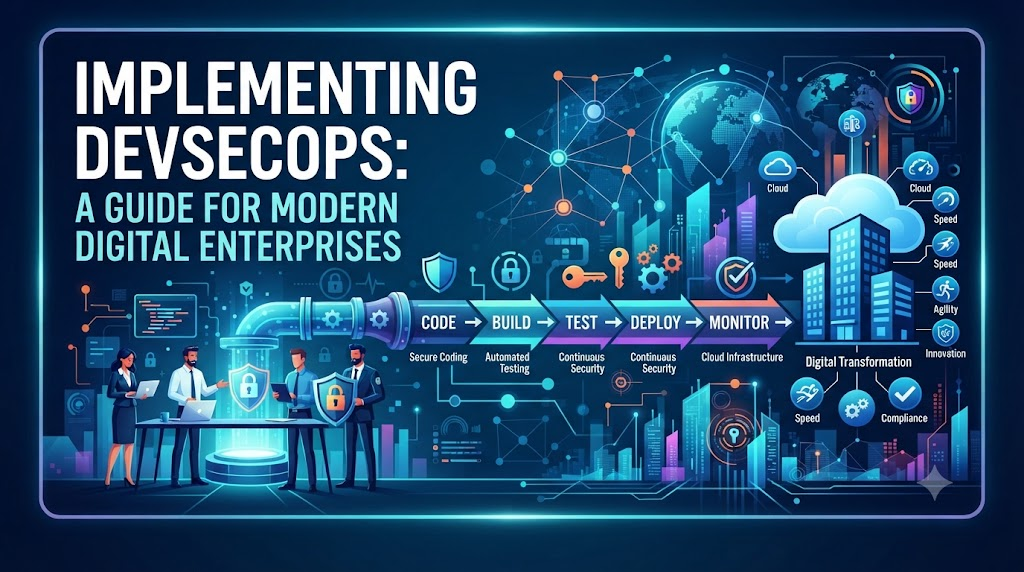
To support transformation, security must be woven into the Secure Development Lifecycle (SDLC).
- Planning: Integrate security requirements (threat modeling) into initial feature planning.
- Development: Provide developers with IDE-integrated security linters to catch issues before code is committed.
- Code Review: Implement peer reviews that include security criteria.
- Security Scanning: Execute automated Static Application Security Testing (SAST).
- Build Automation: Automatically scan for vulnerabilities in open-source libraries (Software Composition Analysis – SCA).
- Testing: Integrate Dynamic Application Security Testing (DAST) in the QA environment.
- Compliance Validation: Run automated policy-as-code checks.
- Deployment: Ensure infrastructure configurations are secure before deployment.
- Monitoring: Use runtime security tools to detect anomalies.
- Continuous Improvement: Use feedback loops to update security policies.
Key DevSecOps Practices That Accelerate Transformation
| Practice | Business Benefit | Security Benefit |
| Shift-Left Security | Reduces development cycle time | Fixes vulnerabilities early and cheaply |
| Automated Security Testing | Enables rapid, reliable releases | Removes human error from manual audits |
| Infrastructure as Code (IaC) | Increases infrastructure scalability | Prevents configuration drift and insecure setups |
| Policy as Code | Enables consistent governance | Ensures compliance enforcement across all environments |
| Secrets Management | Protects sensitive credentials | Prevents unauthorized access and leaks |
| Continuous Compliance | Simplifies audits | Maintains a secure posture 24/7 |
| Container Security | Faster application deployment | Isolation of workloads and reduced attack surface |
DevSecOps and Cloud-Native Transformation
Cloud-native adoption requires a paradigm shift in how we view security.
- Kubernetes Security: Securing the orchestration layer is vital. This involves RBAC configuration, network policies, and pod security standards.
- Container Security: Scanning container images for vulnerabilities before they are stored in the registry.
- Multi-Cloud Governance: Centralizing policy management to ensure security parity across AWS, Azure, or GCP.
- Identity and Access Management (IAM): Moving away from static credentials toward dynamic, short-lived tokens and service-to-service authentication.
- Cloud Workload Protection: Utilizing agentless or sidecar-based security to monitor workloads in real-time.
CI/CD Security Integration
The CI/CD pipeline is the nerve center of modern digital transformation. To make it secure:
- Secure Pipelines: Treat the CI/CD pipeline as production-grade infrastructure. Harden the build servers.
- Dependency Scanning: Automatically check third-party libraries for known vulnerabilities (CVEs) during the build.
- SAST & DAST: Automate the execution of SAST for source code and DAST for running applications to identify runtime vulnerabilities.
- Automation: By automating these tests, you gain speed without sacrificing the rigor of manual security assessments.
Infrastructure as Code (IaC) Security
Modern digital transformation relies on IaC (Terraform, CloudFormation, Ansible). Security must treat infrastructure configuration just like application code.
- Secure Provisioning: Use predefined, hardened modules.
- Configuration Validation: Scan templates for misconfigurations (e.g., open S3 buckets, overly permissive Security Groups) before they are deployed.
- Drift Detection: Monitor the live environment to ensure it matches the approved IaC state. If changes occur outside the pipeline, trigger an alert or auto-remediate.
Continuous Monitoring and Threat Detection
Monitoring is the feedback loop that completes the DevSecOps circle.
- Logging: Centralize logs from applications, infrastructure, and CI/CD tools.
- Metrics: Track security-specific metrics (e.g., number of high-severity vulnerabilities found in production).
- SIEM Integration: Feed security events into a Security Information and Event Management system for correlation.
- Incident Response: Build playbooks that trigger automated responses (e.g., isolating a compromised container).
Measuring DevSecOps Success
| Metric | Why It Matters | Business Value |
| Vulnerability Remediation Time | Speed of fixing security issues | Reduces the window of exposure for attackers |
| Deployment Frequency | Measures velocity | Shows that security isn’t blocking releases |
| Compliance Rate | Adherence to standards | Reduces regulatory risk and legal costs |
| Mean Time to Detect (MTTD) | How fast threats are found | Minimizes potential impact of breaches |
| Mean Time to Recover (MTTR) | Speed of restoring service | Maximizes business continuity |
| Security Incident Reduction | Success of preventive measures | Demonstrates long-term security ROI |
Common Challenges
| Challenge | Impact | Recommended Solution |
| Cultural Resistance | Teams view security as a blocker | Invest in cross-training and shared goals |
| Legacy Applications | Difficult to secure monoliths | Use “wrapper” security and incremental refactoring |
| Skill Shortages | Inability to implement tools | Partner with training experts |
| Tool Complexity | “Tool sprawl” and alert fatigue | Consolidate security tools and prioritize alerts |
| Compliance Requirements | Rigid, slow manual audits | Adopt continuous compliance and evidence automation |
Best Practices
- Integrate Security Early: Involve security teams in the design and planning phases.
- Automate Security Testing: Ensure SAST and SCA run on every commit.
- Standardize Policies: Define security policies as code that all teams must follow.
- Train Development Teams: Security is a skill. Upskill your developers to write secure code.
- Monitor Continuously: Move from periodic scans to real-time runtime monitoring.
- Review Regularly: Conduct post-mortems on security incidents to improve processes.
Real-World Example: Financial Services Transformation
Goal: A large financial institution needed to move its core banking applications to the cloud to support mobile banking, aiming to cut deployment times from months to weeks.
Challenge: Their legacy security processes relied on manual penetration tests performed once a quarter, which would have stalled the new CI/CD pipeline completely.
Implementation:
- Automation: Integrated automated SCA and container scanning into the Jenkins pipelines.
- IaC: Standardized Terraform templates with pre-approved security configurations.
- Culture: Embedded a “Security Champion” in each development squad to handle day-to-day security decisions.
Outcomes:
- Speed: Deployment frequency increased by 400%.
- Security: High-risk vulnerabilities discovered in the build phase reduced by 80%.
- Compliance: Real-time compliance dashboards replaced manual spreadsheet audits.
Common Beginner Mistakes
- Treating Security as a Final Step: If you scan at the end, you will always be late to market.
- Ignoring Automation: Manual processes do not scale in a modern digital enterprise.
- Weak Documentation: Without clear documentation, security policies are ignored or misinterpreted.
- Poor Collaboration: Silos are the enemy of DevSecOps. Security must talk to Development daily.
- Overlooking Compliance: You cannot bolt on compliance after the fact. It must be built into the architectural design.
Future of DevSecOps and Digital Transformation
The industry is moving toward “Autonomous Security.” This includes:
- AI-Assisted Security: Using AI/ML to detect sophisticated threats that traditional rules-based systems miss.
- Platform Engineering: Creating internal developer platforms that have security baked in by default, so developers don’t even have to think about infrastructure security.
- Zero Trust Architecture: Moving from network-level security to identity-based security, where no entity is trusted by default, regardless of their location in the network.
- Policy as Code: Scaling governance to manage thousands of microservices via centralized code repositories.
Certifications & Learning Paths
Continuous learning is the bedrock of a successful transformation. Platforms like the learning ecosystem at DevOpsSchool provide structured paths for mastering these technologies.
| Certification | Best For | Skill Level | Focus Area |
| Certified DevSecOps Professional | Practitioners | Intermediate | Tools, Pipelines, Security |
| Kubernetes Security Specialist | Cloud Engineers | Advanced | Cluster Security, Containers |
| Cloud Security Practitioner | Architects | Advanced | Cloud Policy, IAM |
| Infrastructure as Code Certification | DevOps Engineers | Intermediate | Terraform, Policy as Code |
| Linux Security Basics | Beginners | Beginner | OS Hardening |
Practical DevSecOps Transformation Checklist
- Define your “Definition of Done” to include security checks.
- Inventory all current applications and infrastructure.
- Implement a centralized secret management solution (e.g., HashiCorp Vault).
- Automate the build-time vulnerability scanning.
- Enforce immutable infrastructure patterns.
- Establish a feedback loop for security incidents (Blameless Post-Mortems).
- Provide security training sessions for all engineering staff.
- Standardize environment configurations using IaC.
FAQs
- What is DevSecOps?It is the integration of security practices within the DevOps process, ensuring that security is a shared responsibility throughout the software development lifecycle.
- How does DevSecOps support digital transformation?It provides the guardrails necessary for speed, allowing organizations to innovate quickly without exposing the business to unacceptable risk.
- Why is shift-left security important?It catches vulnerabilities during the design or coding phase, significantly reducing the cost and effort of remediation compared to fixing bugs in production.
- How does DevSecOps improve cloud security?Through automated infrastructure-as-code validation and continuous monitoring, it prevents configuration drift and ensures consistent security postures in cloud environments.
- Which KPIs should organizations monitor?Key metrics include deployment frequency, vulnerability remediation time, MTTR (Mean Time to Recover), and the percentage of automated tests.
- Can small businesses implement DevSecOps?Yes. Start by automating one pipeline and gradually introduce security checks. It is about culture more than expensive tools.
- What certifications are recommended?Start with foundations in cloud and DevOps, then move to specialized certifications in Kubernetes security or specific DevSecOps methodologies.
- How should beginners get started?Focus on learning one area of the pipeline—such as automating SAST—and gradually expand your knowledge. Leveraging structured learning paths is highly recommended.
- What is the role of IaC in security?IaC allows you to version-control your infrastructure, ensuring that security settings are audited, reproducible, and standardized.
- How do you handle cultural resistance?Show, don’t tell. Start with a “pilot” team, achieve a quick win with automation that makes the developer’s life easier, and publicize the success.
- Is DevSecOps just about tools?No, it is 20% tools and 80% culture, collaboration, and process optimization.
- How does DevSecOps handle compliance?By implementing “Compliance as Code,” where audit requirements are automatically tested during the CI/CD process.
- Does DevSecOps slow down development?Properly implemented, it actually accelerates development by reducing the rework required for security patches discovered post-release.
- What is the biggest mistake in implementation?Trying to implement everything at once. DevSecOps is an evolutionary, not revolutionary, process.
- How does DevSecOps impact the C-suite?It provides transparency, reduces risk, and aligns security strategy with business velocity, allowing leadership to make data-driven decisions.
Final Thoughts
Digital transformation is a marathon, not a sprint. The integration of DevSecOps is not a “quick fix” or a single project—it is a fundamental change in how your organization views, builds, and maintains its digital footprint.
By prioritizing automation, embracing a culture of shared responsibility, and investing in continuous education, you create an environment where your teams can innovate with confidence. Security should be the enabler of your transformation, not the barrier. Focus on small, iterative improvements, measure your progress, and always prioritize the resilience of your systems.






Leave a Reply
You must be logged in to post a comment.