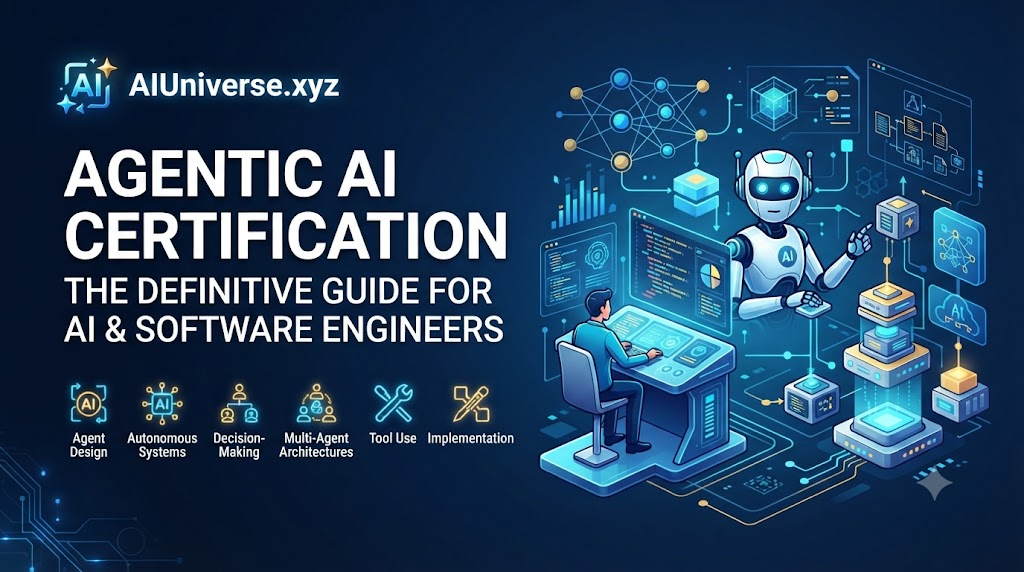
The artificial intelligence landscape has reached a decisive turning point with the shift from passive prediction and text generation to Agentic AI—autonomous, goal-directed systems capable of setting objectives, reasoning through multi-step logic, using external digital tools, correcting their own errors, and executing complex workflows with minimal human oversight. As enterprises rapidly replace static code bases and simple prompt loops with dynamic multi-agent architectures, a critical engineering talent gap has emerged, making an Agentic AI certification course an essential strategic investment for software engineers, data scientists, cloud architects, and IT leaders looking to master modern enterprise automation and advance their technical careers.
Understanding Agentic AI: The Next Frontier
What is Agentic AI?
Agentic AI refers to artificial intelligence systems engineered with high autonomy, agency, and goal-directed behavior. Unlike conventional AI models that rely on simple input-output prompt structures, agentic systems analyze broad objectives, break them down into discrete sequential steps, formulate plans, execute actions using external digital tools, evaluate the results, and autonomously iterate until the primary goal is achieved.
At its core, an agentic system transforms Large Language Models (LLMs) from static knowledge retrievers into active reasoning engines. By combining base foundational models with short-term and long-term memory systems, planning strategies (such as Tree-of-Thought or ReAct prompt designs), and external execution capabilities (executing Python scripts, executing SQL queries, querying APIs), agentic software independently navigates complex, unscripted technical environments.
The Architectural Evolution: Rule-Based to Autonomous
Understanding how we reached agentic autonomy requires evaluating the structural shifts over the past few decades:
[ Traditional Rule-Based AI ]
              │
              ▼
[ Machine Learning (MLOps) ]
              │
              ▼
[ Deep Learning & NLP ]
              │
              ▼
[ Generative AI (LLMs) ]
              │
              ▼
[ Agentic AI (Multi-Agent Systems) ]
- Rule-Based Systems: Operated on rigid
if-thenlogic. Highly predictable, but completely brittle when exposed to unscripted edge cases. - Machine Learning & Deep Learning: Recognized pattern distributions within structured/unstructured datasets to produce statistical predictions. They depended heavily on manual feature engineering and targeted pipeline maintenance using traditional MLOps.
- Generative AI: Introduced large-scale context understanding and generation across text, code, audio, and images. However, execution remained passive; models operated purely within the context window of a user request.
- Agentic AI: Integrates LLM reasoning within an active execution loop. The model acts as a orchestrator that interacts dynamically with software environments, continuously adjusting its approach based on runtime feedback.
Core Capabilities: Perception, Reasoning, Planning, and Tool Usage
A certified agentic AI practitioner masters four essential architectural pillars:
- Perception & Context Assimilation: Ingesting unstructured data stream inputs from user prompts, enterprise databases, or system webhooks, and contextualizing them against real-time operational status.
- Reasoning & Self-Reflection: Evaluating internal logic using reflection patterns. When an action yields an unexpected result or code failure, the system analyzes the error logs and refines its instructions before retrying.
- Planning & Decomposition: Breaking high-level enterprise mandates (e.g., “Analyze our quarterly supply chain bottlenecks and write a patch for inventory stock allocation”) into sequential sub-tasks.
- Tool Execution & API Integration: Calling third-party REST APIs, writing and running local sandbox scripts, reading vector databases, and invoking external utilities safely.
Why Learn Agentic AI? Industry Impact & Demand
The Shift from Passive Generative Models to Active Systems
Organizations are quickly realizing the operational limits of standalone chatbot interfaces. Simply generating text or suggesting code leaves human operators burdened with manual execution, integration testing, and operational tracking.
Agentic systems automate full process cycles. For example, rather than simply generating a draft resolution for a customer support ticket, an agentic setup can autonomously verify user identities, check real-time warehouse databases, process a system refund, update internal ERP registers, and issue a customized email update—reserving human intervention solely for high-risk boundary cases.
+-----------------------------------------------------------------------+
|                       PASSIVE GENERATIVE WORKFLOW                     |
|                                                                       |
|  [User Prompt] ───> [Generative Model] ───> [Text/Code Output]         |
|                                                     │                 |
|                                                     ▼                 |
|                                          (Manual Human Execution)     |
+-----------------------------------------------------------------------+

+-----------------------------------------------------------------------+
|                      AUTONOMOUS AGENTIC WORKFLOW                      |
|                                                                       |
|  [User Goal] ───> [Agent Reasoning Core] <───> [Memory / Vector Store]|
|                           │                                           |
|                           ▼                                           |
|                   [Planning Unit]                                     |
|                           │                                           |
|                           ▼                                           |
|                  [Tool & API Execution] <───> [External Systems]      |
|                           │                                           |
|                           ▼                                           |
|               [Self-Reflection Loop] ───> (Auto-Iterate if Failed)    |
|                           │                                           |
|                           ▼                                           |
|                  [Final Goal Met]                                     |
+-----------------------------------------------------------------------+
Market Trajectory and Hiring Trends
According to research covering enterprise automation trends, the global agentic AI market is set to expand rapidly over the next decade. Major tech ecosystems, cloud service providers, and global enterprises are restructuring their engineering focus around autonomous agent development.
   AGENTIC AI MARKET ADOPTION TRAJECTORY (PROJECTED)

   Market Focus
   ^
   |                                          [Enterprise-Wide
   |                                          Multi-Agent Networks]
   |                                 /--------
   |                        /--------
   |               /-------- [Targeted Process Automation]
   |      /--------
   | /---- [Single Agent Tasking]
   +-----------------------------------------------------------> Time
   2023        2024         2025        2026         2028+
This structural shift has triggered high enterprise demand for engineers with practical credentials. Completing an Agentic AI certification course validates your capability to build robust, fault-tolerant, multi-agent infrastructure, separating you from generalists who rely exclusively on baseline prompt engineering.
Career Advantages for Tech Professionals
- For Software & Cloud Engineers: Upgrade from building standard deterministic web services to engineering non-deterministic, agent-driven microservices.
- For Data Scientists & ML Engineers: Transition from traditional offline model training to building real-time, dynamic agent networks using modern frameworks.
- For DevOps & Infrastructure Leads: Bridge the gap between operations and automation by leveraging AIOps certification concepts alongside autonomous self-healing operational agents.
- For IT Managers & CTOs: Gain the architectural knowledge needed to direct internal digital transformation and evaluate modern AI vendors effectively.
Key Skills Acquired in an Agentic AI Certification Course
A structured Agentic AI certification course delivers a balance of practical system design, theoretical foundation, and hands-on implementation. Key technical skills covered include:
+--------------------------------------------------------------------+
|                AGENTIC AI CORE CURRICULUM SKILLS                   |
+--------------------------------------------------------------------+
|  1. Multi-Agent Frameworks   │ LangGraph, CrewAI, AutoGen           |
|  2. Memory Architectures     │ Ephemeral, Vector (ChromaDB, Pinecone)|
|  3. Tool & API Execution     │ Function Calling, Open-API Schemas  |
|  4. Reflection Loops         │ ReAct, Self-Correction, Debugging   |
|  5. Operational Governance   │ MLOps, AIOps, Observability, Guards |
+--------------------------------------------------------------------+
Framework Orchestration (LangGraph, CrewAI, AutoGen)
Learn how to build single and multi-agent topologies using modern frameworks.
- LangGraph: Mastering stateful, cyclic multi-agent graph design, handling human-in-the-loop checkpoints, and managing transactional states.
- CrewAI: Engineering role-based collaborative agents designed to mimic structured enterprise operational departments.
- AutoGen: Developing conversational multi-agent communication networks capable of complex group problem-solving.
Advanced Prompt Engineering & Memory Systems
- Implementing Best prompt management tools to track, version-control, test, and evaluate complex system prompts across dynamic agent networks.
- Integrating dual-tier memory systems: Ephemeral Short-Term Memory (Context-Window state tracking) and Persistent Long-Term Memory via high-performance Vector Databases (ChromaDB, Pinecone, Qdrant).
Tool Calling, Function Calling, and API Integration
- Designing precise, typed schema definitions (JSON Schema, Pydantic) that allow base models to query web APIs, interact with relational databases, and execute local shell code safely.
- Handling edge-case failures when third-party tools time out or return malformed payloads.
Self-Correction and Reflection Loops
- Configuring ReAct (Reason + Act) mechanisms and evaluation graphs that inspect output payloads, run unit-test validations, analyze exception stack traces, and rewrite parameters dynamically to achieve task completion.
Enterprise MLOps & AIOps Deployment
- Integrating multi-agent systems into production workflows by leveraging principles taught in an MLOps certification course and AIOps certification course.
- Mastering telemetry, continuous tracking, latency management, guardrails, and cost management across large-scale LLM deployments.
Who Should Pursue an Agentic AI Certification?
This educational path caters to tech professionals seeking to master advanced software systems:
+---------------------------+-------------------------------------------------------------+
| TARGET ROLE               | CORE BENEFIT OF AGENTIC AI CERTIFICATION                    |
+---------------------------+-------------------------------------------------------------+
| Software Engineers        | Transition from static REST endpoints to agentic workflows. |
| Machine Learning Engineers| Expand from offline training pipelines to dynamic systems.  |
| Data Scientists           | Leverage LLM reasoning to automate unstructured data processing.|
| Cloud/DevOps Engineers    | Build self-healing systems and intelligent cloud pipelines. |
| Technical Architects      | Design secure multi-agent platforms for enterprise scale.   |
| Engineering Leaders/CTOs  | Lead enterprise AI strategy with hands-on technical depth.  |
+---------------------------+-------------------------------------------------------------+
Detailed Agentic AI Certification Course Curriculum
A comprehensive curriculum balances fundamental concepts with advanced, production-grade systems engineering.
COURSE MODULE ROADMAP
├── Module 1: Foundations of Agentic Systems
├── Module 2: Prompt Management & Memory Architectures
├── Module 3: Framework Orchestration (LangGraph & CrewAI)
├── Module 4: Multi-Agent Collaboration & Tool Calling
├── Module 5: Enterprise MLOps, Observability, & AIOps
└── Module 6: Security, Governance, & Production Deployment
Module Breakdown
Module 1: Foundations of Agentic Systems
- Transitioning from deterministic logic to agentic reasoning architectures.
- Understanding the inner mechanics of Large Language Models as reasoning engines.
- Deconstructing agentic design patterns: Reflection, Tool Use, Planning, and Multi-Agent Collaboration.
- Setting up isolated development environments (Python, Docker, API gateways).
Module 2: Advanced Prompt Management & Memory Architectures
- Utilizing best prompt management tools for system prompt versioning, continuous testing, and optimization.
- Implementing Short-Term Memory through stateful context management.
- Building persistent Long-Term Memory using enterprise Vector Databases.
- Retrieval-Augmented Generation (RAG) vs. Dynamic Agent Memory: Architectural tradeoffs.
Module 3: Framework Orchestration (LangChain, LangGraph, CrewAI)
- Building directed acyclic graphs (DAGs) and cyclic state graphs for complex agent workflows using LangGraph.
- Constructing role-based multi-agent teams using CrewAI.
- Managing state persistence, time-travel debugging, and manual human interventions.
- Developing customized agent tools and robust error-handling wrappers.
Module 4: Multi-Agent Collaboration & Advanced Tool Calling
- Inter-agent communication protocols: Hierarchical networks, peer-to-peer delegation, and round-robin coordination.
- Connecting agents safely to SQL/NoSQL databases, third-party REST APIs, and external code sandboxes.
- Handling non-deterministic output structures with strict schema enforcement (Pydantic).
- Implementing fallback execution paths for real-time tool failures.
Module 5: Enterprise MLOps, AIOps, and Observability
- Connecting agentic workflows to enterprise infrastructure using concepts from an MLOps certification course.
- Real-time system monitoring, tracing agentic decision trees, and debugging infinite agent execution loops.
- Leveraging concepts from an AIOps certification course to create self-healing infrastructure operations.
- Evaluating token costs, execution latency, and agent step efficiency.
Module 6: Security, Governance, & Production Deployment
- Safeguard controls: Mitigating prompt injection attacks, malicious tool execution, and resource consumption spikes.
- Implementing Federated learning platforms for privacy-preserving model tuning across distributed enterprise node sites.
- Deploying agentic microservices inside microservice orchestration environments (Kubernetes, serverless execution nodes).
- Building continuous testing suites for non-deterministic AI pipelines.
Hands-on Portfolio Projects
To earn an industry-recognized credential, students complete real-world capstone projects:
                       PRACTICAL CAPSTONE PROJECTS

   +--------------------+     +--------------------+     +--------------------+
   |    PROJECT 01      |     |    PROJECT 02      |     |    PROJECT 03      |
   | Autonomous Software|     | Enterprise Financial|     | Multi-Agent Health |
   | Engineering Agent  |     |  Audit System      |     | Triage Infrastructure|
   +--------------------+     +--------------------+     +--------------------+
   | Reads repos, writes|     | Extracts data,     |     | Processes records, |
   | patches, runs tests|     | checks compliance, |     | checks interactions|
   | autonomously.      |     | outputs reports.   |     | highlights risk.   |
   +--------------------+     +--------------------+     +--------------------+
- Autonomous Software Development & QA Agent: A multi-agent framework that monitors a target GitHub repository, reads open bug reports, clones the codebase, reproduces errors locally, writes a fix, runs test suites, and submits a pull request.
- Enterprise Financial Compliance & Audit Orchestrator: A collaborative multi-agent network that continuously ingests multi-format financial documents, cross-examines line items against corporate regulatory constraints, highlights compliance anomalies, and generates structured audit reports.
- Healthcare Patient Triage & Operational Assistant: An agentic pipeline that processes patient intake records, cross-references medical knowledge bases via high-speed RAG vectors, flags potential drug interaction risks, and drafts preliminary assessment schedules for human clinician review.
The AI Tool Stack: What You Will Master
Navigating the ecosystem requires familiarity with the top modern tools for development, operational management, monitoring, and scaling.
+-----------------------------------------------------------------------------------+
|                        THE ENTERPRISE AGENTIC AI STACK                            |
+-----------------------------------------------------------------------------------+
|  Agent Frameworks     | LangGraph, CrewAI, AutoGen, LlamaIndex                    |
|  Prompt Management    | Langfuse, PromptLayer, Arize Phoenix                      |
|  MLOps & Observability| MLflow, Weights & Biases, LangSmith, TruLens              |
|  Vector Storage       | Pinecone, Qdrant, Milvus, ChromaDB                        |
|  Privacy & Governance | Federated Learning Platforms, NeMo Guardrails             |
+-----------------------------------------------------------------------------------+
Orchestration & Agent Frameworks
- LangGraph: Ideal for complex state machine control, cyclic graphs, and fine-grained state management.
- CrewAI: Excellent for production workflows that map cleanly to human team structures and role definitions.
- Microsoft AutoGen: A powerful framework for multi-agent conversation research and advanced task delegation.
- LlamaIndex: Essential for indexing complex, heterogeneous data structures for agentic retrieval operations.
Best Prompt Management Tools & Vector Databases
Using the best prompt management tools allows developers to decouple system prompts from application code, track changes, run evaluations, and minimize token costs across enterprise teams:
- Langfuse & PromptLayer: Invaluable for real-time prompt tracing, usage analytics, version control, and latency monitoring.
- Pinecone, Qdrant, & Milvus: High-performance vector databases optimized for large-scale similarity searches and persistent agent memory management.
Best MLOps Tools & Monitoring Frameworks
Selecting the best MLOps tools ensures production stability, deployment tracking, and automated model evaluation:
- LangSmith & Arize Phoenix: Provides deep execution-graph visual traces, step-by-step latency analysis, token consumption counters, and assertion testing.
- MLflow & Weights & Biases: Industry standards for tracking experiment parameters, managing foundational model artifacts, and tracking performance over time.
Federated Learning Platforms for Enterprise Privacy
- In sensitive sectors like banking, healthcare, and defense, using privacy-focused federated learning platforms allows organizations to train and refine agentic reasoning models across distributed data centers without centralizing confidential datasets.
Agentic AI vs. Generative AI vs. Traditional AI: Comparative Analysis
The table below breaks down the primary operational differences across AI architectural models:
| Feature / Paradigm | Traditional Machine Learning | Standard Generative AI | Agentic AI Systems |
| Primary Function | Pattern classification & statistical prediction | Unstructured content generation & transformation | Multi-step task execution & goal realization |
| Operational Mode | Passive batch execution | Passive single-prompt interaction | Active, goal-driven execution loops |
| Human Involvement | High manual feature extraction & pipeline code | Continuous manual prompt inputs required | Strategic supervision (Human-in-the-loop) |
| Decision Logic | Static mathematical bounds | Statistical token prediction | Dynamic reasoning, planning, & reflection |
| Tool Capabilities | Limited to hardcoded target systems | Restricted to the active context window | Flexible API access, custom scripts, & web tools |
| Memory Architecture | Fixed model weights | Context window limits | Dual-tier (Ephemeral short-term + Vector long-term) |
| Error Handling | Code-level failure or system exception | Produces hallucinations; no native self-fix | Self-reflection loops, auto-debugging, & re-planning |
| Underlying Ops Framework | Classical MLOps | Generative AI Monitoring | Integrated MLOps + AIOps + Agent Observability |
Cross-Industry Enterprise Use Cases
Organizations across diverse industries are moving beyond simple chatbots to deploy autonomous agentic systems at scale:
+----------------------------------------------------------------------------+
|                    CROSS-INDUSTRY AGENTIC USE CASES                        |
+----------------------------------------------------------------------------+
| Healthcare    | Automated clinical triage & drug interaction analysis      |
| Finance       | Real-time fraud detection & automated regulatory auditing  |
| Logistics     | Dynamic supply chain rerouting & warehouse inventory management|
| IT Operations | Self-healing cluster management & incident remediation     |
| Telecom       | Automated network traffic re-routing & signal optimization |
+----------------------------------------------------------------------------+
Healthcare & Life Sciences
- Clinical Trial Orchestration: Autonomous agents process diverse clinical trial records, cross-examine subject data against regulatory rules, and highlight protocol discrepancies.
- Diagnostic & Triage Support: Multi-agent systems synthesize patient histories, laboratory diagnostic reports, and medical imaging transcripts to draft holistic baseline evaluations for medical teams.
Financial Services & Banking
- Autonomous Regulatory Auditing: Multi-agent networks continuously verify cross-border transactions against updated global regulatory databases, isolating potential money laundering attempts in real time.
- Automated Loan Processing: Agents analyze applicant records, pull real-time credit reports, cross-check income verifications, evaluate risk profiles, and assemble complete approval packages for credit underwriters.
Logistics & Supply Chain
- Dynamic Inventory Allocation: Intelligent agents monitor real-time warehouse inventory levels, monitor global weather anomalies, predict transport delays, and re-route shipping vectors without requiring human intervention.
IT Operations & Cloud Infrastructure
- Self-Healing Kubernetes Infrastructure: By combining principles taught in AIOps certification courses with agentic logic, cloud agents analyze log streams, detect pod failures, issue patch commits, and re-deploy healthy containers automatically.
Enterprise Integration: Corporate AI Training & AI Consulting Services
Adopting agentic systems across an enterprise requires more than just picking modern tools—it calls for organizational upskilling and clear strategic planning.
                           ENTERPRISE ADOPTION LIFECYCLE

  +----------------------+      +----------------------+      +----------------------+
  |    PHASE 1: ASSESS   |      |   PHASE 2: UPSKILL   |      |  PHASE 3: INTEGRATE  |
  |  AI Consulting       | ---> |  Corporate AI        | ---> |  Production MLOps    |
  |  Services            |      |  Training            |      |  & Governance Setup  |
  +----------------------+      +----------------------+      +----------------------+
  | Map high-ROI tasks   |      | Train internal teams |      | Deploy self-healing  |
  | & set security boundaries|  | on frameworks & tools|      | agentic architecture |
  +----------------------+      +----------------------+      +----------------------+
Upskilling Engineering Teams with Corporate AI Training
Deploying corporate AI training enables enterprises to upskill their internal engineering teams, helping them shift from maintaining legacy code bases to managing modern agentic infrastructure. Custom corporate programs focus on:
- Standardizing internal tool usage across team environments.
- Designing centralized system-prompt registries and secure local vector storage.
- Establishing unified security protocols for executing external API calls.
- Reducing external reliance on third-party vendors by building proprietary agentic workflows.
Navigating Implementation Hurdles with AI Consulting Services
Organizing an initial deployment strategy often presents technical challenges, particularly regarding data governance, access controls, token costs, and infrastructure alignment. Relying on specialized AI consulting services allows leadership teams to:
- Perform feasibility audits on targeted business processes.
- Design secure human-in-the-loop review checkpoints for sensitive workflows.
- Build secure execution sandboxes to isolate agentic script runs from core production networks.
- Identify high-ROI processes suited for early multi-agent deployment.
The Interplay of Agentic AI, MLOps, and AIOps
Modern autonomous AI systems rely on the combined strengths of three core operational disciplines:
                      THE THREE PILLARS OF AI OPERATIONS

                     +----------------------------------+
                     |            AGENTIC AI            |
                     |  (Reasoning, Task Execution,     |
                     |   Goal-Oriented Autonomous Loops)|
                     +----------------------------------+
                                      /\
                                     /  \
                                    /    \
                                   /      \
                                  /        \
                                 /          \
  +---------------------------------+    +---------------------------------+
  |              MLOPS              |    |              AIOPS              |
  | (Model Lifecycle, Deployment,   | <->| (Infrastructure Telemetry,      |
  |  Data Versioning, Tracking)     |    |  Self-Healing Systems, Logs)     |
  +---------------------------------+    +---------------------------------+
MLOps (Machine Learning Operations)
A strong foundation in an MLOps certification course equips engineers to manage foundational model pipelines, track fine-tuning datasets, monitor context window drift, and maintain vector store indexes. MLOps ensures that the models powering your agent’s reasoning core remain performant, safe, and cost-effective over time.
AIOps (Artificial Intelligence for IT Operations)
Taking an AIOps certification course focuses on applying AI models to infrastructure management, log analysis, system telemetry, and incident response. When integrated with agentic frameworks, AIOps enables self-healing cloud ecosystems—where software agents monitor operational logs, detect root causes, and autonomously deploy infrastructure fixes.
Step-by-Step Guide: How to Start Your Agentic AI Learning Journey
                        LEARNING ROADMAP MILESTONES

  [STEP 1] Master Python, Async Programming, & Pydantic Schema Parsing
     │
     ▼
  [STEP 2] Learn Advanced Prompt Engineering & Use Prompt Management Tools
     │
     ▼
  [STEP 3] Master LangGraph, CrewAI, and Tool/Function Calling Systems
     │
     ▼
  [STEP 4] Build Ephemeral & Vector Memory Integrations (Qdrant/Pinecone)
     │
     ▼
  [STEP 5] Implement MLOps Observability Traces (LangSmith/Arize Phoenix)
     │
     ▼
  [STEP 6] Deploy Secure, Multi-Agent Applications with Human-in-the-Loop Safeguards
- Strengthen Your Software Foundations: Master asynchronous Python programming, API development (FastAPI), JSON schema parsing, and database operations.
- Master Core Generative Mechanics: Gain hands-on experience using base foundation LLM APIs, prompt engineering methodologies, and structured data outputs using libraries like Pydantic.
- Learn Key Agent Orchestration Frameworks: Build functional single-agent execution scripts using LangChain and CrewAI, then advance to building multi-agent state machines with LangGraph.
- Integrate Memory & External Tooling: Connect your agent setups to persistent vector storage engines (Pinecone, Qdrant) and grant them access to external APIs, web scraping utilities, and local code sandboxes.
- Implement Robust Observability: Utilize best MLOps tools like LangSmith or Arize Phoenix to trace agent decision loops, evaluate token usage, optimize execution steps, and eliminate infinite execution loops.
- Deploy Production Projects: Earn an industry-recognized credential by building, testing, and deploying multi-agent applications complete with sandboxed execution environments and human-in-the-loop safeguards.
Comprehensive Checklists for Professionals and Enterprises
Technical Skills Checklist (Individual)
- Advanced proficiency in Python (specifically AsyncIO and type hinting)
- Mastery of Pydantic for input/output schema validation
- Practical implementation of LangGraph state machine designs
- Experience building collaborative multi-agent teams using CrewAI
- Knowledge of Vector Storage setups (Pinecone, Qdrant, ChromaDB)
- Hands-on integration of best prompt management tools (Langfuse, PromptLayer)
- Mastery of function calling and secure API usage
- Expertise in building self-reflection and re-planning execution loops
- Understanding of tracing, observability, and cost control across LLM deployments
Enterprise Readiness Checklist (Organizations)
- Feasibility assessment completed for candidate agentic workflows
- Secure API key management and token consumption budget caps established
- Sandboxed execution environments set up for running code autonomously
- Human-in-the-loop review checkpoints integrated for high-risk operations
- Telemetry and observability tools active across all agent setups
- Role-based access control (RBAC) enforced for data stores and database tools
- Employees upskilled using comprehensive corporate AI training
- Ethical guardrails, data privacy rules, and security frameworks in place
Best Practices: Ethics, Governance, and Responsible AI
Building autonomous software systems requires strict operational guardrails and safety protocols:
                       RESPONSIBLE AI GOVERNANCE FRAMEWORK

  +-------------------+     +-------------------+     +-------------------+
  | SECURE SANDBOXING |     | HUMAN-IN-THE-LOOP |     | SYSTEM TRACING    |
  | Execute code inside| --> | Set explicit risk | --> | Log every reasoning|
  | isolated environments|   | approval gates    |     | step and API call |
  +-------------------+     +-------------------+     +-------------------+
- Sandboxed System Execution: Never allow an AI agent to execute arbitrary generated code directly on core production networks. Always run tool executions inside isolated, resource-capped container sandboxes (e.g., Docker containers, WebAssembly runtimes).
- Human-in-the-Loop Checkpoints: Mandate manual human approval before an agent executes high-impact operations—such as sending outbound financial transfers, modifying production databases, or contacting external customers.
- Comprehensive Execution Tracing: Maintain complete audit logs of every agent step, reasoning trace, tool invocation, and API response. This guarantees accountability and simplifies post-incident debugging.
- Least-Privilege API Permissions: Issue micro-scoped API tokens specifically designed for agentic tool use. An agentic customer support tool, for example, should have read-access to specific order tables, but zero authority to drop databases or alter global platform privileges.
- Data Privacy & Compliance: Utilize federated learning platforms and localized vector databases to ensure that personal identifiable information (PII) never leaks into public model training pipelines.
Common Pitfalls to Avoid
+------------------------------------+---------------------------------------------------+
| PITFALL                            | PREVENTION STRATEGY                               |
+------------------------------------+---------------------------------------------------+
| Infinite Execution Loops           | Enforce hard upper limits on agent step counts.   |
| Uncapped Token Costs               | Implement token tracking and per-task budget caps. |
| Monolithic Agent Designs           | Split large agents into specialized sub-agents.   |
| Unchecked Code Execution           | Run code isolated inside sandboxed environments.  |
| Neglecting System Observability    | Integrate tracing tools from day one.            |
+------------------------------------+---------------------------------------------------+
- Designing Overly Complex Monolithic Agents: Avoid trying to build a single, multi-purpose agent that handles every task. Instead, build networks of specialized sub-agents managed by a central supervisor graph.
- Unbounded Tool Execution Loops: Always enforce strict maximum step limits (e.g., capping execution at 10 iterations). This prevents broken agents from looping indefinitely and consuming excessive API tokens during unexpected system errors.
- Ignoring Real-Time Telemetry and Tracing: Attempting to debug non-deterministic multi-agent systems using basic print statements is extremely inefficient. Implement dedicated tracing utilities like LangSmith or Arize Phoenix right from the start.
- Over-relying on High-Latency Models for Basic Sub-Tasks: Save top-tier reasoning models for complex planning and reflection loops. Use smaller, faster models for simpler sub-tasks like parsing JSON, extracting keyword lists, or formatting text summaries.
- Failing to Design Fallback Options: Always configure clear fallback paths for when external APIs, database queries, or tool executions fail. An agent should gracefully handle tool exceptions rather than crashing completely.
Actionable Expert Advice for Success
For Students and Job Seekers
Focus heavily on portfolio creation over simple theoretical understanding. Employers value candidates who can demonstrate functional, public multi-agent repositories that feature clear state graph topologies, sandboxed execution safety, precise system prompts, and complete system tracing.
For Working Engineers
Identify repetitive, multi-step operational tasks within your current team that currently require manual intervention. Build an isolated prototype using multi-agent frameworks to demonstrate clear ROI, time savings, and operational efficiency to engineering leadership.
For Enterprise Leaders
Avoid jumping straight into fully autonomous deployments without internal preparation. Begin by deploying internal pilot programs, setting up clear governance frameworks, and enrolling key technical personnel in targeted corporate AI training alongside specialized AI consulting services.
Frequently Asked Questions (FAQs)
1. What is an Agentic AI certification course?
An Agentic AI certification course is an advanced training program designed to teach engineers, architects, and technical leaders how to design, build, and deploy autonomous, goal-driven AI systems. The curriculum covers core multi-agent frameworks (LangGraph, CrewAI, AutoGen), memory design, function/tool calling, self-reflection mechanisms, and enterprise MLOps deployment strategies.
2. How does Agentic AI differ from traditional Generative AI?
Standard Generative AI models are passive systems that generate text, code, or media responses based on direct user input prompts. Agentic AI uses foundational LLMs as a central reasoning engine to break down broad goals, construct sequential plans, execute actions using external digital tools (APIs, code scripts, databases), evaluate execution outputs, and adjust its approach until the goal is achieved.
3. What background prerequisites are needed to take this course?
A solid foundation in Python programming, experience working with REST APIs, a basic understanding of database operations, and familiarity with Large Language Model fundamentals are recommended. Prior exposure to basic Machine Learning concepts is helpful, but deep mathematical expertise is not strictly required.
4. Which multi-agent frameworks are covered in the curriculum?
Comprehensive training programs focus heavily on modern industry-standard frameworks, including LangGraph (for stateful cyclic graph workflows), CrewAI (for role-based team management), Microsoft AutoGen (for conversational multi-agent systems), and LlamaIndex (for structured memory retrieval and indexing).
5. Why is learning MLOps important for building Agentic AI systems?
Agentic workflows operate dynamically and non-deterministically across multiple system steps. Completing concepts found in an MLOps certification course equips developers to manage model deployments, track context window drift, monitor vector indexes, evaluate system latency, and control API token consumption across enterprise deployments.
6. How does AIOps fit into the Agentic AI landscape?
While MLOps focuses on the lifecycle of machine learning models, AIOps certification course concepts focus on applying intelligent automation to IT operations and cloud infrastructure. Combining AIOps with agentic frameworks enables self-healing cloud ecosystems—where agents autonomously detect infrastructure errors, trace log files, and execute operational fixes.
7. What are the best prompt management tools used in agentic development?
Top prompt management frameworks include Langfuse, PromptLayer, Arize Phoenix, and LangSmith. These utilities allow engineering teams to version-control system prompts, track usage metrics, analyze step-by-step latency, run automated evaluations, and optimize API token spend.
8. What role do federated learning platforms play in enterprise agent security?
Federated learning platforms allow organizations operating in highly regulated fields (such as healthcare, banking, and government) to train and refine AI models across decentralized edge nodes or regional data centers. This ensures that sensitive internal data never leaves local security boundaries while still updating central reasoning performance.
9. What high-value job roles can I apply for after certification?
Graduates qualify for in-demand specialized positions such as Agentic AI Engineer, Multi-Agent Systems Architect, Enterprise AI Solutions Developer, MLOps Specialist, AI Automation Lead, and Principal AI Infrastructure Consultant.
10. How long does it usually take to complete a full certification program?
Most intensive certification programs run between 8 to 16 weeks, depending on whether you choose a full-time accelerated path or a part-time professional track. The coursework includes theoretical lectures, framework lab exercises, and practical capstone projects.
11. Can custom corporate AI training programs be tailored for enterprise engineering teams?
Yes. Tailored corporate AI training initiatives are structured specifically around an enterprise’s unique software stack, internal data security boundaries, target business goals, and industry compliance requirements.
12. How do AI consulting services accelerate enterprise agent deployment?
Professional AI consulting services assist organizations with feasibility audits, architectural design reviews, security sandboxing, data governance models, and setting up effective human-in-the-loop review checkpoints. This minimizes deployment risks and accelerates time-to-value for enterprise automation projects.
13. What tools are recommended for hosting persistent agent long-term memory?
Persistent long-term agent memory is primarily managed using modern, high-performance Vector Databases such as Pinecone, Qdrant, Milvus, Weaviate, or ChromaDB.
14. How do agentic frameworks handle unexpected runtime errors?
Agentic systems utilize self-reflection and dynamic re-planning loops. When a tool call or code execution fails, the system ingests the exception stack trace or error log into its context, re-evaluates its reasoning logic, modifies its parameters, and attempts an alternative execution path.
15. Are multi-agent architectures scalable for large enterprise workloads?
Yes, provided they are engineered with proper cloud microservices architectures. By deploying specialized agents within isolated microservices, using robust message queues (e.g., Kafka, RabbitMQ), and applying strict token consumption and step limits, multi-agent networks scale efficiently across enterprise workloads.
Conclusion
The shift from passive Generative AI text models to active, goal-driven Agentic AI systems represents a major evolution in enterprise software architecture. By combining advanced language model reasoning with persistent dual-tier memory, structured tool use, self-reflection loops, and robust multi-agent orchestration, agentic systems unlock entirely new levels of enterprise automation.
For engineers, data scientists, architects, and technology leaders, mastering these technologies is one of the most effective ways to position yourself at the forefront of modern software engineering. Enrolling in an Agentic AI certification course provides the practical skills, structural framework knowledge, tool fluency, and hands-on portfolio experience needed to design, deploy, and govern production-grade autonomous systems successfully.
As enterprise adoption accelerates, the ability to build self-correcting, fault-tolerant, and secure multi-agent networks will remain a high-value skill across the software industry. Continuous learning, practical execution, and strict adherence to responsible AI practices are key to leading this next era of artificial intelligence.






Leave a Reply
You must be logged in to post a comment.