Introduction
Picture a mid-sized engineering team rushing to deploy a critical feature before a major product launch. The developers have written clean code, the operations team has provisioned cloud infrastructure, and the release window is fast approaching. Suddenly, an automated security scan flags a critical vulnerability in a third-party dependency. Instead of working together to resolve it, the security team sends an automated email alert with a generic error code, development assumes it is a false positive, and operations proceeds with the deployment because nobody explicitly told them to halt. Within hours, the vulnerability is exploited in production.
This scenario highlights a fundamental truth about modern software engineering: technical tools alone cannot secure a pipeline. While automated scanners, static analysis tools, and container linters are essential, they are only as effective as the people operating them.
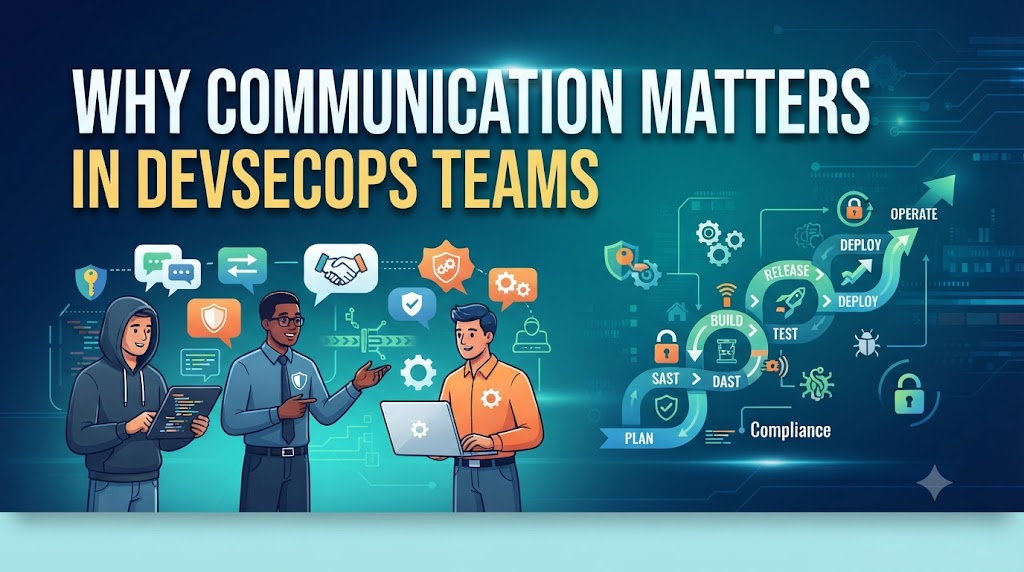
DevSecOps is fundamentally designed to bridge the gap between development, security, and operations. However, when multiple teams share responsibility for software delivery, communication becomes the critical glue holding the process together. Poor communication creates security blind spots, deployment delays, and costly misunderstandings. This article explores why effective communication is the backbone of successful DevSecOps teams and how intentional collaboration transforms security from a bottleneck into a shared capability.
What Is DevSecOps?
DevSecOps represents the evolution of software delivery, integrating security practices directly into the DevOps workflow from the very beginning. Rather than treating security as a final gatekeeper review before production, DevSecOps embeds security considerations throughout the entire software development lifecycle (SDLC).
At its core, DevSecOps combines people, processes, culture, and technology. It relies on several key pillars:
- Shift-Left Security: Introducing security checks earlier in the development process, such as during code authoring and architectural design.
- Continuous Security: Maintaining ongoing security assessments rather than relying on periodic, manual audits.
- Security Automation: Integrating automated security testing, vulnerability scanning, and compliance checks directly into continuous integration and delivery (CI/CD) pipelines.
- Shared Responsibility: Distributing ownership of security outcomes across developers, operations, QA engineers, and security specialists.
DevSecOps is not simply “DevOps plus security tools.” Installing a vulnerability scanner in a pipeline does not create a DevSecOps culture if the people reviewing the findings do not understand them, trust them, or talk to eachour other. True DevSecOps requires active collaboration between everyone involved in building, securing, and running applications.
Why Communication Is Central to DevSecOps
Security decisions are only effective when the people responsible for building, securing, deploying, and operating software understand and communicate with each other.
In a traditional siloed organization, security teams operate in isolation, handing down strict compliance rules that developers struggle to interpret. In a mature DevSecOps environment, communication acts as the primary mechanism for aligning security goals with delivery speed. Effective communication helps teams:
- Share security requirements clearly before coding begins.
- Identify architectural risks earlier in the design phase.
- Understand vulnerabilities in context rather than just reading raw scanner outputs.
- Coordinate remediation efforts efficiently when issues arise.
- Reduce misunderstandings between technical specialties.
- Make faster decisions without sacrificing safety or compliance standards.
- Improve release quality through continuous feedback loops.
When communication channels are open, security stops being a last-minute activity that blocks deployments and instead evolves into a collaborative dialogue.
Communication Between Development, Security, and Operations
Sustaining a high-performing DevSecOps culture requires bridging the historical gaps between distinct technical teams.
Development and Security
Developers write code quickly, while security specialists focus on risk mitigation. Communication between these groups must center on secure coding practices, vulnerability findings, and threat models. Rather than delivering raw, overwhelming vulnerability reports, security teams should provide actionable guidance, explaining not just what the vulnerability is, but why it matters and how to fix it in the specific framework being used.
Development and Operations
Developers focus on feature delivery, while operations teams care about stability, infrastructure reliability, and monitoring. Communication here revolves around deployment schedules, configuration management, infrastructure-as-code changes, and release planning. When developers and operations talk regularly, infrastructure surprises in production drop significantly.
Security and Operations
Security and operations teams must align on infrastructure security, access controls, threat detection, and incident response. Operations engineers manage the underlying cloud environments, while security teams monitor them for anomalies. Clear communication ensures that access policies do not accidentally break operational workflows and that security alerts receive rapid, coordinated responses.
Cross-Functional Communication
Beyond pairs of teams, successful software delivery requires organization-wide alignment. Product managers, compliance officers, QA engineers, and SRE professionals must share common security and delivery objectives, ensuring compliance requirements are understood early rather than appended at the end of a project.
How Poor Communication Creates DevSecOps Risks
When communication breaks down, technical debt and security risks accumulate rapidly. Common problems include:
- Misunderstood Security Requirements: Developers build features without knowing regulatory or cryptographic standards, leading to major redesigns later.
- Ignored Vulnerabilities: Automated tools flood developers with alerts lacking context, causing teams to dismiss them as noise.
- Siloed Incident Response: During a security incident, operations, security, and development scramble separately, increasing downtime and confusion.
- Security as a Bottleneck: Manual security reviews scheduled at the end of a sprint halt deployments, forcing friction between teams.
- Conflicting Priorities: Security teams demand immediate patching, while product teams push for new features, leading to internal friction.
Transparent, continuous communication directly mitigates these risks by replacing assumptions with shared understanding.
Communication Throughout the Software Development Lifecycle
Effective communication must be woven into every stage of the SDLC:
- Planning: Discuss security requirements, threat models, and compliance obligations before writing a single line of code.
- Design: Review system architecture collaboratively to identify potential attack surfaces and design secure authentication flows.
- Development: Provide developers with clear, accessible security documentation and inline guidance during code creation.
- Testing: Share security test results quickly and clearly, ensuring automated pipeline feedback is easy to interpret.
- CI/CD: Use pipeline notifications to alert relevant engineers immediately when a build fails security checks.
- Deployment: Ensure development, security, and operations teams have aligned on release risks, rollback plans, and deployment verifications.
- Production: Route monitoring data, operational feedback, and security alerts to the appropriate teams for continuous learning.
Communication and Security Culture
Strong communication cannot exist in a vacuum; it requires a healthy security culture founded on psychological safety.
Teams must feel comfortable discussing vulnerabilities, configuration errors, and near-misses without fear of blame. When a security failure occurs, a blameless post-incident review focuses on systemic improvements, missing documentation, or communication gaps rather than pointing fingers at individuals. Cultivating transparency, mutual respect, and cross-team trust transforms security from an individual burden into a shared organizational value.
Tools That Support DevSecOps Communication
While culture and human interaction drive DevSecOps, the right toolset simplifies communication and keeps distributed teams aligned. Organizations utilize various platforms to support these workflows:
- Issue Tracking Systems: Centralize vulnerability tickets alongside feature requests so security tasks are tracked like any other engineering work.
- Collaboration Platforms: Facilitate real-time discussions, dedicated security channels, and cross-functional problem-solving.
- CI/CD Pipeline Notifications: Send direct alerts to developer chat channels when automated security tests detect a regression.
- Security Dashboards: Provide visibility into overall risk posture, active vulnerabilities, and remediation progress for both technical and leadership stakeholders.
- Documentation Platforms: Maintain living runbooks, threat models, and architectural decision records.
The primary goal of these tools is to bring contextual information directly to where engineers already work, reducing friction and delays.
Communication During Incident Response
During a security incident, clear communication is critical to minimizing impact and recovery time. Uncoordinated communication leads to panic, conflicting actions, and extended downtime.
An effective incident response plan relies on predefined escalation paths, clear role assignments, and centralized communication channels. Technical updates must be communicated clearly to responders, while stakeholder updates must keep management informed without overwhelming engineering teams. Following resolution, a collaborative post-incident review ensures that lessons learned are translated into improved processes and automated safeguards.
How to Improve Communication in DevSecOps Teams
Organizations looking to enhance their DevSecOps collaboration can adopt several practical strategies:
- Establish Shared Goals: Align development, security, and operations around common business and reliability objectives.
- Define Clear Responsibilities: Ensure everyone knows who owns specific security controls, patching schedules, and operational decisions.
- Use Common Language: Explain security concepts in practical terms that developers and operations engineers can easily digest.
- Integrate Security into Regular Meetings: Include security topics in standard sprint planning and backlog grooming sessions.
- Improve Feedback Loops: Ensure security findings reach the right engineers quickly with clear, actionable context.
- Conduct Cross-Team Training: Encourage engineers to expand their skill sets, exploring areas like secure software development and modern cloud security through dedicated programs such as those offered by DevOpsSchool.
Communication Best Practices
To maintain high communication standards across engineering units, teams should adhere to a few foundational practices:
- Communicate early in the design and planning phases.
- Keep messages clear, concise, and focused on actionable steps.
- Provide necessary technical context alongside error codes or alerts.
- Keep security requirements and compliance checklists visible within workspaces.
- Encourage questions and cross-team inquiries without judgment.
- Review and refine communication workflows during retrospectives.
Measuring Communication Effectiveness
Organizations can track improvements in DevSecOps communication by monitoring practical operational indicators:
- Remediation Speed: Reduced time required to understand and patch security findings.
- Rework Reduction: Fewer security-related bugs escaping into production environments.
- Cross-Team Participation: Increased engagement from developers and operators in security reviews.
- Incident Coordination Efficiency: Smoother execution during security events with fewer recurring communication breakdowns.
Selecting metrics tailored to a specific team’s environment helps maintain continuous improvement.
Common Communication Mistakes
Avoiding common pitfalls helps sustain a healthy DevSecOps environment:
- Relying exclusively on overly technical security jargon that alienates developers.
- Treating security as an isolated responsibility assigned only to the security team.
- Sending automated alerts with zero context, creating alert fatigue.
- Failing to document important architectural or security decisions.
- Blaming individuals for security oversights rather than fixing underlying process flaws.
Role of Training and Skill Development
Modern software engineering requires professionals to possess both deep technical expertise and strong collaboration skills. DevSecOps engineers, developers, and cloud professionals must understand continuous integration, infrastructure as code, container security, and vulnerability management.
Building a well-rounded engineering team often requires structured professional training. Organizations frequently look to comprehensive programs and guidance from established providers like DevOpsSchool to help engineers master both technical tooling and collaborative modern software delivery practices.
Future of Communication in DevSecOps
As artificial intelligence, automated security analysis, and policy-as-code frameworks evolve, the nature of DevSecOps communication is changing. Intelligent automation will handle routine alert filtering and straightforward code fixes, reducing noise and manual overhead. However, this shift places an even higher premium on human communication for complex risk evaluation, architectural decision-making, and fostering trust across multidisciplinary teams.
Frequently Asked Questions
Why is communication important in DevSecOps?
Communication ensures that security requirements, operational constraints, and development goals are aligned, preventing silos and reducing vulnerabilities before code reaches production.
What happens when security and development teams do not communicate?
Without communication, security becomes a bottleneck, vulnerabilities are ignored or misunderstood, and deployments face frustrating delays or increased risk.
How can DevSecOps teams improve communication?
Teams can improve collaboration by establishing shared goals, integrating security into regular sprint planning, using clear language, and providing actionable feedback loops.
What is the role of communication during a security incident?
Clear communication during an incident ensures rapid alert escalation, coordinated technical response, proper role assignment, and effective stakeholder management.
How does communication support security automation?
Communication ensures that automated pipeline notifications reach the right engineers with sufficient context to resolve issues quickly.
Final Thoughts
DevSecOps is ultimately a human discipline supported by technology. While automated pipelines and advanced vulnerability scanners are vital, they cannot replace the necessity of clear, open dialogue between developers, security specialists, and operations engineers. By embracing shared responsibility, breaking down traditional silos, and prioritizing transparent communication, organizations can build secure, resilient software delivery pipelines that scale effectively.







Leave a Reply
You must be logged in to post a comment.