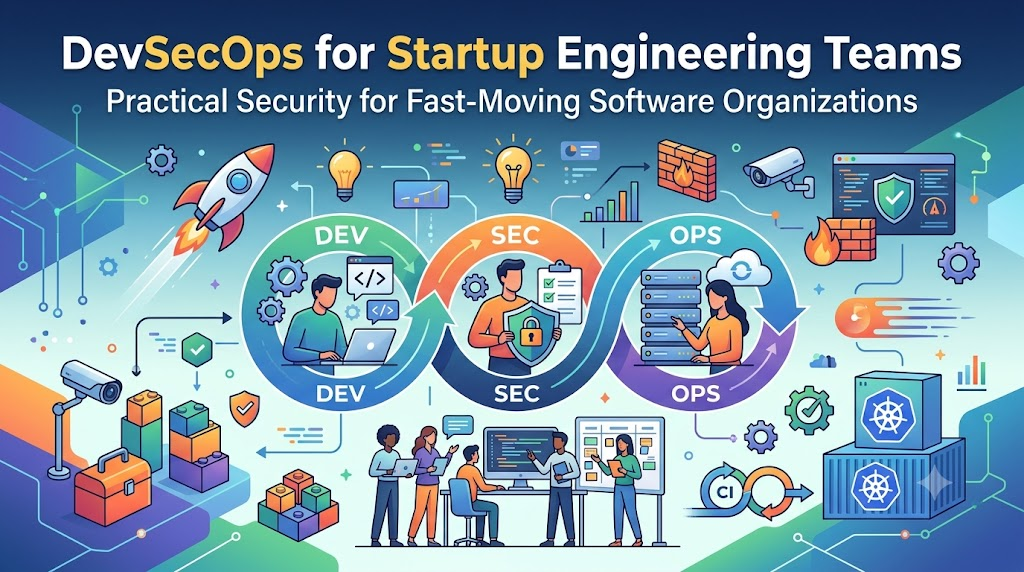
A five-person startup engineering team pushes code multiple times a day. They build microservices with modern frameworks, containerize workloads, deploy automatically to a public cloud, and connect dozens of open-source packages to ship features ahead of competitors. Everything moves fast until a routine audit reveals a production database password committed in plain text to a repository, three dozen container images running with root privileges, and third-party dependencies carrying critical vulnerabilities exposed directly to the public internet.
This scenario plays out constantly across early-stage tech ventures. When speed is the primary survival metric, security is often treated as an informal checklist or deferred entirely to an undefined future date. By the time customer growth demands proof of robust safeguards, retrofitting security across undocumented infrastructure and sprawling repositories becomes disruptive and expensive.
Integrating security into early engineering workflows protects your product from preventable disruptions without requiring enterprise budgets or slowing release cadence.
What Is DevSecOps?
DevSecOps represents the structural integration of security practices, automated validation, and risk governance directly into continuous DevOps workflows. Rather than treating security as an isolated gate at the end of a sprint, DevSecOps distributes security visibility across every phase of software delivery:
Plan → Code → Build → Test → Release → Deploy → Operate → Monitor → Improve
DevOps + Security = DevSecOps
Continuous Delivery with Integrated Quality and Risk Controls
True DevSecOps is not merely bolting commercial scanners onto a continuous integration pipeline. It is an engineering discipline built on five pillars:
- Shared Responsibility: Engineering, operations, and product teams treat security hygiene as a shared standard rather than an external inspection.
- Continuous Feedback: Automated checks provide immediate, actionable feedback to developers while context is fresh.
- Intelligent Automation: Repetitive validation—such as secret detection, linting, and dependency checks—runs unattended in existing development pipelines.
- Risk-Based Prioritization: Vulnerabilities are addressed based on real-world exposure, reachability, and business impact rather than theoretical severity scores alone.
- Secure-by-Design Defaults: Platform defaults (e.g., restricted base images, isolated VPC networks, least-privilege service roles) guide engineers toward secure choices automatically.
Why DevSecOps Matters for Startups
Establishing security fundamentals early provides structural advantages that compound as engineering operations expand:
- Customer Trust and Enterprise Readiness: Enterprise buyers require rigorous vendor security reviews. An established security baseline simplifies vendor assessments and accelerates sales cycles.
- Mitigating Security Debt: Unaddressed architectural vulnerabilities and permissive access rules compound over time. Remedying security debt early prevents expensive refactoring later.
- Safer, Faster Deployments: Automated pre-deployment guardrails catch misconfigurations before release, minimizing operational rollbacks.
- Targeted Incident Response: Clear visibility into configurations, dependencies, and audit logs allows small teams to isolate and remediate incidents quickly.
- Streamlined Compliance Preparation: Standardized logging, controlled access, and pipeline testing reduce the friction of achieving standard security certifications down the road.
Unique DevSecOps Challenges for Startups
Startup engineering operates under constraints that differ significantly from mature enterprises. Managing these trade-offs requires pragmatic security controls.
| Startup Constraint | Core Challenge | Practical DevSecOps Mitigation |
| Small Teams | Engineers handle feature development, infrastructure, and operations simultaneously. | Adopt automated guardrails that integrate into daily Git and pull request workflows. |
| Limited Security Expertise | Dedicated security personnel rarely exist in early stages. | Implement secure-by-default infrastructure templates and clear baseline standards. |
| Restricted Budgets | Enterprise security platforms are often cost-prohibitive. | Maximize native cloud security tooling, open-source scanners, and core pipeline hooks. |
| Rapid Release Cycles | Frequent code pushes increase the likelihood of introducing regressions. | Enforce fast, asynchronous scanning that only blocks builds on critical, exploitable risks. |
| Cloud Dependence | Misconfigured cloud services directly expose sensitive production data. | Use Infrastructure as Code (IaC) with automated static analysis before provisioning. |
| Heavy Dependency Use | Fast feature delivery relies on hundreds of third-party open-source libraries. | Implement automated software composition analysis and enforce lock files. |
| Accumulated Technical Debt | Quick architectural shortcuts can leave long-term security blind spots. | Schedule routine dependency updates and enforce branch protection policies. |
Core DevSecOps Principles for Small Teams
Effective startup security relies on pragmatic rules of engagement:
- Right-Place Security Over Pure “Shift Left”: “Shift left” does not mean forcing every complex security task onto developers during local coding. Run fast feedback (linting, secret detection) locally or in pull requests, while heavier runtime scanning runs asynchronously during deployment pipelines.
- Principle of Least Privilege: Grant users, service accounts, and deployment pipelines only the minimum permissions necessary to complete their functions.
- Secure Defaults: Provide developers with pre-configured container base images, validated Terraform modules, and standardized authentication libraries.
- Continuous Monitoring and Feedback: Ensure logging is active from day one so unauthorized configuration shifts or access attempts are visible immediately.
- Risk-Based Action: Focus team energy on internet-reachable vulnerabilities, active credential exposures, and sensitive data access paths.
Establishing an Early Security Baseline
Before investing in advanced tooling, establish a clean, measurable security baseline across your stack. Prioritize actions by calculating:
$$\text{Priority} = \text{Impact} \times \text{Likelihood} \times \text{Exposure}$$
                ┌───────────────────────────────────────────────┐
                │          Early Security Baseline              │
                └───────────────────────┬───────────────────────┘
                                        │
      ┌─────────────────┬───────────────┴───────────────┬─────────────────┐
      ▼                 ▼                               ▼                 ▼
[Identity & Access] [Secrets Management]       [Dependency Control]  [Cloud & IaC]
 • MFA enforced      • Centralized vaults       • Lock files pinned   • No public buckets
 • No root accounts  • Zero hardcoded tokens    • Automated SCA       • Scanned templates
- Identity & Access: Multi-factor authentication (MFA) on all developer, cloud, and repository accounts. No shared administrator accounts.
- Secrets: No API keys, passwords, or certificates stored in source code.
- Dependencies: Lock files committed for all package ecosystems; automated vulnerability scanning on pull requests.
- Cloud Configuration: Storage buckets private by default; SSH and management ports closed to the open internet.
- Backups & Recovery: Automated, tested snapshots for transactional databases with point-in-time recovery enabled.
Secure Source Code Management
Source code repositories are a startup’s core intellectual property and a primary target for attackers.
- Branch Protection Rules: Require pull request reviews, passing automated test suites, and clean security checks before merging code into main deployment branches.
- Repository Access Control: Grant repository access according to project needs. Ensure contractors and external collaborators have scoped, time-bound repository permissions.
- Pre-Commit Secret Detection: Use pre-commit hooks and repository scanning tools to detect API tokens, private keys, and connection strings before code leaves local workstations.
- Secure Coding Standards: Document straightforward secure coding guidelines focusing on input sanitization, parameterized database queries, and standardized authentication patterns.
Secrets Management
Hardcoded secrets in application repositories are among the most common causes of startup security incidents.
- Decouple Secrets from Code: Never store passwords, database credentials, API tokens, or encryption keys in source files, environment variable files committed to Git, or Dockerfiles.
- Centralized Secret Vaults: Store secrets in native cloud secret managers, platform-native vaults, or dedicated key-management services.
- Dynamic Injection at Runtime: Inject secrets into running containers and serverless functions as environment variables or mounted files at runtime, isolated from build artifacts.
- Secret Rotation and Revocation: Maintain automated or documented playbooks for rotating database credentials and third-party API tokens without service downtime.
Dependency and Supply Chain Security
Modern web applications are composed largely of third-party libraries and frameworks. A vulnerability in an imported package directly exposes your production environment.
- Software Composition Analysis (SCA): Run automated dependency scanners during pull request workflows to identify known Common Vulnerabilities and Exposures (CVEs).
- Deterministic Lock Files: Always commit lock files (e.g.,
package-lock.json,Pipfile.lock,Cargo.lock,go.sum) to prevent unauthorized or unexpected upstream updates during deployment builds. - Prune Unused Packages: Audit direct dependencies periodically to remove unmaintained, abandoned, or redundant libraries.
- Monitor Malicious Packages: Protect against typosquatting and dependency confusion by establishing verified package registries and namespace controls.
Building a Secure CI/CD Pipeline
The CI/CD pipeline is the central operational engine of modern engineering. Integrating automated checks ensures that security gates execute reliably without manual intervention.
Developer Commit / Pull Request
  │
  ├─► [1] Pre-Flight Checks: Linting + Secret Detection (Blocks on match)
  ├─► [2] Static Analysis (SAST): Framework-level vulnerability detection
  ├─► [3] Dependency Scan (SCA): Identifies vulnerable third-party packages
  ├─► [4] Container & IaC Scan: Image vulnerabilities & Terraform misconfigurations
  │
  ▼
Artifact Build & Staging Deployment (Only if Critical/High gates pass)
  │
  ▼
Production Deployment & Runtime Telemetry
Designing Non-Blocking vs. Blocking Gates
To prevent pipeline fatigue, calibrate automated gate severity:
- Block the Build Immediately: Detected plaintext secrets, critical reachability-confirmed CVEs, and high-severity Infrastructure as Code misconfigurations (such as opening port 22 or 0.0.0.0/0 to the world).
- Warn and File an Issue: Low or medium vulnerabilities without public exploit paths, outdated dependencies without security advisories, or stylistic linting notices.
Container and Cloud-Native Security
Containers provide deployment consistency, but insecure container images introduce host-level exposure.
- Minimal Base Images: Build production containers using minimal or distroless base images (such as Alpine Linux or scratch images). Removing compilers, shells, and package managers reduces attack surfaces significantly.
- Non-Root Execution: Always configure container workloads to run under a dedicated, unprivileged user ID (
USER appuser) rather than root. - Container Image Scanning: Scan container layers during the build process to catch vulnerable operating system packages before images enter your container registry.
- Multi-Stage Builds: Use multi-stage Dockerfiles to compile source code in a build container, copying only the final binary or runtime assets into the final production image.
Kubernetes and Platform Security
For startups orchestrating workloads with Kubernetes or managed container platforms:
- Role-Based Access Control (RBAC): Restrict cluster management permissions using tightly scoped ServiceAccounts and RoleBindings.
- Network Policies: Implement default egress and ingress network rules to prevent unconstrained pod-to-pod communication across different namespaces.
- Workload Isolation: Separate staging, testing, and production workloads into isolated namespaces or distinct cloud clusters.
- Admission Control: Enforce baseline pod security standards to reject pods requesting root privileges, host path mounts, or privileged capabilities.
Infrastructure as Code (IaC) Security
Modern startups define cloud infrastructure using Terraform, CloudFormation, Pulumi, or OpenTofu. Auditing infrastructure files before deployment prevents cloud misconfigurations from reaching production.
- Static IaC Scanning: Scan IaC templates automatically in pull requests to catch open security groups, unencrypted databases, missing access logs, and overly broad IAM policies.
- Standardized Architecture Modules: Maintain a library of pre-configured, hardened infrastructure modules that engineering teams can consume directly.
- State File Protection: Store IaC state files in centralized, encrypted object storage with state locking and restricted write permissions to prevent credential exposure.
Practical Cloud Security and IAM
Cloud providers use a shared responsibility model: the provider secures the underlying infrastructure, while you secure your configurations, data, identities, and network perimeters.
┌─────────────────────────────────────────────────────────────┐
│                 Shared Responsibility Model                 │
├──────────────────────────────┬──────────────────────────────┤
│  Startup Responsibility      │ Cloud Provider               │
├──────────────────────────────┼──────────────────────────────┤
│ • Customer Data & Encryption │ • Physical Data Centers      │
│ • Identity & Access (IAM)    │ • Hardware Maintenance       │
│ • Network Configuration      │ • Hypervisor Virtualization  │
│ • Application Logic & OS     │ • Core Facility Security     │
└──────────────────────────────┴──────────────────────────────┘
- Eliminate Root Account Usage: Lock away cloud root account credentials behind hardware MFA and generate individual, role-scoped accounts for administrative tasks.
- Role-Based IAM with Least Privilege: Avoid attaching broad administrator policies to developers or automated CI/CD runners. Grant resource-specific permissions.
- Short-Lived Credentials: Replace static cloud access keys with temporary OpenID Connect (OIDC) authentication between your CI/CD platform and cloud provider.
- Default Encryption: Enforce storage and database encryption at rest using managed keys, and require TLS 1.3/1.2 for all data in transit.
Security Testing Strategy for Small Teams
Layering testing techniques provides comprehensive risk coverage without overloading developers.
               ▲
              / \
             /   \      Manual Penetration Testing / Reviews (High value, low frequency)
            / DAST \    Dynamic Testing (Staging environments, periodic)
           /--------\
          /   SAST   \   Static Code Analysis (Integrated in CI/CD)
         /------------\
        / SCA & Secrets\ Dependency & Secret Scanning (Automated on every PR)
       /────────────────\
- Pre-Commit / PR Scanning (SCA & Secrets): Runs in seconds, blocks leaks, and updates dependency trees.
- Static Application Security Testing (SAST): Scans source code patterns to identify injection vulnerabilities and logic flaws.
- Dynamic Application Security Testing (DAST): Tests running web services and APIs against common web attack vectors in staging environments.
- Targeted Manual Reviews: Perform threat-informed manual architecture reviews for high-risk components like payment processing, identity federation, and data export endpoints.
Pragmatic Vulnerability Management
Finding vulnerabilities is trivial; prioritizing and fixing them efficiently is where startups struggle. Avoid vanity metrics and manage issues through a structured lifecycle:
Discover ──► Validate ──► Prioritize ──► Remediate ──► Verify ──► Monitor
Evaluate vulnerabilities against three contextual dimensions:
- Exploitability: Is there an active, publicly available exploit for this CVE?
- Reachability / Exposure: Is the vulnerable code path executed by your application, and is the service accessible from the public internet?
- Data Impact: Does the vulnerable component have read or write access to sensitive customer data?
If a vulnerability has a high CVE score but resides in an unused development-only sub-dependency behind a private network, its real-world priority is low. Focus immediate engineering efforts on internet-facing, reachable risks.
Security Monitoring, Logging, and Observability
Visibility allows teams to detect anomalies before they evolve into severe breaches.
- Centralize Critical Event Logs: Collect authentication attempts, privilege escalations, API token generations, and network routing modifications into a centralized, immutable log store.
- Define Actionable Alerts: Avoid alert fatigue by configuring notifications exclusively for high-signal events:
- Repeated failed root/admin logins
- Disabling of security controls or logging services
- Creation of unapproved public database instances or storage buckets
- Mass data exfiltration patterns
- Monitor Signal Quality Over Volume: Small engineering teams cannot review thousands of raw log lines. Focus on auditable identity events and cloud control-plane metrics.
Incident Response Planning for Startups
A functional incident response plan does not need to be a hundred-page corporate binder. A simple, tested operational runbook is sufficient for early-stage teams.
┌──────────────┐     ┌──────────────┐     ┌───────────────┐
│ Preparation  │ ──► │  Detection   │ ──► │  Containment  │
└──────────────┘     └──────────────┘     └───────────────┘
                                                  │
┌──────────────┐     ┌──────────────┐             ▼
│   Lessons    │ ◄── │   Recovery   │ ◄── ┌───────────────┐
│   Learned    │     │              │     │ Investigation │
└──────────────┘     └──────────────┘     └───────────────┘
Core Incident Phases
- Preparation: Document who is on call, create an emergency communication channel (e.g., a dedicated private messaging room), and maintain offsite administrator credentials.
- Detection & Triage: Identify the affected systems, confirm the scope of exposure, and assign an Incident Commander.
- Containment: Isolate compromised servers, revoke leaked API keys, invalidate active user sessions, and block malicious network addresses.
- Investigation: Review audit logs to determine the root cause, timeline of access, and data impacted.
- Recovery: Restore verified clean systems from backups, rotate all related secrets, and deploy software fixes.
- Lessons Learned (Post-Mortem): Conduct a blameless post-mortem to identify systemic gaps and update automation to prevent recurrence.
Defining Clear Security Responsibilities
Security is a shared responsibility, but ambiguity leads to inaction. Defining clear ownership across engineering roles prevents tasks from falling through the cracks.
┌────────────────────────────────────────────────────────────────────────┐
│                        Shared Security Model                           │
├────────────────────┬─────────────────────────────┬─────────────────────┤
│ Developers         │ DevOps / Platform Engineers │ Security Leads / Adv│
├────────────────────┼─────────────────────────────┼─────────────────────┤
│ • Secure code      │ • CI/CD security pipelines  │ • Threat modeling   │
│ • Dependency aware │ • Infrastructure as Code    │ • Security policies │
│ • Secret hygiene   │ • Vaults & secret injection │ • Risk assessments  │
│ • Unit test auth   │ • Cluster & cloud controls  │ • Compliance guides │
│ • Review PRs       │ • Logging & alert routing   │ • Incident triage   │
└────────────────────┴─────────────────────────────┴─────────────────────┘
Practical Threat Modeling for Small Teams
Threat modeling helps engineering teams identify design weaknesses before writing code. Small teams can run lightweight, 20-minute threat modeling sessions during sprint planning for new architectural components.
Ask four fundamental questions:
- What are we building? (Review architecture diagrams, data models, and entry points.)
- What can go wrong? (Identify untrusted inputs, lack of authentication, data leakage, and denial-of-service risks.)
- What are we going to do about it? (Define input validation, rate limiting, encryption, and authorization checks.)
- Did we do a good enough job? (Verify that mitigations are tested in CI/CD.)
Managing DevSecOps on a Startup Budget
Security does not require expensive enterprise software suites. Startups can optimize spending across three tiers:
┌─────────────────────────────────────────────────────────┐
│ Tier 1: Essential / High Priority (Low Cost / High ROI) │
│ • Cloud IAM & MFA                                       │
│ • Centralized Secret Management                         │
│ • Native Pipeline SCA & Secret Detection                │
│ • Basic Cloud Configuration Auditing                    │
├─────────────────────────────────────────────────────────┤
│ Tier 2: Medium Priority (Growth Stage)                  │
│ • Automated IaC Static Analysis                         │
│ • Centralized Log Aggregation & Alerting                │
│ • Dynamic API Vulnerability Testing                     │
├─────────────────────────────────────────────────────────┤
│ Tier 3: Context-Dependent (Scale / Compliance Stage)    │
│ • Automated Compliance Evidentiary Tooling              │
│ • Commercial Runtime Application Self-Protection (RASP)│
│ • Dedicated Managed Detection & Response (MDR) Services │
└─────────────────────────────────────────────────────────┘
Build vs. Buy for Startup Security
Startups must preserve engineering bandwidth for core product differentiators.
- When to Buy or Use Managed Services: Secrets vaults, identity and authentication providers (AuthN/AuthZ), managed logging aggregators, and commercial compliance platforms. Building custom authentication or cryptographic engines is an anti-pattern.
- When to Build / Configure Internally: Custom business logic authorization checks, internal infrastructure deployment modules, CI/CD pipeline automation scripts, and product-specific data validation logic.
Common DevSecOps Mistakes in Startups
- Treating Security as a Final Approval Gate: Postponing security checks until days before a major release causes friction and delayed launches.
- Alert Overload: Enabling dozens of noisy static analysis rules creates fatigue, leading developers to ignore security alerts entirely.
- Over-Privileged Service Keys: Generating long-lived cloud administrator keys for local testing or CI/CD runners introduces massive exposure.
- Tooling Without Process: Purchasing security platforms without clear ownership or remediation processes results in unmanaged vulnerability dashboards.
- Security Through Obscurity: Assuming that unadvertised API endpoints or internal microservices do not require authentication or encryption.
DevSecOps Maturity Roadmap for Startups
Growing startups should adopt security practices systematically across defined maturity phases.
Level 1: Basic Hygiene
  │   • MFA enforced everywhere
  │   • Centralized secret storage
  │   • Dependency lock files committed
  ▼
Level 2: Automated Pipeline Checks
  │   • Automated secret scanning in CI
  │   • SCA vulnerability scanning on PRs
  │   • Base image container scanning
  ▼
Level 3: Integrated Cloud & IaC Governance
  │   • IaC linting and static security checks
  │   • Ephemeral CI/CD cloud credentials (OIDC)
  │   • Branch protection and mandatory peer reviews
  ▼
Level 4: Continuous Monitoring & Observability
  │   • Centralized audit logging and alerting
  │   • Regular automated DAST in staging
  │   • Formal incident response runbooks
  ▼
Level 5: Proactive Risk Governance
      • Continuous compliance automation
      • Lightweight sprint threat modeling
      • Blameless security post-mortems and SLA tracking
Practical DevSecOps Startup Workflow
Here is how an optimized, automated DevSecOps workflow operates in daily engineering:
Developer commits code to feature branch
  │
  ▼
Pre-commit hook verifies no raw secrets are staged
  │
  ▼
Pull Request opened: CI triggers automated unit tests, SAST, and SCA checks
  │
  ▼
Container image built using minimal base and scanned for CVEs
  │
  ▼
IaC security scanner validates Terraform/CloudFormation configuration
  │
  ▼
Peer review approved + all blocking security gates pass
  │
  ▼
Automated deployment to Staging environment using short-lived OIDC credentials
  │
  ▼
Automated smoke tests and API security baseline scans execute
  │
  ▼
Production release deployed with central logging and telemetry active
  │
  ▼
Continuous runtime monitoring alerts team on abnormal activity
Measuring DevSecOps Success
Track metrics that reflect operational resilience and delivery flow rather than raw vulnerability counts:
- Mean Time to Remediate (MTTR) Critical Vulnerabilities: Measures how quickly your team patches high-risk, reachability-confirmed security defects.
- Exposed Secret Incidents: Tracks occurrences of credentials pushed to source control, demonstrating the effectiveness of pre-commit and pipeline filters.
- Pre-Production Detection Rate: The percentage of security defects discovered during CI/CD checks versus in production environments.
- Security Pipeline Duration: Ensures automated security checks do not add excessive overhead to standard deployment cycles.
- Dependency Patch Currency: The average time elapsed between an upstream security patch release and your production deployment.
Professional Skills and Educational Foundation
Building a security-conscious engineering organization requires team members to understand modern cloud infrastructure, pipeline automation, containerization, and configuration governance. Developing these skills internally empowers software engineers and platform operators to make informed architectural decisions.
Structured educational curricula from specialized training providers help engineering teams master modern delivery workflows. For teams seeking comprehensive instruction across continuous delivery, container platforms, cloud infrastructure, and security automation, DevOpsSchool provides structured learning programs covering DevOps, DevSecOps, Kubernetes, CI/CD, and Infrastructure as Code engineering.
The Future of DevSecOps for Small Teams
As software delivery models evolve, startup security practices will continue to adapt:
- AI-Assisted Remediation: Automated tools that not only detect code vulnerabilities but also suggest contextual patches and refactored code directly within pull requests.
- Software Supply Chain Provenance: Automated generation and verification of Software Bills of Materials (SBOMs) to track artifact integrity from commit to deployment.
- Policy as Code (PaC): Standardized, declarative governance policies that validate compliance across cloud configurations, Kubernetes clusters, and source repositories.
- Identity-First Security: Moving beyond perimeter security to zero-trust architectures centered around ephemeral identity tokens and mutual TLS (mTLS) communication.
Frequently Asked Questions
What is DevSecOps for startups?
DevSecOps for startups is the practice of integrating automated security checks, access controls, and risk-based decision-making into standard continuous development and deployment workflows without slowing down product shipping speed.
Why should early-stage engineering teams prioritize security?
Addressing security early prevents the accumulation of structural security debt, protects customer data, accelerates enterprise sales cycles, and eliminates expensive retrofitting as the infrastructure scales.
How can a small startup implement DevSecOps without a dedicated security team?
Startups can establish secure defaults by using automated secret detection, dependency scanning in CI/CD pipelines, minimal container base images, and native cloud access management controls.
What security controls should a startup implement first?
The initial priorities should be enforcing multi-factor authentication across all developer accounts, removing hardcoded secrets from source code in favor of a secret manager, pinning dependencies with lock files, and securing cloud access permissions.
How does DevSecOps avoid slowing down engineering velocity?
DevSecOps avoids bottlenecks by running fast, automated checks asynchronously in pipelines, establishing high-signal alerts, and configuring deployment blockers only for critical, reachable vulnerabilities rather than low-risk notices.
Does a startup need to purchase expensive commercial security suites?
No. Early-stage startups can achieve a strong security posture using open-source linters, package scanners, native cloud provider identity services, and pre-commit secret detection tools.
What is the difference between SAST and DAST in a startup pipeline?
Static Application Security Testing (SAST) analyzes source code directly for insecure patterns before compilation, while Dynamic Application Security Testing (DAST) tests running applications from the outside to identify reachable runtime vulnerabilities.
How should startups prioritize fixing discovered vulnerabilities?
Prioritize issues based on contextual risk: focus first on vulnerabilities that have active public exploits, are reachable on internet-facing services, and have access paths to sensitive data.
Final Thoughts
DevSecOps is not an all-or-nothing proposition, nor does it require early-stage ventures to construct enterprise-scale security operations overnight. For a startup, effective DevSecOps means embedding practical, risk-aware habits and automated guardrails into the standard ways software is written, tested, and deployed.
By securing identities, managing secrets responsibly, validating third-party dependencies, and embedding automated checks into continuous delivery pipelines, small engineering teams can protect their products, build customer trust, and maintain rapid delivery velocity as they scale.






Leave a Reply
You must be logged in to post a comment.