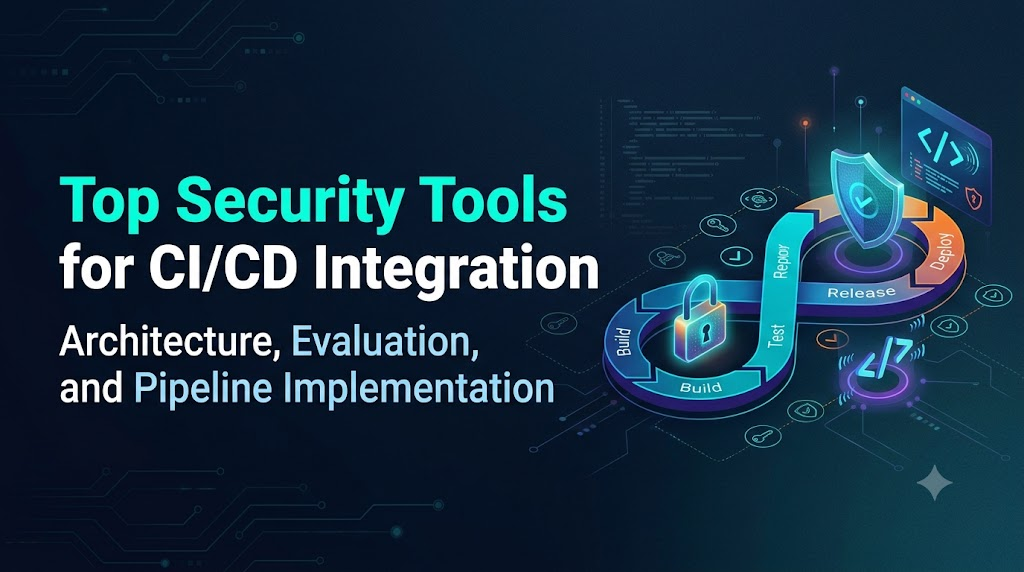
Modern engineering organizations face a persistent operational tension: shipping features at continuous delivery velocity while preventing vulnerabilities from entering production environments. Automated CI/CD pipelines streamline software builds, packaging, and deployments, yet without intentional security controls, they also accelerate the distribution of security flaws.
A compromised pipeline or an uninspected release candidate can expose infrastructure keys, bundle known Common Vulnerabilities and Exposures (CVEs) through third-party packages, deploy misconfigured cloud resources, or ship vulnerable source code directly to users. Integrating automated security verification into the delivery lifecycle mitigates these risks before code lands in staging or production.
Selecting the Top Security Tools for CI/CD Integration requires understanding your technical architecture, language ecosystems, runtime environments, and pipeline performance boundaries. Rather than buying an all-in-one suite or chaining random scanners together, engineering teams must evaluate tools by the specific failure modes they address, the fidelity of their findings, and how cleanly they fit into automated developer workflows.
CI/CD Security and DevSecOps Fundamentals
Continuous Integration and Continuous Delivery (CI/CD) pipelines automate the journey of software from raw source code to running workloads. In a typical delivery loop:
- Developers commit code to a shared repository.
- Build agents compile dependencies, execute unit tests, and assemble deployable artifacts (such as container images or binaries).
- Automated deployment routines release these artifacts across test, staging, and production environments.
The Role of Security in the Pipeline
Historically, security teams audited applications at the end of the development lifecycle—often days before scheduled deployment—creating severe delivery bottlenecks and expensive remediation loops. DevSecOps embeds automated security controls directly into this delivery loop.
+----------------------------------------------------------------------------------------------------+
|                                    TYPICAL DEVSECOPS PIPELINE                                      |
|                                                                                                    |
|  [Commit & PR]   -->    [Build & Package]    -->    [Artifact & Supply Chain]   -->   [Deploy]     |
|   - Pre-commit hooks     - Compiler checks           - SBOM Generation (Syft)          - OPA / Kyverno
|   - Secret scanning      - Dependency CVEs (SCA)     - Signature Verification (Cosign) - Admission ctrl
|     (Gitleaks)           - Image scanning (Trivy)    - Policy Checks                   - Runtime audits
|   - Fast SAST (Semgrep)  - IaC Audits (Checkov)                                                    |
+----------------------------------------------------------------------------------------------------+
Practical DevSecOps balances two categories of controls:
- Preventive Controls: Automated gates that block unvetted changes from progressing (for example, rejecting a pull request that introduces an unencrypted API secret or failing a container build containing an exploitable critical CVE).
- Detective Controls: Passive monitors and audit workflows that log findings, track vulnerability lifecycles, and generate software bills of materials (SBOMs) without interrupting delivery timelines.
The Operational Guardrails: Speed, Context, and Ownership
Shifting security left does not mean running every heavy vulnerability scanner on every local code change. Effective integration rests on three operational realities:
- Feedback Velocity: If a security check adds fifteen minutes to a pull request, developers will look for ways to bypass it. Fast, lightweight checks belong in PR workflows; deep, complex analysis belongs in parallel builds, staging jobs, or nightly pipelines.
- Actionable Findings: A scanner that outputs hundreds of low-confidence warnings causes alert fatigue. Tools must provide deterministic findings, precise code locations, and practical upgrade or remediation steps.
- Explicit Remediation Ownership: A security finding without a designated engineering owner is simply pipeline noise. Vulnerabilities detected during build and packaging must route to the developer authoring the change, whereas base-image OS vulnerabilities belong to platform or infrastructure maintainers.
Automated scanners do not replace threat modeling, architectural reviews, least-privilege identity designs, or secure coding fundamentals. They act as automated guardrails to catch known regressions at scale.
Mapping Security Tools to Pipeline Stages
Different security tools inspect different abstractions of the application. Running tools at the wrong stage wastes compute resources and slows developers down.
+---------------------------------+------------------------------------------+------------------------------+
| Pipeline Stage                  | Target Asset                             | Primary Security Objective   |
+---------------------------------+------------------------------------------+------------------------------+
| Pull Request / Code Commit      | Uncompiled source, Git commits, PR diffs | Secrets, Fast SAST, IaC      |
| Build & Compilation             | Raw binaries, compiled classes, AST      | Deep SAST, Code Quality      |
| Packaging & Dependency Check    | Lockfiles, Base OS, Container Images     | SCA, Base Image CVEs, SBOM   |
| Artifact Verification & Release | Container Images, Binaries, Manifests    | Cryptographic Signatures     |
| Test & Staging Environments     | Running Web Application                  | Dynamic Testing (DAST)       |
| Production & Runtime            | Running Pods, Cloud Infrastructure       | Policy & Admission Control   |
+---------------------------------+------------------------------------------+------------------------------+
1. Source Code and Pull-Request Stage
- Primary Scans: Secret detection, lightweight Static Application Security Testing (SAST), Infrastructure-as-Code (IaC) linting.
- Cadence: Every commit and pull-request update.
- Goal: Provide sub-minute feedback on hardcoded credentials, obvious code injection flaws, and misconfigured infrastructure definitions before code merges into protected branches.
2. Build and Packaging Stage
- Primary Scans: Software Composition Analysis (SCA), container image vulnerability scanning, deep AST-based SAST.
- Cadence: On merge to main or during continuous release builds.
- Goal: Parse third-party dependencies, scan base operating system layers, and identify known CVEs in external packages.
3. Supply Chain and Artifact Integrity Stage
- Primary Tasks: SBOM generation, provenance metadata collection, cryptographic artifact signing.
- Cadence: Immediately following artifact construction.
- Goal: Attest that the artifact was generated by an authorized pipeline workflow from a verified commit, preventing tampering downstream.
4. Staging and Dynamic Testing Stage
- Primary Scans: Dynamic Application Security Testing (DAST), API security fuzzing.
- Cadence: Post-deployment to ephemeral or staging environments; scheduled nightly pipelines.
- Goal: Identify runtime vulnerabilities (such as authentication bypasses, broken object-level authorization, and header misconfigurations) that cannot be deduced from static source text alone.
5. Runtime and Admission Control Stage
- Primary Tasks: Image signature verification, Kubernetes admission policy enforcement.
- Cadence: Pre-deployment execution inside target clusters.
- Goal: Verify that only cryptographically signed images with passing security policies can execute on compute nodes.
Deep Dive: Top Security Tools for CI/CD Integration
1. Static Application Security Testing (SAST)
SAST analyzers inspect uncompiled or compiled application code without executing it. They search for insecure syntax, dangerous function calls, untrusted inputs routed to sensitive sinks, and violations of secure coding guidelines.
+----------------------------------------------------------------------------------------------------+
|                                    STATIC ANALYSIS (SAST)                                          |
|                                                                                                    |
|    Source Code  -->  [Parser / AST Engine]  -->  [Rule Evaluation]  -->  Findings (CWE-89, etc.)   |
|    (app.py)          - Lexical analysis          - Taint tracking        - Line numbers            |
|                      - Semantic graph            - Pattern matching      - Remediation hints       |
+----------------------------------------------------------------------------------------------------+
Semgrep
- Primary Purpose: Fast, lightweight, syntax- and semantic-aware static analysis using an expressive, pattern-matching rule syntax.
- What It Detects: Common coding flaws (OWASP Top 10, CWEs), business logic antipatterns, insecure framework configurations, and API misuse.
- Pipeline Integration: Pull request workflows, pre-commit hooks, and commit-stage CI jobs.
- Key Strengths: Exceptional scanning speed; rules look like actual code rather than complex abstract syntax trees (ASTs); straightforward authoring of custom organizational rules.
- Limitations: Advanced cross-file taint analysis across deeply decoupled services requires commercial extensions; primarily inspects code semantics rather than dynamic execution paths.
- Best Fit: Engineering teams that want rapid pull-request feedback and simple syntax for enforcing internal coding standards.
SonarQube
- Primary Purpose: Combined static code analysis, code quality auditing, and security vulnerability scanning.
- What It Detects: Security hotspots, injection flaws, memory leaks, code smells, test-coverage deficits, and technical debt.
- Pipeline Integration: Build-stage execution during compilation, reporting status checks back to pull requests.
- Key Strengths: Strong unified view of overall code health; mature integration with enterprise CI orchestrators; native support for a wide array of enterprise languages.
- Limitations: Scanning runtimes can be substantial on large monorepos; demands persistent database infrastructure for on-premises deployments.
- Best Fit: Organizations seeking a centralized dashboard that tracks maintainability and security debt alongside traditional vulnerability metrics.
CodeQL
- Primary Purpose: Deep, semantic, query-driven code analysis that treats code as a relational database to uncover complex dataflow vulnerabilities.
- What It Detects: Complex, cross-file taint paths, remote code execution (RCE), SQL/command injection, and memory safety vulnerabilities.
- Pipeline Integration: GitHub Actions native integration, scheduled continuous builds, and release validation.
- Key Strengths: Industry-leading semantic and dataflow modeling; powerful declarative query language (QL); broad open-source community sharing vulnerability queries.
- Limitations: High compute and memory footprint; requires explicit build steps for compiled languages (such as C++, Java, and Go); steep learning curve to author custom queries.
- Best Fit: Projects built within GitHub ecosystems requiring deep taint-tracking across complex data execution paths.
2. Software Composition Analysis (SCA) & Dependency Management
Modern applications are predominantly assembled from third-party open-source libraries. SCA scanners inspect lockfiles and manifest declarations to identify known vulnerabilities (CVEs) and incompatible software licenses.
+----------------------------------------------------------------------------------------------------+
|                                SOFTWARE COMPOSITION ANALYSIS (SCA)                                 |
|                                                                                                    |
|    Package Lockfile  -->  [Dependency Tree Resolution]  -->  [Vulnerability DBs]  -->  Findings    |
|    (package-lock.json)    - Transitive dependencies          - NVD / OSV / GitHub       - CVE IDs  |
|                           - Direct dependencies              - Advisory feeds           - Fix ver. |
+----------------------------------------------------------------------------------------------------+
OWASP Dependency-Check
- Primary Purpose: Open-source software composition analysis tracking known disclosure feeds.
- What It Detects: Publicly disclosed CVEs within Java, .NET, Node.js, Python, and other managed language dependencies.
- Pipeline Integration: Post-dependency resolution build steps (such as Maven, Gradle, or CLI invocation).
- Key Strengths: Completely free and open-source; straightforward integration into enterprise Java build tooling.
- Limitations: Relies heavily on CPE (Common Platform Enumeration) string matching, which can yield false positives; local vulnerability database synchronization can introduce pipeline delays without caching.
- Best Fit: Java-centric environments looking for zero-license-cost dependency validation.
Snyk (Snyk Open Source)
- Primary Purpose: Developer-first dependency scanning, automated vulnerability remediation, and software license compliance.
- What It Detects: Known CVEs in direct and transitive open-source dependencies, malicious packages, and license compliance violations.
- Pipeline Integration: PR checks, CLI build steps, IDE extensions, and continuous repository webhooks.
- Key Strengths: Curated, high-fidelity vulnerability database; actionable remediation paths with automated pull requests for non-breaking dependency upgrades.
- Limitations: Commercial SaaS model; advanced enterprise policy engines and high scan volumes require paid tiers.
- Best Fit: Developer-focused teams that prioritize automated, self-healing remediation pull requests directly in their source control system.
Trivy (Dependency Scanning Engine)
- Primary Purpose: All-in-one lightweight vulnerability scanner covering language-specific package manifests alongside OS packages.
- What It Detects: CVEs across ecosystem lockfiles (
Gemfile.lock,package-lock.json,go.sum,poetry.lock) and license conflicts. - Pipeline Integration: Single static binary execution in any CI environment during build or pre-packaging steps.
- Key Strengths: Fast execution speed; no background daemon or external database server required; shares findings syntax with container and IaC scanners.
- Limitations: Primarily surfaces vulnerability data based on direct lockfile parsing; does not automatically generate complex dependency remediation trees.
- Best Fit: Cloud-native pipelines needing a single, fast scanner for both application libraries and container layers.
3. Secret Detection
Secret detection tools prevent hardcoded credentials—such as cloud service tokens, private encryption keys, API secrets, and database passwords—from being stored in source control history.
Gitleaks
- Primary Purpose: Lightweight, high-velocity Git repository and file scanning to detect unencrypted secrets.
- What It Detects: API keys, AWS/GCP/Azure access credentials, private SSH keys, webhook tokens, and custom regex-defined secrets.
- Pipeline Integration: Pre-commit hooks, pull request validation, and branch-push CI triggers.
- Key Strengths: Fast execution; written in Go as a standalone binary; handles differential scanning (
--log-opts="origin/main..HEAD") cleanly in CI jobs. - Limitations: Relies on regular expressions and Shannon entropy checks; cannot determine on its own whether a detected credential is valid or revoked.
- Best Fit: Engineering pipelines requiring rapid, deterministic secret detection on every Git push.
TruffleHog
- Primary Purpose: Secret scanner capable of deep commit-history analysis and automated credential validation.
- What It Detects: Exposed secrets, tokens, and certificates across Git history, filesystems, and continuous pipelines.
- Pipeline Integration: Pull request verification, weekly deep-history audits, and repository onboarding checks.
- Key Strengths: Features active verification detectors that query identity providers (such as AWS, Slack, or GitHub APIs) to confirm if an exposed credential is live.
- Limitations: Live verification checks require outbound network access from CI runners; deep commit-history audits can be resource-intensive on large repositories.
- Best Fit: Teams requiring verified secret detection to eliminate time spent investigating inactive or false-positive tokens.
Operational Insight: Revocation and rotation take precedence over repository cleanup. If a secret appears in a remote pipeline log or Git branch, treat it as compromised immediately. Simply rewriting Git history does not invalidate an active key.
4. Container and Artifact Security
Container scanners inspect the layers of an Open Container Initiative (OCI) image, uncovering vulnerable system libraries (glibc, openssl), outdated runtimes, and insecure image configurations.
+----------------------------------------------------------------------------------------------------+
|                                    CONTAINER IMAGE SCANNING                                        |
|                                                                                                    |
|    Container Image  -->  [Layer Unpacking]  -->  [OS & Package Fingerprint]  -->  Vulnerability    |
|    (app:v1.2.0)          - Base layers           - Debian/Alpine/RHEL packages    Report           |
|                          - Application layer     - Embedded runtimes & libraries  - Base vs App    |
+----------------------------------------------------------------------------------------------------+
Trivy (Container Security Engine)
- Primary Purpose: Comprehensive security scanning of container images, filesystems, and Git repositories.
- What It Detects: Vulnerabilities in base OS distributions (Alpine, Debian, Ubuntu, Red Hat, etc.), embedded language runtimes, misconfigurations, and sensitive files.
- Pipeline Integration: Immediately following
docker buildor before pushing to an artifact registry. - Key Strengths: Exceptional speed, comprehensive vulnerability database integration, clean SARIF output, and broad ecosystem adoption.
- Limitations: Highly detailed scans can produce extensive lists of vulnerabilities that lack practical runtime exploit paths.
- Best Fit: Modern container pipelines across Docker, Podman, and Kubernetes workflows.
Grype
- Primary Purpose: Specialized, standalone container and filesystem vulnerability scanner developed by Anchore.
- What It Detects: Known CVEs in container images and filesystems, designed to work directly alongside Syft SBOMs.
- Pipeline Integration: Post-build image scanning steps and decoupled vulnerability monitoring pipelines.
- Key Strengths: Deep integration with the Syft ecosystem; rapid evaluation of existing SBOM files without re-pulling or unpacking large container images.
- Limitations: Focuses primarily on vulnerability matching rather than broader misconfiguration or compliance checks.
- Best Fit: Architectures separating the generation of an SBOM from subsequent vulnerability analysis.
Clair
- Primary Purpose: API-driven, vulnerability-parsing engine for container images, commonly embedded into registries (such as Project Quay).
- What It Detects: Known vulnerabilities across operating system layers in OCI-compliant container artifacts.
- Pipeline Integration: Registry-level scanning upon artifact push, or asynchronous webhook-triggered analysis.
- Key Strengths: Scalable client-server architecture built for enterprise registries handling continuous image uploads.
- Limitations: Requires running and maintaining independent services and databases; less suited for single, ephemeral CLI steps inside simple CI runners.
- Best Fit: Platform engineering teams running centralized on-premises container registries.
5. Infrastructure-as-Code (IaC) & Cloud Configuration
IaC security scanners parse declarative configuration files (Terraform, CloudFormation, Kubernetes YAML, Helm, Ansible) before provisioning infrastructure. They identify misconfigurations that expose resources to public networks, run workloads with excessive privileges, or skip encryption controls.
+----------------------------------------------------------------------------------------------------+
|                                    IaC CONFIGURATION VALIDATION                                    |
|                                                                                                    |
|    Terraform / K8s  -->  [Static Parser]  -->  [Policy Rules Engine]  -->  Policy Violations       |
|    Manifests             - Graph generation    - CIS Benchmarks            - Wildcard IAM          |
|                          - HCL/YAML parsing    - Custom Rego policies      - Public S3 Buckets     |
+----------------------------------------------------------------------------------------------------+
Checkov
- Primary Purpose: Static analysis tool for Infrastructure as Code, enforcing security and compliance policies across cloud definitions.
- What It Detects: Misconfigurations in Terraform, CloudFormation, Kubernetes, Helm, ARM Templates, Serverless framework files, and Dockerfiles.
- Pipeline Integration: Pull-request checks in infrastructure repositories, plan-time execution before
terraform apply. - Key Strengths: Thousands of out-of-the-box policies covering CIS benchmarks, AWS Well-Architected frameworks, and PCI-DSS; supports custom Python and YAML rules.
- Limitations: Can run slowly on sprawling infrastructure repositories with thousands of nested resources; graph analysis consumes notable memory.
- Best Fit: Platform teams managing cloud environments through Terraform, OpenTofu, or CloudFormation definitions.
Terrascan
- Primary Purpose: Extensible infrastructure vulnerability and compliance scanner powered by Open Policy Agent (OPA) and Rego policies.
- What It Detects: Security misconfigurations, privilege escalations, and compliance drift in Terraform, Kubernetes, and Dockerfiles.
- Pipeline Integration: Pre-merge Git checks, CI validation steps, and admission controller execution.
- Key Strengths: Built directly on OPA’s Rego engine, simplifying the use of unified organizational policies across pipelines and runtime environments.
- Limitations: Smaller built-in rule library compared to some commercial alternatives; slower cadence of new cloud resource policies.
- Best Fit: Organizations standardizing on Open Policy Agent (OPA) for their organizational policy definitions.
KICS (Keeping Infrastructure as Code Secure)
- Primary Purpose: Open-source static analysis engine for infrastructure as code, maintained by Checkmarx.
- What It Detects: Security vulnerabilities, compliance violations, and architectural misconfigurations across infrastructure manifests.
- Pipeline Integration: CI validation steps on pull requests and scheduled audits.
- Key Strengths: Wide language support (Terraform, Ansible, Helm, CloudFormation, Kubernetes); broad collection of predefined queries.
- Limitations: Complex custom rule syntax requiring query customization; can produce noisy output without tuning out-of-the-box rules.
- Best Fit: Teams maintaining mixed IaC estates containing Ansible playbooks, Helm charts, and Terraform modules within the same repository.
6. Dynamic Application Security Testing (DAST)
DAST solutions assess running applications by sending HTTP requests, payload variations, and attack sequences against exposed endpoints.
+----------------------------------------------------------------------------------------------------+
|                             DYNAMIC APPLICATION SECURITY TESTING (DAST)                            |
|                                                                                                    |
|    Running App   <-- [HTTP Traffic / Payloads] <-- [DAST Engine: OWASP ZAP]                        |
|    (Staging/QA)  --> [Response Analysis]       --> Identifies: SQLi, XSS, Auth Bypass, CORS        |
+----------------------------------------------------------------------------------------------------+
OWASP ZAP (Zed Attack Proxy)
- Primary Purpose: Automated and manual web application vulnerability scanner and penetration testing proxy.
- What It Detects: Runtime vulnerabilities including Cross-Site Scripting (XSS), SQL Injection, cross-origin resource sharing (CORS) misconfigurations, insecure authentication cookies, and header weaknesses.
- Pipeline Integration: Scheduled builds against stable staging environments, or automated baseline scans within ephemeral test environments.
- Key Strengths: Flexible automation via Docker and GitHub Actions; strong open-source backing under the Software Freedom Conservancy; fully scriptable via Python and REST APIs.
- Limitations: Requires a running application and stable test data; deep authenticated scans require complex configuration to avoid invalidating sessions; scans are time-intensive.
- Best Fit: Teams validating running web apps and APIs in QA or staging environments before promoting to production.
7. Software Supply Chain and Artifact Integrity
Securing the supply chain requires validating where an artifact came from, how it was built, and whether it has been altered since compilation.
+----------------------------------------------------------------------------------------------------+
|                               SUPPLY CHAIN INTEGRITY & PROVENANCE                                  |
|                                                                                                    |
|   1. Build Artifact  -->  2. Generate SBOM   -->  3. Sign Artifact   -->  4. Runtime Verification  |
|      (Image / Binary)        (Syft)                   (Cosign)                (Kyverno / OPA)      |
|                              - CycloneDX / SPDX       - Sigstore / OIDC       - Blocks unsigned    |
+----------------------------------------------------------------------------------------------------+
Syft
- Primary Purpose: Purpose-built CLI tool and library for generating detailed Software Bills of Materials (SBOMs) from container images and filesystems.
- What It Delivers: Complete inventories of direct packages, indirect dependencies, OS libraries, and software licenses, exported in standard formats like SPDX and CycloneDX.
- Pipeline Integration: Post-build packaging step running immediately after artifact assembly.
- Key Strengths: Fast execution; accurate cataloging across multiple package ecosystems; seamless handoff to scanners like Grype.
- Limitations: Generates software bills of materials rather than vulnerability findings; requires downstream tooling to inspect the generated catalog.
- Best Fit: Organizations establishing compliance with SBOM mandates or maintaining explicit software inventories.
Cosign (Sigstore)
- Primary Purpose: Container signing, signature verification, and attestation management for OCI registries.
- What It Delivers: Cryptographic signing of container images, attestations of build provenance, and keyless signing using OpenID Connect (OIDC) identities.
- Pipeline Integration: Signs images immediately following container registry uploads; verifies signatures at cluster admission.
- Key Strengths: Eliminates the complexity of managing long-lived private signing keys via keyless OIDC workflows; broad integration with Kubernetes admission controllers (such as Kyverno and Gatekeeper).
- Limitations: Requires an OCI registry that supports storing additional artifact references alongside images.
- Best Fit: Production Kubernetes deployments enforcing verified build origins for running containers.
Tool Comparison by Security Category
| Tool Category | Primary Security Objective | Pipeline Stage | Primary Findings & Focus | Integration Footprint | Best-Fit Architecture |
| Semgrep (SAST) | Pattern-based source code security | Pull Request / Commit | OWASP Top 10, bad patterns, custom rules | Standalone CLI binary, ultra-fast runtimes | Fast PR gates, custom internal coding standards |
| SonarQube (SAST & Quality) | Code maintainability, quality, and security | Build / Compilation | Security hotspots, code smells, technical debt | Centralized server or SaaS, requires DB | Enterprise monorepos and mixed-language projects |
| CodeQL (SAST) | Deep semantic dataflow and taint analysis | Nightly / Branch Merge | Complex cross-file vulnerabilities, injection sinks | Heavy compute, native GitHub integration | Security-sensitive applications on GitHub |
| Snyk (SCA) | Dependency vulnerability & license management | PR / CLI / Build | Open-source CVEs, out-of-date packages, licenses | Cloud SaaS connection, native IDE/SCM hooks | Developer-led remediation and automated PR updates |
| OWASP Dep-Check (SCA) | Open-source dependency CVE analysis | Build / Packaging | Known CVEs matched against public NVD feeds | Local binary / build plugin, requires feed sync | Cost-conscious Java and .NET environments |
| Gitleaks (Secret Detection) | Fast credential and token pattern discovery | Pre-Commit / PR | API tokens, cloud keys, private certificates | Lightweight Go binary, local or CI runner | Fast commit-time blocking on every code push |
| TruffleHog (Secret Detection) | Deep secret discovery with active verification | PR / Scheduled Audit | Verified active credentials across Git history | Standalone binary, optional outbound network calls | Enterprise audits and historical secret discovery |
| Trivy (Container/SCA) | Comprehensive image & filesystem scanning | Build / Post-Packaging | OS package CVEs, embedded runtime flaws, misconfigs | Single binary, local DB caching, fast execution | Container-first microservices and Kubernetes |
| Checkov (IaC) | Cloud infrastructure policy enforcement | Pre-Plan / PR | Overly permissive IAM, unencrypted disks, public buckets | Python CLI binary, extensive pre-built rules | Terraform, Helm, and CloudFormation pipelines |
| OWASP ZAP (DAST) | Dynamic application security testing | Staging / Test Deploy | Active injection flaws, broken auth, headers | Docker container or CLI, requires target URL | Running web apps and API endpoints in staging |
| Syft (SBOM) | Software inventory and bill of materials | Post-Build Packaging | Detailed dependency manifests (SPDX, CycloneDX) | Fast CLI binary, no network requirement | Supply chain transparency and software inventory |
| Cosign (Attestation) | Cryptographic signing & provenance tracking | Post-Build / Pre-Deploy | Image signatures, build attestations, provenance | CLI tool, integrates with OIDC and registries | Enforcing verified container origins at deploy |
Practical Pipeline Integration: GitHub Actions Example
Below is a production-oriented GitHub Actions workflow demonstrating how these tools integrate into an automated delivery pipeline.
The pipeline runs lightweight checks (secret scanning, fast SAST, IaC checks) in parallel, proceeds through build and packaging, performs container scanning, generates an SBOM, signs the resulting artifact, and validates deployment policies.
YAML
name: Secure Delivery Pipeline

on:
  push:
    branches: [ "main" ]
  pull_request:
    branches: [ "main" ]

permissions:
  contents: read
  security-events: write
  packages: write
  id-token: write # Required for Cosign keyless signing

jobs:
  commit-validation:
    name: Secrets, SAST & IaC Validation
    runs-on: ubuntu-latest
    steps:
      - name: Checkout Source Code
        uses: actions/checkout@v4
        with:
          fetch-depth: 0 # Full history needed for Git diff scans

      - name: Detect Hardcoded Secrets
        uses: gitleaks/gitleaks-action@v2
        env:
          GITHUB_TOKEN: ${{ secrets.GITHUB_TOKEN }}

      - name: Fast Static Analysis (SAST)
        run: |
          # Install and run Semgrep with lightweight rules
          python3 -m pip install semgrep
          semgrep scan --config=auto --error --skip-unknown-extensions

      - name: Validate Infrastructure as Code
        run: |
          # Install and execute Checkov across infrastructure manifests
          python3 -m pip install checkov
          checkov -d ./infra --framework terraform --output cli --soft-fail

  build-and-package:
    name: Build, Scan & Sign Container Image
    needs: commit-validation
    runs-on: ubuntu-latest
    if: github.ref == 'refs/heads/main'
    env:
      REGISTRY: ghcr.io
      IMAGE_NAME: ${{ github.repository }}
    steps:
      - name: Checkout Code
        uses: actions/checkout@v4

      - name: Set up Docker Buildx
        uses: docker/setup-buildx-action@v3

      - name: Log into Container Registry
        uses: docker/login-action@v3
        with:
          registry: ${{ env.REGISTRY }}
          username: ${{ github.actor }}
          password: ${{ secrets.GITHUB_TOKEN }}

      - name: Build Container Image Locally
        uses: docker/build-push-action@v5
        with:
          context: .
          load: true
          tags: ${{ env.REGISTRY }}/${{ env.IMAGE_NAME }}:${{ github.sha }}

      - name: Scan Container Image for Vulnerabilities
        uses: aquasecurity/trivy-action@0.28.0
        with:
          image-ref: ${{ env.REGISTRY }}/${{ env.IMAGE_NAME }}:${{ github.sha }}
          format: 'table'
          exit-code: '1' # Fail the pipeline on Critical vulnerabilities
          ignore-unfixed: true
          severity: 'CRITICAL'

      - name: Generate Software Bill of Materials (SBOM)
        uses: anchore/sbom-action@v0
        with:
          image: ${{ env.REGISTRY }}/${{ env.IMAGE_NAME }}:${{ github.sha }}
          format: spdx-json
          output-file: sbom.spdx.json

      - name: Push Verified Container Image
        run: |
          docker push ${{ env.REGISTRY }}/${{ env.IMAGE_NAME }}:${{ github.sha }}

      - name: Install Sigstore Cosign
        uses: sigstore/cosign-installer@v3.5.0

      - name: Sign Image (Keyless OIDC)
        run: |
          cosign sign --yes ${{ env.REGISTRY }}/${{ env.IMAGE_NAME }}:${{ github.sha }}

      - name: Attest SBOM
        run: |
          cosign attest --yes --predicate sbom.spdx.json --type spdx ${{ env.REGISTRY }}/${{ env.IMAGE_NAME }}:${{ github.sha }}

  staging-dast-validation:
    name: Dynamic Security Testing
    needs: build-and-package
    runs-on: ubuntu-latest
    steps:
      - name: Run OWASP ZAP Baseline Scan
        uses: zaproxy/action-baseline@v0.12.0
        with:
          token: ${{ secrets.GITHUB_TOKEN }}
          target: 'https://staging.internal.example.com'
          issue_title: 'ZAP Security Baseline Alert'
          fail_action: false # Baseline alerts create tickets without failing deployments
Pipeline Flow and Error Handling
- Parallel Execution at the Commit Gate: Secret detection, Semgrep, and Checkov run together on code pushes, providing fast feedback to developers.
- Deterministic Blocking on Build: If Trivy detects an unmitigated Critical CVE with an available upstream patch in the container layers, the build terminates before publishing the image.
- Artifact Provenance: Syft generates an inventory of all embedded packages, while Cosign cryptographically binds this inventory directly to the container registry using GitHub’s short-lived OIDC tokens.
- Decoupled Dynamic Auditing: The staging DAST job targets an active environment post-deployment, surfacing runtime issues via structured issues without interrupting continuous integration.
Establishing Security Gates and Vulnerability Policies
A common breakdown in automated pipelines occurs when security gates are configured with naive, zero-tolerance policies (such as failing builds on any reported issue). Developers are quickly overwhelmed by alert fatigue, while platform teams face pressure to disable the scans entirely.
+----------------------------------------------------------------------------------------------------+
|                                    VULNERABILITY GATE DECISION                                     |
|                                                                                                    |
|    Vulnerability Detected (CVSS 9.8)                                                               |
|    |                                                                                               |
|    +--> Is there a known public exploit (EPSS > 0.4 / CISA KEV)?                                   |
|    |    |-- YES --> Is the vulnerable code or package reachable in runtime?                        |
|    |    |           |-- YES --> [FAIL PIPELINE - IMMEDIATE BLOCK]                                  |
|    |    |           \-- NO  --> [LOG HIGH TICKET - 7-DAY REMEDIATION]                              |
|    |    \-- NO  --> Is an upstream vendor patch available?                                         |
|    |                |-- YES --> [WARN IN BUILD - 14-DAY REMEDIATION]                               |
|    |                \-- NO  --> [DOCUMENT EXCEPTION / ACCEPT RISK]                                 |
+----------------------------------------------------------------------------------------------------+
Context-Aware Triage and Exploitability
Raw CVSS scores are poor metrics for pipeline blocking when used in isolation. A vulnerability rated CVSS 9.8 in an unused test utility does not pose the same risk as an actively exploited remote code execution vulnerability rated 8.1 in an ingress proxy.
- EPSS (Exploit Prediction Scoring System): Use EPSS data to identify whether a vulnerability is actively being exploited in the wild. High CVSS coupled with high EPSS warrants an immediate deployment block.
- Reachability and In-Use Analysis: Evaluate whether the vulnerable function or library is actually loaded and invoked by the application, or simply present in a dormant directory on disk.
- Fix Availability: Failing a release on a vulnerability that lacks an upstream patch creates an unresolvable obstacle. Instruct scanners to ignore unfixed CVEs (
--ignore-unfixed) for pipeline-blocking gates, while routing those findings to vulnerability management backlogs for monitoring.
Handling False Positives and Documented Exceptions
Security policies must provide a clear path for managing false positives and documenting accepted risks:
- In-Repository Waivers with Expirations: Store suppression files (such as
.trivyignore,.checkov.baseline, or.semgrepignore) directly in source control alongside the code. Require an issue link, security approver, and expiration date (e.g., 30 days) within each suppression entry. - Service Level Agreements (SLAs): Establish practical remediation timelines tied to severity:
- Critical (Known Exploits): Block pipeline immediately; remediation required within 24–48 hours.
- High: Warn on pull request; block release if unresolved after 14 days.
- Medium / Low: Aggregate into development backlogs; address during normal maintenance cycles.
Integrating Security with Developer Workflows
Security tools should provide direct, actionable feedback within the environments developers already use, rather than requiring them to log into separate security dashboards.
+----------------------------------------------------------------------------------------------------+
|                                 DEVELOPER-CENTRIC FEEDBACK LOOP                                    |
|                                                                                                    |
|  1. Local Scan (pre-commit)  --> 2. Pull Request Check     --> 3. Automated Remediation            |
|     - Fast linting              - Inline code comments         - Direct dependency updates         |
|     - Local secret check        - Links to specific lines      - Clear remediation guidance        |
+----------------------------------------------------------------------------------------------------+
Effective Pull-Request Feedback
- Inline Annotations: Surface findings as comments directly on the affected lines in the pull request diff, rather than generating a generic build failure log.
- Actionable Remediation Guidance: Explain why the pattern is risky and provide safe replacement code. For example, rather than simply flagging
CWE-89 (SQL Injection), show how to rewrite the query using parameterized statements. - Automated Update PRs: Configure dependency scanners to open automated pull requests that update vulnerable libraries when safe, non-breaking releases are available.
Local Feedback Loops
Prevent pipeline failures by enabling developers to catch issues locally before opening a pull request:
- Pre-commit Hooks: Use frameworks like
pre-committo run fast checks (such as Gitleaks and Semgrep) on staged files before they are committed. - IDE Extensions: Provide editor extensions that flag insecure patterns and misconfigured manifests directly in the code editor as changes are written.
Protecting the CI/CD Pipeline Itself
Adding security scanners to an insecure CI/CD pipeline creates a false sense of security. The delivery system itself is a high-value target; attackers who compromise a runner, workflow configuration, or deployment credential can bypass scanning controls entirely.
+----------------------------------------------------------------------------------------------------+
|                                  CI/CD PIPELINE ATTACK VECTORS                                     |
|                                                                                                    |
|  [Compromised PR]     --> Runs untrusted code on runner, attempts to steal secrets                 |
|  [Mutable Action Tag] --> Supply chain attack replaces v1.0.0 with malicious payload               |
|  [Overprivileged Key] --> Stolen AWS deployment key provides full admin access to cloud             |
|  [Unprotected Branch] --> Attacker pushes directly to main, bypassing all security checks         |
+----------------------------------------------------------------------------------------------------+
1. Hardening Workflow Actions and Plugins
- Pin Actions to Immutable SHAs: Third-party pipeline plugins and GitHub Actions referencing mutable tags (such as
@v1or@main) can be redirected if an upstream repository is compromised. Pin external actions to full commit hashes and use automated tools to keep them current:YAML# Vulnerable to upstream tag manipulation: uses: actions/checkout@v4 # Hardened against upstream tampering: uses: actions/checkout@b4ffde65f46336ab88eb53be808477a3936bae11 # v4.1.1
2. Eliminating Long-Lived Credentials via OIDC
- Replace permanent cloud provider access keys stored in CI secret stores with short-lived OpenID Connect (OIDC) federated tokens. AWS, Google Cloud, and Azure can validate the identity of the specific CI runner, issuing short-lived credentials that expire automatically after the build completes.
3. Securing Pipeline Runners and Build Isolation
- Prevent Poisoned Pipeline Execution (PPE): Never run automated workflows with access to privileged deployment secrets on untrusted pull requests originating from public forks.
- Ephemeral Runners: Run jobs in isolated virtual machines or containers that are discarded immediately after each build, preventing lateral movement or credential harvesting across runs.
- Protect Core Branches: Enforce branch protection on primary delivery branches. Require passing security status checks, code reviews, and signed commits before changes can merge.
Open-Source Tools vs. Commercial Security Platforms
Engineering teams often debate whether to assemble an open-source security toolkit or deploy a commercial platform. Each approach comes with distinct tradeoffs:
+----------------------------------------------------------------------------------------------------+
|                                     TOOLING SELECTION TRADEOFF                                     |
|                                                                                                    |
|   Open-Source Scanners (CLI-Driven)               Commercial Security Platforms (SaaS)             |
|   + Zero upfront licensing costs                  + Unified cross-stage dashboards                 |
|   + Complete configuration ownership              + Out-of-the-box compliance reporting            |
|   + Direct, scriptable pipeline integration       + Enterprise identity & access controls          |
|   - Manual tuning and maintenance required        - Significant annual software costs              |
|   - Siloed reports without unified tracking       - Potential data privacy / SaaS lock-in          |
+----------------------------------------------------------------------------------------------------+
| Evaluation Criteria | Open-Source Security Scanners (Trivy, Semgrep, Checkov) | Commercial DevSecOps Platforms (Snyk, Veracode, Prisma) |
| Direct Software Cost | No licensing fees; community-maintained releases. | Per-developer or per-repository recurring subscription fees. |
| Operational Overhead | Engineering teams handle updates, integrations, and reports. | Vendor manages infrastructure, databases, and feeds. |
| Vulnerability Intelligence | Relies on public feeds (NVD, OSV, GitHub Security Advisory). | Proprietary research teams, curated threat data, earlier alerts. |
| Centralized Visibility | Requires custom aggregation (e.g., DefectDojo, Grafana). | Native single-pane-of-glass dashboards with organization-wide metrics. |
| Remediation Workflows | Output parsing left to custom scripts and SARIF files. | Automated pull requests, direct Jira sync, IDE integrations. |
| Enterprise Governance | Maintained across individual repository workflow files. | Centralized policy enforcement, RBAC, and audit logs. |
A Practical Framework for Selecting CI/CD Security Tools
To choose the right security tools for your organization, follow this step-by-step selection framework:
+----------------------------------------------------------------------------------------------------+
|                                    10-STEP SELECTION ROADMAP                                       |
|                                                                                                    |
|  1. Map Architecture  --> 2. Identify Risks    --> 3. Inventory Controls --> 4. Target Gaps        |
|  5. Check Tech Fit    --> 6. Run Pilot Pipeline--> 7. Define Gates       --> 8. Measure Impact     |
|  9. Review Overhead   --> 10. Reassess Regularly                                                   |
+----------------------------------------------------------------------------------------------------+
- Map Software Delivery Architecture: Document your core technologies: programming languages, package managers, cloud providers, and orchestration systems.
- Identify Primary Risks: Determine where your application is most vulnerable (e.g., exposed credentials, third-party libraries, container misconfigurations).
- Inventory Existing Controls: Check for built-in capabilities in your current CI/CD platform (e.g., GitHub Advanced Security or GitLab Ultimate features) before introducing new standalone tools.
- Target Clear Coverage Gaps: Avoid stacking multiple overlapping tools in the same category until you have covered basic requirements across secrets, dependencies, code, and infrastructure.
- Verify Technical Compatibility: Confirm the scanner runs natively in your CI environment as a standalone binary or container, outputs structured data (SARIF/JSON), and supports your languages.
- Run a Pilot Pipeline: Test the tool against two or three representative codebases. Measure how much time it adds to the build and inspect the quality of its findings.
- Define Gates and Remediation Rules: Document which severities will block builds and establish clear SLAs for fixes before rolling the tool out across the organization.
- Measure Developer Impact: Track pipeline execution time, false-positive reports, and developer feedback during the pilot phase.
- Review Long-Term Maintenance Overhead: Factor in the operational cost of managing rules, tuning exceptions, updating databases, and triaging alerts.
- Reassess Regularly: Periodically review your security tooling as your architecture evolves—such as shifting from virtual machines to serverless or container runtimes.
Sizing Considerations
- Small Teams & Startups: Prioritize high-signal, zero-maintenance tools. Start with pre-commit secret scanning (Gitleaks), container vulnerability checks (Trivy), and automated dependency alerts.
- Mid-Market / Cloud-Native: Add automated IaC validation (Checkov), fast SAST (Semgrep) in pull requests, and cryptographic container signing (Cosign).
- Regulated Enterprises: Implement end-to-end provenance with signed SBOMs, centralized policy enforcement, unified vulnerability dashboards, and regular DAST scans in staging.
Common Implementation Mistakes
1. Activating Scanners Without Clear Policies
- Mistake: Turning on every available scanner check simultaneously with out-of-the-box configurations.
- Impact: Hundreds of legacy findings halt pipeline builds, frustrating developers and prompting teams to bypass the checks.
- Remediation: Introduce tools in an informational “audit mode” first. Measure baseline findings, establish clear policies, and enforce blocking gates only on newly introduced issues.
2. Treating a Clean Scan as Proof of Security
- Mistake: Assuming that an artifact passing static and container scans is free of security flaws.
- Impact: Business logic flaws, broken access controls, and multi-step exploitation chains remain undetected.
- Remediation: Treat scanners as automated guardrails for known risks, while maintaining routine threat modeling, peer code reviews, and periodic penetration testing.
3. Exposing Credentials in CI Logs
- Mistake: Passing secrets as plaintext arguments to build steps or running tools with verbose debugging enabled.
- Impact: Build logs expose sensitive credentials to anyone with read access to the repository.
- Remediation: Use native CI/CD secret masking, pass credentials through environment variables or mounted files, and sanitize scan outputs before storing them.
4. Overlooking Supply Chain and Build Integrity
- Mistake: Scanning application source code while pulling unverified third-party base images and untagged pipeline scripts.
- Impact: Attackers can compromise build scripts or dependencies upstream, bypassing source-level protections.
- Remediation: Pin external pipeline actions to immutable commit SHAs, scan base container images, and sign build artifacts using tools like Cosign.
Measuring the Effectiveness of CI/CD Security
To evaluate whether your security integration is working, track clear, outcome-focused metrics over time:
+---------------------------------+------------------------------------------+------------------------------+
| Metric Category                 | Key Performance Indicator                | Practical Significance       |
+---------------------------------+------------------------------------------+------------------------------+
| **Coverage**                    | % of active repositories with checks     | Measures adoption breadth    |
| **Remediation Speed**           | Mean Time to Remediate (MTTR) criticals  | Validates engineering agility|
| **Pipeline Performance**        | P95 execution time added by security     | Guards against friction      |
| **Finding Quality**             | Ratio of dismissed / false-positive alerts| Monitors rule health         |
| **Supply Chain Verification**   | % of production images signed with SBOMs | Tracks provenance maturity   |
+---------------------------------+------------------------------------------+------------------------------+
Interpreting Findings in Context
- Vulnerability Count: An increase in total detected vulnerabilities often reflects improved scanning coverage rather than declining code quality.
- Focus on Actionable Outcomes: Track the reduction of Mean Time to Remediate (MTTR) and the number of exposed-secret incidents over time. A healthy DevSecOps program surfaces issues quickly and resolves them efficiently without stalling delivery teams.
Realistic Use Cases
Use Case 1: Early-Stage Startup Implementing Initial Delivery Controls
- Context: An early-stage SaaS startup ships a Python and TypeScript application via GitHub Actions to an automated cloud container service.
- The Challenge: Developers frequently commit API keys to feature branches, and third-party dependencies are rarely updated after initial project setup.
- Tooling Selection: Gitleaks for pre-commit and PR secret scanning; Trivy for dependency and base-image vulnerability scans.
- Integration Approach: Add Gitleaks to pull-request workflows with immediate blocking on detected credentials; add Trivy to package builds, surfacing warnings for high-risk vulnerabilities.
- Operational Outcome: Eliminates exposed API keys in source control and establishes baseline visibility into third-party dependencies without slowing down delivery velocity.
Use Case 2: Cloud-Native Engineering Team Hardening Kubernetes Deployments
- Context: A mid-sized organization manages dozens of microservices deployed across Amazon EKS clusters via Terraform and Helm charts.
- The Challenge: Developers regularly deploy containers with critical operating system vulnerabilities and define insecure Kubernetes manifests (such as running containers as root).
- Tooling Selection: Checkov for IaC validation; Trivy for container scanning; Cosign for image signing; Kyverno for Kubernetes admission control.
- Integration Approach: Checkov validates Terraform and Helm files during pull requests. The CI pipeline builds the container, runs Trivy scans, and signs the image using Cosign. Kyverno blocks any unsigned image from running in the cluster.
- Operational Outcome: Prevents misconfigured manifests from reaching production and ensures that only verified, signed containers run in the Kubernetes cluster.
Use Case 3: Enterprise Team Strengthening Supply Chain Integrity
- Context: A financial services firm with hundreds of developers building Java and Go services must comply with regulatory requirements for software supply chain transparency.
- The Challenge: The team must maintain accurate software inventories, prove build provenance, and prevent unauthorized modifications to production artifacts.
- Tooling Selection: Semgrep for fast static analysis; Syft for automated SBOM generation; Cosign for image signing; Snyk for dependency vulnerability management.
- Integration Approach: Semgrep scans code during pull requests. The build pipeline produces artifacts, uses Syft to generate SPDX-formatted SBOMs, and binds the SBOM attestations to the image via Cosign.
- Operational Outcome: Satisfies regulatory requirements for software bills of materials, provides a verified record of artifact origins, and automates dependency updates.
Frequently Asked Questions
What are the best security tools for CI/CD pipelines?
The most effective toolset combines complementary solutions tailored to your technical stack: Gitleaks for secret detection, Semgrep or CodeQL for static application analysis, Trivy or Snyk for dependency and container auditing, Checkov for infrastructure configuration, and Cosign with Syft for artifact signing and SBOM generation.
Which security checks should run on every commit?
Every commit or pull request should run fast, lightweight checks: secret detection, syntax-aware static analysis (SAST), and Infrastructure-as-Code (IaC) linting. These jobs should finish in under two minutes to provide fast feedback without disrupting developers.
What is the difference between SAST, DAST, SCA, and secret scanning?
- SAST: Analyzes raw source code for insecure programming patterns and dataflow injection flaws without running the application.
- DAST: Tests a running web application from the outside by sending simulated attacks against exposed endpoints.
- SCA: Analyzes third-party dependencies, open-source libraries, and licenses to identify known published CVEs.
- Secret Scanning: Searches code, commits, and configuration files for exposed credentials, API keys, and cryptographic certificates.
Can open-source tools secure a CI/CD pipeline?
Yes. Open-source tools like Semgrep, Trivy, Gitleaks, Checkov, Syft, and Cosign provide robust, enterprise-grade scanning capabilities. The primary tradeoff is operational: teams must build their own aggregation dashboards, tune rule sets, and manage false positives manually.
How do security gates affect deployment speed?
When configured with realistic thresholds, security gates add minimal pipeline overhead. Keep pull-request checks fast, reserve heavy scans for build or staging stages, and block only on high-confidence, actionable vulnerabilities with available fixes.
Which tools can scan Docker images and Kubernetes configurations?
Trivy and Grype are excellent choices for scanning Docker and OCI container images for operating system and application library vulnerabilities. For Kubernetes configurations, Checkov, KICS, and Terrascan validate manifests and Helm charts against security best practices before deployment.
How can teams reduce false positives in automated security scans?
Fine-tune scanning configurations to focus on your specific deployment environment. Filter out test directories, ignore vulnerabilities that lack upstream patches (--ignore-unfixed), leverage reachability analysis, and maintain version-controlled suppression files with required expiration dates and review comments.
Is an SBOM enough to secure the software supply chain?
No. An SBOM is an ingredients list that catalogs what packages and libraries are inside an artifact. Securing the supply chain also requires signing those artifacts (using tools like Cosign), verifying build provenance, scanning for known vulnerabilities, and locking down the CI/CD pipeline runners.
How can a team get started with DevSecOps?
Start simply:
- Add automated secret scanning (such as Gitleaks) to prevent hardcoded credentials.
- Introduce lightweight dependency scanning (such as Trivy) to detect known CVEs in external libraries.
- Once those checks run reliably without disrupting developers, expand into static code analysis, Infrastructure-as-Code checks, and artifact signing.
Conclusion
Effective CI/CD security is not about deploying every available scanner, but about engineering an automated, policy-driven workflow where complementary tools address distinct risks across commit, build, packaging, and runtime stages. By pairing fast secret detection and static analysis at the pull-request boundary with targeted container scanning, dependency tracking, and cryptographic signing before deployment, engineering teams establish durable guardrails that catch real vulnerabilities without causing alert fatigue or delivery bottlenecks. Focus first on your most critical visibility gaps, enforce clear remediation ownership with transparent gate policies, and harden the underlying build runners themselves to ensure your pipeline serves as a reliable safeguard rather than an unmonitored risk.




Leave a Reply
You must be logged in to post a comment.