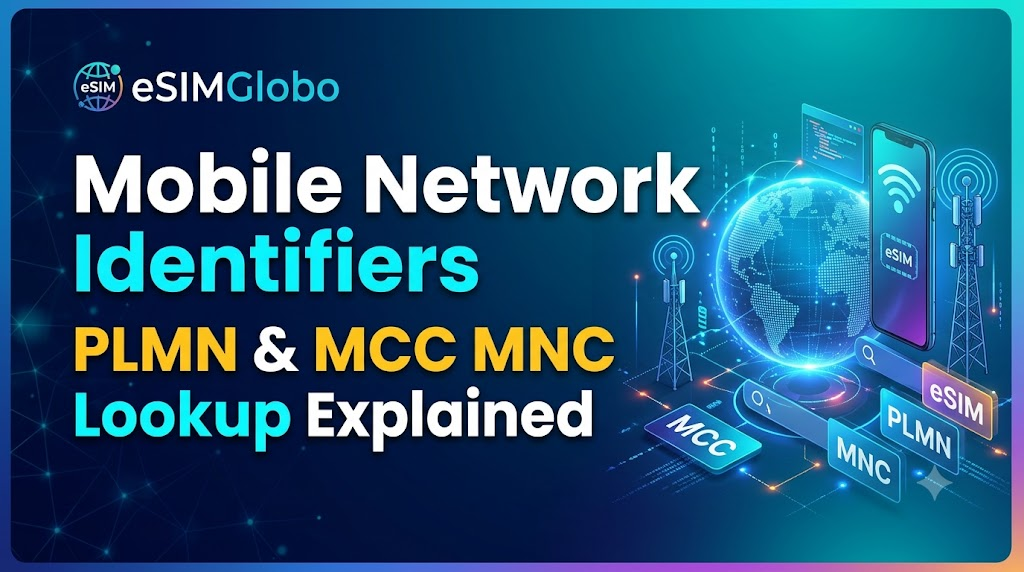
Whenever a connected terminal registers on a foreign cellular grid, an intricate signaling negotiation executes in milliseconds. Rather than querying retail brand names or marketing designations, carrier infrastructure speaks in standardized numerical strings established by the International Telecommunication Union (ITU). For infrastructure engineers, embedded systems architects, and fraud prevention teams, these numerical tuples are the foundational layer of network identification. Executing an MCC MNC lookup allows technical practitioners to unmask the legal assignee behind an unknown signal, trace subscriber provenance, and debug routing bottlenecks. However, reliable telecom intelligence is notoriously difficult to maintain. Public carrier registries often suffer from bit rot, confuse wholesale spectrum holders with retail rebrands, or fail to document regulatory provenance. Independent directories such as eSIMGlobo help solve this visibility challenge by organizing carrier attribution against primary ITU-T E.212 filings and national telecommunication gazettes.
Technical Anatomy: The ITU-T E.212 Numbering Scheme
The operational backbone of terrestrial and non-terrestrial mobile identification is defined by ITU-T Recommendation E.212. This standard lays out the global numbering layout that provisions every subscriber card and carrier radio node.
+--------------------------------------------------------------------------+
|                  International Mobile Subscriber Identity                |
|                                   (IMSI)                                 |
+------------------------------------+-------------------------------------+
|     Public Land Mobile Network     |    Mobile Subscriber Identification |
|              (PLMN ID)             |              Number (MSIN)          |
+------------------+-----------------+-------------------------------------+
|  Mobile Country  |  Mobile Network | Device-level identity provisioned   |
|    Code (MCC)    |    Code (MNC)   | within the home operator's HSS/UDM  |
|    [3 Digits]    |  [2-3 Digits]   |                                     |
+------------------+-----------------+-------------------------------------+
1. Mobile Country Code (MCC)
The MCC is a three-digit decimal block assigned by the ITU to denote a sovereign territory, sovereign administrative zone, or non-geographic global operation. Consulting an authoritative Mobile Country Code list shows that:
204represents the Netherlands302designates Canada454covers Hong Kong525identifies Singapore
Beyond national borders, the ITU reserves shared functional ranges. The primary example is MCC 901, an international, non-geographic umbrella allocation used by global maritime transceivers, aeronautical satcom links, and trans-border connectivity brokers.
2. Mobile Network Code (MNC)
The MNC is a two- or three-digit identifier assigned by sovereign spectrum regulators (or directly by the ITU for shared non-geographic pools). It distinguishes individual network operators licensed within that jurisdiction. European frameworks traditionally enforce two-digit MNCs, while North American administrations use three-digit allocations.
3. The PLMN String
When concatenated, the country code and network code construct the composite Public Land Mobile Network (PLMN) identity:
For instance, coupling MCC 505 (Australia) with MNC 01 (Telstra) yields PLMN 505-01.
Executing a PLMN code lookup translates this raw numerical string into the licensed operational entity. Because this prefix forms the initial sequence of every International Mobile Subscriber Identity (IMSI) etched into physical UICC cards and software-defined eSIM profiles, it governs core network discovery, roaming arbitration, and policy enforcement.
Signaling Flow: From Air Interface to HSS Authentication
When an antenna modem initializes, it does not scan for alphanumeric brand tags. It executes a rigorous hardware-level handshake:
- Broadcast Acquisition: The user equipment (UE) locks onto terrestrial RF carriers and decodes the System Information Block (SIB 1) transmitted by the nearest base station (eNodeB or gNodeB).
- PLMN Extraction: The modem isolates the broadcast PLMN string from the SIB data stream.
- Identity Comparison: The baseband contrasts the broadcast PLMN against the primary Home PLMN (HPLMN) burned into the device’s IMSI.
- Roaming Resolution: If the broadcast code indicates a foreign network, the firmware evaluates internal priority tables (such as the Operator Controlled PLMN Selector) to see if an active roaming interconnection exists.
- Transit Signaling: The serving base station forwards authentication vectors through international IPX carrier exchanges via Diameter (LTE) or HTTP/2 (5G Core) back to the subscriber’s Home Subscriber Server (HSS) or Unified Data Management (UDM) core.
[Mobile Device / UE]
       │
       ▼ (Decodes SIB 1 Over Air)
[Local Base Station (eNodeB/gNodeB)]
       │
       ▼ (Evaluates Visited vs. Home PLMN)
[IPX Transit / Signaling Broker]
       │
       ▼ (Dispatches Authentication Vector via E.212 Identity)
[Home Core Registry (HSS / UDM)]
A technical MCC MNC lookup mirrors this procedure in reverse. By feeding an observed broadcast sequence into a structured telecom operator database, engineers can verify the corporate licensee, regulatory authority, and operational parameters of the transmitting node.
Real-World Operational Use Cases
┌─────────────────────────────────┬────────────────────────────────────────────┐
│ Engineering Domain              │ Operational Value of MCC/MNC Data          │
├─────────────────────────────────┼────────────────────────────────────────────┤
│ Industrial Fleet Telematics     │ Carrier profile switching & cost controls  │
│ A2P SMS Firewalls               │ Gray-route detection & spoofing mitigation │
│ eUICC Remote SIM Provisioning   │ Dynamic localization & profile matching    │
│ Clearinghouse Settlement        │ TAP3/BCE billing reconciliation audits     │
│ Regulatory Compliance           │ Spectrum allocation & licensing audits     │
└─────────────────────────────────┴────────────────────────────────────────────┘
1. Enterprise IoT and Fleet Telematics
Connected telemetry modules deployed on transcontinental cargo routes frequently experience handover events across multiple regional carriers. Embedded Multi-IMSI firmware monitors network identifiers dynamically, executing algorithmic profile switches to prevent costly “permanent roaming” penalties and sustain uninterrupted sensor uploads.
2. A2P SMS Routing and Anti-Spoofing
Enterprise communication gateways processing high-throughput two-factor authentication (2FA) traffic run real-time queries against telecom registries. This ensures outbound traffic routes through legitimate wholesale termination paths rather than rogue SIM boxes or exploitative international revenue-sharing circuits.
3. Remote SIM Provisioning (eUICC Architecture)
Modern consumer wearables and commercial eSIM units rely on Local Profile Assistants (LPA) to fetch operator profiles over the air. Structuring and configuring these profiles requires exact network-code mapping so the embedded chip can accurately locate its home network anchor once deployed.
Practical Complexities: De-linking Paper Assignments from Reality
Enterprise systems developers often assume a 1:1 parity between network codes and consumer brands. In practice, the regulatory topography is more nuanced:
- Spectrum Licensees vs. Commercial Brands: An ITU E.212 allocation records the legal entity authorized to access spectrum or signaling infrastructure. A single assignee might power a dozen different consumer brands or white-label platforms over a solitary broadcast PLMN.
- MNOs versus MVNO Architecture: Mobile Network Operators (MNOs) deploy and maintain the physical radio masts and spectrum licenses. Mobile Virtual Network Operators (MVNOs) lease this physical layer. While an infrastructure-heavy “Full MVNO” operating its own packet core may hold an independent MNC, lighter virtual brands generally broadcast under their host MNO’s PLMN ID.
- Legacy Assignments and M&A Activity: Telecom acquisitions and corporate mergers regularly leave retired MNCs active inside carrier signaling configurations decades after the legacy company was dissolved.
- Non-Geographic Allocations: The rapid deployment of Low Earth Orbit (LEO) satellite direct-to-cell constellations and global private networks relies heavily on non-geographic codes (like MCC
901), breaking standard assumptions that an MCC always maps to a physical country border.
Cross-Referencing Telecom Intelligence with eSIMGlobo
Maintaining high-integrity network registries requires verifying field data against regulatory source records. eSIMGlobo functions as an independent global telecom provider directory built to make carrier identity research transparent and structured.
Rather than relying on unvetted web scrapers, eSIMGlobo ties its records back to published ITU E.212 bulletins and national telecom regulator filings.
- Targeted Lookups: Users can execute a focused PLMN code lookup or analyze regional spectrum allocations by reviewing mobile network codes by country.
- Source Attribution: Platform entries contextualize the relationship between registered spectrum assignees and operational identities, highlighting provenance rather than relying on guesswork.
- Planned Feature Pipeline: eSIMGlobo is actively developing specialized modules, including a comprehensive MVNO directory, an eSIM provider directory, downloadable structured datasets, and a dedicated MCC MNC lookup API designed for programmatic integration into developer workflows.
Whether auditing interconnect agreements, deploying IoT fleets, or validating routing logs, engineers can consult the mobile network operator directory on eSIMGlobo to reference verified network data.
Telecom Data Hygiene: Best Practices for Engineers
When integrating telecom metadata into production databases or backend business logic, keep these design considerations in mind:
- Verify Against Regulatory Baselines: Always cross-reference carrier lookups with official filings from bodies such as the FCC (US), BNetzA (Germany), Ofcom (UK), or the ITU’s bi-weekly Operational Bulletins.
- Do Not Conflate Allocation with Coverage: A registered network code simply confirms an administrative grant of spectrum or signaling rights. It does not prove that physical base stations are active, that consumer SIMs are in circulation, or that commercial roaming is permitted.
- Store MNCs as String Types: Never store MCCs or MNCs as numeric integers. Converting these fields to numerical types strips vital leading zeros (e.g., turning
02into2), which corrupts downstream database queries and breaks lookups. - Implement Fallback Logic for Non-Geographic Scopes: Ensure validation logic does not mandate standard ISO 3166-1 alpha-2 country codes for non-territorial entries (such as MCC
901).
7. Frequently Asked Questions
What is the functional difference between an MCC and an MNC?
An MCC (Mobile Country Code) is a three-digit sequence identifying a sovereign state, overseas territory, or international shared platform. An MNC (Mobile Network Code) is a two- or three-digit sequence identifying an individual network operator licensed within that specified jurisdiction.
What information does a PLMN code provide?
A Public Land Mobile Network (PLMN) code is the complete string created by combining an MCC with an MNC. It serves as the globally unique technical fingerprint for a carrier network and forms the routing prefix of a SIM card’s IMSI.
Does a valid PLMN guarantee that an operator is currently broadcasting?
No. An assignment merely reflects an administrative authorization granted by a telecom authority. It does not indicate active radio tower infrastructure, commercial operational status, or consumer service availability.
Do all MVNOs hold their own unique network codes?
No. Full MVNOs that control independent switching cores, HSS registries, and GMSC nodes may apply for dedicated MNC assignments. Thin or branded MVNOs typically reuse the broadcast PLMN identifier of their underlying host MNO.
How can I cross-check whether an international network code is authentic?
Carrier assignments can be confirmed via official ITU E.212 annexes, national spectrum regulatory gazettes, and curated research platforms like eSIMGlobo that aggregate and source carrier assignment data.
Conclusion
Global mobile connectivity relies on structured, reliable identifiers to keep devices communicating across borders. While retail branding and corporate acquisitions continuously reshape the consumer telecom market, the underlying ITU E.212 framework provides a stable, deterministic foundation for global routing. Successfully managing these network relationships requires clean, verifiable reference data. By combining primary regulatory gazettes with independent reference tools like eSIMGlobo, telecommunications engineers, systems developers, and connectivity specialists can cut through marketing ambiguity and accurately track the infrastructure powering global wireless networks.





Leave a Reply
You must be logged in to post a comment.