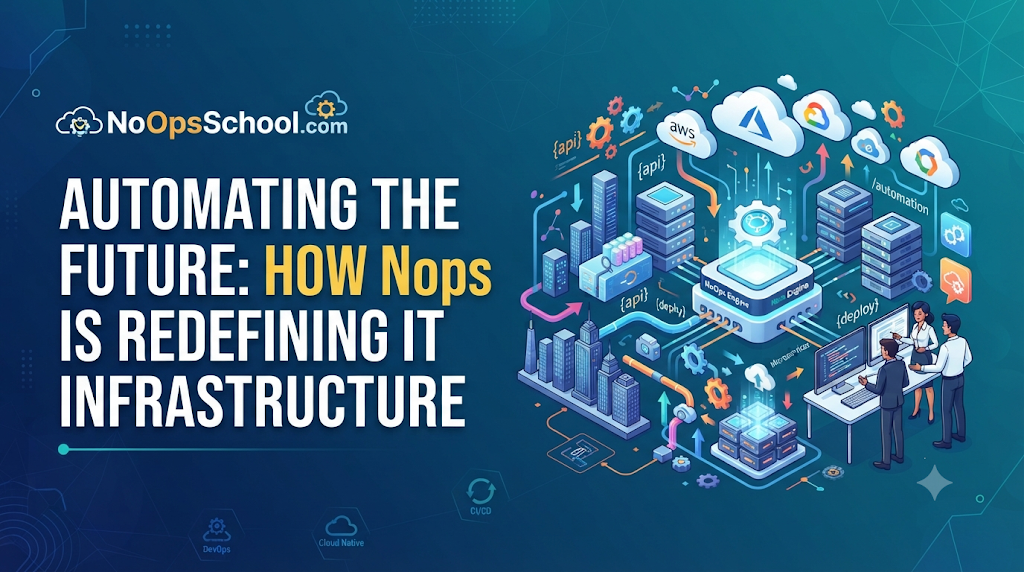
The speed of modern software delivery often outpaces the traditional operational models built to support it. For fast-growing tech enterprises, business success brings an explosion of users, massive datasets, and relentless pressure to ship features. Yet, beneath the surface of this rapid expansion, engineering teams frequently hit a stubborn operational wall.
Picture a typical mid-sized SaaS organization. Its development squads push out code updates multiple times a week, while the infrastructure group remains buried under a mountain of support tickets, manual provisioning requests, and firewall rule tweaks. Every deployment introduces subtle configuration drift between testing environments and live production clusters. A minor patch applied manually on a Tuesday afternoon breaks cluster scaling during peak traffic hours on Thursday, triggering emergency incident calls, delayed releases, and frustrated developers.
When infrastructure management relies heavily on manual touchpoints, operations inevitably become the primary bottleneck. Organizations quickly realize that simply hiring more engineers to review support queues and spin up virtual machines only scales labor costs linearly without fixing core systemic inefficiencies. To break this loop, forward-thinking companies are looking beyond conventional DevOps toward a truly autonomous operational model—ushering in the era of NoOps.
The Turning Point: Rethinking the Role of Operations
Strategic operational shifts rarely happen overnight. They usually kick off after a severe system outage or a prolonged release delay exposes the fragility of manual workflows. Leadership teams start asking hard questions: Why are expensive, highly skilled software engineers spending half their day clicking through cloud consoles or writing custom scripts just to set up basic test environments?
This urgent drive to eliminate repetitive manual work pushes organizations toward comprehensive automation. Leaders begin demanding solutions that handle infrastructure provisioning, continuous deployment, deep health monitoring, and automated disaster recovery without human intervention. This push for zero-touch operations is not about getting rid of system administrators entirely; rather, it fundamentally redefines how operational capabilities are delivered.
Through this organizational evolution, companies discover the core tenets of NoOps. Instead of treating infrastructure management as an ongoing series of manual administrative chores, the NoOps model embeds battle-tested operational guardrails directly into self-service internal platforms and automated pipelines. Developers can provision resources, deploy code, and monitor performance autonomously without submitting tickets or waiting for manual approvals from a separate IT department.
A Closer Look at the NoOps Operating Model
To grasp what is NoOps, one must look at how it reshapes the dynamics between software creators, cloud infrastructure, and operational safety. NoOps envisions an environment where the heavy lifting of infrastructure management is entirely abstracted away from application development teams through advanced platform engineering.
Inside a mature NoOps framework, developers interact with clean internal developer portals rather than raw, complex cloud infrastructure primitives. These platforms supply standardized environments, automated deployment workflows, and embedded security compliance out of the box. When a developer pushes new code to a repository, automated engines handle compilation, testing, security vulnerability scanning, infrastructure provisioning, and production deployment seamlessly without human intervention from operations staff.
Self-service capabilities form the backbone of this model. Instead of acting as bureaucratic gatekeepers, operations professionals evolve into platform engineers who design and maintain the underlying automation templates, guardrails, and tools that developers can leverage safely and independently.
The DevOps Connection: Where NoOps Takes a Different Direction
A frequent debate across technology forums involves NoOps vs DevOps. While both movements strive to dissolve historical barriers between software development and IT operations, their practical scopes and execution strategies diverge significantly.
DevOps concentrates heavily on cultural alignment, shared ownership, team collaboration, and breaking down organizational silos. It introduces operations considerations early into the development lifecycle, encouraging developers and sysadmins to partner closely on CI/CD pipelines, system monitoring, and infrastructure code.
NoOps takes the core automation principles championed by DevOps and carries them to their logical conclusion. Where DevOps relies on continuous collaboration between dev and ops personnel to manage releases and infrastructure, NoOps eliminates routine operational friction entirely through full automation of provisioning, scaling, and incident remediation.
Crucially, NoOps is not an excuse to ignore system reliability or a blanket replacement for human accountability. Engineering discipline remains vital. Someone must still architect the automation pipelines, establish security parameters, and design fault-tolerant systems. NoOps simply strips away repetitive manual effort, liberating engineers to focus on architectural innovation, platform enhancement, and high-level system reliability.
Rebuilding the Infrastructure Workflow
Transitioning toward a NoOps-ready environment demands a comprehensive overhaul of technical workflows. Companies must discard ad-hoc administrative patches in favor of declarative, code-driven processes.
Infrastructure as Code and GitOps
Contemporary infrastructure workflows depend heavily on Infrastructure as Code (IaC) solutions like Terraform to define cloud resources inside version-controlled configuration repositories. When paired with containerization platforms like Docker and orchestration systems like Kubernetes, applications and their execution environments achieve true portability, reproducibility, and consistency across local development, staging, and production.
GitOps further streamlines this architecture by treating Git repositories as the absolute single source of truth for both declarative infrastructure states and application releases. Automated reconciliation loops continuously check the desired state stored in Git against the live state running in the cluster, automatically correcting any configuration drift.
What Happens When Routine Tasks Become Automated?
Automating repetitive operational tasks reshapes every single phase of the software delivery lifecycle. Organizations that successfully implement these automated workflows notice dramatic changes across several key domains:
- Infrastructure provisioning and configuration: Environments spin up in minutes utilizing pre-validated Terraform modules instead of manual console adjustments.
- Application deployment and rollback: Continuous delivery pipelines test and push applications automatically, triggering instant rollbacks if telemetry spots anomalies.
- Automatic scaling and resource management: Cloud resources expand or shrink dynamically based on live traffic demands, optimizing cloud spend.
- Monitoring, alerting, and incident detection: Advanced observability tools track health indicators continuously, yielding actionable intelligence instead of alert fatigue.
- Self-healing infrastructure: Automated remediation scripts restart failed containers, replace unhealthy virtual machines, or route traffic around compromised network segments.
- Security and compliance checks: Policy-as-code engines scan infrastructure blueprints for security gaps before deployment even occurs.
While these automated workflows greatly accelerate release velocity and configuration accuracy, they also introduce distinct boundaries. Automated scripts cannot foresee novel architectural edge cases, and flawed automation logic can propagate configuration errors across environments at lightning speed.
The Technology Decisions That Shape NoOps
Choosing the correct NoOps automation tools is a critical responsibility for technical leaders and platform architects. Organizations must carefully evaluate tools based on their specific workload profiles, strict security requirements, and existing technical stacks.
Tool evaluation generally spans several core categories:
- Infrastructure automation: Declarative tools for provisioning cloud resources.
- Orchestration and containers: Platforms managing large-scale containerized applications.
- CI/CD pipelines: Systems automating build, test, and release cycles.
- Observability suites: Solutions offering unified logging, metrics, and distributed tracing.
- Configuration management: Utilities enforcing desired states across servers.
- AI-driven operations (AIOps): Advanced machine learning frameworks predicting anomalies and automating incident triage.
Educational platforms like NoOpsSchool.com help engineering managers and hands-on practitioners navigate these complex tool choices by providing structured insights into modern automation architectures.
Measuring Whether the Transformation Is Actually Working
Deploying automation without tracking outcomes leads to false confidence. Enterprises must evaluate their automation initiatives using rigorous, data-driven metrics rather than subjective intuition.
Essential performance benchmarks include:
- Deployment frequency: How often new code successfully hits production.
- Lead time for changes: The total duration required for code to travel from initial commit to live release.
- Mean time to recovery (MTTR): How fast systems bounce back from unexpected outages.
- Change failure rate: The proportion of deployments that result in degraded production performance.
- Configuration consistency: The measurable reduction of drift across environments.
- Resource utilization: Tangible efficiency improvements in cloud expenditures.
Focusing on these metrics ensures that automation genuinely translates into stronger operational resilience and superior business agility.
The People Behind the Automated Environment
As routine administrative chores become automated, professional roles within IT undergo a profound transformation. System administrators and operations engineers no longer spend their shifts responding to late-night pager alerts for disk space issues or manually provisioning virtual servers.
Instead, engineers dedicate their time to engineering robust internal platforms, writing automation logic, designing resilient cloud topologies, and enforcing security guardrails. Despite the high degree of automation, professionals still require deep expertise in cloud architecture, scripting, troubleshooting, security best practices, and system reliability principles.
Creating Different Career Paths in NoOps
As the industry matures, technical professionals are specializing to meet the demands of automated cloud environments. Career trajectories now span specialized engineering and leadership domains:
- NoOps engineers: Focus on writing infrastructure code, building CI/CD pipelines, and maintaining platform workflows.
- NoOps architects: Design scalable, secure, and resilient automated cloud environments.
- NoOps managers: Coordinate cross-functional teams, govern operational strategy, and guide digital transformation initiatives.
For professionals aiming to validate their expertise, specialized credentials such as a NoOps engineer certification, NoOps architect training, and NoOps manager certification offer recognized pathways for professional growth.
From Learning Concepts to Demonstrating Practical Skills
Turning theoretical concepts into practical capability requires genuine hands-on experience. A robust NoOps training course must move far beyond slide decks, immersing participants in realistic operational scenarios.
Effective educational frameworks emphasize:
- Practical labs focusing on infrastructure-as-code projects.
- Kubernetes deployment and cluster administration exercises.
- CI/CD pipeline creation and GitOps workflow implementation.
- Observability configuration and automated recovery simulations.
For ongoing professional development, practitioners often turn to specialized providers like NoOpsSchool.com, which delivers role-based learning tracks tailored for modern cloud-native operations. Earning a respected NoOps certification proves an engineer’s capability to design, build, and maintain autonomous IT systems.
When Internal Teams Need Additional Expertise
Even highly capable internal engineering teams occasionally encounter complex modernization challenges that surpass their current bandwidth or specialized knowledge. Businesses frequently look for outside support regarding automation strategy, cloud modernization, infrastructure provisioning, and CI/CD adoption.
Engaging expert NoOps consulting services enables companies to fast-track their automation journeys, sidestep common architectural pitfalls, and implement industry standards rapidly. External consultants partner directly with internal teams to transfer critical knowledge and establish sustainable operational frameworks.
Building a Flexible Technical Workforce
Scaling an enterprise automation initiative often demands flexible temporary talent. Companies regularly bring in specialized independent professionals for project-based automation requirements, such as migrating legacy architectures to Kubernetes or establishing GitOps delivery pipelines.
When looking to hire NoOps freelancers, technical leaders assess candidates based on hands-on proficiency with IaC tools, cloud platforms, and automation frameworks. Clear project scoping, strong communication skills, and verifiable portfolio projects ensure successful collaboration between internal staff and external specialists.
What Automation Cannot Decide on Its Own
While automation successfully eliminates routine toil, it cannot replace critical human judgment. Adopting autonomous operations introduces distinct hazards, including automation errors that propagate failures instantly, security misconfigurations, compliance oversights, and complex architectural debt.
Furthermore, relying on substandard monitoring practices in a heavily automated environment can obscure critical failures until widespread customer impact occurs. Human oversight, rigorous code reviews, ethical governance, and strategic architectural decisions remain completely indispensable. Automation executes instructions with extreme efficiency, but humans define the intent, operational boundaries, and ethical guidelines of the system.
The Next Chapter: Moving Toward More Autonomous IT
The trajectory of IT operations points directly toward intelligent automation, self-service infrastructure platforms, and AI-assisted workflows. As cloud-native ecosystems continue to mature, the boundary between application code and underlying infrastructure administration will continue to fade.
Organizations and practitioners who embrace continuous learning, disciplined engineering practices, and practical automation tools will lead this shift. By collaborating with specialized platforms like NoOpsSchool.com for training and consulting, forward-looking teams can build resilient, highly scalable IT operations designed for the demands of tomorrow’s business world.






Leave a Reply
You must be logged in to post a comment.