Introduction
In the rapidly evolving world of software development, the gap between rapid delivery and strict regulatory requirements has become a significant challenge for many organizations. Traditionally, compliance was treated as a “final hurdle”—a manual, time-consuming phase that occurred just before a product launch. This approach often created bottlenecks, delayed releases, and introduced human error into critical security processes.
Today, the integration of security into the development lifecycle has transformed this dynamic. By adopting DevSecOps, teams can move away from reactive, periodic audits toward a model of continuous compliance. At DevOpsSchool, we emphasize that security is not a barrier to speed but an enabler of quality and trust. As practitioners navigate this landscape, mastering the intersection of automation and governance is essential. This article explores how modern engineering teams utilize DevSecOps to maintain robust compliance posture while fostering innovation, helping professionals understand the shift from manual “tick-box” exercises to automated, reliable security controls.
What Is Compliance Posture?
Compliance posture refers to an organization’s overall state of adherence to legal, regulatory, and security requirements. Think of it as the health index of your security controls. It is not merely about having a firewall or a policy document; it is about how effectively your systems, processes, and people perform at any given moment to protect data and meet industry standards like GDPR, HIPAA, or SOC2.
If your “posture” is strong, your organization can demonstrate that it knows exactly which systems hold data, how that data is protected, and who has access to it. It is the difference between hoping you are compliant and being able to prove it with real-time data.
Why Compliance Matters in Modern IT
In a digital-first economy, trust is the most valuable currency. Customers and partners expect organizations to handle their information with the highest level of care.
- Risk Reduction: Proactive compliance prevents data breaches, which can lead to catastrophic financial and reputational damage.
- Regulatory Expectations: Global regulations are becoming stricter. Non-compliance can result in heavy fines and legal liabilities.
- Competitive Advantage: Being audit-ready allows companies to win enterprise contracts faster, as they can demonstrate superior security maturity compared to competitors.
For example, a fintech startup that embeds compliance early in its pipeline can onboard new banking partners in weeks rather than months, simply because its audit logs and security controls are already transparent and verifiable.
What Is DevSecOps?
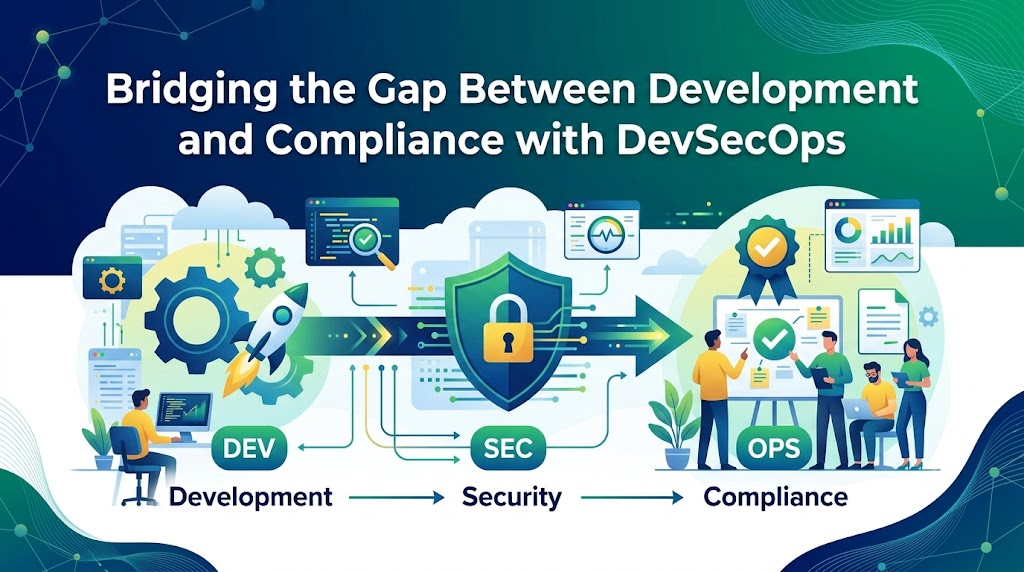
DevSecOps is the philosophy of integrating security practices into every phase of the software development lifecycle, from initial design through to integration, testing, deployment, and delivery. Instead of “tacking on” security at the end, DevSecOps ensures that every team member—developers, operators, and security experts—shares the responsibility for building secure and compliant software. It relies on the “shift-left” approach, where security checks occur as early as possible in the development process.
How DevSecOps Enhances Compliance Posture
By automating manual processes, DevSecOps ensures that compliance is a continuous state rather than a point-in-time event.
| DevSecOps Practice | Compliance Benefit |
| Automated security testing | Eliminates human error and ensures consistent policy application. |
| Infrastructure as Code (IaC) | Standardizes environments, preventing “configuration drift.” |
| Continuous monitoring | Provides real-time visibility into security incidents. |
| Policy as Code | Automates governance checks against compliance rules. |
| Audit logging | Automatically collects evidence for regulatory reporting. |
Continuous Compliance Explained
Continuous compliance is the practice of maintaining compliance 24/7 rather than preparing for an audit once a year. In a continuous compliance model, the system is constantly checked against defined security benchmarks. If a developer pushes code that violates a policy—such as an open S3 bucket—the system detects the issue immediately and blocks the deployment. This ensures that the production environment is always in a “known-good” state.
Security Automation and Compliance
Automation is the engine of DevSecOps. By integrating vulnerability scanners (like SAST or DAST) into the CI/CD pipeline, security teams can ensure that every line of code is tested for security flaws before it ever reaches production. Configuration validation also ensures that cloud environments are deployed according to pre-approved blueprints, ensuring that security patches and hardening steps are never skipped.
Infrastructure as Code and Compliance
Infrastructure as Code (IaC) allows engineers to define their infrastructure using version-controlled code, such as Terraform or CloudFormation. This is a game-changer for compliance because it enables “Policy as Code.” Organizations can write automated tests that inspect IaC templates to ensure that resources are encrypted, properly tagged, and isolated from public access before they are even created. If an engineer tries to deploy insecure infrastructure, the CI/CD pipeline stops the process, effectively preventing a compliance violation before it happens.
Audit Readiness Through DevSecOps
Traditional audits are often stressful “fire drills” where teams scramble to collect logs and screenshots. DevSecOps turns this process into an automated workflow. By maintaining centralized, immutable logs of all changes in the development pipeline, teams can generate a full audit trail automatically. This transparency means that when an auditor asks for evidence of who approved a change or when a security scan was performed, the data is ready at the click of a button.
Monitoring and Compliance Visibility
Modern DevSecOps platforms offer compliance dashboards that provide real-time visibility. These dashboards display the status of various security controls across the entire organization. For instance, a CISO can log in and see a live heat map showing which applications are currently compliant and which require attention, allowing for data-driven decisions regarding security investments.
Real-World Example: Traditional Compliance Approach
In a traditional environment, a team develops a feature over three months. Two weeks before launch, the security team conducts a manual audit. They discover five major vulnerabilities. The release is delayed, the development team is forced to drop new feature work to fix old bugs, and the business misses its market window.
Real-World Example: DevSecOps-Driven Compliance
In a DevSecOps-driven team, the same feature undergoes automated security scans at every commit. A minor vulnerability is flagged by an automated tool during development. The developer fixes it in 15 minutes before even merging the code. The feature reaches production on time, fully compliant, with the audit logs automatically generated and archived.
Common Compliance Mistakes Organizations Make
- Treating compliance as a separate project: Compliance must be a part of the “Definition of Done.”
- Ignoring automation: Relying on manual spreadsheets and human checks leads to gaps.
- Lack of documentation: Failing to store version history or approval workflows.
- Configuration drift: Allowing manual changes in the production environment that bypass code-based controls.
- Siloed teams: Keeping security, development, and operations teams separate.
Best Practices for Improving Compliance Posture
- Integrate compliance early: Embed security and policy checks into the earliest stages of the SDLC.
- Automate validation checks: Use tools to enforce security standards automatically in the CI/CD pipeline.
- Maintain audit trails: Use version control for both application code and infrastructure definitions.
- Monitor continuously: Implement tools that provide real-time alerts on configuration changes.
- Encourage shared responsibility: Build a culture where everyone understands their impact on security and compliance.
Role of DevOpsSchool in Learning DevSecOps Compliance Concepts
At DevOpsSchool, we provide structured learning paths that bridge the gap between technical execution and governance. Our programs focus on teaching students how to integrate security tools into CI/CD pipelines, how to manage compliance as code, and how to build environments that are secure by design. By fostering a deep understanding of practical CI/CD workflows and security-first engineering, learners are better prepared to handle the complexities of modern regulatory environments in their professional careers.
Career Importance of Compliance Knowledge
Understanding compliance is no longer just for legal teams. Roles like DevSecOps Engineer, Security Engineer, Cloud Security Engineer, Compliance Analyst, and Site Reliability Engineer (SRE) now require a solid grasp of how to operationalize compliance. Professionals who can bridge the gap between technical infrastructure and business governance are among the most sought-after experts in the industry today.
Industries Where DevSecOps Compliance Matters
- Banking & Finance: Handling sensitive transactions and personal data.
- Healthcare: Protecting patient records under strict privacy laws.
- Government & Public Sector: Ensuring national security and data integrity.
- E-Commerce: Managing payment gateways and user identity securely.
- Telecom: Maintaining infrastructure availability and data protection.
- SaaS Companies: Demonstrating trust to enterprise clients via SOC2/ISO reports.
Future of DevSecOps Compliance
The future of compliance is “autonomous.” We are moving toward AI-assisted monitoring where systems will not only detect policy violations but also automatically remediate them. “Self-healing” infrastructure that corrects misconfigurations in real-time will become the standard, making continuous audit readiness a baseline expectation rather than a premium capability.
FAQs
- What is DevSecOps compliance? It is the integration of compliance controls and regulatory checks directly into the DevSecOps pipeline.
- Why is compliance important? It protects the business from risk, ensures legal adherence, and builds customer trust.
- What is continuous compliance? An ongoing process of automated checks to ensure systems remain compliant 24/7.
- How does automation improve compliance? It removes human error and ensures that security policies are applied consistently.
- Can DevSecOps help with audits? Yes, by providing automated, immutable evidence trails of all changes.
- What role does Infrastructure as Code play? It allows compliance policies to be codified and enforced automatically.
- Is compliance only for large organizations? No, every company handling data has a responsibility to maintain a secure posture.
- What tools support compliance automation? Tools like Terraform, Sentinel, Open Policy Agent, and various CI/CD security plugins.
- How do I start? Start by automating one security check in your pipeline and expand from there.
- Does DevSecOps replace security teams? No, it empowers them to focus on high-level strategy rather than manual checks.
- What is “Shift Left”? Moving security and compliance testing to the earliest stages of development.
- How do I measure compliance posture? Use automated dashboards that track security controls against your specific regulatory framework.
- Is DevSecOps mandatory for all compliance? While not “mandatory” by law, it is the most efficient way to meet modern standards.
- How do I handle legacy systems? Wrap them in modern monitoring and use compensating controls until they can be modernized.
- Does DevSecOps cost more? It requires an upfront investment in tools and training but saves significant costs in the long run by preventing breaches and audit failures.
Final Thoughts
Improving your organization’s compliance posture is a journey, not a destination. By embracing DevSecOps, you move away from the stress of manual audits and toward a culture of continuous readiness. When security and compliance are woven into the fabric of your development process, you don’t just achieve regulatory goals—you build better, more resilient software. Remember that the goal is not to reach a perfect state overnight, but to consistently improve your automation, tighten your controls, and foster a culture of shared responsibility.






Leave a Reply
You must be logged in to post a comment.