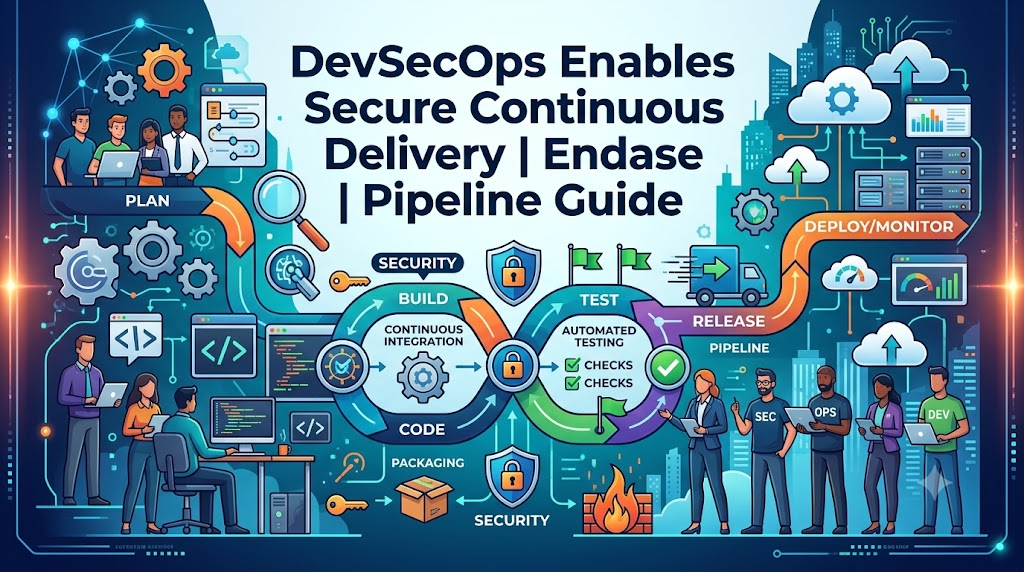
Engineering teams frequently face a difficult trade-off: deliver software features rapidly to stay competitive, or halt releases to complete comprehensive security evaluations. Treating security as an isolated checkpoint at the end of the software development lifecycle creates friction, delays deployments, and forces engineering teams into reactive patch cycles.
DevSecOps eliminates this dilemma by integrating security practices, automated assessments, and shared operational responsibility directly into the software delivery pipeline. Rather than serving as a downstream gatekeeper, security becomes an intrinsic property of the build, test, and release lifecycle.
By applying security principles continuously, organizations achieve secure continuous delivery: the ability to ship resilient, compliant software to production predictably, frequently, and with minimal friction.
Understanding DevSecOps and Continuous Delivery
To understand how security fits into modern software delivery pipelines, it is essential to distinguish between the delivery mechanisms and the security mindset that governs them.
Defining Continuous Delivery and Continuous Deployment
Continuous Delivery (CD) is a software engineering practice where code changes are automatically built, tested, and prepared for release to production. The primary objective is to keep software in an inherently deployable state at all times. In continuous delivery, releasing code to production remains a deliberate, risk-informed decision that may involve manual authorization or automated governance checks.
Continuous Deployment, by contrast, takes automation a step further. Every change that passes through the automated test suite and meets all acceptance criteria is automatically pushed directly to live production environments without human intervention.
Both approaches depend on a fast, reliable Continuous Integration and Continuous Delivery (CI/CD) pipeline. However, if that pipeline only tests functional logic and ignores security, it simply accelerates the deployment of vulnerabilities to production environments.
The Evolution from DevOps to DevSecOps
DevOps broke down the operational silos between software development and IT operations, fostering shared ownership, automated infrastructure, and frequent deployments. However, security teams often remained separated from this fast-paced loop, functioning under audit-heavy, perimeter-focused paradigms.
DevSecOps extends DevOps by introducing security as a shared responsibility across development, security, and operations teams. It is not simply a collection of automated scanners; it is an engineering philosophy that embeds security controls, threat awareness, and compliance enforcement across every phase of the software delivery lifecycle.
Traditional Delivery:
[ Code ] ──> [ Build ] ──> [ Test ] ──> [ Release ] ──> [ Manual Security Audit ] (Bottleneck)

DevSecOps Continuous Delivery:
[ Secure Code ] ──> [ Build & SCA ] ──> [ SAST & Artifact Verification ] ──> [ DAST & IaC Audit ] ──> [ Secure Deployment & Observability ]
      ▲                                                                                                          │
      └──────────────────────── Continuous Feedback Loop ────────────────────────────────────────────────────────┘
Why Traditional Security Approaches Create Delivery Bottlenecks
Traditional application security models rely heavily on periodic reviews: manual penetration tests scheduled weeks before a release, centralized security architecture reviews, and long spreadsheets of static audit questions.
While manual reviews provide deep context, using them as the primary release gate introduces systemic problems in modern engineering environments:
- Feedback Latency: When a developer receives a vulnerability report three weeks after writing a pull request, the mental context is gone. Remediating flaws late in the development cycle requires re-architecting components, modifying schemas, and repeating regression cycles.
- Release Deadlocks: When critical security findings appear days before a planned go-live date, teams must choose between delaying business deliverables or accepting unquantified security risks into production.
- Friction and Alert Fatigue: Security teams auditing completed systems often produce large vulnerability backlogs full of unverified alerts and false positives. Without context, development teams struggle to prioritize what genuinely matters.
- Fragile Point-in-Time Assurance: A system audited on a Friday may ingest an updated third-party library or deploy an altered cloud configuration on Monday, rendering the previous security sign-off obsolete.
DevSecOps resolves these bottlenecks through shift-left security, introducing testing, verification, and automated guardrails at the earliest possible stage—starting right at the developer’s workstation.
Where Security Fits Into the CI/CD Pipeline
A resilient DevSecOps pipeline weaves automated controls across every stage of the software supply chain. Each automated phase targets specific classes of risk before code moves further downstream.
| Pipeline Phase | Primary Security Activity | Target Risk / Vulnerability |
| Source & Commit | Secret detection, pre-commit hooks, branch protection | Hardcoded credentials, unreviewed code, unauthorized commits |
| Build & Unit Test | Software Composition Analysis (SCA) | Outdated third-party packages, transitive vulnerabilities, license risks |
| Static Analysis | Static Application Security Testing (SAST) | Insecure syntax, SQL injection, buffer overflows, path traversals |
| Infrastructure Definition | Infrastructure as Code (IaC) linting and policy scanning | Overly permissive IAM roles, exposed storage buckets, unencrypted disks |
| Packaging & Artifacts | Container image scanning, provenance signing | Vulnerable OS base layers, tampering, unverified container registries |
| Staging & Integration | Dynamic Application Security Testing (DAST) | Runtime misconfigurations, cross-site scripting (XSS), auth bypasses |
| Deployment & Runtime | Admission control, least-privilege deployment, monitoring | Drift, unauthorized privilege escalations, unpatched zero-days |
1. Source Code and Version Control Security
Security begins before the build system ever compiles an asset:
- Branch Protection: Enforce mandatory peer reviews and require automated validation jobs to pass before merging into target branches.
- Secret Scanning: Scan every commit for accidentally committed API keys, tokens, and private certificates. If a secret is committed, deleting the commit is insufficient; the credential must be invalidated and rotated immediately.
- Pre-commit Hooks: Run lightweight syntax validation and secret detection locally on the developer workstation to catch mistakes before code leaves local branches.
2. Software Composition Analysis (SCA)
Modern applications are rarely built entirely from scratch; open-source and third-party libraries frequently constitute over 70% of a modern codebase. SCA tools inspect package manifests (such as npm, Maven, PyPI, or Go modules) to inventory third-party components, identify known Common Vulnerabilities and Exposures (CVEs), and flag incompatible software licenses. Teams can generate a Software Bill of Materials (SBOM) during the build to establish a clear, auditable inventory of every deployed component.
3. Static Application Security Testing (SAST)
SAST tools review source code without executing the application. They analyze data flows, taint tracking, and code structure to spot anti-patterns such as SQL injection, hardcoded cryptographic seeds, and cross-site scripting risks. To keep delivery pipelines fast, teams often configure SAST to run fast, targeted rule sets on incremental pull requests, reserving comprehensive whole-application static scans for integration builds.
4. Infrastructure as Code (IaC) Security
Modern infrastructure is declared as code through tools like Terraform, OpenTofu, CloudFormation, and Kubernetes manifests. Automated IaC security checks analyze these templates before deployment, flagging misconfigurations such as:
- Cloud storage buckets configured with public read access.
- Ingress security groups allowing unrestricted traffic on sensitive ports.
- Identity and Access Management (IAM) policies granting broad administrative wildcards.
5. Container and Artifact Security
As applications are packaged into container images, pipelines must ensure base image integrity. Container scanners unpack container layers to evaluate operating system packages and language dependencies. Best practices include using minimal or distroless base images, verifying cryptographic image signatures through tools like Cosign, and maintaining strict control over verified, internal container registries.
6. Dynamic Application Security Testing (DAST)
DAST tools test running applications from the outside in, behaving like an external adversary. By evaluating active endpoints in a staging environment, DAST identifies runtime authentication flaws, cookie security misconfigurations, and environment-specific headers that static analysis cannot see. Because DAST scans take longer to execute, they are generally triggered in staging pipelines or scheduled nightly runs rather than on every small commit.
7. Deployment Guardrails and Runtime Protection
Secure delivery continues through deployment execution:
- Least-Privilege Pipelines: Build runners and deployment agents should use short-lived, narrowly scoped credentials (such as OpenID Connect authentication to cloud providers) rather than long-lived administrative service account keys.
- Admission Controllers: In container orchestration environments like Kubernetes, admission controllers can reject images that have not been signed by the build system or images that contain unresolved critical CVEs.
- Runtime Observability: Runtime Application Self-Protection (RASP), security information management, and continuous eBPF-based telemetry detect unexpected process forks, outbound connection anomalies, and memory exploits in live environments.
A Practical Secure Continuous Delivery Workflow
The following step-by-step workflow illustrates how a DevSecOps-enabled pipeline processes a feature branch through validation, staging, and production readiness without introducing unmanageable friction.
[1. Developer Commit] ──> [2. CI Pipeline Trigger] ──> [3. Build & Unit Test]
                                                               │
                                                               ▼
[6. Image Signing] <── [5. Container Scan] <── [4. SAST, SCA & Secret Scan]
        │
        ▼
[7. Staging Deploy] ──> [8. DAST & Smoke Test] ──> [9. Release Approval Gate]
                                                             │
                                                             ▼
[12. Telemetry Loop] <── [11. Runtime Monitor] <── [10. Production Deploy]
- Commit and Pull Request: A developer commits changes to a feature branch. Pre-commit hooks run secret detection locally.
- Pipeline Trigger: The pull request triggers the CI pipeline.
- Build and Unit Validation: The application is compiled, dependencies are fetched, and functional unit tests execute.
- Static and Dependency Analysis: SCA verifies dependencies against vulnerability feeds; SAST scans modified source files; secret detection checks the commit history.
- Artifact Packaging and Container Inspection: A container image is generated and evaluated for OS-level vulnerabilities against an established security baseline.
- Provenance and Signing: If checks pass, the artifact is cryptographically signed, tagged, and published to an internal container registry.
- Staging Deployment: The signed artifact is deployed to an ephemeral or dedicated staging environment via declarative GitOps pipelines.
- Dynamic Testing: DAST scans and API functional checks execute against the running staging application.
- Risk-Based Quality Gates: The pipeline evaluates aggregate findings against defined security policies. If no blocking issues are detected, the artifact is promoted to release status.
- Production Deployment: The release is deployed to production using zero-downtime deployment patterns (such as blue-green or canary rollouts) under temporary, tightly scoped credentials.
- Continuous Runtime Protection: Production runtime monitors and logging agents track system calls, network egress, and application metrics for anomalous patterns.
- Feedback Loop: Findings, vulnerabilities, and telemetry are channeled into the team’s issue tracker with contextual metadata for future sprints.
Defining Risk-Based Quality Gates
A common failure in DevSecOps implementations is configuring automated scanners to fail builds on every single finding, regardless of severity or exploitability. This practice disrupts delivery and fosters adversarial relationships between teams.
Instead, pipelines should enforce risk-based quality gates:
- Critical / High Exploitability: Directly exploitable flaws with public Proof-of-Concept exploits, unauthenticated remote code execution paths, or plaintext secrets break the build immediately.
- Medium / Low Risk: Non-exploitable dependencies, theoretical warnings, or low-severity findings generate automated tracking tickets with established Service Level Agreements (SLAs) for remediation without halting the release.
- Documented Exceptions: Engineering workflows should support formal risk-acceptance procedures with expiration dates, requiring approval from designated engineering leads or security architects.
Real-World Implementation Examples
Practical examples illustrate how automated pipelines detect issues, handle failures, and guide developers toward remediation.
Example 1: Preventing Secret Leaks in CI
- The Risk: A developer testing an external integration accidentally commits a raw SaaS API token into a client initialization file.
- Detection Point: Secret scanning runs as the first stage of the CI pipeline.
- Pipeline Response: The pipeline halts immediately, flags the exact file and line number, and masks the token in console logs.
- Remediation: The developer invalidates and rotates the exposed API token in the third-party dashboard. They then remove the credential from the commit history, load the token via secure environment variables or a secrets manager, and push the updated branch.
YAML
# Illustrative CI snippet for secret scanning
name: Secret Detection Gate
on: [pull_request]
jobs:
  scan-secrets:
    runs-on: ubuntu-latest
    steps:
      - uses: actions/checkout@v4
        with:
          fetch-depth: 0
      - name: Run Secret Scanner
        run: |
          echo "Scanning commit range for credential exposure..."
          trufflehog git file://. --since-commit origin/main --fail
Example 2: Intercepting Vulnerable Dependencies (SCA)
- The Risk: An application imports an older version of an HTTP parsing library that contains a known, critical denial-of-service vulnerability.
- Detection Point: The SCA scan runs during dependency resolution in the build stage.
- Pipeline Response: The scanner correlates the dependency against the vulnerability database, notes a CVSS score of 9.1, and returns an exit code indicating a policy violation. The build stops before artifact creation.
- Remediation: The scanner’s output specifies that updating the package from version 1.2.0 to 1.2.4 patches the CVE. The developer updates the dependency declaration, verifies that local unit tests pass, and re-submits the pull request.
Example 3: Enforcing Least Privilege in Infrastructure as Code
- The Risk: A Terraform configuration defines a cloud storage bucket with public read access enabled to host assets, inadvertently exposing sensitive internal data paths.
- Detection Point: An IaC policy engine scans the infrastructure plan before changes are applied.
- Pipeline Response: The scan detects a policy violation against the internal CIS benchmark for cloud storage and terminates the pipeline run before running
terraform apply. - Remediation: The engineer modifies the configuration to enforce private access controls and configures an authenticated Content Delivery Network (CDN) distribution to serve static assets instead.
Terraform
# Illustrative Terraform misconfiguration flagged by automated IaC scanning
resource "aws_s3_bucket_public_access_block" "insecure_example" {
  bucket = "company-internal-assets"

  # Policy violation: public access must be blocked
  block_public_acls       = false
  block_public_policy     = false
  ignore_public_acls      = false
  restrict_public_buckets = false
}
Tool Categories Across the Delivery Lifecycle
DevSecOps relies on specialized tools that target distinct attack surfaces. Selecting appropriate tooling requires balancing language support, accuracy, workflow integration, and scan velocity.
Development & Commit     Build & Packaging        Staging & Release        Runtime & Production
────────────────────     ─────────────────        ─────────────────        ────────────────────
• Secret Scanning        • SCA Scanning           • DAST Testing           • Runtime Monitoring
  (Gitleaks, Detect-       (Trivy, Snyk,            (OWASP ZAP, Burp         (Falco, Wazuh)
   Secrets)                 Dependency-Check)        Suite Enterprise)
                                                                           • Policy Controllers
• Pre-commit Tooling     • SAST Analysis          • Ephemeral Env Checks     (OPA/Gatekeeper,
  (pre-commit framework)   (Semgrep, SonarQube)     (Postman security,         Kyverno)
                                                     API fuzzers)
                         • Container Analysis                              • Secret Providers
                           (Trivy, Grype)                                    (HashiCorp Vault,
                                                                              Cloud KMS)
                         • IaC Policy Linters
                           (Checkov, tfsec,
                            KICS)
Tool selection should prioritize integration depth and developer ergonomics. Tools that integrate directly into code repository interfaces (such as generating inline pull request comments) reduce context switching and accelerate remediation far more effectively than tools that simply produce detached PDF reports.
Benefits and Operational Trade-Offs
Integrating security into continuous delivery offers clear organizational benefits, but it also introduces technical and operational trade-offs that engineering leadership must manage.
Tangible Benefits
- Rapid Remediation: Vulnerabilities caught during pull request reviews take hours or days to fix, compared to weeks or months when discovered after production deployment.
- Audit and Compliance Readiness: Security policies defined as code and executed continuously provide automated, auditable evidence of testing, artifact provenance, and policy adherence.
- Reduced Human Bottlenecks: Security teams transition from manually auditing every minor patch to maintaining automated guardrails, freeing security specialists to focus on high-impact threat modeling and complex architecture reviews.
- Resilient Software Supply Chains: Systematically checking dependencies, base images, and build provenance protects against upstream package poisoning and malicious injections.
Operational Challenges and Trade-Offs
- Pipeline Latency: Adding multiple deep security scans to every commit can lengthen pipeline runtimes, frustrating developers and slowing deployment cadence.
- False Positives and Alert Fatigue: Scanners with broad heuristic rules can overwhelm developers with non-exploitable findings. If developers stop trusting pipeline alerts, security posture deteriorates.
- Maintenance and Governance Overhead: Rules, base images, exclusion lists, and tool integrations require continuous engineering maintenance as languages, frameworks, and threat landscapes evolve.
- False Sense of Security: Automated tools identify common syntactic flaws and known CVEs, but they cannot assess complex business logic errors, broken access controls, or contextual application risks. Automation complements human analysis; it does not replace it.
Implementation Best Practices
Teams seeking to adopt secure continuous delivery should pursue a phased, deliberate rollout rather than trying to activate every tool simultaneously.
1. Start with High-Confidence, High-Impact Checks
Begin by automating secret scanning and software composition analysis. These checks execute quickly, produce low false-positive rates, and address significant, widespread risks (exposed credentials and vulnerable open-source libraries).
2. Meet Developers in Their Existing Tools
Deliver security feedback directly inside pull requests, IDEs, and messaging systems that engineering teams already use daily. A scanner that highlights an issue directly on the offending line of code within a pull request makes remediation straightforward and educational.
3. Baseline First, Enforce Gradually
When introducing a new static or container scanner, run it in an informative, non-blocking mode first. Establish a baseline of existing technical debt, tune out false positives, and train teams on the findings. Only activate blocking build gates once the signal-to-noise ratio is tuned and actionable.
4. Secure the Delivery Pipeline Itself
The CI/CD pipeline is itself a high-value operational target. Protect the pipeline infrastructure:
- Restrict access to CI/CD configuration files and pipelines.
- Ensure build workers run in isolated, ephemeral environments.
- Use short-lived, least-privilege tokens for cloud deployment operations.
- Never store plain-text secrets in build environment variables or repository settings.
5. Invest in Training and Security Champions
Tooling cannot compensate for an engineering culture that lacks security awareness. Organizations such as DevOpsSchool provide structured training programs and certifications in DevSecOps, container security, and CI/CD automation that help engineering teams understand how to design and maintain secure delivery pipelines. Establishing “Security Champions”—developers within product squads who receive focused application security training—creates direct, peer-level guidance that bridges security and delivery teams.
Measuring DevSecOps Effectiveness
To verify that security investments are supporting continuous delivery rather than obstructing it, organizations should track objective engineering and security metrics.
- Mean Time to Remediate (MTTR): Measures the time elapsed between discovering a security vulnerability and deploying a verified patch. A healthy DevSecOps practice consistently reduces MTTR.
- Vulnerability Escape Rate: Tracks the number and severity of vulnerabilities discovered in production (by bug bounties, audits, or runtime monitors) versus those caught by pipeline checks during development.
- Deployment Frequency and Lead Time: Monitoring standard DevOps metrics alongside security metrics confirms that security controls are not slowing delivery cadence or lengthening the time required to take a commit to production.
- Pipeline Security Failure Rates: Tracks how often builds are halted by security quality gates. Spikes in failure rates can highlight poorly tuned rules, new architectural anti-patterns, or emerging training gaps.
- Dependency Age and Freshness: Evaluates how closely an organization’s third-party dependencies track current, patched upstream releases, minimizing exposure windows to known exploits.
Metrics should serve as diagnostic indicators for organizational learning rather than punitive targets. If teams are penalized simply for reporting vulnerabilities, they may be incentivized to suppress warnings or circumvent scanners, undermining the organization’s overall security posture.
Frequently Asked Questions
How does DevSecOps improve continuous delivery?
DevSecOps improves continuous delivery by automating security evaluations alongside functional testing. By catching flaws, misconfigurations, and vulnerable libraries early in the pipeline, teams eliminate late-stage release blockers and manual audit bottlenecks, ensuring software remains safely deployable at all times.
Which security tests should be included in a CI/CD pipeline?
A balanced pipeline typically integrates secret scanning, Software Composition Analysis (SCA), Static Application Security Testing (SAST), Infrastructure as Code (IaC) linting, container image analysis, and Dynamic Application Security Testing (DAST) in staging environments.
What is the primary difference between DevSecOps and traditional DevOps?
DevOps focuses primarily on collaboration between software development and IT operations to accelerate deployment speed and operational stability. DevSecOps incorporates security as an equal, shared responsibility throughout that collaboration, integrating security automation, compliance, and governance into every stage of the lifecycle.
Should every security vulnerability block a software release?
No. Halting releases for every low-severity or theoretical alert causes alert fatigue and stalls delivery. Organizations should configure risk-based quality gates that block builds on critical, highly exploitable flaws while routing lower-risk findings into standard engineering backlogs for prioritized remediation.
Can automated security testing completely replace manual reviews?
No. Automated tools excel at detecting known CVEs, syntax anti-patterns, configuration drift, and credential leaks at scale. However, they cannot evaluate contextual application risks, flawed business logic, or complex authorization workflows. Manual code reviews, threat modeling, and focused penetration testing remain essential complements to automated pipelines.
Conclusion
DevSecOps transforms security from an unpredictable release barrier into an automated, predictable engine for continuous delivery. By shifting security left, automating high-confidence checks, securing the software supply chain, and establishing pragmatic quality gates, engineering organizations can ship features rapidly while maintaining a robust, defensible security posture.
Achieving secure continuous delivery is an ongoing journey of cultural and technical maturation. Organizations that succeed focus on clear developer feedback loops, reliable tooling, sound engineering judgment, and continuous skill development—ensuring that speed and security strengthen one another with every release.



Leave a Reply
You must be logged in to post a comment.