Introduction
Modern software delivery moves faster than ever before, but high-speed deployments using automated CI/CD pipelines often create severe security risks if vulnerability checks are left as an afterthought. Modern cybersecurity is no longer a late-stage manual bottleneck; it has become an essential technical requirement embedded directly into every phase of the software development lifecycle. This cultural and automated evolution created DevSecOps—the seamless integration of Development, Security, and Operations. In this comprehensive guide, you will learn how to Start Your DevSecOps Journey step-by-step, building the foundational skills, tooling knowledge, and hands-on experience needed to succeed, supported by structured learning paths from platforms like DevOpsSchool.
What Is DevSecOps?
DevSecOps stands for Development, Security, and Operations. It is an evolution of traditional DevOps principles that embeds security practices, controls, and automated compliance checks early and continuously throughout the entire software development life cycle.
                  +-----------------------------------+
                  |           DEVELOPMENT             |
                  |  (Planning, Coding, Building)     |
                  +-----------------+-----------------+
                                    |
                                    v
                  +-----------------+-----------------+
                  |            SECURITY               |
                  |  (Scanning, Policy, Encryption)   |
                  +-----------------+-----------------+
                                    |
                                    v
                  +-----------------+-----------------+
                  |           OPERATIONS              |
                  | (Deployment, Cloud, Monitoring)   |
                  +-----------------------------------+
Core Philosophy: Shift Left Security
In a legacy deployment model, code was written, compiled, and deployed to a staging environment before security teams ran vulnerability assessments. Finding a critical vulnerability at that stage required developers to stop current work, re-contextualize old code, rewrite architecture, and re-test the entire application.
DevSecOps relies on the concept of “Shift Left.” By moving security practices to the left side of the project timeline (earlier in the development process), security vulnerabilities are identified while developers write code. Finding a flaw on a developer’s local machine takes minutes to fix; finding that same flaw in production can take days, cost thousands of dollars, and expose data to malicious actors.
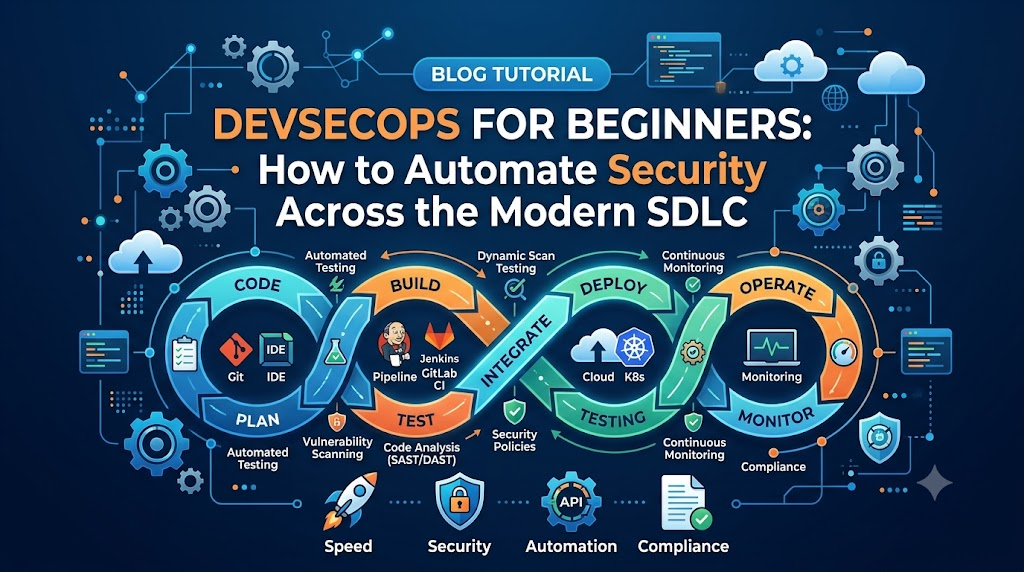
The Secure Software Development Lifecycle (SSDLC)
In a DevSecOps environment, security is integrated into every phase of the development lifecycle:
- Plan: Threat modeling, security requirements, architecture review.
- Code: Secure coding guidelines, IDE scanning plugins, secret management rules.
- Build: Static Application Security Testing (SAST), Software Bill of Materials (SBOM) generation, dependency scanning.
- Test: Dynamic Application Security Testing (DAST), container scanning, integration testing.
- Release: Automated infrastructure checks, configuration validation, policy compliance.
- Deploy: Secure deployment pipelines, Infrastructure as Code scanning, access controls.
- Operate: Zero Trust access, runtime protection, secrets management.
- Monitor: Log aggregation, continuous runtime security checks, threat detection, incident response.
The Shared Responsibility Model
DevSecOps breaks down administrative silos. Security is no longer sole responsibility of a dedicated cybersecurity team. Instead, engineers, system administrators, QA specialists, and operations managers share accountability for application integrity and workload protection.
Why DevSecOps Matters Today
Modern applications rely heavily on microservice architectures, third-party open-source libraries, managed cloud environments, and containerized deployments. While these technologies increase development velocity, they expand the technical attack surface.
+-----------------------------------------------------------------------+
|                       THE MODERN ATTACK SURFACE                       |
+------------------------------------+----------------------------------+
| Component                          | Security Risk Exposure           |
+------------------------------------+----------------------------------+
| Open-Source Dependencies           | Known vulnerabilities (CVEs)     |
| Application Source Code            | Injection, logic errors          |
| Container Images                   | Outdated OS libraries            |
| Infrastructure as Code             | Publicly exposed storage/ports   |
| Cloud Access & Identity            | Over-privileged service roles    |
+------------------------------------+----------------------------------+
The Cost of Reactive Security
Fixing a vulnerability in production requires emergency patching, risk assessment meetings, potential application downtime, and emergency code releases. DevSecOps reduces these costs by catching bad configurations and unpatched code libraries in automated integration pipelines before release candidate builds reach staging or production infrastructure.
Regulatory Compliance and Fast Releases
Organizations operating in finance, healthcare, and e-commerce must satisfy strict compliance regulations like HIPAA, PCI-DSS, SOC 2, and GDPR. Manual security reviews create severe release bottlenecks. DevSecOps uses Compliance as Code to evaluate compliance rules automatically inside continuous delivery pipelines, allowing compliant code releases to flow to production without manual delays.
Who Should Learn DevSecOps?
DevSecOps is an adaptable field that benefits professionals from multiple technical backgrounds.
+------------------------+--------------------------------------------------+
| Background             | Primary DevSecOps Focus                          |
+------------------------+--------------------------------------------------+
| Software Developers    | Secure coding, dependency management, SAST       |
| DevOps Engineers       | Automated security gates, pipeline scanning      |
| Cloud Engineers        | Cloud IAM, IaC scanning, infrastructure rules    |
| System Administrators  | OS hardening, secrets management, access control |
| Security Engineers     | Threat modeling, automated policies, DAST        |
| Students & Switchers   | Core fundamentals across Linux, Git, and Cloud   |
+------------------------+--------------------------------------------------+
- Software Developers: Learn to identify unsafe functions, eliminate hardcoded credentials, and fix vulnerable open-source packages in their everyday workflow.
- DevOps Engineers: Expand automation pipelines to include automated security scanners, container image checks, and deployment verification rules.
- Cloud Engineers: Secure cloud resources using Infrastructure as Code checks, policy enforcement, identity management, and automated guardrails.
- Security Engineers: Shift from manual security testing to building automated security controls that run inside developer environments and build pipelines.
- System Administrators & Career Switchers: Transition from manual system configuration management to automated, secure, modern platform management.
Prerequisites Before Learning DevSecOps
Before adopting complex automated security scanners, you need a firm understanding of fundamental technical concepts. Attempting to master DevSecOps without understanding operating system basics, basic networking, and version control leads to confusion.
                     +----------------------------------+
                     |    DEVSECOPS FOUNDATIONS         |
                     +----------------------------------+
                                      |
         +----------------------------+----------------------------+
         |                            |                            |
         v                            v                            v
  [ Operating Systems ]       [ Networking & Git ]        [ Cloud & Containers ]
  - Linux CLI                 - TCP/IP, DNS, HTTP/S       - AWS / Azure / GCP
  - Shell Scripting           - Branching & Commits       - Docker & Run times
  - Permissions & Storage     - Secret hygiene            - CI/CD concepts
Core Prerequisite Checklist
- Linux Operating System: Mastery of terminal commands, file permission systems (chmod/chown), SSH configuration, system services, and process monitoring.
- Basic Networking: Clear understanding of TCP/IP, OSI layers, DNS resolution, HTTP/HTTPS protocols, subnets, routing, and firewalls.
- Version Control (Git): Branching strategies, pull requests, merge conflict resolution, commit hygiene, and managing code workflows.
- Scripting Skills: Proficiency in Bash or Python to automate configuration tasks and process API payloads.
- Cloud & Container Concepts: Familiarity with cloud resources (AWS, Azure, or GCP) and container management platforms like Docker.
DevSecOps Learning Roadmap
This structured learning path outlines how to go from foundational concepts to advanced, enterprise-level DevSecOps implementation.
+-------+-----------------------------+-------------------------------------------------------+
| Stage | Focus Area                  | Key Competencies & Expected Outcomes                  |
+-------+-----------------------------+-------------------------------------------------------+
| 1     | Technical Fundamentals      | Linux CLI, Bash scripting, Networking, Git usage      |
| 2     | Core DevOps Concepts        | Continuous Integration (CI), Infrastructure setup     |
| 3     | Application Security        | SAST, Secrets detection, Dependency Scanning (SCA)    |
| 4     | Container Security          | Image hardening, Trivy scanning, Kubernetes RBAC      |
| 5     | Infrastructure as Code      | Terraform, Ansible, Checkov IaC security analysis     |
| 6     | Continuous Security (DAST)  | OWASP ZAP, Dynamic analysis, Runtime checks           |
| 7     | Observability & Governance  | Log aggregation, Policy as Code, Prometheus, Grafana  |
+-------+-----------------------------+-------------------------------------------------------+
Stage 1: Technical Fundamentals
Focus on core operating system controls, user access policies, network communication paths, and Git repository workflows.
Stage 2: DevOps & Automation
Understand continuous integration systems, deployment automation, containerization concepts with Docker, and cloud infrastructure management.
Stage 3: Application Security Automation
Introduce static code inspection engines, secrets exposure preventions, dependency vulnerability scanning, and secure coding standards directly into developers’ local workspaces and source repositories.
Stage 4: Container & Orchestration Hardening
Learn to build lightweight container images, execute static vulnerability audits on image layers, apply runtime security policies, and manage cluster resources with Kubernetes Role-Based Access Control (RBAC).
Stage 5: Infrastructure as Code (IaC) Security
Automate cloud provisioning using tools like Terraform or Ansible. Validate configuration scripts using static security tools to prevent common cloud misconfigurations before infrastructure deployment.
Stage 6: Dynamic Testing and Secrets Protection
Execute dynamic application security tests on running services, use centralized vault engines to manage secrets, and control API interactions without relying on hardcoded configuration secrets.
Stage 7: Runtime Observability and Policy as Code
Implement enterprise-wide policy rules, gather service metrics, build centralized logging systems, and trigger automated alerts when suspicious system activity occurs in operational environments.
Core DevSecOps Concepts Every Beginner Should Know
Shift-Left Security
Shift-left security means executing security controls early in the application lifecycle. Instead of auditing code during late-stage production candidates, automated scanners check local developer workstations and continuous build systems immediately upon code submission.
Continuous Security
Security verification runs automatically every time a developer updates code or modifies an infrastructure configuration script. Continuous delivery pipelines evaluate these changes instantly, ensuring security operates alongside rapid release cycles.
Zero Trust Architecture
The Zero Trust model operates on a single baseline rule: Never Trust, Always Verify. Every connection attempt, user interaction, API request, and microservice call must undergo strict authentication, authorization, and encryption validation regardless of network location.
                        Zero Trust Policy Architecture

   +---------------+        Mutual TLS / Identity       +---------------+
   | Workload A    |  ===============================>  | Workload B    |
   +---------------+   [ Always Verify Every Request ]  +---------------+
Threat Modeling
Threat modeling is a structured process used to identify architectural design flaws, potential entry vectors, sensitive assets, and risk mitigations during the initial design phase of a software project.
Policy as Code & Compliance as Code
Instead of referencing long, written compliance documents, engineering teams define security standards in programmatic rulesets. These rules can be evaluated automatically in build pipelines, preventing non-compliant infrastructure from deploying.
Essential DevSecOps Tools to Learn
Mastering DevSecOps requires understanding where specific open-source and enterprise tools fit inside a modern pipeline.
+-----------------------+---------------------+-------------------------------------------------+
| Tool Category         | Popular Tools       | Primary DevSecOps Function                      |
+-----------------------+---------------------+-------------------------------------------------+
| Version Control       | Git, GitHub         | Code storage, PR verification, commit checks    |
| CI/CD Automation      | Jenkins, GitHub Act | Pipeline execution, step security enforcement   |
| Code Analysis (SAST)  | SonarQube           | Static source code quality & vulnerability scan |
| Software Composition  | Snyk, OWASP Dependency| Third-party dependency vulnerability check    |
| Container Scanning    | Trivy, Grype        | Container image layer CVE discovery             |
| Dynamic Testing (DAST)| OWASP ZAP           | Dynamic HTTP request attack simulation          |
| Infrastructure Security| Checkov, Tfsec     | Terraform/Ansible configuration analysis        |
| Secrets Management    | HashiCorp Vault     | Secure storage and rotation of credentials      |
| Policy as Code        | OPA, Kyverno        | Admission control, declarative rule validation  |
| Observability         | Prometheus, Grafana | Continuous operational telemetry & alerting     |
+-----------------------+---------------------+-------------------------------------------------+
Version Control & Integration Systems
- Git: Stores source code, manages branch policies, tracks commits, and acts as the entry point for continuous delivery checks.
- Jenkins / GitHub Actions: Automates source code collection, build verification tasks, security execution scripts, and production deployment flows.
Application Security Scanning Tools
- SonarQube: Scans source code repositories to uncover quality issues, code smells, and common security bugs.
- Snyk / OWASP Dependency-Check: Evaluates application dependencies against vulnerability databases to discover outdated libraries.
- OWASP ZAP: Performs dynamic application security testing against live target endpoints to expose potential application flaws.
Infrastructure & Container Security Tools
- Trivy: Analyzes container images, operating system package layers, and configuration files to find known vulnerabilities.
- Checkov / Tfsec: Evaluates Terraform files, CloudFormation scripts, and Kubernetes manifests to catch misconfigurations before deployment.
- HashiCorp Vault: Provides secure, encrypted storage for API keys, passwords, certificates, and short-lived credentials.
Building a Secure CI/CD Pipeline
A secure continuous integration and delivery pipeline serves as the primary enforcement engine in a DevSecOps workflow. Code changes must pass through a succession of automated security gates before reaching production environments.
                       SECURE CI/CD PIPELINE WORKFLOW

   [ Developer Commit ]
            |
            v
   [ 1. Secrets Scan ]  ----( Secret Found? )---> [ REJECT BUILD ]
            |
            v
   [ 2. SAST Scan ]     ----( High Flaw? )------> [ REJECT BUILD ]
            |
            v
   [ 3. SCA Check ]     ----( Critical CVE? )---> [ REJECT BUILD ]
            |
            v
   [ 4. Build Image ]
            |
            v
   [ 5. Image Scan ]    ----( Vulnerability? )--> [ REJECT BUILD ]
            |
            v
   [ 6. Deploy Staging ]
            |
            v
   [ 7. DAST Scanning ] ----( Attack Risk? )----> [ REJECT BUILD ]
            |
            v
   [ 8. Production Deploy ]
Pipeline Execution Stages
- Developer Code Commit: Developer checks in code updates to a protected repository branch.
- Secrets Scanning: Automated pre-commit hooks or early pipeline steps check for exposed tokens, private keys, or passwords.
- Static Application Security Testing (SAST): Static analysis tools analyze raw source code files to uncover logical errors and insecure design patterns.
- Software Composition Analysis (SCA): Scans imported dependencies and third-party libraries against public database records for security bugs.
- Container Build and Image Analysis: Build systems compile container images, while image scanners audit embedded distribution packages for vulnerabilities.
- Infrastructure Validation: Static checks verify that target infrastructure scripts meet defined security parameters.
- Dynamic Application Security Testing (DAST): Automated tests launch dynamic attack patterns against a live, running target in staging environments.
- Automated Secure Deployment: Validated release builds deploy to production nodes automatically, backed by continuous monitoring systems.
Infrastructure Security
Modern cloud infrastructure relies heavily on declarative code rather than manual server configurations. Infrastructure as Code (IaC) allows teams to provision virtual hardware, network interfaces, and storage buckets using configuration scripts.
Securing Infrastructure as Code
Securing IaC requires validating files created with systems like Terraform, CloudFormation, or Ansible before applying changes:
- Prevent Public Resource Exposure: Verify storage buckets and administrative ports are not accessible to the public internet.
- Enforce Encryption Requirements: Ensure data storage volumes and database configurations enforce encryption both at rest and in transit.
- Implement Least Privilege Policies: Audit identity definitions to restrict permissions strictly to those required by the service.
Terraform
# Insecure Configuration Example (Terraform)
resource "aws_s3_bucket" "insecure_example" {
  bucket = "company-sensitive-data"
}

# Secure Configuration Example (Terraform)
resource "aws_s3_bucket" "secure_example" {
  bucket = "company-sensitive-data"
}

resource "aws_s3_bucket_public_access_block" "secure_protection" {
  bucket                  = aws_s3_bucket.secure_example.id
  block_public_acls       = true
  block_public_policy     = true
  ignore_public_acls      = true
  restrict_public_buckets = true
}
Container and Kubernetes Security
Containers streamline deployment across cloud environments, but unhardened container setups introduce security risks.
               CONTAINER & KUBERNETES SECURITY LAYERS

+-----------------------------------------------------------------+
| Layer 1: Container Image Security                               |
| - Minimal base distributions (Alpine/Distroless)                |
| - Non-root execution users                                      |
+-----------------------------------------------------------------+
                                |
                                v
+-----------------------------------------------------------------+
| Layer 2: Cluster Access Controls                                |
| - Strict Role-Based Access Controls (RBAC)                      |
| - Isolated Kubernetes Service Accounts                          |
+-----------------------------------------------------------------+
                                |
                                v
+-----------------------------------------------------------------+
| Layer 3: Network & Runtime Controls                             |
| - Declarative Network Isolation Policies                        |
| - Admission controllers (e.g., OPA Gatekeeper, Kyverno)         |
+-----------------------------------------------------------------+
Container Best Practices
- Use Minimal Base Distributions: Select minimal base images (like Alpine or Distroless) to reduce installed packages and potential attack vectors.
- Avoid Root Users: Configure Dockerfiles so applications execute under unprivileged user identities rather than root.
- Scan Image Dependencies: Check base images and application additions against vulnerability databases regularly.
Kubernetes Security Essentials
- Role-Based Access Control (RBAC): Restrict access permissions across cluster namespaces using dedicated service accounts.
- Network Isolation Policies: Define explicit rules governing inter-pod communication, blocking unapproved cross-namespace traffic.
- Admission Controllers: Enforce security policies across incoming resource deployment requests using tools like Kyverno or Open Policy Agent (OPA Gatekeeper).
Cloud Security Fundamentals
Securing cloud environments (AWS, Azure, Google Cloud Platform) requires understanding shared accountability frameworks, identity systems, and encrypted storage configurations.
               AWS / CLOUD SHARED RESPONSIBILITY MODEL

+-----------------------------------------------------------------+
| CUSTOMER RESPONSIBILITY:                                        |
| Data Encryption | IAM Access Policies | Container Security     |
| Network Traffic | Application Logic   | OS Security Rules      |
+-----------------------------------------------------------------+
====================== SECURITY OF THE CLOUD ======================
+-----------------------------------------------------------------+
| CLOUD PROVIDER RESPONSIBILITY:                                  |
| Hardware Infrastructure | Physical Data Center Security        |
| Host Virtualization    | Global Network Edge Locations          |
+-----------------------------------------------------------------+
Core Cloud Security Pillars
- Identity and Access Management (IAM): Provide precise service permissions, enforce multi-factor authentication, and avoid long-lived access keys.
- Data Encryption Systems: Use managed KMS mechanisms to handle key management and ensure sensitive data is encrypted everywhere.
- Centralized Logging Systems: Route CloudTrail, VPC Flow, and application event logs into centralized security analytical platforms.
Monitoring and Security Observability
Continuous security relies on operational visibility. You cannot protect workloads or detect active security threats without monitoring operational metrics and system log data.
                    SECURITY OBSERVABILITY PIPELINE

  +------------------+     +------------------+     +-------------------+
  | System Logs /    | --> | Aggregation Engine| --> | Visualization &   |
  | App Telemetry    |     | (ELK / Loki)     |     | Alerts (Grafana)  |
  +------------------+     +------------------+     +-------------------+
- Logs: Centralize log output from container workloads, application endpoints, identity controls, and network firewalls using systems like Fluentd, Loki, or the ELK Stack.
- Metrics: Track resource consumption anomalies, failed authentication attempts, and service health indicators with Prometheus.
- Alerting Systems: Build clear alert thresholds that send contextual operational events directly to response teams via PagerDuty, Slack, or automated incident channels.
Hands-On Projects for Beginners
Building practical projects helps reinforce technical concepts and demonstrates real-world skills to employers.
+---------------------------------------+---------------------------------------------------+
| Project Title                         | Primary Technical Outcome                         |
+---------------------------------------+---------------------------------------------------+
| 1. End-to-End Secure CI/CD Pipeline   | Integrates SAST, secrets, and container scanning  |
| 2. IaC Cloud Infrastructure Hardening | Provisions encrypted cloud resources via Terraform|
| 3. Secrets Management with Vault      | Removes plain-text credentials using Vault APIs   |
| 4. Kubernetes Security & Policy Lab   | Implements cluster network policies and RBAC      |
| 5. Continuous Vulnerability Monitor   | Tracks and alerts on newly published CVEs         |
+---------------------------------------+---------------------------------------------------+
Project 1: Build an End-to-End Secure CI/CD Pipeline
- Goal: Create a complete continuous delivery pipeline using GitHub Actions or Jenkins.
- Implementation: Include secrets scanning (TruffleHog), static code analysis (SonarQube), dependency checking (Snyk), and container image verification (Trivy).
- Outcome: Rejects builds that fail configured security checks.
Project 2: Provision Hardened Infrastructure with Terraform
- Goal: Build reusable Terraform templates that deploy secure, isolated cloud infrastructure.
- Implementation: Create private network configurations, restricted storage buckets, and encrypted logging systems verified using Checkov checks.
- Outcome: Demonstrates automated infrastructure security verification.
Project 3: Implement Centralized Secrets Management
- Goal: Remove hardcoded API keys and credentials from application source files.
- Implementation: Deploy HashiCorp Vault inside a local container ecosystem, configure dynamic secrets retrieval, and update microservices to fetch runtime credentials via API.
- Outcome: Eliminates static environment credentials across build systems.
Common Mistakes Beginners Make
- Ignoring Core Operating System Fundamentals: Jumping directly into complex security tools without mastering Linux CLI basics, permissions, or system logs.
- Relying Solely on Security Tools: Treating tools as complete solutions rather than automated helpers. Understanding underlying concepts matters more than knowing specific command options.
- Skipping Hands-On Practice: Reading tutorials without building actual pipelines or deploying real cluster environments.
- Neglecting Cloud IAM Basics: Focusing exclusively on code scanning while leaving administrative cloud roles over-privileged.
- Focusing Only on Certification Credentials: Prioritizing exam certificates over functional, hands-on repository projects and lab demonstrations.
Best Practices for Learning DevSecOps
- Master One Tool Category at a Time: Learn version control first, then container platforms, followed by continuous integration platforms, before layering on specialized security tools.
- Build and Maintain Personal Repositories: Document your progress on GitHub. Include custom pipelines, Terraform configuration templates, and project setup guides.
- Practice Manual Troubleshooting: Intentionally introduce vulnerable packages or misconfigured infrastructure scripts into test pipelines to observe how scanners catch and report flaws.
- Follow Industry Security Standards: Study guidance from industry resources like the OWASP Top 10, Cloud Security Alliance (CSA), and CIS Benchmarks.
- Prioritize Team Collaboration: Practice explaining security findings clearly to developers, offering fix suggestions rather than just flagging vulnerabilities.
Career Opportunities in DevSecOps
Demand for DevSecOps professionals remains strong across tech companies, financial institutions, cloud service providers, and healthcare organizations.
                       DEVSECOPS CAREER PATHWAY

                  +-----------------------------------+
                  |      Mid-Level Roles              |
                  | - DevSecOps Engineer              |
                  | - Cloud Security Specialist       |
                  | - Security Automation Specialist  |
                  +-----------------+-----------------+
                                    |
                                    v
                  +-----------------+-----------------+
                  |      Advanced Roles               |
                  | - Platform Security Architect     |
                  | - Cloud Security Architect        |
                  | - Chief Information Security    |
                  |   Officer (CISO)                  |
                  +-----------------------------------+
Key Career Roles
- DevSecOps Engineer: Focuses on pipeline automation, tool integration, vulnerability checks, and container deployment security.
- Cloud Security Engineer: Specializes in cloud infrastructure protection, identity management, compliance automation, and network isolation controls.
- Security Automation Specialist: Builds custom automation scripts, API integrations, and policy-as-code validations across build ecosystems.
- Platform Security Architect: Designs long-term secure architecture strategies, access guidelines, and policy governance across enterprise infrastructures.
Certifications and Learning Path
Industry certifications can help validate your expertise and complement hands-on project work.
+---------------------------------------+------------------------+-------------------+-----------------------------------+
| Certification                         | Issuer                 | Skill Target      | Recommended Experience Level      |
+---------------------------------------+------------------------+-------------------+-----------------------------------+
| Certified DevSecOps Professional      | Practical DevSecOps    | Intermediate      | Hands-on pipeline automation      |
| AWS Certified Security - Specialty    | Amazon Web Services    | Intermediate/Adv  | Advanced AWS cloud infrastructure |
| Certified Kubernetes Security (CKS)   | Cloud Native (CNCF)    | Advanced          | In-depth Kubernetes orchestration |
| Certified Information Systems (CISSP) | ISC2                   | Professional/Exec | Strategic enterprise security     |
+---------------------------------------+------------------------+-------------------+-----------------------------------+
Participating in structured training programs, such as courses provided by DevOpsSchool, can help you prepare for these certifications with hands-on labs and expert-led instruction.
Industries Hiring DevSecOps Professionals
- Financial & Banking Sector: Financial platforms handle high volumes of sensitive transactions requiring strict data security and compliance checks.
- Healthcare Organizations: Health platforms manage sensitive patient data and must meet rigorous regulatory standards like HIPAA.
- E-Commerce Platforms: Online retailers protect user payment details, process customer data, and maintain continuous service availability.
- Software as a Service (SaaS): SaaS providers rely on secure multi-tenant architectures, rapid delivery cycles, and continuous security checks.
- Enterprise IT & Telecommunications: Telecom providers and IT enterprises manage large, complex infrastructure networks requiring automated access control and operational visibility.
Future Trends in DevSecOps
- AI-Assisted Security Operations: Machine learning models will increasingly help analyze build logs, triage scan reports, and suggest code fixes.
- Platform Engineering Focus: Modern organizations are consolidating security pipelines into developer self-service platforms that enforce security default configurations automatically.
- Software Supply Chain Integrity: Increasing focus on verifying signed commits, generating Software Bill of Materials (SBOM), and tracking package provenance.
- Widespread Policy as Code: Shift toward declarative, cross-cloud policy enforcement engines that govern compliance across multi-cloud environments.
Frequently Asked Questions (FAQs)
1. What is DevSecOps?
DevSecOps integrates security practices, tools, and controls continuously throughout every step of the software development and operations lifecycle.
2. Is DevSecOps suitable for absolute beginners?
Yes, but beginners should build foundational knowledge in Linux, networking, Git, and basic system administration before focusing on advanced security tooling.
3. What skills should I learn first?
Start with Linux command-line tools, basic networking concepts, and version control using Git, then progress to continuous integration pipelines.
4. Is Linux knowledge mandatory for DevSecOps?
Yes. Linux powers most production servers, container environments, and cloud infrastructure nodes.
5. Which programming language should I learn for DevSecOps?
Python and Bash are great choices for automation scripting, pipeline processing, and operational tasks.
6. Is Kubernetes required for entry-level roles?
While deep Kubernetes experience is not always required for entry-level positions, understanding basic container concepts with Docker is essential.
7. Which cloud provider should I start with?
AWS, Azure, and Google Cloud are all good options. AWS holds a large market share, making it a common starting point for beginners.
8. How long does it take to learn DevSecOps?
With dedicated study and daily hands-on practice, you can build solid foundational skills in 6 to 9 months.
9. Are industry certifications required to get a job?
Certifications validate your skills, but hands-on experience, functional GitHub repositories, and practical demonstration projects often matter more to employers.
10. Do I need previous cybersecurity experience?
No. Software developers, system administrators, QA engineers, and cloud specialists can all transition into DevSecOps by expanding their security automation knowledge.
11. Which security tools should I start learning first?
Begin with static application security testing (SonarQube), dependency checking (Snyk), and container image scanning (Trivy).
12. Is DevSecOps a good career path?
Yes. Demand for DevSecOps skills remains high as organizations prioritize rapid software delivery alongside strong security controls.
13. What salary range can I expect?
Salaries vary by location, experience, and role. Entry-to-mid-level engineers earn competitive compensation, while experienced architects earn top-tier industry salaries.
14. Can I transition from a traditional DevOps role to DevSecOps?
Yes. DevOps engineers are well-positioned to transition into DevSecOps by incorporating automated security checks, policy validations, and cloud security practices into their existing pipelines.
15. How can I gain practical experience?
Build personal CI/CD build pipelines, deploy secure infrastructure using Terraform, run local container security labs, and publish your project repositories on GitHub.
Final Thoughts
Transitioning into DevSecOps is a journey of continuous learning. You do not need to master every security scanner or cloud provider overnight. Begin by building a solid foundation in core operating systems, networking fundamentals, version control workflows, and basic build automation. From there, gradually layer on security controls: scan code for static bugs, check dependencies for vulnerabilities, inspect container images, and automate cloud infrastructure validations. Focus on understanding why security rules exist rather than just learning how to configure specific tools. Security is no longer an isolated phase at the end of a project—it is a shared responsibility integrated into every line of code, deployment script, and cloud resource. With continuous hands-on practice, practical project building, and a clear learning path, you can build the skills needed for a successful career in DevSecOps.







Leave a Reply
You must be logged in to post a comment.