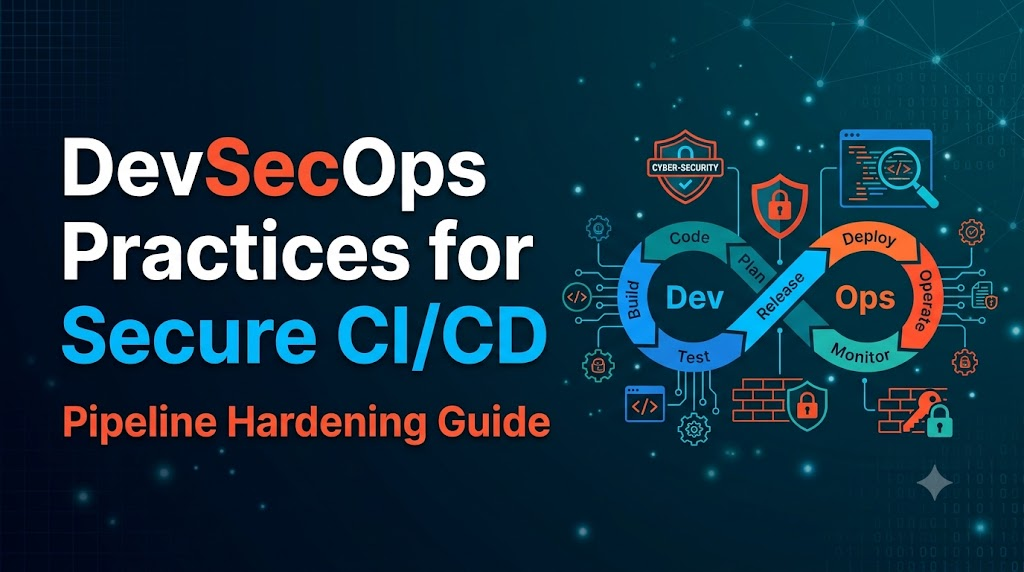
Continuous Integration and Continuous Delivery (CI/CD) systems have become the backbone of modern software engineering. They build source code, resolve third-party packages, execute automated tests, provision cloud infrastructure, and deploy workloads directly to production.
Because build and release pipelines require deep access across source code management (SCM) platforms, artifact registries, and production cloud infrastructure, they represent one of the most critical security boundaries in an organization. If a pipeline runner or credential is compromised, an attacker can bypass traditional perimeter firewalls entirely, injecting malicious code directly into production or exfiltrating sensitive data at the build stage.
Integrating security into software delivery—the core principle of DevSecOps—is not about stacking commercial scanners until deployments grind to a halt. Instead, an effective DevSecOps approach balances actionable, risk-prioritized controls with high-velocity deployment, ensuring code remains resilient from the developer workstation through to production.
What DevSecOps Means in Modern CI/CD Workflows
Traditional application security often treated validation as a final gate right before release. Security engineers ran extensive audits or dynamic penetration tests late in the development cycle, frequently identifying architecture flaws or vulnerable dependencies when remediation was most disruptive and costly.
DevSecOps reframes this model by embedding automated, contextual security controls directly into the developer workflow and deployment automation.
+-----------------------------------------------------------------------------------+
|                            Continuous DevSecOps Pipeline                          |
+-----------------------------------------------------------------------------------+
|  Plan / Code  |       Build      |       Test       |      Release     |  Production  |
|---------------+------------------+------------------+------------------+--------------|
| • Pre-commit  | • Scoped Runners | • DAST / API     | • Image Signatures| • Drift     |
|   Hooks       | • SCA & SBOM     |   Testing        | • Cosign / Sigstore|   Detection|
| • Pre-receive | • Secrets Scan   | • Ephemeral Test | • OIDC Short-lived| • Runtime   |
|   Rules       | • SAST (Semgrep) |   Environments   |   Cloud Tokens   |   Observability|
| • Branch Locks| • Container Scan | • Quality Gates  | • Immutable Audit| • Least-Priv |
|   & Dual-Auth |   (Trivy)        |   (Risk-based)   |   Logs           |   Roles      |
+-----------------------------------------------------------------------------------+
In a CI/CD context, DevSecOps relies on three operational pillars:
- Shared Ownership and Actionable Feedback: Developers receive immediate, low-noise feedback in pull requests (PRs) where code context is fresh, while security teams define policies and monitor risk trends rather than manually approving individual commits.
- Shift-Left and Shield-Right: Shift-left controls (such as linting, static analysis, and dependency verification) catch regressions early. Complementary shield-right mechanisms (including immutable container registries, cryptographic signing, and runtime drift detection) verify integrity and configuration enforcement before and after deployment.
- Pipeline Infrastructure as a Security Boundary: The pipeline itself is treated with the same rigor as production infrastructure: build environments are ephemeral, execution privileges are locked down, and human access to production deployment triggers is governed by audit trails and multi-party reviews.
Threat Modeling the CI/CD Pipeline
Securing a pipeline requires analyzing how adversaries target automated build systems. The CNCF Software Supply Chain Security Whitepaper and the SLSA (Supply-chain Levels for Software Artifacts) framework categorize pipeline risks across the entire chain of custody:
| Threat Vector | Real-World Scenario | Potential Impact |
| Long-Lived Secrets Exfiltration | Static AWS/GCP access keys stored as plain CI/CD variables are printed into build logs or stolen via compromised actions. | Total compromise of downstream cloud infrastructure. |
| Dependency Hijacking | A developer pulls a typosquatted package or an upstream open-source library suffers account takeover. | Remote code execution during build or backdoored production software. |
| Poisoned Pipeline Execution (PPE) | An external contributor submits a pull request that alters .github/workflows/ci.yml or Makefile steps to execute malicious code. | Runners exfiltrate repository secrets or compromise the build network. |
| Runner & Host Compromise | A persistent, unhardened self-hosted runner executes untrusted code, retaining state across builds. | Lateral movement within internal VPCs and cross-tenant credential theft. |
| Artifact Tampering | An attacker replaces a built container image in an untrusted registry between the build step and deployment. | Deployment of untrusted, unreviewed application code to production. |
| Over-Privileged Build Identities | A CI runner identity possesses wild-card permissions (*.* or broad IAM roles) instead of scoped deployment privileges. | Blast radius expands across all infrastructure rather than a single target cluster. |
The severity of these risks is determined by architecture and exposure. For instance, public repositories executing automated workflows on external pull requests face elevated PPE risks, while internal enterprise pipelines often struggle most with credential sprawl and unpatched base images.
Core DevSecOps Controls and Pipeline Hardening
A resilient CI/CD architecture applies defense-in-depth across the code, the pipeline execution engine, and built artifacts.
1. Secrets Management and Keyless Cloud Authentication
Static, long-lived API tokens or service account keys stored in CI settings represent a major threat vector. If an engineer rotates a credential incorrectly or logs environment variables during a failed run, keys are compromised.
- OpenID Connect (OIDC): Wherever possible, eliminate static cloud credentials in favor of OIDC federated authentication between your CI provider (e.g., GitHub Actions, GitLab CI) and cloud platforms (AWS, Google Cloud, Azure). Ephemeral, short-lived tokens are issued on the fly, scoped specifically to repository, branch, and environment claims.
- Dedicated Secrets Engines: Centralize secrets using external secret managers (HashiCorp Vault, AWS Secrets Manager, Azure Key Vault). Fetch secrets dynamically during job execution with strict time-to-live (TTL) limits.
- Log Masking and Pre-Commit Scans: Enforce local and pre-receive hook scanning using tools like
gitleaksortrufflehogto stop credentials before they are committed to git history. Configure runners to aggressively redact known secrets from stdout/stderr.
2. Source Control and Branch Protections
Source repositories represent the root of trust. Build systems must execute only reviewed, authorized changes.
- Enforce Branch Protections: Block direct pushes to production and staging branches. Require signed commits (GPG/SSH) and at least one independent, authenticated peer review.
- Restrict Workflow File Modifications: Require explicit code-owner approvals on any alterations to CI/CD definitions (e.g.,
.github/workflows/*or.gitlab-ci.yml). - Safe Handling of Forks and Untrusted Pull Requests: Never expose production secrets or auto-trigger write-permission workflows on
pull_request_targetor fork-based runs without manual authorization.
3. Application and Dependency Security Scanning
Automated scanning identifies vulnerabilities before code advances through the delivery lifecycle:
- Static Application Security Testing (SAST): Analyzes uncompiled or compiled source code for logic vulnerabilities, injection flaws, and unsafe function usage. Modern SAST engines (such as Semgrep or SonarQube) favor pattern-matching rules tailored to frameworks, keeping false positives low.
- Software Composition Analysis (SCA): Catalogs open-source dependencies and compares them against vulnerability databases (CVEs/GHSA). SCA tools evaluate direct and transitive dependencies and flag license non-compliance.
- Container Image Scanning: Evaluates base image OS packages and application runtimes for unpatched vulnerabilities, misconfigurations, and root execution defaults using scanners like Trivy or Grype.
- Infrastructure as Code (IaC) Scanning: Analyzes Terraform, OpenTofu, Kubernetes manifests, and Helm charts for policy violations (such as public S3 buckets, privilege escalation, and open security groups) using tools like Checkov, tfsec, or KICS.
4. Software Bill of Materials (SBOM) and Artifact Provenance
Vulnerability scanning alone only captures known vulnerabilities at the moment of scanning. Generating a Software Bill of Materials (SBOM) in a standardized format (SPDX or CycloneDX) provides an auditable inventory of all components, enabling rapid vulnerability assessment when zero-days emerge post-release.
To ensure artifacts are not tampered with downstream, implement cryptographic artifact signing using tools like Cosign (Sigstore). Before deployment, admission controllers (e.g., Kyverno, OPA Gatekeeper) verify that the image matches its signature and originates from an approved pipeline.
5. Build Runner Isolation
Build runners must be isolated to prevent cross-job contamination:
- Ephemeral Build Environments: Favor disposable runners (containers or short-lived VMs) that tear down completely after a single job completes.
- Network Segmentation for Self-Hosted Runners: If self-hosted runners are required to access internal build resources, place them inside dedicated, firewalled subnets. Never permit self-hosted runners on public repositories where arbitrary pull request code can run inside your private network.
Practical Pipeline Implementation: A Hardened GitHub Actions Workflow
Below is a production-grade GitHub Actions workflow demonstrating:
- Least-privilege permissions configured at both workflow and job levels.
- Keyless OIDC authentication to AWS (no long-lived secrets).
- Secret scanning, SAST, SCA, and container security with SARIF reporting.
- Minimal surface area for untrusted pull requests.
YAML
name: Secure Build and Test

on:
  push:
    branches: [ "main" ]
  pull_request:
    branches: [ "main" ]

# Explicitly drop all default ambient permissions
permissions: {}

jobs:
  validate-and-scan:
    name: Code Quality & Security Analysis
    runs-on: ubuntu-latest
    permissions:
      contents: read             # Required to checkout code
      security-events: write     # Required to upload SARIF vulnerability findings
    steps:
      - name: Checkout Source Code
        uses: actions/checkout@v4
        with:
          fetch-depth: 0         # Full history allows accurate git-based scanning

      - name: Check for Hardcoded Secrets
        uses: gitleaks/gitleaks-action@v2
        env:
          GITHUB_TOKEN: ${{ secrets.GITHUB_TOKEN }}

      - name: Execute SAST (Semgrep)
        uses: semgrep/semgrep-action@v1
        with:
          config: >-
            p/security-audit
            p/secrets
            p/owasp-top-ten
          generateSarif: "semgrep.sarif"

      - name: Publish SAST Results to Security Dashboard
        if: always()
        uses: github/codeql-action/upload-sarif@v3
        with:
          sarif_file: semgrep.sarif

  container-security:
    name: Build & Image Vulnerability Scan
    needs: validate-and-scan
    runs-on: ubuntu-latest
    permissions:
      contents: read
      security-events: write
    steps:
      - name: Checkout Code
        uses: actions/checkout@v4

      - name: Build Local Container Image
        run: |
          docker build -t internal/app:${{ github.sha }} .

      - name: Run Container Scan (Trivy)
        uses: aquasecurity/trivy-action@0.28.0
        with:
          image-ref: internal/app:${{ github.sha }}
          format: 'sarif'
          output: 'trivy-results.sarif'
          severity: 'CRITICAL,HIGH'
          ignore-unfixed: true   # Focuses on actionable vulnerabilities with existing patches

      - name: Upload Container Scan Results
        if: always()
        uses: github/codeql-action/upload-sarif@v3
        with:
          sarif_file: trivy-results.sarif

  deploy-staging:
    name: Authenticate via OIDC and Deploy
    needs: container-security
    if: github.ref == 'refs/heads/main' && github.event_name == 'push'
    runs-on: ubuntu-latest
    permissions:
      id-token: write            # Required for requesting the OIDC JWT token
      contents: read
    steps:
      - name: Configure AWS Credentials via OIDC
        uses: aws-actions/configure-aws-credentials@v4
        with:
          role-to-assume: arn:aws:iam::123456789012:role/ci-deploy-staging
          aws-region: us-east-1
          audience: sts.amazonaws.com

      - name: Verify Identity
        run: |
          # Confirms the runner assumed the role via STS without storing static AWS keys
          aws sts get-caller-identity
Key Security Decisions in This Workflow:
permissions: {}Root Declaration: GitHub Actions grants default broad read/write permissions to workflows unless locked down. Dropping permissions at the top level forces each job to declare only what it requires.- Short-Lived OIDC Tokens: The deployment step uses
id-token: writeto exchange a short-lived token with AWS STS, eliminating long-lived credentials stored in repository settings. - SARIF Integration: Security outputs are converted to SARIF (Static Analysis Results Interchange Format) and uploaded natively into the developer repository interface, avoiding external dashboard context-switching.
Designing Sensible Quality Gates and Handling Exceptions
A common failure mode in DevSecOps initiatives is configuring pipelines to block releases for every discovered CVE or minor warning. This results in alert fatigue, frustrated development teams, and engineers creating unauthorized workarounds to bypass CI checks.
To maintain both security and delivery cadence, establish risk-based, contextual quality gates:
+-----------------------------------------------------------------------------------+
|                        Risk-Based Quality Gate Matrix                             |
+-----------------------------------------------------------------------------------+
| Finding Category        | Actionable Context          | Pipeline Action           |
|-------------------------+-----------------------------+---------------------------|
| Known Remote Code       | Direct dependency, public   | Block Build Immediately   |
| Execution (RCE)         | exploit available, fix is   | (Exit Code 1)             |
|                         | published                   |                           |
|-------------------------+-----------------------------+---------------------------|
| High / Critical Severity| Development dependency, no  | Allow Build, Flag Warning,|
| Vulnerability           | network exposure, or no fix | Open Tracked Ticket with  |
|                         | currently available         | 14-Day Remediation SLA    |
|-------------------------+-----------------------------+---------------------------|
| Hardcoded API Key       | Active credential discovered| Block Commit / PR Merge   |
| Discovered in Diff      | in git diff                 | Immediately               |
|-------------------------+-----------------------------+---------------------------|
| Low / Moderate SAST     | Code style, informational   | Informational Only;       |
| Finding                 | pattern                     | Non-blocking in PR        |
+-----------------------------------------------------------------------------------+
Managing False Positives and Temporary Exceptions
Security exceptions are an inevitable part of software maintenance. If a library has an unpatched vulnerability that is not exploitable due to application architecture (e.g., vulnerable code path is never called), teams need a structured mechanism to proceed without permanently disabling the scanner:
- Documented Risk Acceptance: Record why the finding does not pose an immediate threat, citing environmental controls or lack of exploitability.
- Time-Bound Waivers: Every scanner exception (e.g.,
.trivyignore,.gitleaksignore) must include an expiration date (e.g., 30 days) and an assigned engineering owner. Once the date passes, the pipeline breaks again, prompting review. - Traceability in Source Control: Exceptions should be committed directly to version control alongside PR approval from designated security champions, ensuring full change auditability.
Overcoming Common DevSecOps Implementation Challenges
1. Slow Pipeline Execution
Running full SAST, deep dependency trees, and multiple container scans on every commit can extend pipeline runs from 3 minutes to 45 minutes, disrupting developer productivity.
- Mitigation: Run fast, incremental checks on pull requests (scanning only changed files or git diffs). Schedule comprehensive scans, license compliance sweeps, and full-image scans as asynchronous background pipelines or nightly jobs.
2. High False-Positive Rates
When scanners flood developers with theoretical risks that do not apply to the project, teams learn to ignore security feedback altogether.
- Mitigation: Curate rule sets deliberately. Turn off generic, low-confidence heuristic rules and focus on high-fidelity vulnerability signatures. Favor analyzers that evaluate reachability—determining whether the vulnerable component is actually executed by the application.
3. Pipeline Inconsistencies Across Teams
In decentralized organizations, individual teams often construct their own CI/CD definitions, resulting in fragmented security checks and uneven compliance.
- Mitigation: Provide centralized, reusable pipeline templates (such as GitHub Actions Reusable Workflows or GitLab CI Templates). Platform engineering teams can maintain hardened, pre-approved building blocks that development teams inherit, ensuring standardized controls without duplicate configuration.
Practical Implementation Scenarios
Scenario A: High-Severity CVE in an Upstream Base Image
- Context: A scheduled nightly build identifies a Critical CVE (CVSS 9.8) in the base OS container image. No patch is available from the upstream Linux distribution.
- Immediate Control: The pipeline identifies that while the CVE exists in the image package, the vulnerable binary is not loaded or referenced by the running service.
- Resolution: The team files a 14-day temporary exception in
.trivyignorereferencing the analysis, signs the image with Cosign, and commits a follow-up ticket to switch to a distroless or minimal base image (such as Chainguard or Alpine) during the next sprint.
Scenario B: Pull Request from a Fork in an Open Source Project
- Context: An external user submits an improvement to an open-source project. The repository uses CI to run automated unit tests and integration tests that require cloud sandbox access.
- Immediate Control: The CI runner uses separate workflow configurations for external contributors. The workflow triggered by
pull_requestruns untrusted code in an unprivileged, sandbox container without access to repository secrets or cloud OIDC tokens. - Resolution: Integration tests requiring credentials run only after a maintainer with write access manually inspects the code diff and explicitly approves the execution via environment protection rules.
Frequently Asked Questions
What is the practical difference between SAST, DAST, and SCA?
- SAST (Static Application Security Testing): Analyzes your proprietary source code at rest without executing it to detect logic errors, injection flaws, and unsafe coding patterns.
- SCA (Software Composition Analysis): Examines the open-source and third-party libraries, packages, and direct/transitive dependencies your application relies on, flagging known vulnerabilities and licensing conflicts.
- DAST (Dynamic Application Security Testing): Tests the compiled, running application from the outside by simulating attacks against live endpoints, finding runtime vulnerabilities, authentication issues, and misconfigurations that source analysis cannot detect.
How can teams eliminate static cloud credentials from CI runners?
By configuring OpenID Connect (OIDC) federated identity. The CI platform issues a cryptographically signed JSON Web Token (JWT) containing metadata about the job (such as the repository name, triggering event, and branch). The target cloud provider (AWS STS, Google Cloud Workload Identity, or Azure Active Directory) validates the token against the CI provider’s public keys and exchanges it for a short-lived IAM session credential that expires automatically when the job finishes.
Should security scans run on every single commit?
Fast, incremental checks—such as git secret scans, code linters, and targeted SAST on modified files—should run on pull requests to give developers rapid feedback before merging. Full-scope scans, comprehensive container vulnerability assessments, and dynamic testing should be structured across integration branches, release candidates, or scheduled nightly runs to avoid bottlenecking day-to-day development.
Conclusion
Securing continuous integration and delivery pipelines is not an exercise in adding friction to deployments. By securing pipeline runners, eliminating static secrets with OIDC, shifting high-signal checks left, and cryptographically verifying artifact provenance, organizations build resilient software supply chains that ship fast without compromising safety.
Begin by taking an inventory of your current pipeline permissions: audit your long-lived repository secrets, verify that branch protection rules prevent direct pushes, and replace static cloud keys with short-lived federated credentials. Layer in targeted automated scanning progressively, ensuring that your quality gates remain actionable, context-aware, and aligned with your team’s operational needs.




Leave a Reply
You must be logged in to post a comment.