Introduction
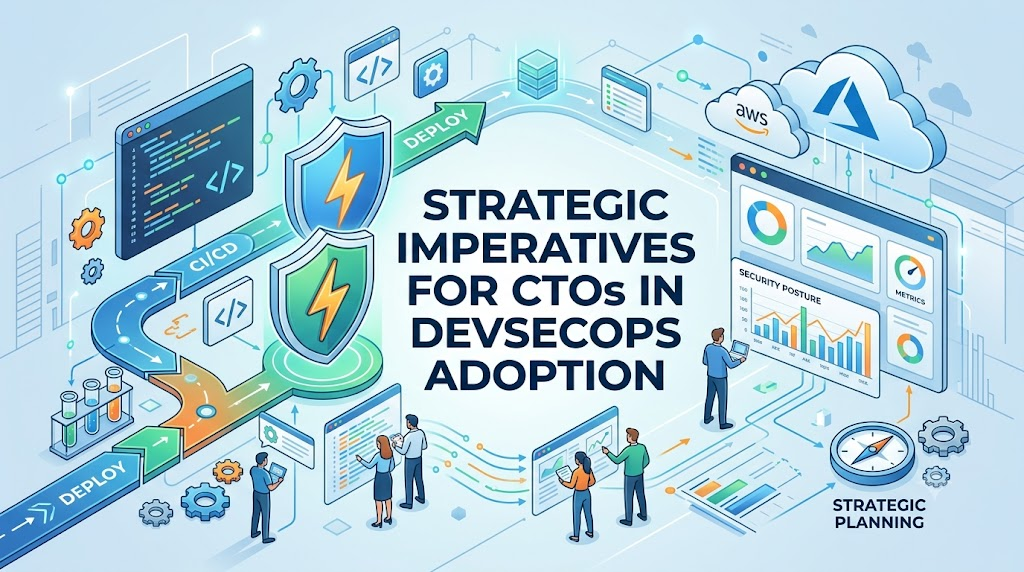
In modern enterprises, software delivery drives business value, yet the tension between rapid innovation and rigorous security remains a critical leadership challenge. DevSecOps represents a structural transformation that integrates security into the core of the development lifecycle, turning it from a release bottleneck into a strategic business enabler. To successfully orchestrate this shift, CTOs must adopt proven frameworks that empower their teams and standardize secure workflows across the enterprise. For leaders looking to bridge the knowledge gap, resources like DevOpsSchool provide essential training and guidance to help organizations build mature, compliant, and scalable software delivery ecosystems.
Why DevSecOps Is a CTO-Level Responsibility
Security, at its core, is a business risk management function. When a production incident occurs due to a misconfigured cloud bucket or an unpatched library, the cost is not merely technical—it is reputational, financial, and regulatory. CTOs are ultimately the stewards of the organization’s technical risk profile.
Business Risk Ownership
In a traditional model, security is often outsourced to a separate department. In a DevSecOps model, the responsibility is internalized. The CTO must own the fact that security decisions impact the bottom line. If a release is delayed because of a security flaw, the cost of that delay is a business metric. If a vulnerability reaches production, the liability is a board-level concern.
Regulatory Pressure and Compliance
For enterprises in regulated sectors like finance or healthcare, compliance is not a point-in-time event; it is a continuous state. DevSecOps provides the audit trail and the automated governance necessary to prove compliance at any moment, rather than scrambling during an annual audit cycle.
The Engineering Velocity Paradox
There is a pervasive myth that security slows down development. In reality, retrofitting security into a finished product is exponentially more expensive and slower than building it in. By embedding security early, CTOs actually increase velocity by reducing the frequency of rework, emergency patches, and production rollbacks.
What DevSecOps Really Means for Enterprises
For the executive, DevSecOps represents a shift from “Gatekeeper Security” to “Guardrail Security.”
Security as a Shared Responsibility
The goal is to move security awareness into the hands of the developers. This does not mean developers become security experts, but it does mean they are empowered to own the security of their code.
Shift-Left and Shift-Right
- Shift-Left: Introducing security testing, threat modeling, and code analysis as early as the design and coding phase.
- Shift-Right: Implementing real-time monitoring, observability, and feedback loops in production to detect and remediate threats that bypass initial controls.
Continuous Security Integration
Security cannot be a periodic activity. It must be woven into the CI/CD pipeline, ensuring that every commit is tested, validated, and approved according to defined security policies.
Core Pillars of DevSecOps for CTOs
To succeed, you must build upon four foundational pillars that align with enterprise architecture.
- People: Cultivating a culture where security is seen as a feature of code quality, not an obstacle to production.
- Process: Standardizing secure workflows that developers find intuitive, not restrictive.
- Technology: Automating security controls so that they run at the speed of deployment.
- Governance: Establishing clear policies, compliance standards, and accountability frameworks.
How DevSecOps Aligns with Business Objectives
| Business Objective | DevSecOps Contribution |
| Faster Time-to-Market | Automating security gates removes manual approval delays. |
| Reduced Risk Exposure | Proactive threat detection prevents data breaches and leaks. |
| Compliance Readiness | Infrastructure-as-Code (IaC) ensures audit-ready environments. |
| Operational Stability | Shift-right monitoring catches issues before they become incidents. |
| Developer Productivity | Clear security guidelines reduce context switching and rework. |
Secure Software Development Lifecycle (Secure SDLC)
A mature DevSecOps organization integrates security into every phase of the SDLC.
- Requirement Phase: Include security requirements in user stories (e.g., “The API must authenticate using OAuth2”).
- Design-Level Threat Modeling: Identify potential attack vectors before a single line of code is written.
- Secure Coding Practices: Implement IDE plugins that provide real-time feedback on insecure patterns.
- Testing and Validation: Integrate Static Application Security Testing (SAST) and Software Composition Analysis (SCA) to identify vulnerabilities in code and dependencies.
CI/CD Security Strategy for CTOs
The CI/CD pipeline is the production line of your software. If it is compromised, the integrity of your entire platform is at risk.
Pipeline Security Controls
Your pipeline must be hardened. Use signed commits, ephemeral build runners, and strictly controlled access to secrets.
Automated Scanning
Security scans must be non-blocking where possible, providing feedback directly to the developer, while acting as hard gates for production deployments only when critical vulnerabilities are detected.
Deployment Governance
Implement “Policy-as-Code” to ensure that any infrastructure deployment meets your organization’s security standards (e.g., encryption at rest enabled, public access blocked).
Cloud Security and DevSecOps Integration
In a cloud-native environment, infrastructure is code. This provides a massive opportunity for security automation.
- Cloud Misconfiguration: Automate the detection of misconfigurations using policy engines.
- Identity and Access Management (IAM): Enforce the principle of least privilege across all environments.
- Policy-as-Code: Define security policies in version-controlled repositories, allowing for automated compliance enforcement across multi-account cloud environments.
Organizational Culture Changes Required
Technology alone will fail if the culture is resistant.
- Breaking Silos: Security teams should act as advisors and enablers, not just auditors.
- Security Ownership: Security becomes a shared KPI. Developers are incentivized to write secure code, and security engineers are incentivized to enable development.
- Developer Empowerment: Provide the tools and training developers need to handle security tasks independently.
- Cross-Team Collaboration: Facilitate regular interactions between Security, DevOps, and Product teams.
Real-World Example: Enterprise Without DevSecOps
Consider a mid-sized fintech firm operating in a legacy model. They have a central security team that performs manual penetration testing two weeks before a major release.
- Late Discovery: A critical SQL injection vulnerability is found 48 hours before the go-live date.
- High Cost: Developers must pause current features to fix the legacy code, creating a massive crunch and technical debt.
- Compliance Delay: The release is pushed back by three weeks, costing the company market share.
- Incident Impact: A month after release, an unrelated dependency vulnerability is exploited because the scan didn’t cover the third-party library, leading to a public data breach.
Real-World Example: Enterprise With Mature DevSecOps
Now consider a SaaS company using mature DevSecOps practices.
- Early Detection: The same SQL injection flaw is caught by an automated SAST tool in the IDE during the initial coding phase.
- Faster Releases: The developer fixes the issue in minutes, and the CI/CD pipeline approves the secure build automatically.
- Reduced Incident Impact: Automated SCA tools immediately flag a newly discovered vulnerability in a third-party library, triggering an automated Jira ticket and a prioritized update path.
- Audit Readiness: Auditors are given read-only access to the CI/CD logs and policy repositories, reducing the audit process from weeks to days.
Common CTO Mistakes in DevSecOps Adoption
- Treating Security as a Tool Problem: Buying expensive tools without changing the processes or culture is the most common failure point.
- Ignoring Developer Experience: Security controls that make the developer’s life harder will be bypassed or ignored.
- Lack of Metrics: Failing to measure progress makes it impossible to demonstrate ROI to the board.
- Over-Complex Pipelines: Adding too many security tools that provide false positives leads to “alert fatigue,” causing developers to ignore security warnings.
- Weak Governance Model: Having tools but no policy to enforce what constitutes a “passing” build.
Best Practices for CTOs Driving DevSecOps
- Define a Security Ownership Model: Clarify who is responsible for what.
- Invest in Automation: If you have to do a security task twice manually, automate it.
- Align Security with CI/CD: Ensure security testing is native to the development workflow.
- Measure Security KPIs: Track metrics that actually matter, such as Time to Remediate (TTR).
- Build Cross-Functional Teams: Ensure Security, DevOps, and AppSec teams share goals.
DevSecOps Metrics CTOs Should Track
- Vulnerability Detection Time: How long does it take from code commit to vulnerability detection?
- Mean Time to Remediate (MTTR): How long does it take to fix a discovered vulnerability?
- Pipeline Security Failures: Are there too many false positives hindering development?
- Compliance Coverage: What percentage of infrastructure and code is currently being scanned for compliance?
Role of DevOpsSchool in Enterprise DevSecOps Learning
The transition to DevSecOps is intellectually demanding for engineering teams. It requires a fundamental shift in technical skills, from traditional operations and manual security audits to understanding automated pipelines, cloud-native security, and infrastructure-as-code patterns.
DevOpsSchool serves as a vital bridge in this transformation. By providing structured exposure to DevSecOps concepts, the platform helps engineering teams master CI/CD security workflows and cloud governance. For a CTO, utilizing such resources helps ensure that the team is not just adopting tools, but developing the necessary engineering mindset to maintain a secure software delivery ecosystem. Training ensures that the “people” pillar of your DevSecOps strategy is robust, knowledgeable, and ready to execute.
Industries Where DevSecOps Is Critical
- Banking & Finance: High regulatory scrutiny and target for cyber-attacks.
- Healthcare: Data sensitivity mandates strict compliance with HIPAA/GDPR.
- E-Commerce: Massive scale and integration of third-party payment APIs increase the attack surface.
- SaaS: Rapid release cycles demand automated security to maintain customer trust.
- Government Systems: High requirement for integrity and availability of public services.
- Telecom: Critical infrastructure requires rigorous security orchestration across massive, distributed networks.
Future of DevSecOps at Enterprise Scale
- AI-Driven Security Automation: Using LLMs to auto-remediate common vulnerabilities.
- Continuous Compliance Systems: Moving away from periodic audits to real-time compliance posture management.
- Autonomous Risk Detection: AI agents that continuously probe for vulnerabilities in production environments.
- Platform Engineering Convergence: Security as a native service provided by the Internal Developer Platform (IDP).
FAQs
- Why is DevSecOps important for CTOs?It aligns software velocity with risk management, ensuring that security scales with the speed of innovation.
- Is DevSecOps a technology or cultural change?It is primarily a cultural change, supported by technology. You cannot automate a culture that ignores security.
- How does DevSecOps reduce business risk?By identifying vulnerabilities earlier and continuously, it prevents incidents and reduces the cost of remediation.
- What is Secure SDLC?It is the integration of security activities, such as threat modeling and testing, into every phase of the software development lifecycle.
- How do CI/CD pipelines improve security?They enable automated, repeatable security testing and ensure that no code reaches production without passing security gates.
- What are common DevSecOps failures?Over-investing in tools, ignoring developer friction, and treating security as a separate silo.
- How should CTOs measure DevSecOps success?Measure through metrics like MTTR, vulnerability frequency, and developer feedback scores.
- Is DevSecOps suitable for startups?Yes. Starting early prevents the massive technical debt that slows down growth later.
- What is the difference between DevOps and DevSecOps?DevSecOps explicitly includes security as a first-class citizen in the development and operations process.
- How do I start a DevSecOps transformation?Start by assessing your current maturity, identifying a pilot team, and automating the “low-hanging fruit” like basic security scans.
- Who is responsible for security in DevSecOps?Everyone involved in the product lifecycle, supported by specialized security teams.
- Does DevSecOps eliminate the need for a security team?No, it pivots the security team from manual auditors to platform enablers.
- What is policy-as-code?Defining security and compliance rules in code, allowing them to be versioned and enforced automatically.
- How do I handle developer resistance?Demonstrate that security tools provide value (like reducing production bugs) rather than just blocking code.
- What is the best way to handle third-party risks?Use Software Composition Analysis (SCA) to automatically track and scan dependencies.
Final Thoughts
DevSecOps is a strategic capability, not merely a collection of tools or a new department name. It is the acknowledgement that in the digital age, the security of your software is indistinguishable from the security of your business. As a CTO, your leadership determines whether this transition results in a secure, high-velocity organization or a chaotic, tool-saturated environment.
Security must be embedded, not added as a final layer. Sustainable delivery requires a meticulous balance between speed and protection. Focus on enabling your teams through better processes and automation, and you will find that security becomes an accelerator rather than a friction point.




Leave a Reply
You must be logged in to post a comment.