Introduction
Modern software engineering moves at an unprecedented pace, with automated pipelines, cloud-native architectures, and microservices enabling organizations to deploy code dozens or hundreds of times a day. However, this delivery speed creates severe security bottlenecks when teams rely on legacy, manual code reviews and late-stage penetration tests right before production launches. To eliminate release friction without exposing systems to cyber threats, modern engineering teams must shift security left, integrating automated controls throughout the entire software development lifecycle (SDLC). Transforming from siloed security to an integrated practice requires a structured journey of cultural alignment, pipeline automation, and continuous assessment—a journey guided by the DevSecOps Maturity Model. Organizations aiming to navigate this evolution effectively turn to training platforms like DevOpsSchool, which offer structured learning paths and practical guidance to help teams automate security checks and build resilient software delivery capabilities.
What Is the DevSecOps Maturity Model?
The DevSecOps Maturity Model is a structured framework that defines the progressive stages an organization goes through as it integrates security into its software development and operational workflows. Rather than treating security as a pass/fail checklist at the end of a release cycle, a maturity model evaluates continuous improvement across multiple operational dimensions, including organizational culture, automation, threat modeling, vulnerability management, and infrastructure control.
The core purpose of measuring security adoption through a maturity framework is to establish an accurate baseline of your current engineering practices and define an actionable, incremental path forward. Trying to move directly from manual security audits to AI-driven, fully automated security operations creates operational friction, tools fatigue, and developer burnout. A maturity model ensures that foundational capabilities, such as automated static code analysis and baseline vulnerability tracking, are firmly established before attempting advanced integrations like automated runtime defense or self-healing pipelines.
+-----------------------------------------------------------------------+
|                    DEVSECOPS MATURITY EVOLUTION                       |
+-----------------------------------------------------------------------+
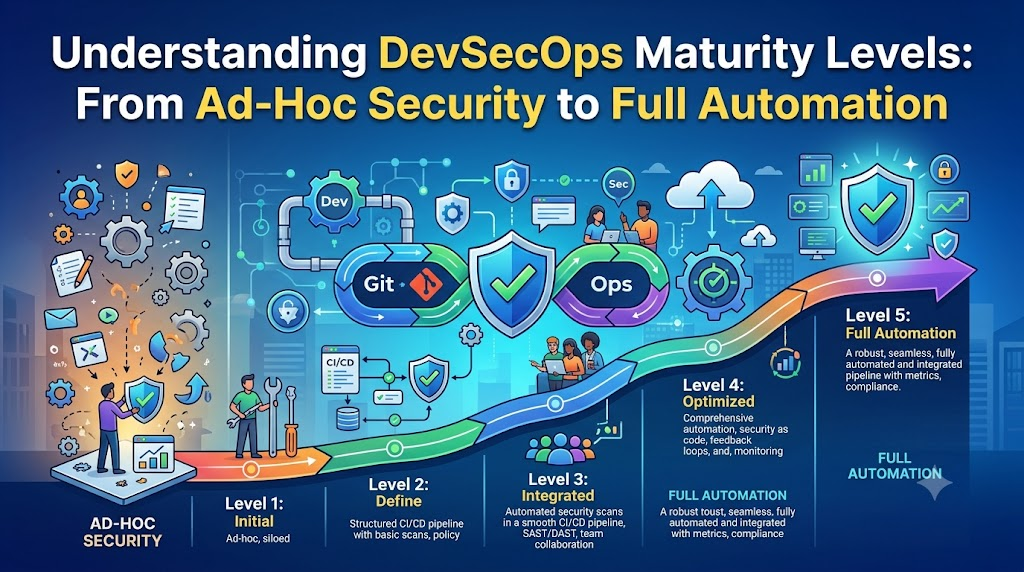
| Level 1: Initial / Ad-Hoc    --> Reactive, manual audits, late testing |
| Level 2: Managed             --> Basic scans, policy definition        |
| Level 3: Defined             --> Standardized CI/CD security gates    |
| Level 4: Automated           --> Infrastructure as Code & auto-triage |
| Level 5: Optimized           --> Continuous feedback, AI threat response|
+-----------------------------------------------------------------------+
A common misconception is that security checklists and security maturity models are the same thing. A security checklist is static; it asks whether specific security controls (such as password policies or code scanning tools) exist. In contrast, a maturity model is dynamic and process-oriented. It evaluates how deeply security is embedded into daily developer workflows, how effectively vulnerability data is triaged and remediated, and how well team cultures support shared responsibility for security.
Why Organizations Need a DevSecOps Maturity Model
Modern organizations operate under continuous pressure to deliver software fast while keeping risks low. A maturity model provides the strategic clarity needed to balance these competing demands effectively.
- Managing Growing Cyber Security Risks: Attack surfaces expand rapidly as organizations move to cloud infrastructure, expose APIs, and adopt open-source dependencies. Relying on periodic manual audits leaves wide windows of exposure. A maturity model systematically drives teams toward continuous, automated vulnerability detection.
- Overcoming Rapid Delivery Bottlenecks: When development teams move fast and security teams inspect slowly, friction is inevitable. Security reviews become release blockers. A maturity framework helps automate compliance and testing, ensuring security checks run at the speed of the pipeline.
- Meeting Strict Regulatory Compliance Requirements: Frameworks such as SOC 2, ISO 27001, HIPAA, and PCI-DSS demand verifiable, repeatable security controls. A maturity model provides a clear audit trail showing how security policies are enforced automatically across the software lifecycle.
- Fostering Cross-Functional Collaboration: Historically, development, operations, and security teams operated in functional silos with competing incentives. Developers were measured on feature velocity, operations on system stability, and security on risk avoidance. A maturity framework aligns these teams around shared metrics, joint accountability, and common security ownership.
DevSecOps vs Traditional Security Approach
Understanding the necessity of a maturity model requires comparing traditional application security against a mature DevSecOps practice.
| Area | Traditional Security | DevSecOps Approach |
| Security Involvement | Introduced at the end of the SDLC (pre-release gate). | Embedded continuously from architecture design to production monitoring. |
| Testing Process | Periodic manual reviews and annual penetration tests. | Automated continuous testing triggered on every code commit and build. |
| Automation | Highly manual, script-heavy, and error-prone. | Integrated pipeline automation using SAST, DAST, SCA, and IaC scanning. |
| Team Collaboration | Security acts as an external auditor or gatekeeper. | Security acts as an enabler; shared ownership across Dev, Sec, and Ops. |
| Vulnerability Management | Long vulnerability backlogs in PDF reports; slow remediation. | Contextual risk scoring, direct issue tracker integration, automated pull request feedback. |
| Release Process | Slow, batch releases delayed by long security review cycles. | High-frequency deployments with continuous, automated security verification. |
In traditional environments, security teams perform manual penetration tests or run heavy security scans right before a planned release. When vulnerabilities are discovered at this late stage, developers must halt production deployment, context-switch back to code written months prior, and apply emergency fixes. This pattern causes delayed launches, high stress, and costly rework.
In a mature DevSecOps environment, security checks run in background build pipelines. When a developer writes code containing a known flaw or introduces an outdated open-source library with a high-severity vulnerability, the CI/CD pipeline immediately highlights the issue inside the developer’s normal environment (such as an IDE or pull request view). The developer fixes the issue within minutes, before the code ever merges into main branches.
Key Components of DevSecOps Maturity
Building a high-performing security practice requires systematic progress across several core pillars.
| Component | Purpose | Business Impact |
| Security Culture | Shift mindset to shared security responsibility across engineering teams. | Reduces human error, builds trust, and eliminates friction between teams. |
| Secure Coding | Train developers in threat modeling, secure design, and defensive coding. | Prevents vulnerabilities at the source, reducing remediation costs. |
| Automated Security Testing | Execute security scans automatically inside development pipelines. | Catches code flaws, hardcoded secrets, and vulnerable dependencies early. |
| CI/CD Security | Secure build systems, pipeline configurations, and software supply chains. | Protects software delivery pipelines against tampering and unauthorized access. |
| Infrastructure Security | Enforce security policies on cloud infrastructure, containers, and orchestration. | Ensures cloud environments are securely configured and compliant by default. |
| Monitoring and Response | Continuous visibility into live applications and runtime environments. | Detects active threats quickly and minimizes incident impact. |
| Compliance Automation | Convert regulatory policies into automated policy-as-code checks. | Simplifies audits, eliminates manual documentation, and ensures ongoing compliance. |
DevSecOps Maturity Model Levels
The DevSecOps Maturity Model categorizes an organization’s engineering security capabilities into five distinct levels. Progressing through these levels requires gradual, consistent improvements across culture, tooling, process, and governance.
       [Level 5: Optimized] ---------> AI-Assisted, Continuous Evolution
      [Level 4: Automated] ----------> CI/CD Security, Policy-as-Code
     [Level 3: Defined] -------------> Standardized Tools & Workflows
    [Level 2: Managed] --------------> Basic Scans, Initial Collaboration
   [Level 1: Initial / Ad-Hoc] -------> Manual, Reactive Security Audits
Level 1: Initial / Ad-Hoc Security Practices
At Level 1, security is entirely reactive and informal. The organization lacks standardized security processes, and security activities are treated as isolated events rather than integrated pipeline steps.
- Manual Security Processes: Security reviews consist primarily of manual code walkthroughs or periodic external penetration tests conducted right before major product releases.
- Limited Collaboration: Development and security teams operate in isolated silos. Security personnel are viewed as external blockers who show up late in the release cycle to deliver bad news.
- Reactive Vulnerability Handling: Vulnerabilities are identified primarily after production incidents occur or through external audit reports. Teams lack a central inventory of security bugs.
- Lack of Automation: Security scans are not integrated into CI/CD pipelines. Security specialists manually trigger standalone tools and distribute results using spreadsheet trackers or static PDF documents.
Challenges at Level 1
Releasing software at this stage carries significant risk. Vulnerabilities frequently slip into production, and fixing security bugs late in the release cycle requires massive rework, leading to missed launch deadlines and team friction.
How to Move Forward
Organizations at Level 1 should focus on establishing basic security awareness, introducing simple developer-centric scanning tools, and creating clear communication channels between DevOps and security teams.
Level 2: Managed DevSecOps Practices
At Level 2, security awareness grows across the engineering organization. Management recognizes the need for systematic security efforts, and baseline tools and workflows are introduced.
- Introduction of Basic Security Processes: Baseline security policies are defined, including code review requirements, basic access controls, and periodic scanning schedules.
- Basic Vulnerability Scanning: Development teams begin utilizing basic Static Application Security Testing (SAST) tools or open-source dependency scanners on developer machines or weekly build schedules.
- Security Awareness Training: Developers receive baseline training on common vulnerability types, such as OWASP Top 10 risks, cross-site scripting (XSS), and SQL injection prevention.
- Initial Collaboration: Security representatives meet regularly with engineering teams during sprint planning to review upcoming features and architectural decisions.
Operational Example
A software company at Level 2 might run weekly dependency checks using tools like OWASP Dependency-Check or npm audit. Identified vulnerabilities are logged in issue trackers like Jira, though manual effort is still required to assign, track, and verify fixes.
Level 3: Defined DevSecOps Implementation
Level 3 marks a major shift from ad-hoc tools to standardized engineering workflows across the entire development organization.
- Standard Security Workflows: Security requirements and checks are fully documented and built into standard software engineering templates, coding guidelines, and pull request criteria.
- Integrated Security Tools: SAST, Software Composition Analysis (SCA), and secret detection scanners are embedded directly into version control platforms and CI/CD build steps.
- Secure Development Practices: Developers regularly perform lightweight threat modeling during feature design, ensuring security controls are designed into system architectures from day one.
- Policy-Based Security: Security rules are defined in centralized configurations, ensuring consistent enforcement across all product lines and engineering squads.
Operational Example
At Level 3, every pull request submitted to the code repository triggers an automated pipeline that checks for exposed secrets, evaluates third-party dependencies against vulnerability databases, and runs static analysis on modified files. Pull requests that violate defined risk thresholds are automatically flagged, preventing vulnerable code from merging.
Level 4: Automated DevSecOps Operations
At Level 4, security operates automatically within fast-moving CI/CD pipelines, cloud environments, and deployment platforms.
- Full CI/CD Security Automation: Security scans execute dynamically during automated builds. SAST, SCA, Dynamic Application Security Testing (DAST), and Infrastructure as Code (IaC) scanning run seamlessly without manual effort.
- Continuous Cloud and Runtime Monitoring: Cloud environments and container platforms run continuous configuration checks and runtime threat monitoring using modern observability platforms.
- Automated Compliance Checks: Regulatory compliance controls (e.g., CIS Benchmarks, NIST standards) are expressed as Code (Policy-as-Code) and checked automatically during infrastructure deployments.
- Faster Remediation Workflows: Security findings feed directly into developer workflow tools, providing contextual remediation advice, code fix suggestions, and automated pull requests for outdated dependencies.
+-----------------------------------------------------------------------------------+
|                        LEVEL 4 AUTOMATED PIPELINE WORKFLOW                        |
+-----------------------------------------------------------------------------------+
| [Git Commit] --> [IaC / Secret Scan] --> [SAST & SCA] --> [Build Image]          |
|                                                                |                  |
| [Deploy Stage] <-- [DAST Scan] <-- [Container Image Scan] <----+                  |
+-----------------------------------------------------------------------------------+
Tools and Workflows
Level 4 organizations leverage tools like SonarQube, Snyk, HashiCorp Sentinel, Trivy, and Open Policy Agent (OPA). Security controls act as non-blocking or blocking quality gates within build steps, ensuring only compliant artifacts reach production deployments.
Level 5: Optimized DevSecOps Environment
Level 5 represents the highest stage of engineering maturity. Security is fully embedded into the corporate culture, operating as a continuous, self-improving engine driven by telemetry, automation, and continuous learning.
- Continuous Improvement Culture: Security metrics, build health data, and incident post-mortems are analyzed continuously to refine development processes, reduce build friction, and eliminate recurrent vulnerabilities.
- AI-Assisted and Advanced Threat Detection: Organizations utilize machine learning systems to analyze log telemetry, detect anomalous runtime behavior, automate threat intelligence analysis, and suggest complex bug fixes.
- Predictive Threat Modeling: Threat modeling is continuously updated using live telemetry, threat intelligence feeds, and automated mapping of enterprise application environments.
- Zero Trust Engineering Architecture: Systems are engineered around Zero Trust principles—requiring explicit identity verification, least-privilege access enforcement, and continuous cryptographic validation at every layer.
Enterprise Example
An enterprise operating at Level 5 uses automated feedback loops. If an unpatched vulnerability is discovered in a production component, automated orchestration workflows can apply micro-segmentation rules, route traffic away from vulnerable nodes, isolate containers, and alert the responsible platform team with pre-validated patch recommendations.
DevSecOps Maturity Model Assessment Framework
To determine your organization’s current maturity stage, engineering leaders can evaluate their capabilities using this assessment framework across primary operational domains.
| Domain | Beginner Stage (Level 1–2) | Advanced Stage (Level 4–5) |
| Culture | Security viewed as an auditor; reactive posture; limited cross-team trust. | Shared security ownership; security champions in squads; blameless learning culture. |
| Automation | Ad-hoc local scripts; manual execution; irregular schedules. | Fully integrated CI/CD pipelines; automated security quality gates; Policy-as-Code. |
| Security Testing | Late-stage manual testing; PDF report handoffs; high false-positive rates. | Shift-left SAST, SCA, DAST, IaC scanning; inline IDE feedback; automated triage. |
| Monitoring | Basic uptime checks; fragmented system logs; delayed incident detection. | Unified observability; SIEM/SOAR integration; real-time runtime threat detection. |
| Compliance | Annual manual audit prep; extensive documentation gathering. | Continuous automated compliance mapping; continuous audit readiness via automated logs. |
| Incident Response | Manual fire-fighting; unstructured escalation; slow root-cause analysis. | Automated playbooks; isolated blast radiuses; fast blameless post-mortems. |
| Governance | Unclear policies; high security debt; untracked software assets. | Centralized asset inventories; automated policy enforcement; live security dashboards. |
Role of CI/CD Security in DevSecOps Maturity
The CI/CD pipeline serves as the primary engine for secure software delivery in a mature DevSecOps ecosystem. Securing the pipeline requires running tests at appropriate stages without slowing down delivery speed.
+-----------------------------------------------------------------------------------+
|                        CI/CD SECURITY INTEGRATION FLOW                            |
+-----------------------------------------------------------------------------------+
| Developer IDE  --> Local SAST & Secret Protection                                 |
| Commit / PR    --> Static Code Analysis (SAST) & Dependency Check (SCA)           |
| Build Step     --> Container Image Security & IaC Verification                     |
| Staging Deploy --> Dynamic Testing (DAST) & Runtime Smoke Tests                   |
| Production     --> Runtime Application Self-Protection (RASP) & Monitoring        |
+-----------------------------------------------------------------------------------+
Key Security Scanning Categories
- Static Application Security Testing (SAST): Scans source code repositories to identify security flaws like buffer overflows, SQL injection vulnerabilities, and improper input handling early in development.
- Software Composition Analysis (SCA): Analyzes third-party and open-source libraries to locate known vulnerabilities (CVEs), verify license compliance, and map software dependencies.
- Dynamic Application Security Testing (DAST): Tests running applications from an external perspective to detect security flaws like misconfigured HTTP headers, broken authentication, and session handling bugs.
- Secret Detection: Scans code commits, commit history, and configuration files to identify exposed secrets, such as API keys, database credentials, or private keys before they enter code repositories.
Infrastructure Security and DevSecOps Maturity
As software environments shift to cloud platforms, infrastructure management becomes an essential component of software security. Managing Infrastructure as Code (IaC) requires treating infrastructure configurations with the same security rigor as source code.
- Secure Cloud Infrastructure: Standardizing secure-by-default cloud templates ensures that every cloud environment, storage bucket, and network segment deployed complies with organizational security baselines.
- Infrastructure as Code (IaC) Scanning: Scanning tools evaluate Terraform scripts, AWS CloudFormation templates, or Ansible playbooks during build pipelines to identify security flaws—such as unencrypted storage buckets or open SSH ports—before infrastructure is provisioned.
- Configuration Management and Drift Detection: Continuous monitoring tools detect drift between intended infrastructure states and active cloud settings, alerting teams or automatically reverting unauthorized manual changes.
- Policy Enforcement as Code: Frameworks like Open Policy Agent (OPA) allow teams to define compliance rules, access boundaries, and operational policies using declarative code, preventing non-compliant infrastructure from deploying.
Container and Kubernetes Security Maturity
Containers and orchestration platforms like Kubernetes require dedicated security practices throughout the container life cycle.
+-----------------------------------------------------------------------------------+
|                      CONTAINER & KUBERNETES SECURITY STACK                        |
+-----------------------------------------------------------------------------------+
| Image Level    --> Minimal base images, image signing, registry vulnerability scan|
| Deployment     --> Admission controllers, RBAC limits, secret protection          |
| Runtime        --> Micro-segmentation, kernel call monitoring, process isolation  |
+-----------------------------------------------------------------------------------+
- Container Image Scanning: Base images and built application containers are scanned automatically in container registries to ensure they contain no unpatched OS vulnerabilities, dangerous utilities, or malware.
- Kubernetes Security Controls: Enforcing strict Role-Based Access Control (RBAC), applying Pod Security Standards (PSS), and using Network Policies limits the blast radius if an individual application instance is compromised.
- Runtime Protection: System call monitoring tools detect abnormal container behavior in real time, such as unauthorized process executions, privilege escalation attempts, or suspicious network connections.
- Secure Deployments and Image Signing: Utilizing cryptographic signing tools (such as Cosign) ensures that Kubernetes clusters deploy only verified container images built directly by trusted CI/CD pipelines.
Monitoring and Incident Response Maturity
Security maturity extends beyond deployment into continuous operational visibility and rapid response capabilities.
- Continuous Security Monitoring: Modern application monitoring combines infrastructure metrics, system logs, and security event telemetry into centralized observability engines.
- Real-time Threat Detection: Security Information and Event Management (SIEM) systems and automated detection rules correlate events across distributed services to catch active intrusion attempts instantly.
- Log Analysis and Telemetry: Secure, centralized, and immutable logging platforms ensure that security teams can perform clear forensic investigations during security incidents without risk of log tampering.
- Incident Management and Post-Mortems: Mature organizations execute response plans through automated playbooks, followed by blameless post-mortem reviews that translate incident lessons into new automated pipeline tests.
DevSecOps Maturity Roadmap for Organizations
Transitioning from an initial security state to an automated, optimized DevSecOps ecosystem requires an organized execution roadmap.
[Step 1: Build Culture] ──> [Step 2: Automate Baseline] ──> [Step 3: Secure Pipelines]
                                                                     │
[Step 5: Optimize Ops]  <── [Step 4: Continuous Monitoring] <────────┘
Step 1: Build Security Culture
- Establish a Security Champions network within engineering squads to advocate for secure design.
- Conduct lightweight threat modeling sessions during sprint planning.
- Define blameless incident response policies to encourage transparent vulnerability reporting.
Step 2: Introduce Baseline Automation
- Integrate secret scanning into pre-commit hooks and Git repositories to stop credential leaks immediately.
- Deploy automated Software Composition Analysis (SCA) to identify vulnerable open-source dependencies.
- Establish standard code review guidelines focused on common application vulnerabilities.
Step 3: Secure CI/CD Pipelines
- Embed SAST tools directly into standard build pipelines to catch source code bugs automatically.
- Introduce IaC scanning for cloud configuration files before infrastructure changes apply.
- Configure clear quality gates that pause builds when critical-severity bugs are identified.
Step 4: Implement Continuous Monitoring
- Roll out container security scanning and runtime security tools across staging and production clusters.
- Centralize log collection and aggregate security telemetry into SIEM dashboards.
- Automate compliance reporting for regulatory standards using continuous policy-as-code checks.
Step 5: Optimize Security Operations
- Automate vulnerability triage through contextual risk scoring and direct ticket assignment.
- Implement Zero Trust network architectures, strict privilege management, and continuous access controls.
- Apply machine learning and telemetry insights to drive proactive threat hunting and auto-remediation.
Real-World DevSecOps Transformation Example
Consider a mid-sized financial technology firm handling online transactions. Initially, the company operated with strict functional separation: developers wrote software rapidly, while an independent security team conducted manual application assessments every quarter.
+-----------------------------------------------------------------------------------+
|                        BEFORE DEVSECOPS TRANSFORMATION                            |
+-----------------------------------------------------------------------------------+
| [Dev Team] --> Writes Code --> Builds Artifact --> Sends to [Security Team]        |
|                                                          |                        |
| [Release Delayed] <-- Logs Critical Flaws in PDF <-------+                        |
+-----------------------------------------------------------------------------------+

+-----------------------------------------------------------------------------------+
|                         AFTER DEVSECOPS TRANSFORMATION                            |
+-----------------------------------------------------------------------------------+
| [Dev Team] --> Local IDE Checks --> Automated CI/CD (SAST/SCA/IaC)                 |
|                                             |                                     |
| [Production Deploy] <-- Fast Merge <--------+ (No manual gating delays)           |
+-----------------------------------------------------------------------------------+
The Initial Bottleneck
Releases were delayed by weeks because the security team repeatedly discovered high-risk flaws—such as SQL injection vulnerabilities and outdated open-source packages—right before launch dates. Fixing these issues late required emergency re-engineering, creating friction between teams and missing product timelines.
The Transformation Journey
- Assessment Phase: The engineering leadership evaluated their workflows and determined they were operating at Level 1 (Initial).
- Tool Integration: The team began inserting light secret scanning and dependency analysis directly into pull request workflows (Level 2).
- Pipeline Automation: SAST and IaC scanning tools were configured as automated checks inside their main build pipelines (Level 3).
- Runtime Security: Container image scanning and Kubernetes policy controllers were added to automatically enforce secure configurations during deployment (Level 4).
The Final Result
Within 12 months, the firm reduced critical production vulnerabilities by over 80%. Release cycle delays dropped from weeks to hours, developer satisfaction improved, and the security team shifted its focus from reviewing routine pull requests to proactive security architecture and threat modeling.
Benefits of Using DevSecOps Maturity Model
Adopting a structured maturity model delivers measurable business and technical advantages:
- Complete Security Visibility: Engineering leaders gain real-time visibility into overall security posture, code quality metrics, and open vulnerability backlogs.
- Reduced Security Debt: Catching bugs early in development makes fixes significantly cheaper and simpler, preventing accumulation of technical security debt.
- Faster Vulnerability Remediation: Contextual feedback provided directly inside developer workflows reduces time-to-fix (MTTR) for critical flaws.
- Streamlined Regulatory Compliance: Automated logging, policy-as-code enforcement, and traceable build pipelines make proving compliance during audits straightforward.
- Stronger Organizational Trust: Shared metrics and collaborative practices replace historical friction with a culture of shared responsibility.
- High-Velocity Secure Delivery: Automated security checks allow organizations to release software rapidly and frequently without increasing operational risk.
Challenges in DevSecOps Maturity Adoption
While the benefits of DevSecOps are clear, organizations often encounter common operational obstacles during adoption.
- Cultural Resistance: Developers may view new security checks as frustrating velocity blockers, while security teams may worry about losing control over gatekeeping decisions.
- Solution: Involve development teams in tool selection, start with non-blocking warning checks, and create a developer security champions program.
- Tool Complexity and Fatigue: Implementing too many security tools simultaneously creates scan noise, excessive false positives, and alert fatigue.
- Solution: Focus on tuning a small set of primary scanning tools to ensure low false-positive rates before adding advanced scanners.
- Skill Shortages: Software engineers may lack secure coding expertise, and traditional security specialists may lack pipeline automation and cloud skills.
- Solution: Invest in hands-on training, interactive security workshops, and peer pairing programs.
- Integration Hurdles: Legacy software platforms and custom architectures often struggle to integrate with modern API-driven scanning tools.
- Solution: Prioritize new microservices and cloud-native workloads first, creating successful blueprints before tackling legacy applications.
Best Practices to Improve DevSecOps Maturity
To ensure a smooth, sustainable maturity journey, follow these core recommendations:
- Start with an Honest Assessment: Benchmark your engineering organization accurately using a recognized maturity framework before buying tools.
- Automate Progressively: Begin by automating simple checks—such as dependency scans and secret protection—before adding complex static or dynamic analysis.
- Invest in Team Training: Provide developers with hands-on secure coding training, interactive labs, and practical guidance instead of static documentation.
- Focus on Developer Experience: Ensure security findings appear inside the tools developers already use (IDE, pull requests, issue trackers) with actionable fix suggestions.
- Measure Meaningful Metrics: Track trends that reflect actual capability growth, such as Mean Time to Remediate (MTTR), pipeline scan duration, and fix rates.
- Iterate Continuously: Treat DevSecOps adoption as an ongoing engineering program that constantly adapts to new threats, architectures, and technologies.
Tools Supporting DevSecOps Maturity
Selecting the appropriate tool stack depends on your maturity level, technical stack, and security goals.
| Category | Popular Tools | Primary Purpose |
| Code Security (SAST & Secrets) | SonarQube, Checkmarx, GitGuardian, Semgrep | Scans source code for security flaws and prevents credential exposure. |
| Dependency Security (SCA) | Snyk, OWASP Dependency-Check, Dependabot | Identifies known security vulnerabilities in open-source libraries. |
| CI/CD Security Tools | GitLab Security, GitHub Advanced Security, Jenkins Plugins | Enforces automated security checks inside build and release pipelines. |
| Container & IaC Security | Trivy, Grype, Checkov, Tfsec, Terrascan | Scans container images and cloud IaC templates for misconfigurations. |
| Cloud Security & Policy | Open Policy Agent (OPA), Wiz, Prisma Cloud, Falco | Enforces policy-as-code and monitors cloud runtime environments. |
| Monitoring & SIEM | Datadog, Splunk, Elastic Security, Prometheus | Aggregates security telemetry, application logs, and system events. |
Industries Using DevSecOps Maturity Models
Different industry sectors implement DevSecOps maturity frameworks to meet specific compliance and operational challenges.
Banking & Finance
Financial institutions prioritize secure payment processing, data encryption, and fraud prevention. DevSecOps maturity models help bank engineering teams comply with PCI-DSS and SOC 2 standards while accelerating digital banking updates.
Healthcare
Healthcare platforms manage protected health information (PHI). A structured security model ensures strict compliance with HIPAA and GDPR regulations by enforcing end-to-end encryption, strict access control, and audited pipelines.
E-Commerce
E-commerce businesses operate under constant risk of credential stuffing, web scraping, and payment processing attacks. DevSecOps maturity models help build resilient web applications, secure API connections, and run zero-downtime releases during peak shopping seasons.
SaaS Companies
SaaS providers handle sensitive customer data across multi-tenant cloud environments. Achieving high DevSecOps maturity allows SaaS vendors to pass vendor security risk reviews, earn enterprise customer trust, and maintain rapid product release cadence.
Government & Public Sector
Government agencies handle critical infrastructure and sensitive public records. Implementing frameworks like FedRAMP and NIST guidelines via DevSecOps maturity models ensures continuous security monitoring and cloud governance.
Career Opportunities Related to DevSecOps
As organizations accelerate their adoption of secure automated delivery, demand for skilled DevSecOps professionals continues to expand globally.
+-----------------------------------------------------------------------------------+
|                        DEVSECOPS CAREER SPECIALIZATIONS                           |
+-----------------------------------------------------------------------------------+
| DevSecOps Engineer          --> Pipeline automation, secure CI/CD integration     |
| Cloud Security Architect    --> IAM policies, cloud infrastructure hardening      |
| Application Security (AppSec)--> Code analysis, threat modeling, security design   |
| Security Automation Engineer--> Custom tooling, policy-as-code, dynamic scans    |
+-----------------------------------------------------------------------------------+
In-Demand Industry Roles
- DevSecOps Engineer: Builds and maintains secure CI/CD pipelines, integrates automated scanning tools, and manages security policies within build systems.
- Cloud Security Engineer: Focuses on securing cloud infrastructure, implementing policy-as-code rules, and configuring identity and access management controls.
- Application Security (AppSec) Engineer: Performs threat modeling, conducts security design reviews, and helps developers fix application vulnerabilities.
- Security Automation Engineer: Develops custom integrations, automated remediation scripts, and security orchestration workflows.
Certifications & Learning Paths
Building expertise in security automation requires combining structured theoretical learning with practical hands-on experience across CI/CD tools and cloud environments.
Professionals looking to accelerate their careers can utilize educational resources from specialized training organizations. Platforms like DevOpsSchool offer comprehensive training programs covering core DevOps concepts, application security, cloud hardening, container protection, and automated delivery pipelines.
| Certification / Training Path | Best For | Skill Level | Core Focus Area |
| Certified DevSecOps Professional (CDP) | Engineers, AppSec Analysts | Intermediate | CI/CD automation, SAST/DAST integration, container security. |
| DevSecOps Master Program | System Architects, Tech Leads | Advanced | Enterprise security architecture, cloud governance, Policy-as-Code. |
| Certified Kubernetes Security Specialist (CKS) | DevOps Engineers, SREs | Advanced | Cluster hardening, runtime defense, container ecosystem security. |
| AWS / Azure Security Specialty | Cloud Engineers | Intermediate–Advanced | Cloud provider security tools, identity management, encryption. |
Common Beginner Mistakes
When starting a DevSecOps maturity initiative, avoid these common traps:
- Treating Security as a Tool-Only Problem: Purchasing modern security tools without updating processes or training teams leads to unused software and noisy dashboards.
- Enforcing All Quality Gates as Blockers Day One: Failing every build for minor warnings instantly causes team frustration and leads developers to bypass security tools.
- Ignoring CI/CD Pipeline Security: Securing application code while leaving build servers, pipeline tokens, and deployment scripts unprotected exposes the software supply chain to risk.
- Focusing Exclusively on Compliance: Meeting audit checklists does not equal real operational security; prioritize real-world threat protection alongside compliance goals.
- Overwhelming Developers with Raw Reports: Handoffs consisting of hundreds of unverified scanning issues demotivate engineering squads. Always filter, prioritize, and contextually enrich vulnerability findings first.
Future of DevSecOps Maturity
The landscape of secure software engineering continues to evolve alongside new cloud technology and automation capabilities.
- AI-Driven Threat Response and Code Remediation: Machine learning tools are shifting from basic detection to automatically suggesting context-aware code patches directly within developer environments.
- Automated Software Supply Chain Security: Modern frameworks prioritize verifiable software provenance (e.g., SLSA standards) and cryptographic Software Bill of Materials (SBOM) generation to verify software components throughout the delivery chain.
- Expanded Zero Trust Architectures: Zero Trust security principles are moving deeper into service-to-service communications, microservices management, and internal pipeline access controls.
- Platform Engineering Integration: Modern internal developer platforms (IDPs) are embedding automated security controls, compliant templates, and security checks directly into self-service portals, making secure development the default path.
Frequently Asked Questions (FAQs)
What is the DevSecOps Maturity Model?
The DevSecOps Maturity Model is a step-by-step evaluation framework that helps organizations measure, plan, and improve how security is integrated into their software development, pipeline automation, and cloud operations.
Why is DevSecOps maturity important?
It provides a structured, realistic roadmap for scaling security. Instead of forcing sudden disruptive changes, a maturity model allows organizations to build security capabilities gradually without disrupting development speed.
How many levels are in a DevSecOps maturity model?
Most standard models define five levels: Level 1 (Initial/Ad-Hoc), Level 2 (Managed), Level 3 (Defined), Level 4 (Automated), and Level 5 (Optimized).
What is the primary difference between DevOps and DevSecOps?
DevOps focuses on automating and streamlining code delivery between development and operations teams. DevSecOps embeds automated security practices and shared risk responsibility across every step of that delivery pipeline.
How do organizations evaluate their security maturity stage?
Teams assess their current workflows against key operational areas—including organizational culture, pipeline automation, code scanning, cloud infrastructure security, monitoring capabilities, and incident response frameworks.
Which security tools are essential for starting DevSecOps automation?
Essential foundational tools include secret scanners (e.g., GitGuardian), static code analysis tools (e.g., SonarQube), open-source dependency scanners (e.g., Snyk), and container/IaC scanners (e.g., Trivy, Checkov).
Is DevSecOps only the responsibility of security teams?
No. DevSecOps relies on shared responsibility. Developers write secure code, DevOps and platform teams automate secure build pipelines, and security specialists act as advisors, enablers, and architechtural guides.
How long does a full DevSecOps transformation take?
Transitioning from Level 1 (Initial) to Level 4 or 5 (Automated/Optimized) typically takes 12 to 24 months, depending on organization size, system complexity, and resource investment.
What is “Shifting Left” in DevSecOps?
“Shifting left” means moving security checks earlier in the software development lifecycle—such as during coding, pull requests, and automated builds—rather than waiting for late-stage audits or post-deployment tests.
What is Policy-as-Code?
Policy-as-Code is the practice of defining, managing, and enforcing security and compliance rules using declarative code files (e.g., using Open Policy Agent or HashiCorp Sentinel) that run automatically within pipelines.
How does DevSecOps help with regulatory compliance?
By embedding compliance rules into automated build checks and generating immutable log trails, organizations can continuously demonstrate compliance with standards like SOC 2, ISO 27001, or HIPAA without manual audit prep.
What is Software Composition Analysis (SCA)?
SCA refers to tools and processes that automatically scan applications to identify third-party open-source dependencies, flag known security vulnerabilities (CVEs), and verify software license compliance.
How can teams prevent false positives from slowing down development?
Start with conservative rule sets, fine-tune scanning policies based on application context, filter out low-severity findings initially, and continually train tools using feedback from engineering teams.
What is a Security Champion?
A Security Champion is a developer or DevOps engineer within a product squad who receives extra security training and acts as the local advocate for secure design, threat modeling, and code security within their team.
Can small companies or startups implement a DevSecOps Maturity Model?
Yes. Startups often reach higher maturity levels faster than large enterprises because they have less legacy architecture, fewer operational silos, and can adopt cloud-native automation and policy-as-code from day one.
Final Thoughts
Achieving high DevSecOps maturity is a journey of continuous operational improvement, not a single software installation project. Software security cannot be solved simply by purchasing security tools; it requires a balanced evolution across team culture, pipeline automation, clear governance, and continuous measurement.
By following a structured maturity model, engineering organizations can move away from reactive fire-fighting and manual gatekeeping. Instead, they build a sustainable engineering ecosystem where security checks run invisibly alongside standard build pipelines, vulnerabilities are caught and fixed within minutes of being written, and software is delivered securely at high velocity.
Step-by-step maturity progression ensures that security becomes an enabler of business agility rather than a bottleneck to innovation.



Leave a Reply
You must be logged in to post a comment.