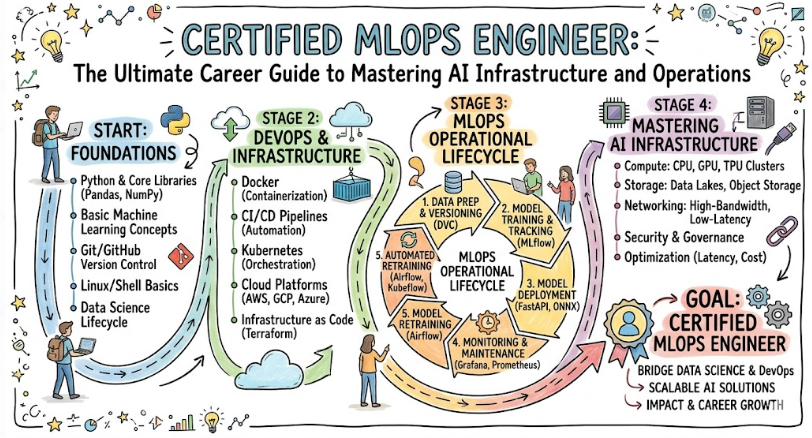
Introduction
The transition from experimental machine learning to production-grade systems is one of the most significant challenges facing modern enterprises. The Certified MLOps Engineer program is designed to bridge the gap between data science research and robust, scalable engineering operations. This guide is crafted for professionals who recognize that machine learning models are only as valuable as the infrastructure supporting them. Whether you are a DevOps professional looking to specialize or a data scientist moving toward engineering, this roadmap provides the clarity needed to navigate the evolving landscape of automated intelligence.
At AIOps School, the focus is on moving beyond theory to master the practicalities of model deployment, monitoring, and governance. In today’s competitive market, simply knowing how to train a model is insufficient; engineers must understand how to build resilient pipelines that ensure model reliability and performance in real-time environments. This guide helps technical leaders and individual contributors make informed career decisions by mapping certification milestones to actual industry requirements and organizational needs.
What is the Certified MLOps Engineer?
The Certified MLOps Engineer designation represents a specialized discipline that merges machine learning (ML) with DevOps principles to streamline the development and deployment of ML systems. Unlike general cloud certifications, this path focuses specifically on the unique challenges of machine learning, such as data drift, model versioning, and the computational demands of distributed training. It exists to standardize the skill set required to manage the entire machine learning lifecycle, from data ingestion to continuous monitoring in production environments.
In a modern enterprise, this certification signifies that a professional understands how to apply CI/CD (Continuous Integration/Continuous Deployment) and CT (Continuous Training) to machine learning workflows. It emphasizes the creation of reproducible environments and the implementation of automated testing for both code and data. This ensures that machine learning projects move away from manual, error-prone processes and toward a reliable, automated framework that aligns with the speed of business.
Who Should Pursue Certified MLOps Engineer?
This certification is ideal for software engineers, DevOps practitioners, and Site Reliability Engineers (SREs) who are tasked with operationalizing machine learning models. It is particularly beneficial for those already working in cloud-native environments who want to expand their expertise into the AI domain. Additionally, data engineers who are responsible for data pipelines and feature stores will find this certification invaluable for understanding how their work integrates into the broader deployment ecosystem.
Beyond individual contributors, technical architects and engineering managers should pursue this path to better understand the infrastructure requirements and team structures necessary for successful AI initiatives. In regions like India, where the tech sector is rapidly evolving toward high-value AI services, this certification provides a competitive edge for professionals looking to lead global projects. Beginners with a strong foundation in Linux and Python can use this as a structured entry point into one of the highest-paying niches in the technology sector.
Why Certified MLOps Engineer is Valuable and Beyond
The demand for MLOps expertise is driven by the fact that many organizations struggle to move their ML models out of the “proof of concept” stage. By becoming a Certified MLOps Engineer, you demonstrate the ability to solve the “last mile” problem of machine learning. As enterprises continue to adopt cloud-native architectures, the ability to manage complex ML workloads on platforms like Kubernetes or managed cloud services becomes a critical, high-demand skill that offers long-term career longevity.
Moreover, this certification helps professionals stay relevant in an era where automation is reshaping traditional software roles. Instead of focusing on transient tools, it teaches the fundamental principles of automation, scalability, and observability in the context of AI. The return on investment is significant, as certified professionals often command higher salaries and are eligible for leadership roles in platform engineering and AI operations teams. It transforms a generalist background into a specialized, future-proof career path.
Certified MLOps Engineer Certification Overview
The Certified MLOps Engineer program is delivered via Certified MLOps Engineer and hosted on aiopsschool.com. The program is structured to provide a comprehensive learning journey that balances theoretical knowledge with intensive, hands-on lab work. It is designed to be rigorous, ensuring that those who earn the certification possess the practical skills required to manage production-grade machine learning systems at scale.
The assessment approach moves away from simple multiple-choice questions and instead focuses on real-world scenarios and project-based evaluations. Candidates are expected to demonstrate proficiency in various domains, including pipeline automation, infrastructure as code (IaC) for ML, and the implementation of robust monitoring frameworks. This ownership-centric approach ensures that the certification remains a trusted benchmark for hiring managers and technical leaders across the global tech industry.
Certified MLOps Engineer Certification Tracks & Levels
The certification is divided into progressive levels to accommodate different stages of professional growth. The Foundation level introduces the core concepts of MLOps, focusing on the terminology and basic components of an ML pipeline. This is essential for those new to the field who need to understand how DevOps practices apply to the data science world without getting bogged down in complex architectural details.
As professionals progress to the Professional and Advanced levels, the focus shifts toward specialization and large-scale implementation. These tracks cover advanced topics such as multi-cloud ML deployments, complex feature engineering at scale, and the integration of FinOps to manage the high costs of ML training. By aligning these levels with career milestones—from junior engineer to principal architect—the program provides a clear and structured path for continuous professional development.
Complete Certified MLOps Engineer Certification Table
| Track | Level | Who it’s for | Prerequisites | Skills Covered | Recommended Order |
| Core MLOps | Foundation | Beginners, Managers | Basic IT knowledge | MLOps terms, CI/CD basics, ML lifecycle | 1st |
| Engineering | Professional | DevOps, SREs | Python, Docker, Git | Kubernetes for ML, MLflow, Pipelines | 2nd |
| Architecture | Advanced | Senior Engineers, Leads | Professional Level | Scaling ML, Security, Governance | 3rd |
| Data Strategy | Specialization | Data Engineers | SQL, Data Basics | Feature Stores, Data Versioning, DVC | Optional |
Detailed Guide for Each Certified MLOps Engineer Certification
Certified MLOps Engineer – Foundation
What it is
This certification validates a candidate’s understanding of the fundamental principles of MLOps. It confirms they can speak the language of both data scientists and operations teams effectively.
Who should take it
Aspiring MLOps engineers, project managers, and junior DevOps professionals who want to understand the machine learning workflow from an operational perspective.
Skills you’ll gain
- Understanding the difference between DevOps and MLOps.
- Knowledge of the machine learning development lifecycle.
- Familiarity with containerization basics for ML models.
- Basic understanding of model versioning and tracking.
Real-world projects you should be able to do
- Documenting a standard MLOps workflow for a small team.
- Setting up a basic version control system for a data science project.
- Containerizing a simple Python-based machine learning model.
Preparation plan
- 7–14 days: Review core MLOps terminology and the high-level workflow of ML projects.
- 30 days: Complete introductory labs on Docker and basic CI/CD tools.
- 60 days: Deep dive into the interaction between data scientists and engineers through case studies.
Common mistakes
- Overcomplicating the infrastructure for simple models.
- Ignoring the data management aspect of the lifecycle.
- Confusing standard software deployment with machine learning deployment.
Best next certification after this
- Same-track option: Certified MLOps Engineer – Professional
- Cross-track option: Certified DataOps Professional
- Leadership option: AI Strategy for Managers
Certified MLOps Engineer – Professional
What it is
This level focuses on the technical execution of MLOps pipelines. It validates the ability to build and maintain automated systems for model training, testing, and deployment.
Who should take it
Experienced DevOps engineers, SREs, and Cloud Architects who are responsible for building and maintaining ML infrastructure in production environments.
Skills you’ll gain
- Advanced orchestration using Kubernetes and Kubeflow.
- Implementing Continuous Training (CT) pipelines.
- Monitoring model performance and detecting data drift.
- Managing experiment tracking using tools like MLflow or DVC.
Real-world projects you should be able to do
- Building an automated pipeline that retrains models when performance drops.
- Implementing a centralized model registry for an engineering department.
- Configuring a monitoring dashboard that alerts on data drift and latency issues.
Preparation plan
- 7–14 days: Intensive study of Kubernetes and container orchestration for ML workloads.
- 30 days: Hands-on practice with MLflow, Kubeflow, or TFX for pipeline automation.
- 60 days: Implementing a full end-to-end MLOps pipeline using a cloud provider (AWS/GCP/Azure).
Common mistakes
- Failing to implement robust monitoring for deployed models.
- Neglecting the security aspects of the ML pipeline and data access.
- Building pipelines that are too rigid to accommodate changing model requirements.
Best next certification after this
- Same-track option: Certified MLOps Engineer – Advanced
- Cross-track option: Certified DevSecOps Professional
- Leadership option: Principal MLOps Architect
Certified MLOps Engineer – Advanced
What it is
The Advanced certification focuses on the architectural and strategic aspects of MLOps. It validates the ability to design large-scale, enterprise-grade ML platforms that support multiple teams.
Who should take it
Principal engineers, Technical Architects, and Senior MLOps leads who are designing the next generation of AI infrastructure for global organizations.
Skills you’ll gain
- Designing multi-tenant ML platforms.
- Advanced governance, compliance, and auditing for AI systems.
- Optimizing ML infrastructure costs through FinOps principles.
- Implementing high-availability and disaster recovery for ML services.
Real-world projects you should be able to do
- Architecting a global feature store that serves multiple product lines.
- Designing a compliance framework for ML models in regulated industries (Finance/Health).
- Creating a cost-optimization strategy for massive-scale distributed training jobs.
Preparation plan
- 7–14 days: Reviewing enterprise architecture patterns and large-scale system design.
- 30 days: Studying compliance standards (GDPR/HIPAA) and their application in AI.
- 60 days: Designing and documenting a complex, multi-cloud MLOps architecture.
Common mistakes
- Focusing on technology before understanding the business requirements.
- Underestimating the complexity of data governance and security at scale.
- Designing systems that are too expensive for the business value they provide.
Best next certification after this
- Same-track option: Specialized AI Infrastructure Expert
- Cross-track option: Certified FinOps Practitioner
- Leadership option: Director of AI Operations
Choose Your Learning Path
DevOps Path
The DevOps path focuses on the integration of ML workloads into existing software delivery pipelines. Professionals following this path will learn how to treat machine learning models as software artifacts, applying version control, automated testing, and deployment strategies like blue-green or canary releases. The goal is to ensure that the ML components of an application are as reliable and reproducible as the core application code. This path is essential for teams looking to break down silos between data science and traditional operations.
DevSecOps Path
The DevSecOps path emphasizes the security of the machine learning lifecycle. It covers how to protect sensitive training data, secure model endpoints against adversarial attacks, and ensure compliance with industry regulations. Professionals will learn to integrate automated security scanning into ML pipelines and manage identity and access control for complex data environments. This is a critical path for organizations handling highly sensitive information where a security breach could have devastating consequences.
SRE Path
The SRE path focuses on the reliability, scalability, and performance of machine learning systems in production. It applies Site Reliability Engineering principles, such as Error Budgets and Service Level Objectives (SLOs), to the unique challenges of AI. Engineers will learn how to manage distributed training clusters, optimize inference latency, and build self-healing systems that can recover from model failures. This path ensures that AI services remain available and performant under heavy user loads.
AIOps Path
The AIOps path deals with the application of AI and machine learning to the field of IT operations itself. It focuses on using ML to automate root cause analysis, predict system failures, and optimize resource allocation. This path is distinct from MLOps as it uses AI as a tool to improve infrastructure management rather than just deploying AI models. Professionals in this track will learn how to build and maintain the specialized models used for operational intelligence and automated remediation.
MLOps Path
The MLOps path is the core journey for those dedicated to the operationalization of machine learning models. It covers the entire spectrum from data versioning to model monitoring and retraining. This path is designed for engineers who want a deep understanding of the specific tools and workflows that make machine learning systems sustainable. It emphasizes the “Continuous Training” aspect of MLOps, which is unique to the machine learning world and sets it apart from traditional software engineering.
DataOps Path
The DataOps path focuses on the “Data” part of the machine learning equation. It deals with building robust data pipelines, ensuring data quality, and managing feature stores that serve as the foundation for ML models. Professionals will learn how to apply DevOps principles to data management, reducing the time it takes to move data from source to consumption. This path is vital because the quality of an ML model is directly dependent on the quality and reliability of the data pipelines feeding it.
FinOps Path
The FinOps path is increasingly important as the cost of training and running large machine learning models skyrockets. It focuses on cloud financial management within the context of AI infrastructure. Professionals will learn how to track ML-related costs, optimize resource utilization for GPU and TPU clusters, and ensure that AI initiatives provide a positive return on investment. This path bridges the gap between engineering, finance, and business leadership to ensure sustainable AI growth.
Role → Recommended Certified MLOps Engineer Certifications
| Role | Recommended Certifications |
| DevOps Engineer | Certified MLOps Engineer – Professional |
| SRE | Certified MLOps Engineer – Professional, SRE Foundation |
| Platform Engineer | Certified MLOps Engineer – Advanced |
| Cloud Engineer | Certified MLOps Engineer – Foundation, Professional |
| Security Engineer | Certified MLOps Engineer – Professional, DevSecOps Expert |
| Data Engineer | Certified MLOps Engineer – Foundation, DataOps Specialist |
| FinOps Practitioner | Certified MLOps Engineer – Foundation, FinOps Certified |
| Engineering Manager | Certified MLOps Engineer – Foundation |
Next Certifications to Take After Certified MLOps Engineer
Same Track Progression
Once you have mastered the Professional or Advanced levels of MLOps, the next step is to seek deep specialization in specific technology stacks or specialized AI domains. This might include becoming an expert in Generative AI Operations (GenOps) or focusing on Large Language Model (LLM) orchestration. Staying within the track allows you to move from an execution role to a thought-leadership or principal engineering role where you define the standards for your entire organization.
Cross-Track Expansion
Broadening your skills into related fields like DevSecOps or DataOps can make you a more versatile and valuable asset to your team. For instance, an MLOps engineer with deep DataOps knowledge can optimize the entire data-to-model lifecycle, while one with DevSecOps expertise can ensure that AI deployments meet the highest security standards. This cross-pollination of skills is highly sought after in modern platform engineering teams that require a holistic view of technology.
Leadership & Management Track
For those looking to transition away from hands-on engineering, moving into a leadership or management track is a natural progression. This involves taking certifications focused on AI strategy, product management, or technical leadership. Your background as a Certified MLOps Engineer provides the technical credibility needed to lead complex engineering organizations and make high-level decisions about technology investments, team structure, and long-term AI roadmaps.
Training & Certification Support Providers for Certified MLOps Engineer
DevOpsSchool
DevOpsSchool has established itself as a premier destination for technical training, offering a wide array of courses that cater to the modern engineering landscape. Their approach to the MLOps certification is rooted in a blend of comprehensive theory and rigorous practical application. With a focus on real-world scenarios, they provide students with the environment needed to experiment and master complex deployment pipelines. Their instructors are industry veterans who bring a wealth of practical experience to the classroom, ensuring that learners are not just passing an exam but are truly prepared for the challenges of a production environment. The platform also offers extensive community support and career guidance, making it a holistic choice for career growth.
Cotocus
Cotocus is recognized for its highly specialized and customized training programs that target the specific needs of modern technology teams. Their training modules for the MLOps domain are meticulously designed to cover the most relevant tools and methodologies used in the industry today. Cotocus emphasizes a hands-on learning experience, utilizing cloud-based labs and real-time project simulations to reinforce learning outcomes. This practical focus ensures that professionals can immediately apply their new skills to their current roles. By offering flexible learning paths and personalized mentorship, Cotocus helps engineers bridge the gap between their existing knowledge and the specialized requirements of the MLOps field, fostering both individual and organizational success.
Scmgalaxy
Scmgalaxy is a long-standing community and training platform that has evolved alongside the DevOps movement, making it a reliable resource for MLOps aspirants. It offers a treasure trove of tutorials, blogs, and structured courses that focus on configuration management, CI/CD, and the automation of complex systems. Their MLOps training programs leverage this deep expertise to provide a solid foundation in the operational side of machine learning. Scmgalaxy is particularly valued for its focus on open-source tools and its commitment to keeping content updated with the latest industry trends. For engineers looking for a community-driven learning experience with a strong emphasis on automation and reliability, Scmgalaxy remains a top-tier choice.
BestDevOps
BestDevOps focuses on providing high-quality, accessible training for professionals looking to transition into high-growth technical roles. Their curriculum for MLOps is designed to be streamlined and efficient, cutting through the noise to focus on the core skills that employers value most. They prioritize practical labs and case studies that mirror the actual challenges faced by MLOps teams in various industries. The platform’s goal is to create “job-ready” professionals who can contribute to their teams from day one. With a supportive learning environment and a focus on the most popular cloud platforms, BestDevOps is an excellent option for those who want a practical and straightforward path to certification.
devsecopsschool.com
DevSecOpsSchool is a specialized platform that focuses on the critical intersection of security and operations. As the machine learning lifecycle becomes more complex, the need for integrated security has never been higher, and this platform addresses that need directly. Their MLOps-related content emphasizes securing data pipelines, model endpoints, and the underlying infrastructure. By teaching engineers how to “shift security left” in the ML process, DevSecOpsSchool prepares them to handle the compliance and risk management challenges of modern AI. Their courses are essential for anyone looking to specialize in building resilient and secure machine learning systems in highly regulated industries or security-conscious organizations.
sreschool.com
SRESchool focuses on the principles of reliability and performance that are essential for any production-grade system. In the context of MLOps, this means teaching engineers how to build systems that can scale to handle massive datasets and high inference volumes without failing. Their training programs cover topics like observability, incident response, and capacity planning specifically for ML workloads. By applying the SRE mindset to machine learning, students learn how to set meaningful SLOs and manage the operational health of AI services. This platform is ideal for those who want to ensure that their machine learning models aren’t just accurate, but are also robust, available, and performant in a real-world setting.
aiopsschool.com
AIOpsSchool is the primary authority and hosting site for the MLOps certification, offering the most direct and comprehensive learning path available. As the source of the certification, their curriculum is perfectly aligned with the exam objectives and industry standards they have helped define. They provide an end-to-end learning experience that covers everything from basic terminology to advanced architectural design. The platform is dedicated to the evolution of AI operations, providing learners with cutting-edge tools, specialized labs, and a direct connection to the experts who are shaping the field. Choosing AIOpsSchool ensures that you are getting the most authoritative and up-to-date training for the MLOps certification journey.
dataopsschool.com
DataOpsSchool addresses the foundational layer of the machine learning lifecycle: the data. Without high-quality, reliable data pipelines, MLOps cannot succeed, and this platform provides the specialized training needed to master data engineering at scale. Their courses focus on the automation of data workflows, data versioning, and the management of feature stores. By teaching professionals how to apply DevOps principles to data management, DataOpsSchool ensures that the input for ML models is consistent and trustworthy. This is a vital resource for data engineers and MLOps professionals who want to eliminate the bottlenecks associated with manual data preparation and ensure a smooth flow of information through the ML pipeline.
finopsschool.com
FinOpsSchool is dedicated to the financial management of cloud and AI infrastructure, a topic of growing importance as ML costs continue to rise. Their training programs teach engineers and managers how to monitor, analyze, and optimize the costs associated with training and deploying machine learning models. In a world where a single distributed training job can cost thousands of dollars, the skills taught at FinOpsSchool are essential for maintaining a sustainable AI strategy. They provide the frameworks and tools needed to align engineering decisions with business value, ensuring that AI initiatives are not just technically successful but also financially viable in the long run.
Frequently Asked Questions (General)
- What is the difficulty level of this certification?
The difficulty ranges from moderate for the Foundation level to high for the Advanced level. It requires a strong grasp of both software engineering and machine learning concepts. - How long does it take to prepare?
Most professionals spend between 2 to 4 months of consistent study and hands-on practice, depending on their existing background in DevOps and Python. - Are there any prerequisites?
While anyone can start the Foundation level, the Professional and Advanced levels require experience with Linux, Python, and basic cloud infrastructure. - What is the ROI of becoming a Certified MLOps Engineer?
Professionals often see significant salary increases and gain access to high-demand roles in AI-driven companies, making the time and financial investment highly worthwhile. - In what order should I take the certifications?
We recommend starting with the Foundation level to build a strong conceptual base, then moving to Professional, and finally Advanced or a specialization track. - Is this certification recognized globally?
Yes, the certification is designed to meet global industry standards and is recognized by major technology firms and startups across the world, including India. - How does this differ from a Data Science certification?
While data science focuses on building models, this certification focuses on the engineering and operational aspects of deploying and maintaining those models in production. - Can a manager benefit from this program?
Absolutely. The Foundation level is particularly useful for managers who need to understand the technical requirements and team structures for AI projects. - What tools are covered in the training?
The program covers a wide range of industry-standard tools including Kubernetes, Docker, MLflow, Kubeflow, DVC, and various cloud-native ML services. - Is there a practical exam component?
Yes, the certification includes project-based assessments and labs where you must demonstrate your ability to solve real-world MLOps problems. - Do I need to be an expert in math to pass?
No, a deep mathematical background is not required. The focus is on engineering, automation, and infrastructure rather than algorithmic research. - How often should I renew my certification?
To stay current with the rapidly evolving field of AI and MLOps, we recommend a review and potential recertification or moving to a higher level every two years.
FAQs on Certified MLOps Engineer
- What specific value does this certification add to a DevOps resume?
It distinguishes you as a specialist who can handle the unique data and model management challenges that traditional DevOps certifications do not cover, making you essential for AI teams. - How does it address the issue of model drift?
The curriculum includes specific training on building automated monitoring systems that detect performance degradation and trigger automated retraining pipelines to maintain model accuracy over time. - Does the program include training on specific cloud providers?
Yes, while the principles are cloud-agnostic, the labs and projects often use major providers like AWS, Azure, or GCP to demonstrate how these concepts are implemented in the real world. - What is the role of Kubernetes in the certification?
Kubernetes is a central component, as it is the industry standard for orchestrating containerized ML workloads. You will learn to manage clusters specifically optimized for machine learning tasks. - Is GitOps covered in the MLOps curriculum?
Yes, GitOps is a core part of the “Professional” level, teaching you how to use Git as the single source of truth for both your infrastructure and your machine learning pipelines. - Can I skip the Foundation level?
If you have significant experience in both DevOps and Machine Learning, you may attempt the Professional level directly, though we recommend reviewing Foundation materials to ensure no conceptual gaps exist. - How does this help with AI governance and compliance?
The Advanced level provides specific frameworks for auditing models, tracking data lineage, and ensuring that AI systems meet regulatory requirements for transparency and fairness. - What kind of community support is available?
Certified individuals gain access to a global network of MLOps professionals, private discussion forums, and ongoing webinars that cover the latest shifts in the technology landscape.
Final Thoughts: Is Certified MLOps Engineer Worth It?
As a mentor who has watched the industry shift from manual server management to cloud-native automation, I can confidently state that the rise of MLOps is the next major frontier in engineering. The gap between training a model in a notebook and running it at scale for millions of users is vast, and few professionals have the skills to cross it. This certification is not about collecting a badge; it is about acquiring a specialized set of skills that are becoming the backbone of the modern intelligent enterprise.
If you are an engineer who enjoys the intersection of data and automation, this path is highly recommended. The investment in learning how to build resilient, automated AI systems will pay dividends for years to come. However, it requires a commitment to continuous learning, as the tools will change even if the underlying principles of reliability and automation remain the same. If you are ready to move beyond the hype and into the practical reality of AI operations, this certification is a logical and valuable next step in your career.