Introduction
The Certified MLOps Architect is a professional designation designed for engineers who want to bridge the gap between machine learning development and large-scale production operations. As organizations move beyond experimental AI, the need for a structured framework that combines DevOps principles with data science has never been greater. This guide is written for software engineers, site reliability engineers, and technical leaders who are looking to formalize their expertise in building resilient, scalable, and automated machine learning pipelines.
In the current landscape of platform engineering, the ability to operationalize models is a highly sought-after skill set that separates senior architects from generalist engineers. This guide provides a clear roadmap to understanding the certification, its requirements, and how it fits into your broader career trajectory. By the end of this article, you will have a clear understanding of whether this path aligns with your professional goals and how to navigate the ecosystem hosted by AIOps School.
What is the Certified MLOps Architect?
The Certified MLOps Architect represents a standard of excellence in the engineering community for those who manage the entire lifecycle of machine learning. Unlike traditional data science certifications that focus on model accuracy and algorithm selection, this certification focuses on the “Ops” side of the equation. It validates an engineer’s ability to design systems that handle continuous integration, continuous delivery, and continuous training of models in production environments.
This program exists to solve the “last mile” problem in AI, where models often fail to provide business value because they cannot be deployed or maintained effectively. It emphasizes real-world applications, such as managing feature stores, handling data drift, and ensuring high availability for inference services. By focusing on production-grade workflows, the certification ensures that practitioners can implement enterprise-level practices that go beyond local notebook experiments.
Who Should Pursue Certified MLOps Architect?
This certification is ideal for DevOps engineers and SREs who find themselves increasingly supporting data science teams and need to understand the unique challenges of ML infrastructure. Cloud professionals and platform engineers who want to specialize in AI-driven workloads will find this path particularly rewarding as it adds a specialized layer to their general cloud expertise. It is also highly beneficial for data engineers who want to move into more architectural roles where they oversee the entire pipeline rather than just the data movement.
For beginners in the field, this certification provides a structured learning path that bypasses the trial-and-error approach common in emerging technologies. Experienced engineers can use it to validate their years of practice and stay competitive in a rapidly evolving market. In India and across global tech hubs, engineering managers are increasingly looking for this specific credential to lead digital transformation initiatives that involve significant AI and automation components.
Why Certified MLOps Architect is Valuable and Beyond
The demand for MLOps expertise is skyrocketing as enterprises across finance, healthcare, and retail move their AI initiatives from the lab to the real world. Holding this certification demonstrates a commitment to the long-term reliability of AI systems, a concern that is becoming central to enterprise strategy. As tools and frameworks change, the core architectural principles taught in this program remain relevant, providing professionals with a foundation that is resistant to tool-specific obsolescence.
Furthermore, the return on investment for this certification is high, both in terms of salary potential and project impact. Professionals with these skills are often the highest-paid in the DevOps and Data domains because they solve the most complex scalability problems. By mastering MLOps, you ensure your relevance in a future where almost every software application will incorporate some level of machine learning, requiring an architect who understands how to keep those systems running smoothly.
Certified MLOps Architect Certification Overview
The Certified MLOps Architect program is a comprehensive educational journey delivered through a series of modules and practical assessments. The program is designed to be rigorous, ensuring that anyone who carries the title has demonstrated hands-on capability in complex environments. It covers the full spectrum of operations, from data versioning to model monitoring and governance, providing a holistic view of the machine learning ecosystem.
The assessment approach is primarily focused on performance-based testing, where candidates must solve architectural challenges rather than just answering multiple-choice questions. This ensures that the certification holds weight in the industry as a true measure of skill. Ownership of the program lies with a body of industry experts who update the curriculum regularly to reflect the latest shifts in cloud-native technologies and AI operations practices.
Certified MLOps Architect Certification Tracks & Levels
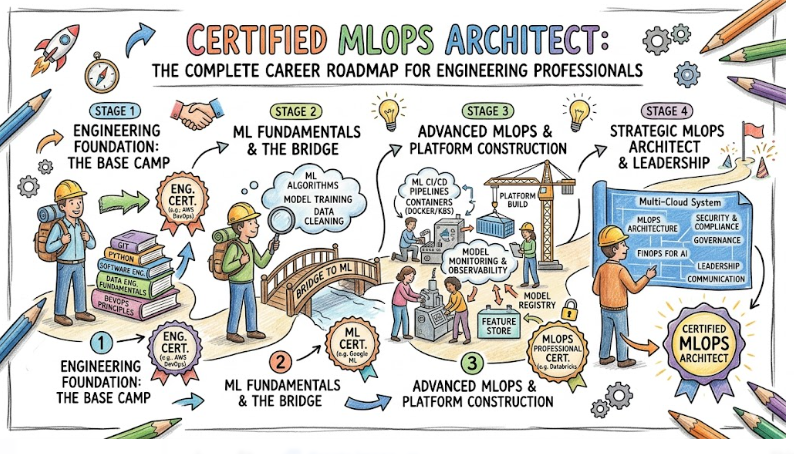
The certification is structured into three primary levels to accommodate professionals at different stages of their careers. The Foundation level introduces the core concepts of MLOps, versioning, and basic pipeline automation. It is the entry point for those new to the intersection of ML and DevOps, providing the vocabulary and basic tooling knowledge needed to work within an MLOps team.
The Professional level dives deeper into advanced CI/CD for ML, automated testing of models, and deployment strategies like canary releases and blue-green deployments for inference services. Finally, the Advanced level is designed for those aspiring to be Lead Architects, focusing on multi-cloud strategies, enterprise governance, security, and cost optimization at scale. Each level is built to align with typical career progression from a junior engineer to a principal architect.
Complete Certified MLOps Architect Certification Table
| Track | Level | Who it’s for | Prerequisites | Skills Covered | Recommended Order |
| MLOps Core | Foundation | Junior Engineers, Analysts | Basic Linux & Python | GitOps, ML Lifecycles, Docker | 1st |
| MLOps Core | Professional | DevOps/Data Engineers | Foundation Level, K8s | CI/CD Pipelines, Drift, Monitoring | 2nd |
| MLOps Core | Advanced | Senior Architects, Leads | Professional Level, Cloud | Governance, Security, Scaling | 3rd |
| Specialization | Security | DevSecOps Engineers | Professional Level | Model Privacy, Data Security | Optional |
| Specialization | FinOps | Managers, Cloud Leads | Professional Level | ML Cost Modeling, Resource Optimization | Optional |
Detailed Guide for Each Certified MLOps Architect Certification
Certified MLOps Architect – Foundation Level
What it is
This level validates the candidate’s understanding of the fundamental principles of MLOps and the transition from manual ML processes to automated workflows. It covers the basic terminology and the importance of reproducibility in machine learning experiments.
Who should take it
Software engineers or data analysts who are new to DevOps and want to understand how to apply operational principles to their machine learning work. It is also suitable for fresh graduates entering the AI space.
Skills you’ll gain
- Understanding the MLOps lifecycle and its components.
- Basic version control for data and models using tools like DVC.
- Containerization basics for ML model packaging.
- Knowledge of different ML deployment patterns.
Real-world projects you should be able to do
- Create a reproducible ML experiment with versioned data.
- Package a simple model into a Docker container for portable deployment.
- Set up a basic automated training trigger using Git events.
Preparation plan
- 7-14 Days: Focus on basic Git, Linux commands, and Python scripts.
- 30 Days: Complete the official foundation course and practice containerization.
- 60 Days: Build and document three small end-to-end reproducible ML experiments.
Common mistakes
- Ignoring data versioning and focusing only on code versioning.
- Not understanding the difference between traditional software and ML models.
- Over-complicating the initial pipeline architecture.
Best next certification after this
- Same-track option: Professional Level Certified MLOps Architect.
- Cross-track option: Certified Kubernetes Administrator.
- Leadership option: Technical Project Management Foundation.
Certified MLOps Architect – Professional Level
What it is
This level validates an engineer’s ability to build and maintain production-grade MLOps pipelines. It focuses on the automation of the entire model lifecycle, including testing, deployment, and real-time monitoring of performance.
Who should take it
DevOps engineers and Data Engineers with at least 2 years of experience who are responsible for maintaining ML platforms in production.
Skills you’ll gain
- Advanced CI/CD pipeline construction specifically for ML assets.
- Implementing automated model testing and validation.
- Monitoring for data drift and concept drift in live environments.
- Managing feature stores for consistent data access across training and serving.
Real-world projects you should be able to do
- Build a full CI/CD pipeline that retrains a model when data drift is detected.
- Implement a model serving layer on Kubernetes with auto-scaling capabilities.
- Set up a monitoring dashboard that tracks both infrastructure and model metrics.
Preparation plan
- 7-14 Days: Deep dive into Kubernetes and CI/CD tools like Jenkins or GitLab CI.
- 30 Days: Work through advanced labs on model monitoring and feature engineering.
- 60 Days: Design and implement a multi-stage pipeline with automated rollbacks.
Common mistakes
- Neglecting the monitoring of data quality in the production pipeline.
- Failing to automate the testing of model performance metrics before deployment.
- Hard-coding environment variables and paths in the pipeline scripts.
Best next certification after this
- Same-track option: Advanced/Architect Level Certified MLOps Architect.
- Cross-track option: Certified Cloud Security Professional.
- Leadership option: Engineering Manager Certification.
Certified MLOps Architect – Advanced Level
What it is
This level is the pinnacle of the certification, validating the ability to design large-scale, enterprise-wide MLOps strategies. It covers high-level topics like multi-cloud deployments, ethical AI governance, and cost-effective scaling.
Who should take it
Senior engineers, Principal Architects, and Technical Leads who need to design the MLOps roadmap for entire organizations or business units.
Skills you’ll gain
- Designing multi-tenant ML platforms for large teams.
- Implementing security and compliance frameworks for AI systems.
- Strategic cost management for large-scale GPU and TPU clusters.
- Architecting global model serving infrastructures with low latency.
Real-world projects you should be able to do
- Design a blueprint for a centralized feature store used by dozens of data science teams.
- Create a governance framework that ensures all deployed models meet regulatory compliance.
- Architect a cost-optimization strategy for high-performance ML workloads in the cloud.
Preparation plan
- 7-14 Days: Review enterprise architecture patterns and cloud governance frameworks.
- 30 Days: Study case studies of large-scale ML deployments at tech giants.
- 60 Days: Draft and defend a full-scale MLOps organizational strategy.
Common mistakes
- Focusing too much on tools and not enough on organizational culture and processes.
- Underestimating the cost of data movement and high-performance computing.
- Failing to account for long-term technical debt in the ML system architecture.
Best next certification after this
- Same-track option: Specialized Masterclasses in Generative AI Ops.
- Cross-track option: Certified Information Systems Security Professional.
- Leadership option: Chief Technology Officer (CTO) Program.
Choose Your Learning Path
DevOps Path
The DevOps path focuses on the integration of ML workloads into existing software delivery pipelines. Engineers on this path will learn how to treat models as software artifacts, ensuring they follow the same rigorous testing and deployment standards as any other code. This involves mastering toolchains that handle both source code and heavy binary assets like model weights.
DevSecOps Path
The DevSecOps path emphasizes the security aspects of the machine learning lifecycle. Professionals will learn how to secure data pipelines, protect models against adversarial attacks, and ensure that sensitive data used for training is handled according to privacy regulations. This path is crucial for industries like finance and healthcare where data integrity and privacy are paramount.
SRE Path
The SRE path is dedicated to the reliability, availability, and performance of ML systems in production. It covers the implementation of Service Level Objectives for model inference, managing technical debt in ML systems, and handling incident response for AI-driven applications. This path ensures that ML services are as stable and predictable as traditional microservices.
AIOps Path
The AIOps path focuses on using artificial intelligence to improve IT operations themselves. Engineers learn how to implement models that predict infrastructure failures, automate root cause analysis, and optimize resource allocation based on historical patterns. This is about turning the lens of ML inward to create more resilient and self-healing systems.
MLOps Path
The pure MLOps path is for those who want to be specialists in the bridge between data science and production. It focuses heavily on the unique artifacts of ML, such as datasets, features, and model versions. Practitioners on this path become experts in the specific lifecycle of machine learning, which differs significantly from standard software development cycles.
DataOps Path
The DataOps path concentrates on the data delivery pipeline that feeds the MLOps process. It focuses on data quality, data engineering automation, and the speed of data delivery from sources to the training environment. This path ensures that the “fuel” for machine learning is clean, consistent, and always available when the models need to retrain.
FinOps Path
The FinOps path is designed for those who need to manage the high costs associated with machine learning. It covers cloud resource tagging for ML jobs, selecting the most cost-effective compute instances (like preemptible VMs), and tracking the ROI of individual models. This path is vital for keeping AI projects financially sustainable as they scale up.
Role → Recommended Certified MLOps Architect Certifications
| Role | Recommended Certifications |
| DevOps Engineer | Foundation + Professional MLOps |
| SRE | Professional MLOps + SRE Specialist |
| Platform Engineer | Professional + Advanced MLOps |
| Cloud Engineer | Foundation + Cloud Specialization |
| Security Engineer | Professional + DevSecOps Specialization |
| Data Engineer | Foundation + DataOps Specialization |
| FinOps Practitioner | Foundation + FinOps Specialization |
| Engineering Manager | Foundation + Advanced (Strategy focus) |
Next Certifications to Take After Certified MLOps Architect
Same Track Progression
Once you have achieved the Advanced level, the next step is often to stay updated with specialized masterclasses in emerging fields. For instance, focusing specifically on Large Language Model Operations (LLMOps) or Edge AI Operations allows you to maintain your status as a top-tier specialist. These niche areas build directly upon the foundation of general MLOps and keep you at the cutting edge of the industry.
Cross-Track Expansion
Many architects choose to broaden their horizons by pursuing certifications in adjacent fields like Cloud Security or Big Data Engineering. Understanding the nuances of high-performance data processing or advanced network security makes you a more versatile architect. This cross-training allows you to see the “big picture” and prevents you from being siloed within just the ML operational domain.
Leadership & Management Track
For those looking to move away from hands-on coding and into strategic roles, the leadership track is the natural next step. Certifications in Technical Management, CTO programs, or even MBA-style courses for engineering leaders can help. These programs focus on team building, budget management, and aligning technical roadmaps with business objectives, preparing you for executive roles.
Training & Certification Support Providers for Certified MLOps Architect
DevOpsSchool
DevOpsSchool is a leading provider of technical training that offers comprehensive support for various operational certifications. They provide a mix of instructor-led sessions and self-paced modules that are designed to help professionals master the intricacies of modern software delivery. Their curriculum is known for being deeply practical, focusing on the tools and methodologies used by top-tier tech companies globally. Students benefit from a vast library of resources and a community of experts who provide guidance throughout the learning journey.
Cotocus
Cotocus specializes in high-end technical consultancy and training, particularly in the cloud-native and automation space. They offer tailored programs that help engineers bridge the gap between theoretical knowledge and production-ready skills. Their trainers are often active practitioners who bring real-world scenarios into the classroom, making the learning experience highly relevant to current industry challenges. Cotocus is recognized for its focus on advanced architectures and its ability to prepare candidates for complex, professional-level assessments in the DevOps and MLOps domains.
Scmgalaxy
Scmgalaxy has built a strong reputation as a community-driven platform for software configuration management and DevOps professionals. They offer extensive training materials, blogs, and tutorials that cover a wide range of operational topics. Their approach is focused on making complex technologies accessible to everyone, from beginners to seasoned experts. By providing a wealth of free and paid resources, Scmgalaxy helps individuals stay ahead of the curve in the rapidly changing world of platform engineering and automation.
BestDevOps
BestDevOps focuses on delivering high-quality, result-oriented training for individuals and corporate teams looking to excel in modern engineering practices. Their programs are designed to be intensive and immersive, ensuring that participants gain a deep understanding of the subject matter in a short period. They place a heavy emphasis on hands-on labs and project-based learning, which is essential for certifications that require practical demonstrations of skill. Their alumni often find themselves well-prepared for the rigors of technical interviews at major firms.
devsecopsschool.com
DevSecOpsSchool is a dedicated platform for engineers who want to integrate security into every stage of the software development lifecycle. They offer specialized courses that cover everything from secure coding practices to automated compliance and vulnerability management. As security becomes a central pillar of all IT operations, the training provided here is increasingly vital. Their curriculum is designed to help professionals transition into security-focused roles within the DevOps ecosystem, providing the tools needed to build “secure by design” systems.
sreschool.com
SRESchool focuses exclusively on the principles and practices of Site Reliability Engineering. Their training covers essential topics like error budgets, monitoring, incident response, and post-mortems. For engineers who want to ensure the stability and reliability of large-scale systems, this school provides the specialized knowledge required to succeed. The courses are structured around the SRE framework popularized by major tech companies, offering a clear path to becoming a reliability expert in any production environment.
aiopsschool.com
AIOpsSchool is the primary hub for professionals looking to master the intersection of artificial intelligence and IT operations. They provide the core curriculum and certification tracks for MLOps and AIOps, focusing on the unique challenges of managing machine learning in production. Their programs are designed by industry veterans who understand the specific needs of AI-driven enterprises. By offering a structured path from foundation to advanced levels, they ensure that practitioners are equipped to lead the next wave of operational transformation.
dataopsschool.com
DataOpsSchool addresses the growing need for better management of data pipelines and data quality. Their training focuses on applying DevOps principles to data engineering, ensuring that data is delivered quickly and reliably to those who need it. They cover topics like data versioning, automated testing of data pipelines, and data governance. This specialized focus is essential for organizations that rely on high-quality data to drive their analytics and machine learning initiatives, making their graduates highly valuable in the market.
finopsschool.com
FinOpsSchool is dedicated to the emerging field of cloud financial management. They provide training that helps professionals balance speed, cost, and quality in the cloud. Their courses teach engineers and managers how to take ownership of their cloud usage and optimize spending without sacrificing performance. As cloud bills become a major concern for enterprises, the skills taught at FinOpsSchool are becoming a mandatory requirement for senior technical leaders and architects who oversee large-scale cloud deployments.
Frequently Asked Questions (General)
- What is the average time required to complete the full Certified MLOps Architect path?
Most professionals take between 6 to 12 months to complete all three levels, depending on their existing experience with DevOps and Python. - Do I need to be a data scientist to pursue this certification?
No, this is an engineering certification. While you need to understand how ML models work, the focus is on the infrastructure and automation rather than the mathematics of the models. - Are there any specific coding languages I should know before starting?
Python is the primary language used in the MLOps ecosystem, so a solid understanding of Python is highly recommended. - How does this certification differ from a standard Cloud Architect certification?
While Cloud Architect certifications focus on general infrastructure, this certification dives deep into ML-specific challenges like GPU management and data versioning. - Is the certification exam proctored and what is the format?
Yes, the exams are proctored and typically consist of a mix of scenario-based questions and practical, hands-on lab challenges. - Can this certification help me get a job in India?
Yes, the demand for MLOps engineers in India is growing rapidly, especially in major tech hubs like Bangalore, Hyderabad, and Pune. - What is the validity period of the certification?
The certification is typically valid for two to three years, after which you may need to recertify to show mastery of new technologies. - Does the program cover tools like Kubeflow and MLflow?
Yes, these are industry-standard tools that are covered extensively in the Professional and Advanced levels of the certification. - Are there any prerequisites for the Foundation level?
There are no formal prerequisites, but basic knowledge of Linux and Git will make the learning process much smoother. - Is the certification recognized globally?
Yes, the curriculum is built on industry-standard practices that are applicable to organizations all over the world. - Can I take the exams online or do I need to go to a center?
The exams are designed to be taken online through a secure, proctored platform, allowing you to certify from anywhere. - How much of the course is hands-on versus theoretical?
The program is designed to be approximately 70 percent hands-on and 30 percent theoretical, focusing on practical implementation.
FAQs on Certified MLOps Architect
- Why should a DevOps engineer choose MLOps over staying in general DevOps?
MLOps is a specialized niche with higher complexity and often higher compensation. It allows you to work on the most innovative AI projects within an organization. - How does this certification address the issue of model drift?
The curriculum includes specific modules on monitoring techniques that detect when a model’s performance degrades over time due to changing data patterns. - What is the role of Kubernetes in the Certified MLOps Architect program?
Kubernetes is treated as the primary orchestration layer for deploying and scaling machine learning models in a cloud-native way. - Does the certification cover the ethical aspects of AI operations?
Yes, the Advanced level includes governance and ethics, focusing on how to build pipelines that ensure models are fair and unbiased. - How is “Continuous Training” different from “Continuous Integration” in this context?
Continuous Training is a unique MLOps concept where the pipeline automatically retrains the model when new data arrives or performance drops. - Is there a focus on specific cloud providers like AWS or Azure?
The certification is designed to be cloud-agnostic, focusing on principles and tools that can be applied to any major cloud provider. - What kind of support is available if I get stuck during my studies?
The providers mentioned, like AIOps School, offer community forums and mentor support to help students through difficult technical sections. - Can I skip the Foundation level if I already have years of DevOps experience?
While possible, it is recommended to review the Foundation materials to ensure you are familiar with the specific ML terminology and lifecycle.
Final Thoughts: Is Certified MLOps Architect Worth It?
As a mentor who has watched the engineering landscape evolve over two decades, I see MLOps as one of the most significant shifts since the advent of cloud computing. The Certified MLOps Architect is not just another badge for your profile; it is a rigorous training ground that prepares you for the reality of modern engineering. The transition from managing static code to managing dynamic, data-driven models is a difficult one, and this certification provides the structure needed to make that transition successfully.
In my experience, the engineers who thrive are those who lean into complexity rather than shying away from it. Machine learning operations is complex, but it is also where the most interesting work is happening today. If you are looking for a way to future-proof your career and move into a role that is both technically challenging and highly impactful, this is an excellent path. It requires dedication and a willingness to learn new paradigms, but the professional growth and opportunities it unlocks are well worth the effort.