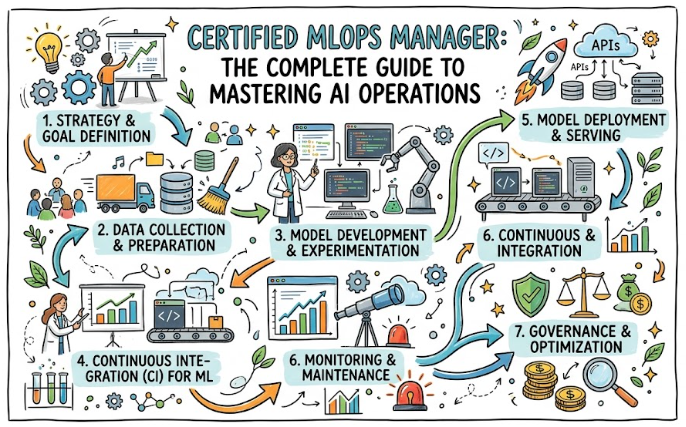
In the modern technology landscape, the role of a Certified MLOps Manager has emerged as one of the most critical positions for any data-driven organization. This guide is designed to demystify the path for professionals who want to transition from traditional software engineering or data science into the high-stakes world of machine learning operations. As companies move beyond simple prototypes, the ability to manage the lifecycle of models at scale has become the primary bottleneck for innovation.
The AIOps School has developed this certification to provide a standardized approach to these challenges, ensuring that professionals across the globe are using consistent and effective methodologies. Whether you are an SRE in Bangalore or a Cloud Architect in New York, the principles of MLOps remain the same: automation, observability, and scalability. This guide will walk you through the essential components of the certification and help you determine how it fits into your long-term career strategy.
What is the Certified MLOps Manager?
The Certified MLOps Manager is a professional designation that validates an individual’s ability to oversee the deployment and maintenance of machine learning systems. It was created to solve the friction that often exists between data science teams, who focus on model development, and IT operations teams, who focus on system uptime. This certification provides a unified framework that allows both teams to work together seamlessly within a production environment.
The curriculum is built on a foundation of real-world application, prioritizing the skills needed to solve actual production issues over theoretical academic exercises. It aligns with enterprise practices by emphasizing the use of containerization, automated testing, and infrastructure as code. For an organization, having a certified manager means they can trust that their AI initiatives are being handled with the same rigor and discipline as their most critical software services.
Who Should Pursue Certified MLOps Manager?
This program is designed for a broad range of technical professionals who are involved in the machine learning lifecycle. Software engineers who want to stay relevant in an AI-first world will find the operational focus particularly useful. Similarly, Data Engineers who are tired of seeing their pipelines break when they hit production will gain the tools needed to build more resilient systems. It is also a perfect fit for SREs and Platform Engineers who are being asked to support new types of data-intensive workloads.
Managers and technical leads will also find immense value in this certification. It provides them with the vocabulary and strategic insight needed to lead cross-functional teams and make informed decisions about tool selection and resource allocation. In the rapidly growing tech markets of India and the global scene, this certification acts as a signal of high-level competence, making it easier for professionals to stand out in a crowded job market.
Why Certified MLOps Manager is Valuable and Beyond
The value of the Certified MLOps Manager lies in its focus on the most difficult part of the AI journey: the “Ops.” While many people can train a model, very few can ensure that the model remains accurate and available under heavy production loads. This certification addresses this scarcity of talent, making those who hold it extremely valuable to employers who are serious about their AI strategy. It is a long-term investment in a field that is only going to grow in complexity.
Beyond the immediate job prospects, this certification helps professionals develop a mindset of continuous improvement and automation. These skills are transferable across different domains and tools, providing a level of career insurance in a fast-changing industry. By mastering the operationalization of AI, you are positioning yourself at the forefront of the next major wave of digital transformation, ensuring your skills remain in demand for years to come.
Certified MLOps Manager Certification Overview
The certification process is managed through the official site at Certified MLOps Manager and is supported by the AIOps School ecosystem. The program is designed to be practical and accessible, with a focus on demonstrating actual competence through a series of increasingly difficult assessments. It covers everything from the initial design of an ML pipeline to the long-term management of models in a multi-cloud environment.
One of the key strengths of this program is its modular approach, which allows professionals to focus on the areas most relevant to their current roles while still gaining a comprehensive overview of the entire field. The assessment approach is designed to be rigorous, ensuring that only those who truly understand the material can achieve the certification. This maintains the prestige of the credential and ensures it remains a trusted signal for hiring managers and technical leaders worldwide.
Certified MLOps Manager Certification Tracks & Levels
To accommodate the diverse needs of the technical community, the certification is divided into three logical levels. The Foundation level is the entry point, providing a high-level overview of the MLOps landscape and the core principles that drive it. It is perfect for those who need to understand the big picture before diving into the technical details. It sets the stage for more advanced study and ensures everyone is starting from a common baseline of knowledge.
The Professional level is where the technical “heavy lifting” happens. This track is focused on the implementation of MLOps pipelines using modern tools and cloud services. The Advanced level, on the other hand, is designed for those who will be making high-level architectural and strategic decisions. It covers topics like enterprise governance, security, and financial optimization. Together, these levels provide a clear career path from junior engineer to senior leadership within the MLOps domain.
Complete Certified MLOps Manager Certification Table
| Track | Level | Who it’s for | Prerequisites | Skills Covered | Recommended Order |
| Core Path | Foundation | Newcomers, Managers | Basic IT Knowledge | MLOps Principles, Lifecycle | 1 |
| Specialist | Professional | Engineers, SREs | Foundation Level | Automation, CI/CD for ML | 2 |
| Strategic | Advanced | Architects, Leads | Professional Level | Governance, Scale, FinOps | 3 |
| Niche | Expert | Security/Data Leads | Advanced Level | Adversarial ML, Lineage | 4 |
Detailed Guide for Each Certified MLOps Manager Certification
Certified MLOps Manager – Foundation
What it is
This level serves as an introductory credential that validates a candidate’s grasp of MLOps terminology and the basic structure of model development and deployment.
Who should take it
It is designed for project managers, junior developers, and anyone who interacts with machine learning teams but does not necessarily build the infrastructure themselves.
Skills you’ll gain
- Ability to define the key stages of the ML lifecycle.
- Understanding why MLOps is necessary for modern business.
- Knowledge of the different roles within an MLOps team.
- Awareness of the common tools used for experiment tracking.
Real-world projects you should be able to do
- Create a flowchart for a standard MLOps pipeline.
- Identify potential bottlenecks in a manual deployment process.
- Communicate the benefits of MLOps to non-technical stakeholders.
Preparation plan
- 7-14 Days: Read the core syllabus and watch introductory videos on the ML lifecycle.
- 30 Days: Participate in study groups and complete the official practice quizzes.
- 60 Days: Read industry case studies to see how MLOps is applied in real companies.
Common mistakes
- Skipping the foundational concepts to jump straight into tool-specific training.
- Underestimating the importance of clear communication between teams.
- Confusing MLOps with simple automation of model training scripts.
Best next certification after this
- Same-track option: Certified MLOps Manager – Professional.
- Cross-track option: Cloud Fundamentals Certification.
- Leadership option: Agile Scrum Master.
Certified MLOps Manager – Professional
What it is
The Professional certification validates the hands-on technical skills required to build and maintain automated machine learning pipelines in a production setting.
Who should take it
This is for the engineers who are “in the trenches”—DevOps professionals, SREs, and Data Engineers who are responsible for the daily operations of ML systems.
Skills you’ll gain
- Building automated CI/CD pipelines for ML models.
- Implementing robust monitoring and observability for ML assets.
- Managing data and model versioning at scale.
- Deploying models as scalable microservices using Kubernetes.
Real-world projects you should be able to do
- Deploy a model that automatically updates itself based on new data.
- Set up a dashboard that tracks both system health and model accuracy.
- Implement a rollback strategy for a failed model deployment.
Preparation plan
- 7-14 Days: Refresh your knowledge of Docker and Kubernetes.
- 30 Days: Work through the official labs to build a complete end-to-end pipeline.
- 60 Days: Deepen your understanding of model monitoring and data quality tools.
Common mistakes
- Focusing only on the “happy path” and ignoring failure scenarios.
- Not paying enough attention to the latency requirements of the inference service.
- Hard-coding configurations instead of using flexible environment variables.
Best next certification after this
- Same-track option: Certified MLOps Manager – Advanced.
- Cross-track option: Kubernetes Administrator (CKA).
- Leadership option: Lead Engineer Certification.
Certified MLOps Manager – Advanced
What it is
This top-tier certification is for those who design the overarching systems and policies that govern how an entire organization uses machine learning.
Who should take it
It is intended for Principal Architects, CTOs, and Senior Engineering Managers who are responsible for the success of multi-team ML initiatives.
Skills you’ll gain
- Designing highly available, multi-region MLOps architectures.
- Creating governance frameworks for model ethics and compliance.
- Managing the total cost of ownership (TCO) for AI infrastructure.
- Building a culture of collaboration between disparate technical teams.
Real-world projects you should be able to do
- Design an MLOps strategy for a company with hundreds of production models.
- Implement a centralized feature store that serves multiple product lines.
- Conduct a post-mortem for a major ML system failure and implement fixes.
Preparation plan
- 7-14 Days: Review advanced enterprise architecture and security patterns.
- 30 Days: Study the financial aspects of cloud computing and GPU management.
- 60 Days: Draft a comprehensive MLOps governance policy for a mock organization.
Common mistakes
- Trying to solve every problem with technology instead of looking at process and people.
- Overlooking the regulatory requirements of different global markets.
- Failing to align the MLOps strategy with the broader business objectives.
Best next certification after this
- Same-track option: Specialized expert modules in AI Security.
- Cross-track option: Executive Leadership Program.
- Leadership option: MBA in Technology Management.
Choose Your Learning Path
DevOps Path
The DevOps path focuses on bringing the discipline of software engineering to the world of data science. You will learn how to automate the movement of code and models through various environments, ensuring that everything is versioned and reproducible. This path is essential for those who want to eliminate manual steps and reduce the risk of human error in the deployment process.
DevSecOps Path
In the DevSecOps path, the focus is on the safety and integrity of the machine learning pipeline. You will learn how to integrate security checks into every stage of the lifecycle, from data ingestion to model serving. This path is becoming increasingly important as AI systems become targets for hackers and as regulations around data privacy become more stringent.
SRE Path
The SRE path is all about the reliability and performance of your ML models once they are in the hands of users. You will learn how to set performance targets, monitor for deviations, and build systems that can automatically recover from failures. This path is ideal for engineers who enjoy troubleshooting complex systems and optimizing for high availability.
MLOps Path
This is the core specialization that covers the intersection of all the other paths. It focuses on the unique challenges of machine learning, such as managing the dependency between code and data. You will learn how to orchestrate the entire flow, ensuring that models are trained on the right data and deployed to the right infrastructure at the right time.
DataOps Path
The DataOps path focuses on the “supply chain” of data that feeds your machine learning models. You will learn how to build robust, scalable pipelines that can handle massive amounts of information while maintaining high levels of quality and consistency. This path is critical because even the best model will fail if the data it consumes is flawed or delayed.
FinOps Path
The FinOps path addresses the financial reality of running modern AI systems. Machine learning can be incredibly expensive, and this path teaches you how to track costs, identify waste, and ensure that your infrastructure is as efficient as possible. This is a vital skill for anyone responsible for a budget in a large-scale technical organization.
Role → Recommended Certified MLOps Manager Certifications
| Role | Recommended Certifications |
| DevOps Engineer | Foundation, Professional |
| SRE | Professional, Advanced |
| Platform Engineer | Foundation, Professional |
| Cloud Engineer | Professional, Advanced |
| Security Engineer | Foundation (DevSecOps focus) |
| Data Engineer | Professional (DataOps focus) |
| FinOps Practitioner | Professional (FinOps focus) |
| Engineering Manager | Foundation, Advanced |
Next Certifications to Take After Certified MLOps Manager
Same Track Progression
After completing the main levels, you should look for niche certifications that focus on specific tools like MLflow or Kubeflow. These deep dives allow you to become an expert in the software that powers the industry’s most advanced pipelines. Staying current with these specific tools ensures that your practical skills remain sharp and relevant.
Cross-Track Expansion
Consider branching out into areas like Big Data or Cloud Security. Understanding how to manage massive data lakes or how to secure complex cloud networks will make you a much more effective MLOps professional. This broad base of knowledge allows you to see the “big picture” and design systems that are robust from every angle.
Leadership & Management Track
If your goal is to move into management, look for certifications in project management or organizational leadership. These programs will teach you how to lead teams, manage budgets, and align your technical goals with the overall strategy of your company. This transition is key for those who want to have a greater impact on their organization’s direction.
Training & Certification Support Providers for Certified MLOps Manager
DevOpsSchool
DevOpsSchool has established itself as a premier destination for those seeking to master the intricacies of modern software delivery. Their MLOps training is built on a foundation of years of experience in traditional DevOps, ensuring that students get a grounded and practical education. They offer a variety of learning formats, including live sessions and self-paced courses, to accommodate different learning styles. By focusing on the tools that are actually used in the industry today, they ensure their graduates are ready to hit the ground running. Their community of experts provides ongoing support, making them a valuable long-term partner in your career journey.
Cotocus
Cotocus is known for its high-quality technical consulting and training services, particularly in the cloud-native space. Their MLOps curriculum is designed to help organizations move from manual processes to fully automated, scalable pipelines. They emphasize the importance of architectural principles and best practices, ensuring that students are building systems that can stand the test of time. Their instructors are seasoned professionals who bring real-world experience into the classroom, providing insights that you won’t find in a textbook. For those looking for a high-level, professional training experience, Cotocus is an excellent choice.
Scmgalaxy
Scmgalaxy is a massive online community and training platform that has been at the forefront of software configuration management for over two decades. Their move into MLOps and AIOps is a natural extension of their expertise in managing complex software systems. They provide a wealth of free resources alongside structured training programs, making them accessible to a wide audience. Their focus is on the practical aspects of version control, automation, and lifecycle management. For many professionals, Scmgalaxy is the first place they go when they need to solve a specific technical problem or learn a new skill in the DevOps domain.
BestDevOps
BestDevOps is an educational hub that curates the most effective learning paths for modern operations professionals. They have identified MLOps as a key area of growth and have developed training that is specifically designed to meet the requirements of the Certified MLOps Manager program. Their approach is focused on identifying the “best” tools and practices in the industry, helping students cut through the noise and focus on what really matters. Their platform is easy to navigate and offers a clear roadmap for career progression, making it a favorite among those who are looking for a structured learning experience.
devsecopsschool.com
DevSecOpsSchool is dedicated to the idea that security must be an integral part of every stage of the software lifecycle. This philosophy is reflected in their MLOps training, which places a heavy emphasis on securing data, models, and infrastructure. They teach students how to build “secure by design” systems that can withstand the unique threats faced by machine learning applications. For professionals who want to specialize in the security aspects of MLOps, this provider offers an unparalleled level of depth and expertise. Their training ensures that your AI deployments are not just efficient, but also safe and compliant.
sreschool.com
SRESchool focuses on the principles of reliability and performance that are essential for any production system. Their MLOps courses teach students how to apply the SRE mindset to machine learning, focusing on observability, incident response, and performance optimization. They provide hands-on experience with the tools and techniques used to keep high-scale AI systems running smoothly. For engineers who are responsible for the uptime of critical business services, SRESchool provides the specialized knowledge needed to manage the unique “brittleness” of machine learning models in a production environment.
aiopsschool.com
AIOpsSchool is the primary authority for the Certified MLOps Manager credential and offers the most comprehensive training available for this role. They are focused on the future of operations, where AI is used both as a tool for management and as a core part of the application stack. Their curriculum is updated constantly to reflect the latest industry trends and technological breakthroughs. By learning directly from the source, you can be sure that you are getting the most accurate and relevant information. AIOpsSchool is the essential starting point for anyone serious about a career in the MLOps space.
dataopsschool.com
DataOpsSchool addresses the critical “data” component of the MLOps equation. They provide training that focuses on the automated management of data pipelines, ensuring that your models are always fed with high-quality, up-to-date information. Their curriculum covers data lineage, quality control, and the orchestration of complex data flows across different platforms. In a world where data is the new oil, the skills taught at DataOpsSchool are absolutely essential for any MLOps professional. They help you build the foundational systems that make successful machine learning possible at an enterprise scale.
finopsschool.com
FinOpsSchool is a specialized provider that helps professionals manage the costs associated with cloud-native infrastructure. As machine learning models become larger and more complex, the cost of running them can quickly spiral out of control. FinOpsSchool teaches you how to track, analyze, and optimize these costs, ensuring that your AI initiatives remain financially sustainable. Their training is essential for managers and architects who need to demonstrate the business value of their technical work. By mastering the art of cloud financial management, you can ensure that your MLOps strategy is as efficient as it is effective.
Frequently Asked Questions (General)
- Is MLOps just DevOps for Data Science?
While it shares many principles, MLOps includes unique challenges like model drift, data versioning, and specialized hardware requirements that aren’t present in traditional DevOps. - What are the most important tools to learn for MLOps?
Key tools include containerization platforms (Docker), orchestration (Kubernetes), model tracking (MLflow), and data versioning (DVC). - Do I need a background in statistics?
A basic understanding is helpful, but the certification focuses more on the engineering and operational aspects of the systems that run the models. - Can this certification help me move from QA to MLOps?
Yes, QA professionals are often great at identifying the edge cases and failure modes that are critical in MLOps, making this a natural transition. - Is the exam hard?
The exam is designed to be challenging and requires both theoretical knowledge and practical experience to pass successfully. - How much does the certification cost?
Costs vary by level and region, so it is best to check the official AIOps School website for the most current pricing information. - Are there renewal fees?
Most certifications require a small fee for renewal or evidence of continuous learning every few years to keep the credential active. - Can I use this certification to work in other countries?
Yes, MLOps is a global field, and this certification is recognized as a standard of professional competence by companies worldwide. - How does MLOps handle “Black Box” models?
The curriculum includes sections on model observability and explainability to help engineers understand and monitor even the most complex systems. - Is there a community for certified professionals?
Yes, AIOps School and its partners maintain active communities where you can network, share knowledge, and find job opportunities. - Does the course cover cloud-specific tools like SageMaker?
While it focuses on general principles, it often uses popular cloud tools as examples to demonstrate how these principles are applied in practice. - What if I fail the exam on the first try?
Most programs allow for at least one retake, often after a short waiting period to allow for further study and preparation.
FAQs on Certified MLOps Manager
- What is the “Manager” part of the title?
It refers to the management of the lifecycle, the infrastructure, and the team processes, not necessarily just managing people in a hierarchical sense. - How is MLOps different from AIOps?
MLOps is about managing the lifecycle of machine learning models, while AIOps is about using AI to improve general IT operations and monitoring. - Is there a focus on edge computing?
Yes, the Advanced level often covers the challenges of deploying and managing models on edge devices with limited resources. - Does the certification cover data engineering?
It covers the intersection of data engineering and MLOps, focusing on how data pipelines feed into the model training and inference stages. - How do I prove my experience for the Professional level?
While the exam tests your knowledge, having a portfolio of projects or documented work history is recommended to truly master the material. - Are the labs hosted in the cloud?
Most training providers use cloud-based lab environments, allowing you to practice in a setting that mimics a real production infrastructure. - What is the role of Kubernetes in the curriculum?
Kubernetes is a major component, as it is the industry standard for orchestrating the containers that run machine learning workloads. - How does the certification stay up to date?
The curriculum is reviewed and updated periodically by a committee of industry experts to ensure it reflects the latest tools and methodologies.
Final Thoughts: Is Certified MLOps Manager Worth It?
In the current tech ecosystem, becoming a Certified MLOps Manager is one of the smartest career moves you can make. It takes you out of the generic “engineer” category and places you into a specialized group of professionals who can solve some of the most difficult problems in modern business. Organizations are desperate for people who can turn their expensive AI research into reliable, revenue-generating products.
From an experienced mentor’s point of view, the real value of this certification is the mental framework it provides. You learn how to think about systems as a whole, rather than just focusing on individual components. This holistic approach is what defines a true technical leader. If you have the drive to learn and the patience to master these complex systems, the Certified MLOps Manager will be the key that opens the door to the next stage of your career.