Introduction
Moving to a new country is perhaps the most significant “reset button” you will ever push. It is a dream fueled by the desire for better healthcare, a safer environment for your children, or a career that actually rewards your hard work. But before you pack your bags and book a flight to Toronto, Sydney, or Auckland, there is a digital gatekeeper you must meet: The PR Points Calculator.
If you’ve spent any time on immigration forums, you’ve likely seen people obsessing over “CRS scores” or “Invitation rounds.” It can feel like a complex math exam where your entire future hangs in the balance. But here’s the good news: the points system isn’t designed to keep you out; it’s designed to find the best version of you for that country’s economy.
In this ultimate guide, we are going to demystify the PR points calculator. Whether you are a software engineer in Bangalore, a nurse in Manila, or a student in London, this guide will show you exactly how to measure your eligibility and—more importantly—how to improve it.
What Is a PR Points Calculator?
At its core, a PR Points Calculator is a digital tool designed to simulate the official government algorithms used to rank immigration applicants.
The Definition
A PR Points Calculator (such as the CRS calculator for Canada or the Points Test for Australia) evaluates your profile based on specific “human capital” factors. It assigns a numerical value to your life experiences—your age, your degrees, your job history, and your language skills.
Why Do Countries Use Points?
Gone are the days of “first-come, first-served” immigration. Countries now want to ensure that the people they invite can integrate quickly into the economy. By using a points system, governments can:
- Remove Bias: The system is objective. If you have the points, you get the invitation.
- Economic Targeting: If a country needs more doctors, they can award extra points for medical experience.
- Efficiency: It allows authorities to manage massive pools of applicants and pick only the highest-ranking individuals.
Eligibility Score vs. Invitation Score
This is a crucial distinction many beginners miss:
- Eligibility Score: The minimum points needed to even enter the “pool” (e.g., 67 points for Canada’s FSWP).
- Invitation Score (Cut-off): The actual score you need to be selected from that pool (e.g., the CRS cut-off for a specific Express Entry draw).
How PR Points Systems Work: The Building Blocks
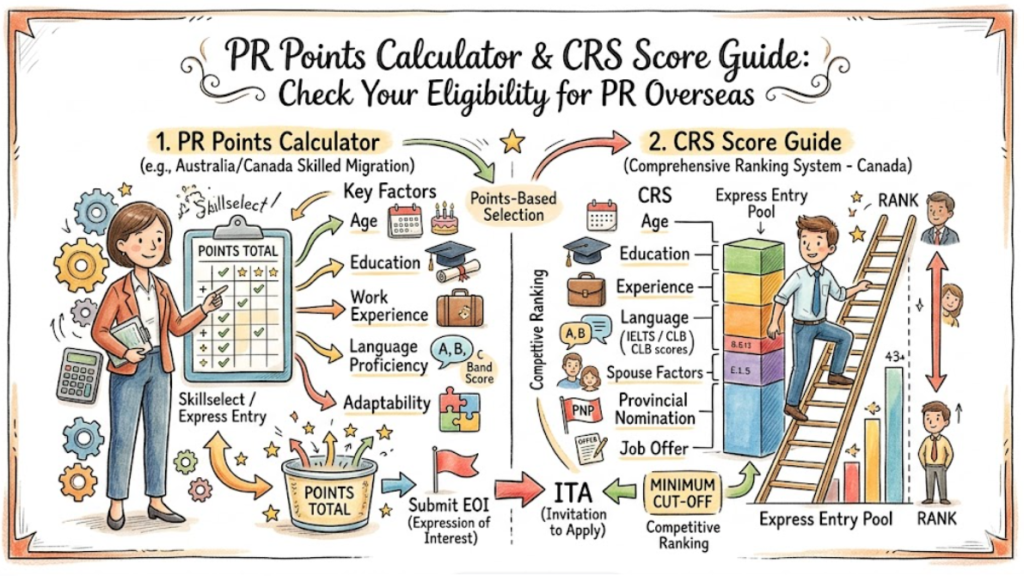
While every country has its own specific rules, almost all PR points calculators focus on the same “Big Five” factors. Let’s break them down.
A. Age Points
Most systems favor younger applicants (typically ages 25–32) because they have a longer working life ahead of them to contribute to the country’s tax base. Once you pass 35 or 40, points usually begin to decline.
B. Education
The higher your degree, the higher your score. A Master’s degree or PhD will always trump a Bachelor’s. Furthermore, “Canadian” or “Australian” education often yields bonus points.
C. Language Proficiency
This is the “Golden Factor.” Most calculators require results from standardized tests like IELTS, CELPIP, or PTE. Improving your English or French score is often the fastest way to boost your total points.
D. Work Experience
Relevant professional experience is vital. Most systems look for “Skilled” work (Managerial, Professional, or Technical trades).
E. Spouse/Partner Factors
If you are applying with a spouse, their education and language skills can either add points to your profile or, in some cases, slightly lower your individual score to balance the “family unit” profile.
Typical Points Distribution (General Overview)
| Factor | Importance | Why it matters |
| Age | Very High | Maximum points for those in their 20s. |
| Education | High | Rewards specialized knowledge and skill levels. |
| Language | Critical | Proves you can survive and thrive in the workplace. |
| Experience | High | Shows you have “real-world” value to employers. |
| Job Offer | Bonus | Often provides a massive “boost” to your score. |
Canada PR Points Calculator: The Express Entry System
Canada is arguably the most popular destination for PR seekers. Their system is called Express Entry, and it uses the Comprehensive Ranking System (CRS).
How the CRS Works
The CRS is a 1,200-point scale. However, most candidates are scored out of 600 points (the “Core” points), with an additional 600 points available for things like Provincial Nominations.
CRS Score Breakdown Table
| Category | Max Points (With Spouse) | Max Points (Without Spouse) |
| Age | 100 | 110 |
| Level of Education | 140 | 150 |
| Official Languages | 150 | 160 |
| Canadian Work Exp | 70 | 80 |
| Skills Transferability | 100 | 100 |
| Additional Points | 600 | 600 |
Improving Your Canada PR Score
If your score is below the current cut-off (which often hovers between 480 and 550 depending on the draw type), you have three main “Boosters”:
- Provincial Nominee Program (PNP): Getting a nomination from a province like Ontario or British Columbia grants you an automatic 600 points, virtually guaranteeing an invitation.
- Learn French: Even basic French can add significant points to your English-based profile.
- Sibling in Canada: Having a brother or sister who is a PR or citizen adds 15 points.
Real-World Example: “The Tech Lead”
- Candidate: Rahul, 29 years old.
- Education: Master’s Degree.
- Experience: 4 years as a Software Developer.
- IELTS: 8.0 (Listening), 7.5 (Reading), 7.5 (Writing), 7.5 (Speaking).
- Result: Rahul scores approximately 475–485. He is in a strong position for “Category-Based” draws for STEM professionals.
Australia PR Points Calculator: Skilled Migration
Australia uses a different points test for its Subclass 189 (Independent), 190 (Nominated), and 491 (Regional) visas. You generally need a minimum of 65 points to be eligible, but in reality, competitive scores are often 85+.
Australian Points Table (Simplified)
- Age (25–32): 30 points
- English (Superior – IELTS 8/PTE 79+): 20 points
- Work Experience (Outside Australia – 8+ years): 15 points
- Education (Bachelor/Master): 15 points
- Specialist Education (STEM in Australia): 10 points
- Partner Qualifications: Up to 10 points
The SkillSelect Process
Unlike Canada, Australia requires a Skills Assessment before you can even calculate your points accurately. You must prove that your foreign degree is equivalent to an Australian one through bodies like ACS (for IT) or Engineers Australia.
New Zealand PR Points Calculator
New Zealand’s Skilled Migrant Category (SMC) underwent a major overhaul recently, moving to a “6-point system.”
The New 6-Point System
You need 6 points to apply. You can claim 3 to 6 points from:
- New Zealand Professional Registration.
- Qualifications (Bachelor’s degree = 3 pts, Master’s = 5 pts, PhD = 6 pts).
- Income (Earning 1.5x to 3x the median wage).
Plus: You must have a job or a job offer in New Zealand with an accredited employer.
PR Systems in Other Countries
While Canada and Australia lead the pack, other nations are adopting points-based models to compete for global talent.
| Country | System Name | Key Focus |
| Germany | Opportunity Card (Chancenkarte) | 6 points needed; rewards German language and “potential.” |
| Japan | Highly Skilled Professional | Fast-track to PR (1–3 years) for high earners/researchers. |
| UK | Skilled Worker Visa | Must score 70 points; heavily dependent on a Job Offer and Salary. |
Step-by-Step Guide to Calculating Your PR Points
Don’t just guess your score. Follow this professional workflow to get an accurate number.
Step 1: Gather Your Documents
You can’t calculate points without data. You need your transcripts, work contracts, and birth certificates.
Step 2: Take a “Mock” Language Test
Don’t assume your English is “good.” Take a practice IELTS/PTE test. A jump from “Competent” to “Superior” can be the difference between rejection and a visa.
Step 3: Evaluate Your Education (ECA)
For Canada, you need an Educational Credential Assessment (ECA) from WES or a similar body. A 4-year degree from India or Pakistan might only be evaluated as a 3-year degree in Canada. Know this before you calculate.
Step 4: Calculate Core Human Capital
Use an online PR Points Calculator to input your age, education, and language scores.
Step 5: Add the “Boosters”
Do you have a sibling in the country? A job offer? A provincial nomination? Add these last.
Strategies to Increase Your PR Score
If your score is too low, don’t panic. Immigration is a marathon, not a sprint.
- Retake the Language Test: This is the most common and effective strategy. Moving from a CLB 8 to a CLB 9 in Canada can net you up to 30 extra points.
- Gain “The Third Year”: In many systems, moving from 2 years of experience to 3 years triggers a significant point jump.
- Spouse Improvement: If your partner improves their English or gets an ECA for their degree, it can add 5–20 points to your joint file.
- Target Regional Areas: Both Australia and Canada offer massive point bonuses for moving to less populated regions (like Saskatchewan or South Australia).
Common Mistakes to Avoid
- Overestimating Language Ability: Thinking you’ll get a perfect score without studying is a recipe for a low points total.
- Claiming “Unskilled” Work: You can only claim points for roles that fall under specific skill levels (TEER 0, 1, 2, 3 for Canada).
- Ignoring Expiry Dates: IELTS scores expire after 2 years. If your score expires while you are in the pool, your points drop to zero.
- Miscalculating Age: Points often drop on your actual birthday. If you are 29 and turning 30, calculate for 30 to be safe.
Real-Life Case Studies
Case Study 1: The “IELTS Improvement” (Canada)
- Candidate: Sarah, 31, Marketing Manager.
- Initial Score: 438 (IELTS: L8, R7, W6.5, S7).
- Problem: Below the cut-off of 470.
- Action: Sarah studied for 2 months and retook the IELTS, achieving “Straight 8s.”
- Final Score: 472.
- Result: Received an ITA (Invitation to Apply) in the next draw.
Case Study 2: The “Regional Strategy” (Australia)
- Candidate: Mark, 38, Civil Engineer.
- Initial Score: 75 (Too low for a 189 Visa).
- Problem: Age was dragging his score down.
- Action: Applied for the Subclass 491 (Regional) visa.
- Final Score: 75 + 15 (Regional Nomination) = 90.
- Result: Granted PR and moved to Adelaide.
Frequently Asked Questions (FAQs)
1. What is a “good” PR points score?
It depends on the country. For Canada’s Express Entry, 500+ is currently very strong. For Australia, 85–95 is often required for competitive occupations.
2. Can I apply for PR without a job offer?
Yes! Both Canada (Express Entry) and Australia (Subclass 189) have pathways that do not require a job offer, provided your human capital points are high enough.
3. Does my age really matter that much?
Yes. Most systems are designed to attract young taxpayers. After age 35, you lose points every year.
4. How accurate are online PR points calculators?
They are very accurate if you provide accurate data. However, they are only as good as the information you input regarding your ECA and IELTS.
5. Which country is easiest to get PR in?
There is no “easy” country, but Canada currently has the highest immigration targets globally.
6. Can I combine my points with my spouse?
In most systems, you apply as a “family unit.” Your spouse can contribute points for their education and language skills, but the “Primary Applicant” should be whoever has the higher individual score.
7. Do I need a lawyer to calculate my points?
No, you can use a PR Points Calculator for free. However, a consultant can help you find “hidden” points you might have missed.
8. What is the CRS in Canada?
The Comprehensive Ranking System. It’s the formula Canada uses to rank applicants in the Express Entry pool.
9. What happens if the points cut-off changes?
If the cut-off drops below your score, you get an invitation. If it rises, you stay in the pool until your profile expires (usually 12 months).
10. How much does it cost to get a PR?
Between English tests, ECA, and government fees, expect to spend $2,500 – $4,000 USD per adult, depending on the country.
11. Can I claim points for my kids?
Generally, no. Children are included in the application, but they do not add to your points total.
12. Does having money in the bank give me more points?
In points-based systems, usually no. You must show “Proof of Funds” to survive, but having $1 million won’t give you more points than having $20,000.
Conclusion: Start Your Journey Today
The journey of a thousand miles begins with a single calculation. A PR Points Calculator is more than just a tool; it’s a reality check and a roadmap. It tells you exactly where you are and what you need to do to get to where you want to be.
Whether you need to study harder for your English test, gain one more year of work experience, or look toward a Provincial Nomination, knowing your score is the first step toward your new life.
Don’t leave your future to chance. Use a PR points calculator, evaluate your profile honestly, and start building the life you’ve always imagined.
Call To Action
- Check Your Score: Head over to a PR Points Calculator right now and see where you stand.
- Book Your IELTS/PTE: Don’t wait. Language scores are the most controllable part of your application.
- Get Your ECA Started: Educational assessments can take months—start yours today.
- Subscribe: Follow our blog for the latest updates on CRS cut-offs and immigration news!









Leave a Reply
You must be logged in to post a comment.