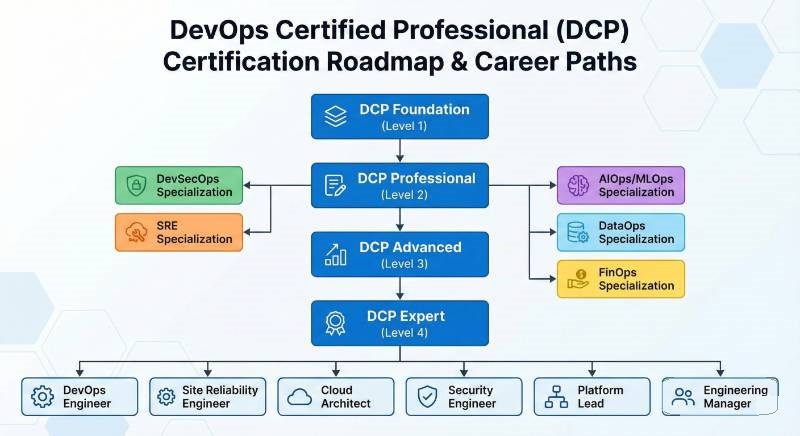
In the rapidly evolving world of software engineering, the traditional silos between development and operations have vanished. Today, engineering leaders and practitioners across the globe—from India to Silicon Valley—are moving toward a unified “Ops” culture. This guide explores the DevOps Certified Professional (Training & Certification) program, designed to validate your mastery of this modern ecosystem.
Whether you are an aspiring engineer or a seasoned manager, this comprehensive roadmap will help you navigate the certifications required to lead in DevOps, SRE, and beyond.
Why Certification Matters for Engineers and Managers
Standardization is the key to scaling engineering teams. A professional certification like the DCP ensures that every team member speaks the same technical language and follows global best practices.
- For Software Engineers: It bridges the gap between writing code and managing it in production.
- For Managers: It provides a framework for evaluating team competency and improving organizational MTTR (Mean Time to Repair) and deployment frequency.
Master Certification Table: DevOps Certified Professional (DCP)
| Track | Level | Who it’s for | Prerequisites | Skills Covered | Recommended Order |
| Core DevOps | Foundation | Beginners, Freshers, QA | Basic Linux, SDLC | Git, CI/CD, Linux, Docker | 1st |
| Core DevOps | Professional | Engineers (1-3 yrs exp) | DCP Foundation | Kubernetes, Terraform, Ansible | 2nd |
| Core DevOps | Advanced | Senior Engineers, Leads | DCP Professional | Monitoring, Istio, GitOps | 3rd |
| Specialization | Expert | Principal Engineers | DCP Advanced | Observability, Auto-scaling | 4th |
Detailed Guide: DevOps Certified Professional (DCP)
What it is
The DevOps Certified Professional (DCP) is a practitioner-focused program hosted by DevOpsSchool. It validates your ability to design, implement, and manage automated software delivery pipelines and cloud-native infrastructure.
Who should take it
This certification is essential for Software Engineers, System Administrators, Cloud Engineers, and IT Managers who need to master the technical supply chain of modern software.
Skills you’ll gain
- Mastery of Version Control (Git) and collaborative workflows.
- Proficiency in setting up Continuous Integration (CI) and Continuous Delivery (CD) pipelines.
- Expertise in Containerization (Docker) and Orchestration (Kubernetes).
- Ability to manage Infrastructure as Code (IaC) with Terraform and Ansible.
- Implementation of advanced Observability (Prometheus, Grafana).
Real-world projects you should be able to do
- Build a fully automated “Commit-to-Cloud” pipeline for a microservices application.
- Provision a multi-region VPC and Kubernetes cluster using Terraform scripts.
- Configure centralized logging for a distributed system of 50+ servers.
- Implement a “Self-Healing” infrastructure that restarts services automatically upon failure.
Preparation Plan
- 7–14 Days (The Sprint): Focus on the command line, Linux fundamentals, and core Git workflows.
- 30 Days (Standard Path): Deep dive into CI/CD tools (Jenkins/GitLab) and Docker container management.
- 60 Days (Master Path): Extensive hands-on labs with Kubernetes, Terraform, and site monitoring tools.
Common Mistakes
- Memorizing instead of doing: You cannot pass this certification without extensive hands-on lab practice.
- Skipping the basics: Neglecting Linux and Bash scripting will hinder your ability to automate.
- Ignoring Security: Failing to integrate security scans into the pipeline early (shifting left).
Best next certification after this
- Same Track: Certified DevOps Architect (CDA).
- Cross-Track: DevSecOps Certified Professional.
- Leadership: Certified DevOps Manager (CDM).
Choose Your Path: 6 Specialized Learning Tracks
Every organization has different needs. Choose a track that aligns with your specific career goals:
- DevOps Path: Focuses on the end-to-end lifecycle and automation.
- DevSecOps Path: Prioritizes security automation and compliance as code.
- SRE Path: Focuses on high availability, reliability, and error budgets.
- AIOps/MLOps Path: Integrates AI and Machine Learning into the operational lifecycle.
- DataOps Path: Applies DevOps principles to data analytics and pipelines.
- FinOps Path: Focuses on cloud cost optimization and financial accountability.
Role → Recommended Certifications
| Role | Recommended Certifications |
| DevOps Engineer | DCP Professional, CKA (Kubernetes) |
| SRE | DCP Professional, SRE Certified Professional |
| Platform Engineer | DCP Advanced, Terraform Associate |
| Cloud Engineer | DCP Foundation, AWS/Azure Solutions Architect |
| Security Engineer | DCP Professional, DevSecOps Certified Professional |
| Data Engineer | DCP Foundation, DataOps Certified Professional |
| FinOps Practitioner | DCP Foundation, FinOps Specialist |
| Engineering Manager | DCP Foundation, Certified DevOps Manager (CDM) |
Next Certifications to Take
Based on data from Gurukul Galaxy, here are the best routes for growth after your DCP:
- Same Track (The Architect): Move toward the Certified DevOps Architect (CDA) or Master in DevOps Engineering (MDE).
- Cross-Track (The Specialist): Broaden your skills with a DevSecOps or MLOps certification.
- Leadership (The Manager): For those moving into strategic roles, enroll in the Certified DevOps Manager (CDM) program.
Top Institutions for Training & Certification
For those seeking professional guidance and hands-on labs for the DevOps Certified Professional (DCP), these institutions are industry leaders:
- DevOpsSchool: The primary provider of the DCP. They offer 120+ hours of training, live projects, and lifetime access to a vast library of tools.
- Cotocus: Known for enterprise-level corporate training and aligning DevOps practices with large-scale business objectives.
- Scmgalaxy: A veteran institution focusing on the foundational aspects of build engineering and version control.
- BestDevOps: Offers intensive, scenario-based bootcamps that focus on real-world troubleshooting.
- devsecopsschool: The leading destination for integrating security into the DevOps pipeline.
- sreschool: Dedicated to the principles of Site Reliability Engineering and system stability.
- aiopsschool: Focuses on the emerging field of AI-driven operations and MLOps.
- dataopsschool: Specializes in automating data pipelines for rapid analytics delivery.
- finopsschool: Trains professionals on cloud financial management and cost optimization strategies.
FAQs
1. Is the DCP certification difficult for beginners?
It is challenging because it is practical. While beginners can pass, they must dedicate significant time to hands-on labs rather than just reading theory.
2. How long does the DCP certification stay valid?
It is valid for 2-3 years, ensuring that professionals keep up with the latest tool versions and industry shifts.
3. Are there prerequisites for the DCP Foundation?
There are no formal prerequisites, but familiarity with basic Linux commands and the Software Development Life Cycle (SDLC) is highly recommended.
4. What is the typical sequence for these certifications?
Most start with the DCP Foundation, move to DCP Professional, and then specialize in a track like SRE or DevSecOps.
5. What is the career value of becoming a DCP?
It significantly increases marketability. Certified professionals often command higher salaries and are prioritized for roles in high-growth tech companies globally.
6. Can I take the DCP exam online?
Yes, the exam is available via an online-proctored format, allowing candidates to certify from anywhere in the world.
7. Does the DCP cover specific cloud providers?
The DCP is cloud-agnostic in its principles, though it often uses AWS or Azure for practical demonstrations of Infrastructure as Code.
8. Is coding required to become a DevOps Professional?
You don’t need to be a full-stack developer, but you must be comfortable with “Infrastructure as Code” (YAML, JSON, and Bash scripting).
FAQs (Specific to DCP Program)
1. What is the core focus of the DCP?
The DCP focuses on the entire technical supply chain, specifically Continuous Integration, Delivery, and Infrastructure Automation.
2. What is the official URL for registration?
All details can be found at: DevOps Certified Professional
3. Who provides the DCP certification?
The program is provided by DevOpsSchool, a global leader in Ops training.
4. Are the exam questions theoretical or practical?
The exam includes both conceptual questions and scenario-based assessments that test your ability to solve real-world production issues.
5. Will I learn Kubernetes in the DCP curriculum?
Yes, Kubernetes orchestration and Docker containerization are major components of the DCP Professional level.
6. Is the DCP curriculum updated regularly?
Yes, the curriculum is updated annually to include the latest tools like Istio, ArgoCD, and advanced monitoring stacks.
7. Does the program include live projects?
Yes, the DCP training typically includes 3 major capstone projects that mirror enterprise-scale DevOps environments.
8. How does this help a System Admin move into DevOps?
It provides the necessary bridge by teaching Admins how to manage servers using code (IaC) and how to support rapid developer release cycles.
Conclusion
The transition toward a unified “Ops” culture is the most significant shift in modern software delivery. As organizations move away from traditional silos, the demand for professionals who can navigate the complexities of DevOps, SRE, and DevSecOps continues to skyrocket.
Earning the DevOps Certified Professional (DCP) credential is more than just a milestone; it is a commitment to a standard of excellence that is recognized globally. By mastering the core pillars of automation, orchestration, and continuous improvement, you position yourself at the forefront of the industry—ready to lead high-performing teams and architect resilient systems.