Introduction
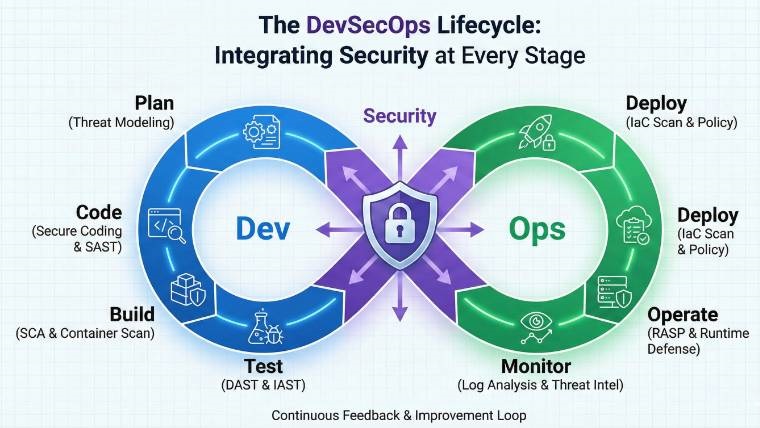
In the current landscape of software engineering, speed is no longer the only metric that matters. We mastered speed with DevOps. But rapid delivery without robust security is just a faster way to deploy vulnerabilities.
Over the years, I’ve watched teams struggle when security is treated as a final gate before production. It creates bottlenecks, frustrates developers, and ultimately fails to protect the organization. The industry solution is clear: DevSecOps.
Shifting security “left”—integrating it early into the development and operations lifecycle—is no longer optional; it is critical. For working engineers, managers, and software developers globally, mastering these skills is the single most effective way to future-proof your career.
This guide focuses on the practical steps to gaining that mastery, specifically through the DevSecOps Certified Professional Online Training (DSOCP). As someone who has mentored countless engineers through career transitions, I will walk you through exactly what this certification entails, how to prepare for it, and how it fits into the broader “Ops” ecosystem.
Why DevSecOps Certification Matters Now
Organizations are desperately looking for professionals who understand the intersection of code, infrastructure, and security. A certification is more than just a badge; it is validation that you possess the hands-on skills to secure modern CI/CD pipelines, containerized environments, and cloud infrastructure.
It signals to employers that you move beyond theory and can implement practical security controls that don’t slow down engineering velocity.
Master Certification Overview
While there are many paths in the modern IT landscape, the DevSecOps Certified Professional is a foundational pillar for securing software delivery. Below is a snapshot of this key certification track.
| Certification Name | Track | Level | Who it’s for | Prerequisites | Skills covered | Recommended order |
| DevSecOps Certified Professional (DSOCP) | DevSecOps / Security | Intermediate to Advanced | DevOps Engineers, Security Professionals, Developers, QA | Basic understanding of Linux, DevOps principles, and CI/CD concepts. | CI/CD Security, Container Security (Docker/K8s), IaC Scanning, SAST/DAST, Compliance as Code. | The foundational step for a DevSecOps career. |
DevSecOps Certified Professional (DSOCP) Online Training
This section breaks down the core certification that drives this guide. This training is designed to bridge the gap between traditional security practices and modern, agile software development.
What it is
The DSOCP is a comprehensive training program designed to teach you how to integrate security practices seamlessly into the DevOps pipeline. It moves beyond theory, focusing on the tools, automation, and cultural shifts necessary to build secure software quickly.
Who should take it
This is ideal for professionals already working near the SDLC who need to incorporate security.
- DevOps Engineers wanting to specialize in security.
- Software Engineers who want to write secure code and understand pipeline security.
- Security Analysts needing to understand modern automation and cloud-native tools.
- Technical Managers who need to lead DevSecOps transformations.
Skills you’ll gain
You will move from understanding concepts to implementing tools.
- Embedding Static Application Security Testing (SAST) into Git workflows.
- Implementing Dynamic Application Security Testing (DAST) in staging environments.
- Software Composition Analysis (SCA) to manage open-source vulnerabilities.
- Securing Containers (Docker) and Orchestration (Kubernetes).
- Infrastructure as Code (IaC) security scanning (e.g., Terraform, Ansible).
- Managing secrets effectively in CI/CD (e.g., HashiCorp Vault).
- Automating compliance checks.
Real-world projects you should be able to do after it
A certification is useless if you cannot build things. Upon completion, you should be able to:
- Build a Secure CI/CD Pipeline: Create a Jenkins or GitLab pipeline that automatically scans code on commit, checks docker images for vulnerabilities, and blocks deployment if critical issues are found.
- Hardening a Kubernetes Cluster: Implement security policies, secure pod configurations, and set up runtime security monitoring for a K8s environment.
- Automate Cloud Security Compliance: Write scripts that automatically check AWS or Azure environments against CIS benchmarks using tools like InSpec or Cloud Custodian.
Preparation plan
Option 1: The Intensive Sprint (7–14 Days)
- Ideal for: Experienced DevOps engineers between jobs or on leave.
- Strategy: Dedicate 6–8 hours a day. Spend days 1–5 consuming all video lectures and theory. Spend days 6–14 exclusively on hands-on labs, repeating them until you don’t need the guides.
Option 2: The Standard Path (30 Days)
- Ideal for: Working professionals with some related experience.
- Strategy: Dedicate 1–2 hours daily. Week 1: Core concepts and SAST/DAST tools. Week 2: Container and Kubernetes security. Week 3: IaC security and Secrets management. Week 4: Capstone projects and practice exams.
Option 3: The Steady Pace (60 Days)
- Ideal for: Beginners to DevOps or those with very demanding day jobs.
- Strategy: Focus on one module per week. Ensure you thoroughly understand the prerequisites (like basic Linux or Docker commands) before moving to the security aspect of that module. Spend significant time troubleshooting labs on your own.
Common mistakes
I see candidates fail when they:
- Focus only on tools, not culture: Knowing Jenkins is good; knowing how to convince developers to fix the bugs Jenkins finds is better.
- Skip the labs: You cannot pass a practical-focused certification just by watching videos. You must break things and fix them.
- Ignore prerequisites: Trying to learn Kubernetes security without knowing basic Kubernetes architecture is a recipe for frustration.
Best next certification after this
Once you have secured the pipeline, look toward specializing further or broadening your scope.
- Same Track (Deepen Security): Certified Kubernetes Security Specialist (CKS) or a Cloud-Specific Security Specialty (AWS/Azure Security).
- Cross-Track (Broaden Skills): Site Reliability Engineering (SRE) certification to understand post-deployment stability and incident response.
- Leadership: If moving into management, look for certifications focused on leading organizational change or Agile leadership.
Choose Your Path: The “DevOps” Ecosystem
DevSecOps does not exist in a vacuum. It is part of a larger family of modern engineering practices. Depending on your career goals, you might diverge into other areas.
- DevOps: The foundation. Focuses on culture, automation, CI/CD, and bridging development and operations teams.
- DevSecOps: The integration of security into DevOps. The focus of this guide.
- SRE (Site Reliability Engineering): Focuses on system reliability, scalability, and availability using software engineering approaches to operations problems.
- AIOps / MLOps: AIOps uses AI to improve IT operations. MLOps focuses on the lifecycle management of machine learning models in production.
- DataOps: Focuses on improving the speed and quality of data analytics by applying Agile and DevOps principles to data pipelines.
- FinOps: The practice of bringing financial accountability to the variable spend model of the cloud, enabling distributed teams to make business trade-offs between speed, cost, and quality.
Role → Recommended Certifications Mapping
If you are currently in a role and wondering where to go next, here is a recommended mapping based on industry demand.
| Current Role | Primary Focus | Recommended Certification Path |
| Software Engineer | Writing better, more deployable code. | DevOps Foundation → DevSecOps Certified Professional |
| DevOps Engineer | Integrating security into existing pipelines. | DevSecOps Certified Professional → CKA/CKS (Kubernetes) |
| Security Engineer | Adapting to modern, agile environments. | DevOps Foundation → DevSecOps Certified Professional → Cloud Security Specialty |
| SRE | Ensuring systems are reliable and secure. | SRE Foundation → DevSecOps Certified Professional |
| Platform Engineer | Building secure internal developer platforms. | DevSecOps Certified Professional → CKA (Kubernetes Administrator) |
| Cloud Engineer | Securing cloud infrastructure specifically. | Cloud Solutions Architect → DevSecOps Certified Professional |
| Data Engineer | Securing data pipelines. | DataOps certifications → DevSecOps Certified Professional (for pipeline security concepts) |
| FinOps Practitioner | Understanding the cost of security tools. | FinOps Certified Practitioner → Cloud Fundamentals |
| Engineering Manager | Leading modern engineering teams. | DevOps Leader/Strategist → DevSecOps Certified Professional (for awareness) |
Top Institutions for DevSecOps Training
When seeking training for the DevSecOps Certified Professional (DSOCP) and related fields, it is crucial to choose providers with deep domain expertise. Here are the top institutions that specialize in this type of training cum certification.
- DevOpsSchool: A premier institution offering comprehensive, hands-on training in DevOps and DevSecOps. They are the primary provider for the DSOCP certification outlined in this guide, known for practical, job-oriented curriculums.
- Cotocus: Focuses on corporate training and upskilling teams in cutting-edge technologies, including cloud-native security and automation frameworks.
- Scmgalaxy: One of the oldest communities and training providers dedicated to SCM, DevOps, and related methodologies, offering strong foundational knowledge.
- BestDevOps: A resource center and training provider aiming to highlight best practices and top-tier training modules across the Ops spectrum.
- devsecopsschool: A specialized branch focusing exclusively on the intersection of development, security, and operations, providing deep-dive security courses.
- sreschool: dedicated to Site Reliability Engineering disciplines, teaching the principles of building scalable and highly reliable software systems.
- aiopsschool & dataopsschool: Emerging institutions focusing on the niche but rapidly growing fields of AI-driven operations and data pipeline management.
- finopsschool: Focuses on the crucial aspect of cloud financial management, teaching teams how to optimize spend in dynamic environments.
General Certification FAQs (Must Read)
1. Are online certifications actually valued by employers? Yes, absolutely. In the practical world of DevOps and DevSecOps, employers value demonstrated hands-on skills. A reputable certification from a known provider that includes lab work validates that you can actually do the job, not just talk about it.
2. How difficult are these certifications? They are designed to be challenging. If they were easy, they wouldn’t have value. They require a mix of theoretical understanding and, crucially, practical implementation skills.
3. Do I need to be a strong coder to take DevSecOps training? You don’t need to be a full-stack application developer, but you must be comfortable reading code (Python, Bash, YAML) and writing scripts for automation. You need to understand how code is built and deployed.
4. How much time should I budget for study? For a working professional, budget anywhere from 40 to 80 hours of total study and lab time, depending on your existing experience level with Linux and basic DevOps concepts.
5. What is the best way to study? Active learning. Do not just watch videos. Follow along with labs, then delete everything and try to build it again from memory. Break things intentionally to learn how to debug them.
6. Will this certification immediately get me a raise? No certification guarantees an immediate raise. However, it qualifies you for higher-paying roles and makes you more valuable to your current organization, providing strong leverage during salary reviews or job hunts.
7. Is there a specific order I must take certifications in? While not strictly enforced, it is highly recommended to understand DevOps fundamentals before attempting DevSecOps. You need to know what a pipeline is before you can secure it.
8. What if I fail the exam? Failure is part of the learning process. Review your weak areas, focus heavily on the labs related to those topics, and try again. Most providers offer retake options.
9. Are these certifications vendor-neutral or specific (like AWS/Azure)? The DSOCP is generally vendor-neutral, focusing on concepts and open-source tools that apply across any cloud (like Jenkins, Docker, Kubernetes). However, the concepts are applicable to cloud-specific tools as well.
10. How long are the certifications valid for? This varies by provider, but given how fast technology changes, most certifications in this space are considered current for 2–3 years before renewal or upskilling is recommended.
11. What is the difference between SRE and DevSecOps? DevSecOps is about building security into the software delivery lifecycle. SRE is about ensuring the reliability and availability of running systems. There is overlap, but their primary goals differ.
12. Can a fresher take this course? While possible, it is challenging. Freshers should first ensure they have strong fundamentals in Linux, basic networking, and at least one scripting language before diving into DevSecOps.
FAQs: DevSecOps Certified Professional Online Training (DSOCP)
1. Does the DSOCP training include hands-on labs? Yes. The training is designed to be highly practical. You will spend a significant portion of your time working in lab environments, implementing the tools and concepts discussed in the theory modules.
2. Is the training self-paced or instructor-led? Online training often offers both formats. Check the specific offering on DevOpsSchool to see if you are signing up for a live cohort or self-paced video access. Both require discipline.
3. What are the exact prerequisites for DSOCP? You should have a working knowledge of Linux command line, understand the basic concepts of Git (version control), and have a conceptual understanding of what CI/CD is.
4. Does this cover Cloud Security (AWS/Azure/GCP)? It covers the principles of cloud security and uses tools that run in the cloud. While it may use AWS or Azure for lab infrastructure, the focus is on DevSecOps processes that apply anywhere, not just the specifics of one cloud provider’s security dashboard.
5. Will I learn about Kubernetes security in this course? Yes. Given the dominance of containers, securing Docker and Kubernetes is a standard and critical part of the DSOCP curriculum.
6. Is the certification exam theoretical or practical? Modern effective certifications lean heavily on practical scenarios. Expect questions that test your ability to apply knowledge to real-world situations, rather than just memorizing definitions.
7. How does this certification compare to others like CKS (Certified Kubernetes Security Specialist)? CKS is extremely deep and focused specifically on Kubernetes. DSOCP is broader, covering the entire software delivery pipeline (source code, CI server, artifact repository, and runtime environment). They complement each other well.
8. Where can I register for this training? You can register directly through the provider website here: DevSecOps Certified Professional Online Training
Conclusion
The transition from DevOps to DevSecOps is not a trend; it is the industry standard for mature software engineering organizations. Security can no longer be an afterthought.
For working engineers and managers, investing time in the DevSecOps Certified Professional Online Training is a strategic career move. It equips you with the necessary skills to integrate security at the speed of agile development, making you an indispensable asset to any technical team.