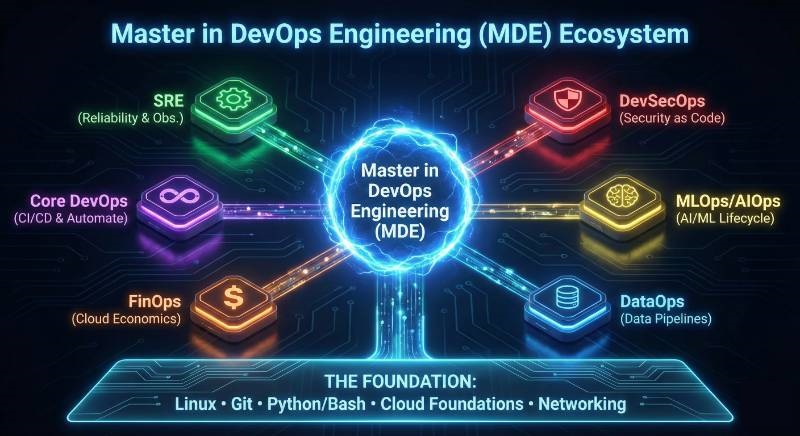
The tech industry does not wait for anyone. Consequently, if you are a software engineer or an engineering manager today, you know that the pressure to deliver high-quality software at lightning speed is higher than ever. It is no longer enough to just “write code” or “manage servers.” Instead, the market demands a unified approach. This is where the concept of “Mastery” comes into play. While many professionals possess basic automation skills, very few can claim the title of a Master in DevOps Engineering (MDE).
This guide serves as a comprehensive roadmap for those ready to move from being tool-users to becoming solution architects. Whether you are based in India or working for a global enterprise, understanding the Master in DevOps Engineering (MDE) ecosystem is the first step toward a recession-proof career.
The Modern Engineering Ecosystem
To understand the value of the Master in DevOps Engineering (MDE) program, we must look at the broader landscape of modern engineering specializations. In the past, teams were siloed. Developers wrote code, and operations teams “hoped” it would run. However, the modern ecosystem has evolved into several specialized “Ops” disciplines.
Mastery today means understanding how DevOps (the culture and automation) interacts with SRE (reliability), DevSecOps (security), AIOps (intelligence), DataOps (data flow), and FinOps (cloud economics). The MDE certification is designed to be the “trunk” of this professional tree, allowing you to branch out into any of these high-paying specializations.
Comprehensive Certification Table: Your Professional Roadmap
Before we dive deep into the MDE program, it is helpful to see how it fits into the overall certification landscape for software engineers.
| Track | Level | Who it’s for | Prerequisites | Skills Covered | Recommended Order |
| DevOps Foundations | Beginner | Freshers, Junior Devs | Basic Linux knowledge | Linux, Git, SDLC, CI/CD basics | 1 |
| AWS Certified Developer | Associate | Software Engineers | Cloud basics | AWS Services, Deployment, Debugging | 2 |
| Certified Kubernetes Admin (CKA) | Professional | DevOps & SREs | Strong Linux skills | K8s Architecture, Networking, Storage | 3 |
| Master in DevOps Engineering (MDE) | Expert | Senior Engineers, Architects | Hands-on DevOps experience | End-to-End Architecture, SRE, DevSecOps, FinOps | Pinnacle |
| PMP / DevOps Manager | Leadership | Aspiring Managers | 3+ years experience | Project management, Agile, ROI, Metrics | 4 |
Deep Dive: Master in DevOps Engineering (MDE) (Training & Certification)
The MDE is more than just a course; it is a validation of your ability to lead complex engineering transformations.
What it is
The Master in DevOps Engineering (MDE) is an elite-level training and certification program. It focuses on integrating the entire software delivery lifecycle (SDLC) with advanced automation, security, and reliability principles. It bridges the gap between simple tool-level knowledge and high-level architectural design.
Who should take it
This program is tailor-made for working Software Engineers, Site Reliability Engineers (SREs), and Engineering Managers. If you are responsible for the uptime, security, or deployment frequency of an application, this certification provides the theoretical and practical depth you need.
Skills you’ll gain
- Designing multi-stage, secure CI/CD pipelines.
- Mastering Infrastructure as Code (IaC) with Terraform and Ansible.
- Implementing advanced Kubernetes patterns for scaling and self-healing.
- Building observability frameworks using Prometheus, Grafana, and ELK.
- Integrating “Shift-Left” security tools directly into the pipeline.
- Managing cloud costs and resource optimization through FinOps.
Real-world projects you should be able to do after it
- Zero-Downtime Deployment: Architect a Blue-Green or Canary deployment strategy for a microservices app.
- Security Automation: Build a pipeline that automatically scans for vulnerabilities and secrets before every merge.
- Infrastructure Scaling: Write Terraform scripts to deploy a multi-region, highly available cloud environment from scratch.
- Observability Dashboard: Set up a central monitoring system that alerts the team based on Service Level Objectives (SLOs).
Preparation Plan
- 7-14 Days (The Fast Track): Focus on refreshing your Linux and Git basics. Review the MDE curriculum to identify your weakest areas (e.g., if you know Jenkins but not Kubernetes) and spend 4 hours daily on those gaps.
- 30 Days (The Standard Path): Spend the first two weeks mastering CI/CD and Containers. Use the third week for IaC and Security. Dedicate the final week to mock exams and real-world project labs.
- 60 Days (The Career Shifter Path): Dedicate Month 1 to foundations: Linux, Python, and basic Cloud services. In Month 2, focus on the advanced MDE modules, completing at least three end-to-end projects before sitting for the exam.
Common mistakes
- Tool Obsession: Learning “how” to click a button in a tool without knowing the “why” of the underlying process.
- Skipping Linux: Many engineers struggle with MDE because they don’t have a strong command-line foundation.
- Ignoring Culture: DevOps is about people. If you focus only on the YAML files and ignore communication, your projects will fail.
Best next certification after this
After MDE, you have three powerful directions to choose from:
- Same Track: Certified DevOps Architect (for deep technical leadership).
- Cross-Track: Certified DevSecOps Professional (to become a security-first engineer).
- Leadership: Certified DevOps Manager (to move into strategic management).
Choose Your Path: 6 Specialized Learning Tracks
The MDE program prepares you for various specialized roles. Depending on your passion, you can choose one of these six directions.
1. The DevOps Path
This is the most popular track. It focuses on the speed and frequency of releases. You will spend your time building “the pipes” that carry code from a developer’s laptop to the production environment.
2. The DevSecOps Path
Security is no longer a separate phase at the end of a project. In this track, you learn how to make security a part of the code itself. You will automate vulnerability checks and compliance rules so that every release is “secure by default.”
3. The SRE Path
Site Reliability Engineering is about making systems stable. You will focus on monitoring, incident response, and performance. This path is perfect for those who love troubleshooting and ensuring that systems never go down.
4. The AIOps / MLOps Path
This is the future of operations. You will learn how to use Artificial Intelligence to manage IT systems. Additionally, you will build pipelines specifically for Machine Learning models, ensuring they are deployed as reliably as standard software.
5. The DataOps Path
Data is the lifeblood of modern apps. This track applies DevOps principles to data pipelines. You will ensure that data flows smoothly from databases to analytics dashboards without breaking along the way.
6. The FinOps Path
Cloud bills can be terrifying for a business. This path teaches you how to bridge the gap between finance and engineering. You will learn how to build high-performance systems that are also cost-efficient.
Role → Recommended Certifications Mapping
| If your current role is… | Your next recommended certification is… |
| DevOps Engineer | Master in DevOps Engineering (MDE) |
| SRE / Reliability Engineer | SRE Foundation → MDE |
| Platform Engineer | Certified Kubernetes Administrator (CKA) → MDE |
| Cloud Engineer | Professional Cloud Architect → MDE |
| Security Engineer | DevSecOps Professional → MDE |
| Data Engineer | DataOps Fundamentals → MDE |
| FinOps Practitioner | FinOps Certified Practitioner → MDE |
| Engineering Manager | Certified DevOps Manager → MDE (for technical oversight) |
Top Institutions for MDE Training & Certification
Choosing the right training partner is vital for your success. Here are the top institutions that provide high-quality training for the Master in DevOps Engineering (MDE).
DevOpsSchool
As the primary provider of the MDE program, DevOpsSchool offers the most comprehensive curriculum in the industry. They focus heavily on hands-on labs and real-world scenarios. Their trainers are industry veterans who teach you how to solve actual problems, not just pass a test.
Cotocus
Cotocus is known for its deep-dive technical workshops. They follow a “Learning by Doing” philosophy, which means you will spend more time in a terminal than in a slide deck. This is an excellent choice for engineers who want to build hard technical skills.
Scmgalaxy
This institution has a long history of teaching Source Code Management and Build Engineering. They are particularly strong in the “CI” (Continuous Integration) part of DevOps. If you want to master Git, Jenkins, and artifact management, Scmgalaxy is a top contender.
BestDevOps
BestDevOps focuses on making complex topics simple. They break down hard subjects like Kubernetes and Terraform into easy-to-understand modules. This platform is perfect for working professionals who need a structured, clear learning path.
DevSecOpsSchool
If your goal is to specialize in security, DevSecOpsSchool is the place to go. They offer specialized modules that integrate perfectly with the MDE certification, focusing on “Security as Code.”
SREschool
This institution is dedicated to the pillars of reliability. They teach you everything from setting up observability stacks to conducting blameless post-mortems. It is the ideal companion for the SRE track of the MDE.
AIOpsSchool
To stay ahead of the AI curve, AIOpsSchool provides the latest training on automated operations. They teach you how to use data science to predict system failures before they happen.
DataOpsSchool
DataOpsSchool bridges the gap between data science and operations. They provide the tools and frameworks needed to automate complex data workflows at scale.
FinOpsSchool
This is the go-to resource for cloud cost management. They provide the practical training needed to implement cost-saving strategies across AWS, Azure, and Google Cloud.
Frequently Asked Questions (FAQs)
General FAQs for Software Engineers & Managers
1. Is the MDE exam difficult?
It is challenging because it tests practical ability, not just memory. However, if you complete the recommended labs and projects, you will find it very fair.
2. How much time is required to prepare?
For most working professionals, 30 to 60 days of steady study is the “sweet spot.”
3. Are there any prerequisites for the MDE?
While anyone can enroll, it is best if you have a basic understanding of Linux and at least one programming or scripting language.
4. In what sequence should I take these certifications?
Start with foundations (Linux/Git), then move to a specific cloud provider (AWS/Azure), then master Kubernetes (CKA), and finally take the MDE to tie everything together.
5. What is the career value of a Master certification?
Certified professionals often see a significant increase in salary and are much more likely to be recruited for senior architecture and leadership roles.
6. Can I take these exams online?
Yes. The certification process is fully digital and can be completed remotely from anywhere in the world.
7. Do these certifications expire?
Yes, most technical certifications last for 2-3 years. This ensures that you stay up-to-date with the latest technology changes.
8. Will this help me move from Development to DevOps?
Absolutely. It provides the “operations” knowledge that developers often lack, making you a true “Full-Stack” DevOps professional.
9. Is this suitable for Engineering Managers?
Yes. Managers need to understand the technical roadmap to lead their teams effectively and make informed budget and tool decisions.
10. How is MDE different from a standard “DevOps Engineer” cert?
Standard certs focus on one tool. MDE focuses on the entire ecosystem and how different domains like SRE and Security work together.
11. Does the MDE cover multiple cloud providers?
Yes. The principles taught are cloud-agnostic, meaning they apply to AWS, Azure, and Google Cloud.
12. Is there a practical project required for the certification?
Yes. To earn the MDE, you must typically complete a capstone project that demonstrates your ability to build a full, secure, and reliable pipeline.
Master in DevOps Engineering (MDE) Specific FAQs
1. What is the official URL for the MDE program?
You can find all official details here: Master in DevOps Engineering (MDE)
2. Who provides the official MDE certification?
The program is provided by DevOpsSchool.
3. Does the MDE course include SRE and DevSecOps?
Yes. One of the unique parts of the MDE is that it integrates SRE and DevSecOps principles into the core curriculum.
4. Can I get a job in India with this certification?
DevOps is one of the fastest-growing job categories in India. This certification is highly recognized by top Indian IT firms and global MNCs.
5. Is the training live or self-paced?
Most providers offer both options: live instructor-led sessions for deep interaction and self-paced modules for flexibility.
6. Does MDE cover Infrastructure as Code (IaC)?
Yes, mastering tools like Terraform and Ansible is a major part of the MDE requirements.
7. Is coding required for MDE?
You don’t need to be a software developer, but you must be comfortable with scripting (Python or Bash) and reading configuration files (YAML/JSON).
8. Why choose MDE over a vendor-specific cert like AWS DevOps Engineer?
While AWS certs are great, they lock you into one platform. The MDE teaches you the “Mastery” of the entire discipline, making you valuable regardless of which cloud provider your company uses.
Conclusion
The journey to becoming a Master in DevOps Engineering (MDE) is not just about learning a new set of tools; it is about adopting a new way of thinking. In today’s fast-paced digital world, the ability to bridge the gap between development, operations, security, and finance is what separates an average engineer from a true industry leader. By pursuing a comprehensive program like the MDE, you are essentially future-proofing your career against the shifting tides of technology.
Remember, mastery is a continuous process. Whether you are focusing on the reliability of SRE, the protection of DevSecOps, or the intelligence of AIOps, the foundation you build during this certification will serve as your roadmap. The industry in India and across the globe is hungry for professionals who can look at the big picture and build systems that are not just functional, but resilient and cost-effective.
Take that first step today. Explore the tracks, dive into the labs, and start your transition from a technician to an architect. Your professional evolution starts with the decision to master the entire ecosystem.