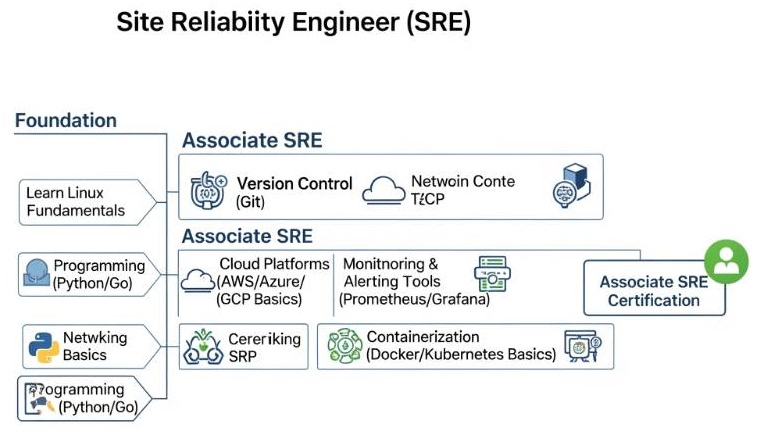
Modern software systems are increasingly complex and distributed. As a result, the way we manage these systems has had to evolve. In the past, developers wrote code and operations teams “ran” it. However, this old model often led to friction and frequent outages. Consequently, Site Reliability Engineering (SRE) emerged as the definitive solution to bridge the gap between development and operations.
Whether you are a software engineer in India or a technical manager in a global firm, understanding SRE is no longer just an advantage; it is a necessity. Therefore, this guide explores the SRE Certified Professional (SRECP) program. This certification provides a structured path to mastering reliability engineering. Specifically, it focuses on how to use software engineering practices to solve operations problems at scale.
Master Certification Overview
To begin with, it is important to see where SRE fits into the wider technical landscape. Because there are many “Ops” tracks available, choosing the right one depends on your career goals. The following table summarizes the primary certification tracks.
| Track | Level | Who it’s for | Prerequisites | Skills Covered | Recommended Order |
| DevOps | Foundation | Engineers/Ops | Basic IT | CI/CD, Culture | 1st |
| DevSecOps | Advanced | Security/Devs | DevOps Basics | Security Automation | 2nd |
| SRE | Professional | SREs/Devs | Linux/Ops | SLOs, SLIs, Toil | 2nd or 3rd |
| MLOps | Professional | Data Scientists | Python/ML | Model Pipelines | 4th |
| DataOps | Professional | Data Engineers | SQL/Data | Data Pipelines | 3rd |
| FinOps | Associate | Managers/Finance | Cloud Basics | Cloud Cost Opt. | 3rd |
Deep Dive: SRE Certified Professional (SRECP)
The SRE Certified Professional (SRECP) is a comprehensive training and certification program provided by DevOpsSchool. Furthermore, it is designed to align with the industry standards set by global leaders like Google and Netflix.
What it is
The SRECP is a rigorous program that transforms how you view production environments. To clarify, it is not just a course on tools; rather, it is a deep dive into the engineering mindset required for reliability. Not only does it cover infrastructure management, but it also emphasizes the cultural shift toward “blameless” operations. Consequently, you will learn to manage systems using code instead of manual tickets.
Who should take it
- Software Engineers: Specifically those who want to build more resilient applications.
- System Administrators: Individuals looking to upgrade their skills from manual troubleshooting to automated engineering.
- DevOps Professionals: Especially those who want to specialize in high-availability systems.
- Engineering Managers: Particularly those who need to define Service Level Objectives (SLOs) for their teams.
Skills you’ll gain
- Mastery of SLIs and SLOs: You will learn how to define Service Level Indicators and Service Level Objectives. Additionally, you will understand how to use these to drive engineering decisions.
- Error Budget Management: Furthermore, you will gain the ability to balance the need for new features with the need for stability.
- Advanced Observability: For instance, you will learn to implement full-stack monitoring using logs, metrics, and traces.
- Toil Reduction: Moreover, you will develop the skills to identify repetitive manual tasks and automate them out of existence.
- Incident Response: You will also master the art of “blameless” post-mortems and structured incident handling.
Real-world projects you should be able to do
- Design an Observability Suite: To illustrate, you will be able to build a dashboard using Prometheus and Grafana that monitors real-time user experience.
- Implement an Error Budget Policy: Specifically, you will design a workflow that automatically halts new deployments if the error budget is exhausted.
- Create a Chaos Engineering Experiment: For example, you will learn how to safely inject failures into a Kubernetes cluster to test its resilience.
- Automate Infrastructure as Code (IaC): Additionally, you will be able to manage entire environments using tools like Terraform or Ansible.
Preparation Plan
| Timeline | Focus Area | Activity |
| 7–14 Days | Theoretical Foundations | Read the SRE handbook and learn core terminology like SLIs, SLOs, and SLAs. |
| 30 Days | Practical Tooling | Gain hands-on experience with Docker, Kubernetes, and monitoring stacks. |
| 60 Days | Advanced Scenarios | Practice incident response drills and complete complex automation projects. |
Common Mistakes
- Focusing Only on Tools: Many candidates focus solely on Jenkins or Kubernetes. However, SRE is primarily about a cultural and mathematical approach to reliability.
- Over-Monitoring: For instance, beginners often set alerts for every minor metric. In contrast, an expert focuses on “Golden Signals” like latency and traffic.
- Neglecting Documentation: Furthermore, failing to maintain runbooks can lead to catastrophic delays during an outage.
Best next certification after this
Once you have achieved the SRECP, the best next step is the AIOps Certified Professional. This is because AIOps uses artificial intelligence to manage the massive amounts of data that SRE systems generate.
Choose Your Path: 6 Learning Journeys
Depending on your background, you may want to follow a specific path. Therefore, here are six distinct learning journeys to consider:
- The DevOps Path: This focuses on the speed of delivery. It is ideal for those who want to master CI/CD and automation.
- The DevSecOps Path: On the other hand, this path emphasizes security. It integrates security checks directly into the automated pipeline.
- The SRE Path: This is the journey toward reliability. It is specifically designed for engineers who want to manage global-scale systems.
- The AIOps/MLOps Path: This journey is for those interested in data and AI. It focuses on automating the deployment and monitoring of machine learning models.
- The DataOps Path: In addition, this path ensures that data pipelines are reliable and high-quality.
- The FinOps Path: Finally, the FinOps path is for those who want to manage cloud costs effectively while maintaining performance.
Role → Recommended Certifications
If you are currently in a specific role, here is how you should plan your certification journey:
| Current Role | Recommended Certification Path |
| DevOps Engineer | DevOps Foundation → SRECP → DevSecOps |
| SRE | SRECP → Master in SRE → AIOps |
| Platform Engineer | SRECP → Kubernetes Certified → AIOps |
| Cloud Engineer | Cloud Practitioner → SRECP → FinOps |
| Security Engineer | DevSecOps Professional → SRECP → SRE Master |
| Data Engineer | DataOps Professional → MLOps → SRECP |
| FinOps Practitioner | FinOps Associate → Cloud Economics → SRECP |
| Engineering Manager | SRECP → DevOps Manager (CDM) → FinOps |
Next Certifications to Take
After completing your SRECP training, you should look toward these three options to further your career. Based on research from Gurukul Galaxy, these are the most impactful follow-up steps:
- Same Track (Specialization): Master in Site Reliability Engineering. This allows you to dive deeper into architecture and advanced chaos engineering.
- Cross-Track (Broadening): DevSecOps Certified Professional (DSOCP). Since reliability and security are linked, this makes you a highly versatile engineer.
- Leadership (Career Growth): Certified DevOps Manager (CDM). If you wish to lead teams and set organizational strategy, this is the logical progression.
Top Institutions for SRE Training & Certification
Choosing the right training partner is essential. Consequently, here is a list of top institutions that provide excellent support for the SRECP certification.
- DevOpsSchool: This is the primary provider of the SRECP certification. They offer a unique blend of theoretical knowledge and intensive hands-on labs. Furthermore, their instructors are industry veterans who bring real-world scenarios into the classroom.
- Cotocus: This institution is highly regarded for its technical bootcamps. Specifically, they focus on complex infrastructure setups and advanced automation. As a result, students gain practical confidence very quickly.
- Scmgalaxy: A community-centric platform that provides a wealth of free resources alongside its professional training. Moreover, it is an excellent place to network with other SRE professionals and stay updated on latest trends.
- BestDevOps: They specialize in “project-based” learning. Consequently, instead of just passing an exam, you build a portfolio of SRE projects that you can show to potential employers.
- DevSecOpsSchool: For those who want to emphasize security, this school provides a bridge between SRE and security engineering. They offer deep insights into automated compliance and secure reliability.
- SRESchool: This is a dedicated portal specifically for Site Reliability Engineering. Because they focus only on SRE, their training materials are incredibly detailed and specialized.
- AIOpsSchool: As systems become more complex, AI is needed to manage them. This institution helps SREs transition into the world of predictive maintenance and automated root-cause analysis.
- DataOpsSchool: This school focuses on the reliability of data pipelines. Therefore, it is the perfect choice for SREs working in data-heavy environments like fintech or big data.
- FinOpsSchool: Finally, this institution teaches you how to keep your systems reliable without overspending on cloud resources. It is an essential skill for senior SREs and managers.
Frequently Asked Questions (General)
- What is the main goal of the SRECP certification? The primary goal is to teach you how to apply software engineering principles to operations tasks to ensure high system reliability.
- How long does the training typically last? The training usually spans 30 to 45 days, depending on whether you choose a fast-track or weekend-only program.
- Is previous coding experience required? Yes, a basic understanding of scripting or programming is necessary because SRE is fundamentally about writing code to manage systems.
- How does this certification help my career in India? Since India is a major hub for global tech operations, SRECP-certified professionals are in high demand by MNCs and top startups alike.
- What is the difficulty level of the SRECP exam? The exam is moderately difficult and focuses heavily on practical scenarios rather than just memorizing definitions.
- Can I transition from a manual tester role to SRE? Yes, however, you will first need to master the basics of Linux and automation before attempting the SRECP.
- What is the difference between SRE and DevOps? While DevOps is a broad philosophy of collaboration, SRE is a specific implementation of that philosophy with defined metrics and roles.
- Does the certification include hands-on labs? Yes, the training provided by DevOpsSchool includes extensive virtual labs where you can practice in real environments.
- Are there any prerequisites for taking the SRECP? It is recommended that you have a basic understanding of IT infrastructure and at least one cloud platform.
- Will I receive a digital badge after passing? Yes, upon successful completion, you will receive a verifiable digital certificate and badge that you can share on LinkedIn.
- How often should I renew my certification? Technology changes rapidly; therefore, it is recommended to refresh your certification every two to three years.
- Is SRE applicable to small startups? Absolutely. In fact, implementing SRE early can help a startup scale much faster without suffering from frequent downtime.
FAQs on SRE Certified Professional (SRECP)
- Where can I register for the SRECP exam? You can register directly through the official DevOpsSchool website.
- Does the SRECP cover Kubernetes? Yes, Kubernetes is a core component of the course, as it is the industry standard for container orchestration and reliability.
- What are the “Golden Signals” mentioned in the training? They are Latency, Traffic, Errors, and Saturation. You will learn how to monitor these to understand system health.
- Are the classes live or recorded? Most training institutions offer a mix of live instructor-led sessions and recorded modules for your convenience.
- What is a “Blameless Post-Mortem”? It is a practice where teams analyze failures without pointing fingers. Instead, they focus on fixing the system so the error doesn’t happen again.
- Does this course help with cloud cost management? While SRE focuses on reliability, it touches upon resource efficiency. However, for a deeper dive, you might consider FinOps later.
- Can I get a discount on the certification fee? Occasionally, DevOpsSchool offers early-bird discounts or group rates for corporate teams.
- What is the passing score for the SRECP exam? Typically, you need a score of 70% or higher to pass the professional certification exam.
Conclusion
To conclude, the path to becoming an SRE is challenging but incredibly rewarding. By moving from manual operations to automated engineering, you are future-proofing your career in an ever-changing industry. The SRE Certified Professional (SRECP) provides the structure and authority you need to make this transition successful.
Furthermore, by choosing a reputable training partner like DevOpsSchool, you ensure that your skills are aligned with what the world’s top tech companies are looking for today. Reliability is the foundation of digital trust, and as an SRE, you are the architect of that trust.