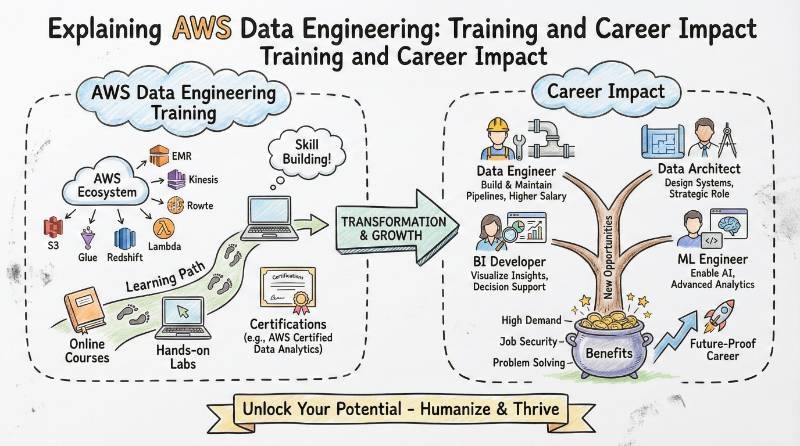
Data is no longer just a byproduct of business; it is the lifeblood of modern technology. Having watched the industry move from heavy, on-premise hardware to the flexible world of serverless cloud computing, I have seen one thing clearly: the biggest challenge today isn’t just keeping data—it’s making it move and work correctly. Companies are drowning in information, and they desperately need engineers who can build the bridges and pipes to handle it.
For software engineers and managers in India and across the globe, staying relevant means specializing. The AWS Certified Data Engineer – Associate is the gold standard for anyone who wants to prove they can handle data at scale. This guide is designed to show you exactly how to master this path and why it is the right move for your career.
Master Overview: AWS Certified Data Engineer Associate
This table provides a quick look at where this certification sits in your professional development.
| Track | Level | Who it’s for | Prerequisites | Skills Covered | Recommended Order |
| Data Engineering | Associate | Software & Data Engineers, Managers | 1-2 years cloud data experience | Ingestion, ETL, Security, Warehousing | After Solutions Architect Associate |
AWS Certified Data Engineer – Associate
What it is
The AWS Certified Data Engineer – Associate (DEA-C01) is a technical credential that proves you know how to build, maintain, and secure data pipelines on Amazon Web Services. It isn’t just about knowing what the services are; it’s about knowing how to connect them. Whether you are dealing with massive batch uploads using AWS Glue or real-time data streams via Kinesis, this certification validates that you can choose the most efficient and cost-effective tool for the job.
Who should take it
This is for Software Engineers who want to move into high-demand data roles, ETL Developers migrating to the cloud, and Engineering Managers who need to understand the technical foundations of their team’s data platforms. It is perfect for anyone who wants to move beyond general cloud knowledge and become a specialist in how information flows through a system.
Skills you’ll gain
Preparing for this exam changes how you look at architecture. You stop seeing data as “files” and start seeing it as a manageable lifecycle.
- Ingestion & Collection: You will learn how to pull data from various sources—databases, IoT devices, or logs—and get it into the cloud efficiently.
- Transformation & Processing: Mastering how to clean and prep data so it is actually useful for analysts and AI models.
- Storage Optimization: Learning the “hot” and “cold” storage strategies using S3, Redshift, and DynamoDB to save money and improve speed.
- Data Security: Understanding how to lock down your data so only the right people can see it, using encryption and fine-grained access.
- Orchestration & Automation: Learning to use Step Functions to make sure every part of your data pipeline happens in the right order without manual work.
Real-world projects you should be able to do
Once you finish this training, you will be prepared to handle actual industry challenges.
- Real-Time Analytics Pipeline: Create a system that captures live website traffic, processes it instantly, and shows results on a dashboard in seconds.
- Automated Data Lake: Build a storage system that automatically organizes data into different stages of “cleanliness” using AWS Glue and S3.
- Secure Multi-Account Access: Set up a central data hub where different departments can access the data they need safely without compromising sensitive information.
- Database Modernization: Lead a project to move an old, slow on-site database into a modern, fast Amazon Redshift warehouse.
Preparation Plan
| Timeline | Strategy |
| 7–14 Days | The Sprint: Review key services like Glue, Redshift, and Athena. Take multiple practice tests to find your weak spots and fix them immediately. |
| 30 Days | The Standard: Spend two weeks on data storage and movement. Spend one week on security and governance. Use the final week for mock exams and review. |
| 60 Days | The Deep Dive: Dedicate the first month to hands-on labs. Build real pipelines in your own AWS account. Use the second month to master the theory and tricky exam scenarios. |
Common Mistakes
Even the best engineers make these errors when starting with cloud data.
- Ignoring the “Security” Pillar: Many focus only on getting the data to move. If you don’t master IAM roles and encryption, you will fail the exam and create risky systems in real life.
- Choosing the Most Expensive Tool: Just because a tool is powerful doesn’t mean it’s right. Using an expensive Redshift cluster when a simple S3/Athena setup would work is a common mistake.
- Skipping the Code: You don’t need to be a Python expert, but you must understand how a basic Spark script works in AWS Glue. Don’t rely purely on the visual interface.
- Poor Schema Design: Setting up a data lake without a clear folder structure (partitioning) leads to slow queries and high costs.
Choose Your Path: 6 Specialized Tracks
This certification acts as a foundation for several career directions.
- DevOps: Use your data knowledge to automate the infrastructure that supports massive applications.
- DevSecOps: Focus on the security of the data pipeline, ensuring that every piece of information is protected as it moves.
- SRE (Site Reliability Engineering): Apply your skills to ensure that data systems are always available and performing at top speed.
- AIOps/MLOps: Become the bridge between data and Artificial Intelligence. Build the pipelines that feed machine learning models.
- DataOps: This is the core path. Focus on the speed and quality of data delivery across the whole company.
- FinOps: Focus on the money. Use your understanding of AWS storage and compute to keep the cloud bill as low as possible.
Role → Recommended Certifications Mapping
| Role | Primary Certification | Secondary/Support Certs |
| Data Engineer | AWS Data Engineer Associate | AWS Solutions Architect Associate |
| DevOps Engineer | AWS DevOps Engineer Professional | AWS Developer Associate |
| SRE | AWS SysOps Admin Associate | AWS DevOps Engineer Professional |
| Platform Engineer | AWS Solutions Architect Professional | CKA (Certified Kubernetes Admin) |
| Security Engineer | AWS Security Specialty | AWS Solutions Architect Associate |
| Cloud Engineer | AWS Solutions Architect Associate | AWS SysOps Admin Associate |
| FinOps Practitioner | AWS Cloud Practitioner | FinOps Certified Practitioner |
| Engineering Manager | AWS Cloud Practitioner | AWS Solutions Architect Associate |
Next Certifications to Take
Once you have secured your Data Engineer Associate, consider these three directions:
- Option 1 (Same Track): AWS Certified Machine Learning – Associate. Move from engineering the data to using it for AI.
- Option 2 (Cross-Track): AWS Certified Solutions Architect – Associate. Understand the wider world of networking and cloud design.
- Option 3 (Leadership): PMP (Project Management Professional). Move into high-level management by learning how to lead large-scale technical projects.
Top Institutions for AWS Data Engineer Training
- DevOpsSchool: A leading choice for those who want instructor-led training. They focus on real-world projects and helping you pass the certification on the first try.
- Cotocus: They specialize in technical deep-dives for corporate teams, ensuring your skills match exactly what the industry is looking for.
- Scmgalaxy: Great for learning how data engineering fits into the wider software development lifecycle and supply chain.
- BestDevOps: Focuses on quick upskilling, helping you learn the most important AWS data tools in a structured, easy-to-understand way.
- devsecopsschool: If you want to specialize in securing data, this is the place. Their courses emphasize protection and compliance.
- sreschool: Teaches you how to build data systems that are incredibly reliable and can handle massive traffic without breaking.
- aiopsschool: Perfect for those looking to jump into the world of AI and understand how data pipelines support machine learning.
- dataopsschool: A dedicated institution for the DataOps professional, focusing on the entire journey of data from start to finish.
- finopsschool: Learn the vital skill of cloud cost management so your data architecture remains profitable.
FAQs : Career, Value, and Strategy
1. How hard is the Data Engineer Associate exam?
It is more specific than the Solutions Architect exam. It is moderately difficult because it requires you to understand exactly how data services like Glue and Redshift work under the hood.
2. Is this certification valuable for someone in India?
Yes, extremely. India’s tech market is seeing a massive shift toward data-driven roles. This certification is a major signal to recruiters at top tech firms.
3. Do I need a computer science degree?
While it helps, it isn’t required. Practical knowledge of cloud services and data logic is what the exam actually tests.
4. Can I take this if I am currently a manager?
Yes. Managers who understand the technical side are much better at hiring, planning, and making budget decisions for their teams.
5. What is the difference between this and the old Data Analytics specialty?
This exam is an “Associate” level, making it a better starting point. It focuses more on the engineering of the systems rather than just analyzing the data at the end.
6. How much do I need to study every day?
Consistency is key. 1 to 2 hours a day for a month is usually much better than trying to “cram” everything into one weekend.
7. Does this help with remote work?
Absolutely. Cloud data engineering is one of the most common remote-friendly roles in the world today.
8. How do I keep my certification active?
You will need to recertify every three years by taking the latest version of the exam or moving up to a Professional-level cert.
9. Is there any SQL on the exam?
Yes. You need to understand how to write and optimize queries for services like Athena and Redshift.
10. What is the most important service to learn?
AWS Glue. It appears in almost every part of the exam, from ingestion to transformation.
11. How much does the exam cost?
The standard price for an AWS Associate exam is $150 USD (prices may vary based on local taxes).
12. Can this lead to a salary increase?
In most cases, yes. Specialized certifications in data engineering often command higher salaries than general cloud certifications.
FAQs : Technical Training & Exam Content
1. What is the “Data Catalog” in AWS Glue?
It is a central place to store metadata about your data. Think of it as a library card catalog for all your data files.
2. When should I use Kinesis instead of S3?
Use Kinesis when you need to process data immediately (streaming). Use S3 when you are storing data to be processed later (batch).
3. What are Redshift “Sort Keys”?
They are used to determine how data is physically stored on the disk. Choosing the right one makes your queries run much faster.
4. What is the purpose of AWS Lake Formation?
It simplifies the process of setting up a secure data lake. It allows you to manage permissions in one place instead of across every individual file.
5. Do I need to learn Apache Spark?
You need to understand the concepts of Spark and how AWS Glue uses it for distributed data processing.
6. What is the difference between Athena and Redshift?
Athena is for querying data directly in S3 without a database. Redshift is a high-performance, full-scale data warehouse.
7. How does AWS handle data encryption?
AWS uses KMS (Key Management Service). You need to know how to encrypt data both “at rest” (on the disk) and “in transit” (moving across the network).
8. What is Step Functions?
It is a way to coordinate different AWS services into a workflow. For example: First run a Glue job, then check if it finished, then send an email.
Conclusion
The evolution of technology has made it clear that data is the most valuable asset any company owns. By pursuing the AWS Certified Data Engineer – Associate certification, you are proving that you are not just a passenger in this cloud revolution, but an architect of it. This journey is about mastering the flow of information, ensuring security, and optimizing costs in a world that never stops generating data. Whether you are a software engineer in India looking for a career boost or a global manager leading a cloud transition, this training provides the technical depth and professional credibility you need. The future of the cloud is built on data—now is the time to build your place in that future.



Leave a Reply
You must be logged in to post a comment.