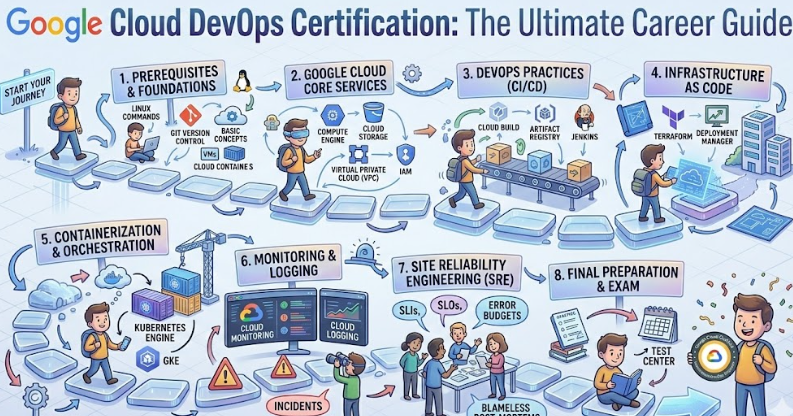
In my time helping teams navigate the shift to the cloud, I have seen many trends come and go. However, the move toward automated, reliable systems is here to stay. Google Cloud Platform (GCP) has built a reputation for excellence because it provides the tools that allow engineers to work at a massive scale. For any software engineer or manager looking to stay ahead of the curve, whether you are based in India or working for a global firm, mastering these tools is the key to long-term success.
The Google Cloud Professional Cloud DevOps Engineer certification is not just a badge for your resume. it is proof that you understand how to bridge the gap between building a product and keeping it running perfectly. This guide will walk you through the entire landscape and show you how to master this specific track.
Mapping Your Journey: Google Cloud Certifications
Before focusing on DevOps, it is helpful to see the full picture of what Google offers. Every track has a different purpose, and knowing where you stand helps you plan your next move.
Certification Master Table
| Track | Level | Who it’s for | Prerequisites | Skills Covered | Recommended Order |
| Cloud DevOps | Professional | SREs, DevOps Engineers | 3+ years experience | CI/CD, SRE, Monitoring | 3rd |
| Cloud Architect | Professional | Solutions Architects | 3+ years experience | Design, Security, Compliance | 1st or 2nd |
| Cloud Security | Professional | Security Leads | 3+ years experience | IAM, Network Defense | 4th |
| Data Engineer | Professional | Data Scientists | 3+ years experience | Big Data, ML Pipelines | 3rd |
| Cloud Developer | Professional | App Developers | 3+ years experience | App Profiling, APIs | 2nd |
| Cloud Network | Professional | Network Engineers | 3+ years experience | Hybrid Cloud, VPC, DNS | 4th |
| Cloud Database | Professional | DB Admins | 3+ years experience | SQL, Spanner, Migrations | 3rd |
Google Cloud Professional Cloud DevOps Engineer
This specific certification focuses on the art of delivery and reliability. It is designed for those who want to be at the heart of technical operations.
What it is
This certification validates your ability to use Google Cloud tools to ensure that software is delivered quickly and runs reliably. It is heavily influenced by Site Reliability Engineering (SRE) principles. Instead of just fixing things when they break, you learn how to build systems that are designed to handle failure gracefully. It covers everything from writing automated scripts to monitoring complex networks.
Who should take it
This path is ideal for Software Engineers who want to understand how their code behaves in the real world. It is also perfect for experienced DevOps professionals who want to prove their skills on a world-class platform like GCP. For managers, this knowledge is vital because it provides a framework for how to run a modern, high-performing engineering team.
Skills you’ll gain
Preparing for this exam will give you a deep understanding of how to manage modern infrastructure. You will learn to treat “operations” like a coding problem.
- SRE Culture Mastery: You will learn how to set Service Level Objectives (SLOs) that actually matter. You will understand how to use “Error Budgets” to decide when to push new features and when to focus on making the system more stable.
- Pipeline Automation: You will gain hands-on experience with Cloud Build and Artifact Registry. This allows you to build a system where code is automatically tested and deployed without human intervention.
- Service Observability: You will learn how to use Google’s Cloud Operations suite to monitor logs and metrics. This gives you the ability to see problems before they affect your users.
- Effective Response: You will learn how to handle system outages professionally, including how to perform “blameless” reviews so your team can learn from every mistake.
Real-world projects you should be able to do
Once you have mastered these skills, you will be able to lead high-impact projects at any company.
- Zero-Downtime Releases: You will be able to set up “Canary” or “Blue-Green” deployments, where new code is rolled out slowly to ensure it is safe.
- Self-Healing Clusters: You can build infrastructure using Google Kubernetes Engine (GKE) that automatically restarts itself if it encounters a bug.
- Infrastructure as Code: You will be able to use tools like Terraform to write your entire data center as a script, making it easy to replicate in any part of the world.
- Smart Scaling: You can design systems that automatically grow when traffic is high and shrink when things are quiet, saving your company a lot of money.
Preparation Timelines: Finding Your Pace
Success on this exam depends on how much time you can dedicate. Choose the plan that fits your current life.
7–14 Days: The Expert Review
- Best for: Engineers already using GCP every day.
- Approach: Focus purely on the exam structure and Google-specific service names.
- Action: Take several practice tests and read the “Best Practices” documents for GKE and Cloud Monitoring.
30 Days: The Professional Track
- Best for: Working engineers with experience in other clouds (like AWS or Azure).
- Approach: Spend your weekends on hands-on labs and your weekdays on theory.
- Action: Build a small application on GCP and set up a full CI/CD pipeline for it. Learn the core SRE concepts of Toil and Error Budgets.
60 Days: The Foundation Track
- Best for: New engineers or managers who want a deep understanding.
- Approach: One hour a day of consistent learning.
- Action: Take a structured course from a provider like DevOpsSchool. Read the official Google SRE book from start to finish.
Common Mistakes to Avoid
Many talented people struggle with this exam because they don’t follow the right strategy.
- Ignoring the “Culture” Questions: Many people think this is only a technical test. It isn’t. You must understand SRE culture to pass.
- Skipping the Console: You cannot pass this exam just by reading books. You must spend time in the Google Cloud Console building real things.
- Trying to be too complex: Google always prefers the simplest, most automated solution. Don’t look for a difficult way to solve a problem if a native GCP tool can do it easily.
Choose Your Path: 6 Specialized Learning Tracks
After the basic certification, you can take your career in several directions:
- DevOps: Focused on the speed and automation of the software lifecycle.
- DevSecOps: Integrating security into every single part of the pipeline.
- SRE: The highest level of reliability and system performance.
- AIOps/MLOps: Using machine learning to manage infrastructure and data models.
- DataOps: Focusing on the reliable delivery and management of big data.
- FinOps: Mastering the financial side of the cloud to keep costs low.
Role → Recommended Certifications Mapping
- DevOps Engineer: Professional Cloud DevOps Engineer + Professional Cloud Architect.
- SRE: Professional Cloud DevOps Engineer + Professional Cloud Security Engineer.
- Platform Engineer: Professional Cloud Architect + Professional Cloud Developer.
- Cloud Engineer: Associate Cloud Engineer + Professional Cloud DevOps Engineer.
- Security Engineer: Professional Cloud Security Engineer + Professional Cloud DevOps Engineer.
- Data Engineer: Professional Data Engineer + Professional Cloud DevOps Engineer.
- FinOps Practitioner: Cloud Digital Leader + Professional Cloud Architect.
- Engineering Manager: Cloud Digital Leader + Professional Cloud DevOps Engineer.
Best Next Certifications to Take
Once you have completed this master guide, you should keep your momentum going. Based on the career insights for software engineers at GurukulGalaxy, here are three paths to consider:
- Same Track (Security): The Professional Cloud Security Engineer is a perfect match for DevOps.
- Cross-Track (Data): The Professional Data Engineer helps you understand the growing world of big data.
- Leadership (Architect): The Professional Cloud Architect is the best step for those moving into management or design roles.
Top Institutions for Training and Certification
Finding the right mentor can save you months of frustration. These institutions provide excellent help for the Google Cloud Professional Cloud DevOps Engineer (CDE) certification:
- DevOpsSchool: This is a top-rated institution known for its very practical workshops. They focus on teaching the logic behind the tools, ensuring you are ready for both the exam and the job.
- Cotocus: They provide specialized training for professionals who need to master modern cloud architecture quickly and effectively.
- Scmgalaxy: A great place for those who like community-based learning. They offer many blogs, guides, and tutorials that are updated constantly.
- BestDevOps: They offer coaching that is strictly aligned with what the industry needs right now, making them a great choice for working engineers.
- devsecopsschool: The best place to learn how to add security into your automated pipelines.
- sreschool: This school focuses entirely on the reliability aspect of the cloud, which is vital for the Google exam.
- aiopsschool: Learn how to use artificial intelligence to make your infrastructure smarter and more efficient.
- dataopsschool: Perfect for those who want to bridge the gap between data science and operations.
- finopsschool: Essential for managers who want to learn how to manage the business and financial side of cloud infrastructure.
FAQs: General DevOps Career Outcomes
1. Is the Professional Cloud DevOps Engineer exam difficult?
Yes, it is considered one of the most challenging professional exams because it requires both technical skill and cultural understanding.
2. How much time should I study?
Most people need about 50 to 70 hours of total study time to feel truly ready.
3. Do I need to be a coding expert?
You should be comfortable with scripting and reading code, but you do not need to be a full-time software developer.
4. What is the best starting point?
If you are new to the cloud, start with the Associate Cloud Engineer. If you have experience, you can jump straight to the Professional DevOps track.
5. How much can I earn with this?
DevOps and SRE professionals are among the highest-paid in the tech industry, both in India and globally.
6. Does it ever expire?
Yes, the certification is valid for two years. This ensures your skills stay fresh as the technology changes.
7. Can I take it from home?
Yes, Google offers remote exams that you can take with an online proctor.
8. Is Google Cloud better than AWS?
Both are excellent, but many engineers prefer Google Cloud for its superior Kubernetes and data tools.
9. Are there any official requirements?
Google suggests 3 years of experience, but there are no mandatory prerequisites to take the test.
10. What if I fail?
You can retake it after a waiting period. Use that time to focus on the sections where you scored lower.
11. Is this good for people in management?
Yes. It gives managers the technical grounding they need to make better decisions for their teams.
12. Does this help with jobs abroad?
Absolutely. Google Cloud certifications are a global standard and are respected by employers everywhere.
FAQs: Specific Questions on the Professional Engineer Exam
1. What is the main focus of the exam?
The main focus is on service reliability and the automation of delivery pipelines using GCP tools.
2. Is it different from the Cloud Architect?
Yes. The Architect designs the system, while the DevOps Engineer builds and maintains it.
3. How much Kubernetes do I need to know?
You should know GKE very well, as it is a central part of almost every exam scenario.
4. Why should I read the SRE book?
Google literally wrote the book on SRE, and the exam questions are built on those exact concepts.
5. Which tools are most important to study?
Make sure you master Cloud Build, Cloud Monitoring, Cloud Logging, and GKE.
6. Is there a lot of networking?
There is enough to be important—focus on load balancing and how services connect in a VPC.
7. Are the questions just simple facts?
No, they are complex scenarios. You have to choose the best way to solve a specific business problem.
8. Can I get a refund?
No, exam fees are generally non-refundable, so make sure you are fully prepared before scheduling.
Conclusion
The decision to pursue the Google Cloud Professional Cloud DevOps Engineer certification is a major commitment to your professional growth. It is about moving beyond being a person who just handles tasks to becoming someone who designs and manages the systems that keep businesses running. By learning to balance the speed of development with the stability of operations, you position yourself as a leader in any technical organization. The journey is not always easy, but the skills you gain—from mastering SRE principles to automating massive cloud environments—will serve as a solid foundation for your entire career. Whether you are aiming for a senior role in India or looking to make your mark on the global stage, the knowledge found in this path is the most valuable tool you can have. The future of technology belongs to those who can make it reliable, and there is no better way to prove you can do that than by mastering Google Cloud.



Leave a Reply
You must be logged in to post a comment.