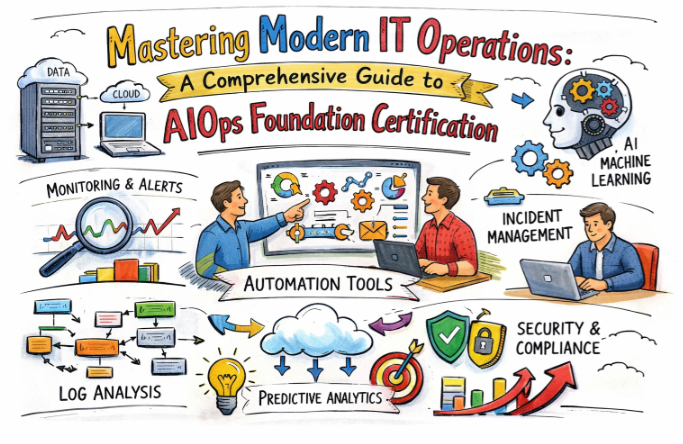
The AIOps Foundation Certification at AIOps School serves as a critical entry point for professionals looking to bridge the gap between traditional IT operations and machine learning. This guide is designed for systems engineers, SREs, and technical managers who need to understand how algorithmic intelligence can reduce noise and automate incident response. By establishing a clear baseline of knowledge, this certification helps practitioners move away from reactive troubleshooting toward proactive, data-driven system management. Navigating the transition to AI-driven operations requires a structured learning path, and this guide provides the clarity needed to make informed career decisions.
What is the AIOps Foundation Certification?
The AIOps Foundation Certification represents a shift from manual monitoring to automated, intelligent observability within modern production environments. It exists to validate a professional’s understanding of how big data, machine learning, and advanced analytics can be applied to IT operations data. Unlike purely theoretical courses, this program focuses on how these technologies function within a live production ecosystem to enhance system reliability. It aligns perfectly with modern engineering workflows by providing the vocabulary and conceptual framework necessary to implement enterprise-grade AIOps strategies.
Who Should Pursue AIOps Foundation Certification?
This certification is highly beneficial for DevOps engineers, Site Reliability Engineers, and Cloud Architects who are responsible for maintaining complex, distributed systems. Security professionals and data engineers also find significant value here as AIOps principles often overlap with threat detection and data pipeline management. It is suitable for beginners entering the field, but it is equally vital for experienced engineers and technical leaders who need to modernize their operations strategy. Whether you are working in the Indian tech hubs or within a global enterprise, this certification provides the cross-functional skills required in today’s market.
Why AIOps Foundation Certification is Valuable and Beyond
The demand for AIOps expertise is growing rapidly as enterprise environments become too complex for human-only intervention. Obtaining this certification ensures long-term career longevity by teaching professionals how to leverage AI tools rather than being replaced by them. It helps engineers stay relevant even as specific monitoring tools change, because the underlying principles of data correlation and anomaly detection remain constant. The return on time and career investment is substantial, as organizations are actively seeking leaders who can reduce Mean Time to Resolution (MTTR) through automation.
AIOps Foundation Certification Overview
The program is delivered via AIOps Foundation Certification and hosted on AIOps School. It is structured into practical levels that move from basic terminology to the deployment of complex algorithmic models in an operational context. The assessment approach is designed to test both conceptual understanding and the ability to apply AIOps logic to real-world infrastructure problems. Ownership of this certification provides a recognized standard of excellence that is respected by hiring managers across the technology sector.
AIOps Foundation Certification Tracks & Levels
The certification is divided into three primary tiers: Foundation, Professional, and Advanced, each targeting different stages of professional growth. The Foundation level introduces core concepts of data ingestion and pattern recognition, while the Professional level dives into predictive analysis and automated remediation. Advanced tracks are reserved for those designing the architectural frameworks for autonomous operations across entire enterprises. These levels align with a natural career progression, allowing an engineer to move from a contributor role into a strategic leadership or architectural position.
Complete AIOps Foundation Certification Table
| Track | Level | Who it’s for | Prerequisites | Skills Covered | Recommended Order |
| Core Operations | Foundation | Junior Engineers, Managers | Basic IT Ops Knowledge | Data Ingestion, Noise Reduction | First |
| Engineering | Professional | SREs, DevOps Engineers | Foundation Cert | Anomaly Detection, Remediation | Second |
| Architecture | Advanced | Principal Engineers, Architects | Professional Cert | Model Tuning, Autonomous Systems | Third |
| Specialized | Expert | Data Scientists in Ops | Advanced Cert | NLP for Logs, Custom Algorithms | Optional |
Detailed Guide for Each AIOps Foundation Certification
AIOps Foundation Certification – Foundation Level
What it is
This certification validates the fundamental understanding of how artificial intelligence integrates with traditional IT operations. It confirms that the candidate can identify the core components of an AIOps platform and understands the lifecycle of operational data.
Who should take it
It is suitable for IT generalists, junior DevOps engineers, and project managers who need to understand the business value and technical terminology of AIOps. No prior machine learning experience is required, making it an ideal starting point.
Skills you’ll gain
- Understanding the five stages of AIOps: Selection, Pattern Discovery, Inference, Collaboration, and Automation.
- Identifying different types of operational data including logs, metrics, and traces.
- Grasping the basics of event correlation and how it reduces alert fatigue.
- Recognizing the difference between supervised and unsupervised learning in an operations context.
Real-world projects you should be able to do
- Configure basic data ingestion pipelines from multiple monitoring sources into a centralized lake.
- Create simple event correlation rules to group related alerts into a single incident.
- Develop a roadmap for transitioning a traditional NOC to an AI-driven operations center.
Preparation plan
- 7–14 days: Focus on high-level definitions, the history of AIOps, and core industry terminology.
- 30 days: Deep dive into the data lifecycle and attend virtual workshops or webinars provided by the hosting site.
- 60 days: Conduct mock exams and review case studies of successful enterprise AIOps implementations.
Common mistakes
- Overcomplicating the machine learning aspect instead of focusing on the operational application.
- Neglecting the importance of data quality and cleaning before it reaches the AI engine.
- Failing to understand how AIOps complements, rather than replaces, existing DevOps practices.
Best next certification after this
- Same-track option: AIOps Professional Certification.
- Cross-track option: SRE Foundation Certification.
- Leadership option: Digital Transformation Lead.
AIOps Foundation Certification – Professional Level
What it is
The Professional level validates a candidate’s ability to implement and manage algorithmic models within an active production environment. It focuses on the practical application of predictive analytics to prevent outages before they occur.
Who should take it
This is designed for SREs and Senior DevOps engineers who have at least two years of experience in infrastructure management. Candidates should have a firm grasp of automation and at least one primary monitoring stack.
Skills you’ll gain
- Implementing anomaly detection algorithms on time-series metric data.
- Configuring predictive maintenance schedules based on historical performance trends.
- Managing feedback loops to improve the accuracy of machine learning models over time.
- Automating root cause analysis through automated topology mapping.
Real-world projects you should be able to do
- Build an automated remediation workflow that triggers based on an AI-detected performance degradation.
- Implement a noise reduction strategy that filters out 90 percent of non-actionable alerts.
- Design a dashboard that visualizes predictive system health for executive stakeholders.
Preparation plan
- 7–14 days: Review professional-level exam domains and identify gaps in practical automation experience.
- 30 days: Set up a lab environment to test different correlation algorithms and predictive models.
- 60 days: Focus on advanced scenarios involving multi-cloud environments and complex microservices architectures.
Common mistakes
- Assuming that the AI will work perfectly out of the box without tuning or human feedback.
- Ignoring the cultural shift required to trust automated insights over manual investigation.
- Focusing too much on a single tool rather than the underlying algorithmic logic.
Best next certification after this
- Same-track option: AIOps Advanced/Architect Certification.
- Cross-track option: FinOps Certified Practitioner.
- Leadership option: Engineering Manager Certification.
Choose Your Learning Path
DevOps Path
Engineers on this path should focus on how AIOps accelerates the feedback loop between development and operations. The goal is to use intelligent insights to improve deployment frequency and lower the change failure rate. By automating the analysis of CI/CD pipelines, DevOps professionals can identify bottlenecks and performance regressions instantly. This path emphasizes the integration of AI tools into the existing toolchain to create a more resilient delivery process.
DevSecOps Path
For those in security, AIOps provides a powerful mechanism for detecting “low and slow” attacks that traditional threshold-based alerts miss. This path focuses on using behavioral analytics to identify deviations from normal user or system activity. Professionals will learn to correlate security events with infrastructure changes to determine if a performance dip is a breach or a misconfiguration. It is about creating a self-healing infrastructure that can also self-defend against emerging threats.
SRE Path
Site Reliability Engineers use AIOps to manage Error Budgets and Service Level Objectives (SLOs) more effectively. This path prioritizes predictive analytics to forecast when an SLO might be breached, allowing for proactive adjustments. SREs learn to use AI to automate the toil of manual incident response, freeing up time for high-value engineering tasks. The focus here is on maintaining system availability and performance through sophisticated, algorithmic oversight of distributed systems.
AIOps Path
The dedicated AIOps path is for specialists who wish to become the primary architects of intelligent operations within an organization. It involves a deep dive into data science for IT, covering everything from data lake architecture to custom model development. These specialists work to unify disparate data silos across the enterprise to provide a single, intelligent source of truth. This path is ideal for those who want to lead the technological evolution of the modern IT department.
MLOps Path
While AIOps focuses on using AI for IT, MLOps focuses on the operationalization of machine learning models themselves. This path is for engineers who need to ensure that the models used in AIOps—and across the business—are deployed, monitored, and retrained reliably. It covers the lifecycle of models, including versioning, feature stores, and drift detection. MLOps professionals ensure that the AI driving the operations is itself running on a stable and scalable foundation.
DataOps Path
The DataOps path is essential for ensuring that the data feeding the AIOps engine is accurate, timely, and high-quality. Professionals on this path learn to build resilient data pipelines that can handle the massive volume and velocity of operational telemetry. They focus on data governance, orchestration, and the automation of data quality checks. Without strong DataOps, an AIOps implementation will fail due to the “garbage in, garbage out” principle, making this a critical supportive track.
FinOps Path
Integrating AIOps with FinOps allows organizations to automate cloud cost optimization based on real-time usage patterns. This path focuses on using AI to identify wasted resources and suggest more cost-effective architectural choices. Professionals learn to correlate performance data with billing data to understand the true unit cost of their services. By applying algorithmic intelligence to financial management, companies can achieve much higher cloud efficiency and more accurate budget forecasting.
Role → Recommended AIOps Foundation Certification Certifications
| Role | Recommended Certifications |
| DevOps Engineer | AIOps Foundation, Professional DevOps |
| SRE | AIOps Foundation, SRE Professional |
| Platform Engineer | AIOps Foundation, Cloud Architect |
| Cloud Engineer | AIOps Foundation, Multi-Cloud Specialist |
| Security Engineer | AIOps Foundation, DevSecOps Expert |
| Data Engineer | AIOps Foundation, DataOps Specialist |
| FinOps Practitioner | AIOps Foundation, FinOps Certified |
| Engineering Manager | AIOps Foundation, Technical Leadership |
Next Certifications to Take After AIOps Foundation Certification
Same Track Progression
Advancing within the AIOps track involves moving from the Foundation level to the Professional and eventually the Architect levels. This deep specialization allows you to master complex topics like Natural Language Processing (NLP) for log analysis and the creation of custom heuristic models. As you progress, the focus shifts from implementation to strategy, design, and the oversight of autonomous enterprise systems. This journey transforms a technical practitioner into a subject matter expert who can dictate the future of an organization’s operational capabilities.
Cross-Track Expansion
Broadening your skills by pursuing certifications in SRE, DevSecOps, or FinOps makes you a much more versatile asset to any engineering team. Understanding how AIOps impacts financial management or security protocols allows you to lead cross-functional projects that have a high business impact. This expansion is particularly valuable in smaller organizations where engineers are expected to wear multiple hats or in large enterprises where “T-shaped” skills are highly prized. It ensures that your technical expertise is grounded in a broad understanding of the entire business ecosystem.
Leadership & Management Track
For those looking to move into management, combining an AIOps background with leadership certifications is a winning strategy. Engineering Managers who understand the potential of AI can better advocate for the resources needed to modernize their teams. This track focuses on the human element: managing the cultural change associated with automation and leading teams through technical transitions. It prepares you for roles such as Director of Platform Engineering or VP of Operations, where strategic vision is as important as technical depth.
Training & Certification Support Providers for AIOps Foundation Certification
DevOpsSchool provides a robust ecosystem for professionals seeking to master modern operational methodologies through intensive, hands-on training. Their curriculum is designed by industry veterans who understand the practical challenges of deploying AIOps and DevOps at scale. Students benefit from a mix of live sessions, comprehensive lab environments, and real-world case studies that bridge the gap between theory and practice. With a strong focus on career placement and continuous skill development, DevOpsSchool remains a top choice for engineers looking to elevate their professional standing in the global market.
Cotocus stands out as a specialized provider that blends technical training with high-level consulting insights for corporate and individual learners. They focus on providing customized learning paths that align with specific organizational goals, ensuring that the skills learned are immediately applicable to the job. Their approach to AIOps training emphasizes the integration of various toolsets and the development of a cohesive automation strategy. By offering mentorship and expert-led workshops, Cotocus helps professionals navigate the complexities of modern cloud-native environments with confidence and technical proficiency.
Scmgalaxy is a premier community-driven platform that has been at the forefront of software configuration management and DevOps education for years. They offer an extensive library of resources, tutorials, and certification paths that cater to both beginners and seasoned experts. Their AIOps training focuses heavily on the intersection of CI/CD pipelines and intelligent monitoring, providing a holistic view of the software delivery lifecycle. Through their active forums and contributor network, Scmgalaxy ensures that learners stay updated on the latest industry trends and best practices.
BestDevOps is dedicated to providing high-quality, accessible training for engineers who want to stay competitive in an ever-evolving technological landscape. Their courses are known for being practical and concise, stripping away the marketing fluff to focus on the core skills required for operational excellence. The AIOps Foundation curriculum offered here is particularly well-suited for professionals who need to gain a deep understanding of the field quickly. With a focus on student success and practical outcomes, BestDevOps has built a reputation for excellence in the professional training space.
devsecopsschool.com focuses specifically on the critical intersection of security and operations, making it an essential resource for the modern security professional. Their training programs emphasize how AIOps can be used to enhance threat detection and automate security responses within a DevOps framework. By teaching students how to integrate security into every stage of the development lifecycle, they help organizations build more resilient systems. The courses are designed to be rigorous and comprehensive, ensuring that graduates are well-equipped to handle the security challenges of modern distributed architectures.
sreschool.com is the go-to destination for those dedicated to mastering the principles of Site Reliability Engineering. Their curriculum is deeply rooted in the practices pioneered by major tech giants, focusing on scalability, reliability, and automation. The integration of AIOps into their SRE training provides students with the tools needed to manage massive scale with minimal manual intervention. By focusing on Service Level Objectives and error budget management, sreschool.com prepares engineers to take on the most demanding roles in the technology industry.
aiopsschool.com serves as the primary hub for specialized education in artificial intelligence for IT operations. They provide the specific framework and certification tracks mentioned in this guide, ensuring a standardized and high-quality learning experience. The school is dedicated exclusively to the AIOps domain, allowing for a level of depth and specialization that is rarely found elsewhere. Their partnership with industry leaders ensures that the curriculum remains relevant and that the certifications carry significant weight with employers worldwide.
dataopsschool.com addresses the vital need for disciplined data management within the context of automated operations. Their training focuses on the creation of robust data pipelines that provide the high-quality telemetry required for successful AIOps implementations. Students learn about data orchestration, governance, and the automation of data quality checks, ensuring that the AI models are always fed with accurate information. This specialization is critical for any organization looking to move beyond basic monitoring and toward true, data-driven operational intelligence.
finopsschool.com provides the specialized training required to manage the financial complexities of modern cloud environments. Their curriculum teaches professionals how to use AI and machine learning to automate cost optimization and improve cloud efficiency. By bridging the gap between finance and engineering, they help organizations achieve a better return on their cloud investments. The training is practical and data-focused, providing students with the skills needed to implement FinOps principles at an enterprise scale, often leveraging AIOps tools to do so.
Frequently Asked Questions (General)
- What is the average time required to complete the foundation certification?
Most professionals complete the foundation level within 30 to 60 days, depending on their existing background in operations and automation. - Do I need to know how to code in Python or R for the foundation level?
While coding knowledge is helpful for later stages, the foundation level focuses more on conceptual understanding and tool interaction rather than manual programming. - Is there a prerequisite for the professional level certification?
Yes, typically you must have completed the foundation level or demonstrate equivalent professional experience in the field of AIOps. - How often do I need to renew my AIOps certification?
Certifications generally remain valid for two to three years, after which you may need to take a bridge exam to stay current with new technologies. - Does this certification help in getting a job in SRE?
Absolutely, as AIOps is a core component of modern SRE practices, having this certification demonstrates your ability to handle complex, automated environments. - What is the format of the examination?
The exam usually consists of multiple-choice questions, scenario-based problems, and sometimes a practical lab component for higher levels. - Can I take the exam online from my home?
Yes, most providers offer proctored online exams that can be taken from anywhere in the world, including India and global locations. - Is the AIOps Foundation Certification recognized by major cloud providers?
While it is an independent certification, the principles taught are universal and align with the AIOps services offered by AWS, Azure, and Google Cloud. - How does AIOps differ from standard monitoring?
Standard monitoring tells you that something is wrong; AIOps tells you why it happened and can often predict the failure before it occurs. - Are there any hands-on labs included in the training?
Most reputable training providers include cloud-based lab environments where you can practice configuring AIOps platforms with real data. - What is the cost range for these certifications?
Prices vary by provider and level, but generally range from two hundred to five hundred dollars for the exam and basic study materials. - Can managers benefit from this technical certification?
Yes, technical managers gain the vocabulary and strategic insight needed to lead AIOps initiatives and make informed tool-purchasing decisions.
FAQs on AIOps Foundation Certification
- How does the AIOps Foundation specifically address alert fatigue?
The certification teaches techniques for event correlation and noise reduction, allowing engineers to focus only on incidents that require human intervention. - Does the course cover specific AIOps tools like Moogsoft or BigPanda?
The foundation level is generally tool-agnostic, focusing on the underlying principles that apply to all major AIOps platforms. - Will I learn about the ethical implications of AI in operations?
Yes, the curriculum often includes sections on algorithmic bias and the importance of maintaining human oversight in automated systems. - How does AIOps integrate with existing ITIL processes?
AIOps enhances ITIL by automating incident, problem, and change management workflows through data-driven insights. - Is machine learning mathematics a large part of the exam?
No, the focus is on the operational application of machine learning rather than the deep mathematical theory behind the algorithms. - Can AIOps help with legacy on-premises infrastructure?
Yes, AIOps is highly effective at unifying data from both legacy data centers and modern cloud environments into a single view. - What role does Big Data play in this certification?
The course covers how AIOps platforms handle the “Three Vs” of big data: Volume, Velocity, and Variety, within an operational context. - Does the certification cover Natural Language Processing for logs?
Basic NLP concepts for log parsing and sentiment analysis in incident tickets are typically introduced at the foundation or professional levels.
Final Thoughts: Is AIOps Foundation Certification Worth It?
From the perspective of a senior engineer who has seen multiple shifts in the industry, I can say that AIOps is not just another buzzword; it is the inevitable evolution of IT operations. As systems continue to scale in complexity, the old methods of manual monitoring and troubleshooting are simply no longer sustainable. Investing in an AIOps Foundation Certification is a pragmatic move that secures your place in the future of engineering. It provides the structured knowledge needed to move beyond the “firefighting” stage of operations and into a role where you are architecting truly resilient, self-healing systems. If you want to remain a high-value contributor or leader in the DevOps and SRE space, this is a path worth taking.



Leave a Reply
You must be logged in to post a comment.