Introduction
In the current landscape of cloud-native engineering and distributed systems, the Certified Site Reliability Professional has emerged as a critical benchmark for engineering excellence. This guide is designed for software engineers, operations professionals, and technology leaders who aim to bridge the gap between traditional IT operations and modern software engineering. By focusing on reliability, scalability, and efficiency, this certification helps individuals navigate the complexities of high-availability environments.
As organizations transition toward platform engineering and automated infrastructure, the demand for verified SRE skills has never been higher. This comprehensive roadmap, hosted by SREschool, provides a structured path for professionals to validate their expertise in managing production systems. Whether you are a veteran administrator or an aspiring site reliability engineer, this guide will help you make informed decisions about your career trajectory and professional development.
The following sections break down the core components of the certification, its real-world applications, and how it aligns with various engineering roles. By the end of this guide, you will have a clear understanding of the preparation required and the tangible benefits this credential brings to your professional portfolio. We aim to provide an unbiased, experience-driven perspective that prioritizes practical knowledge over theoretical concepts.
What is the Certified Site Reliability Professional?
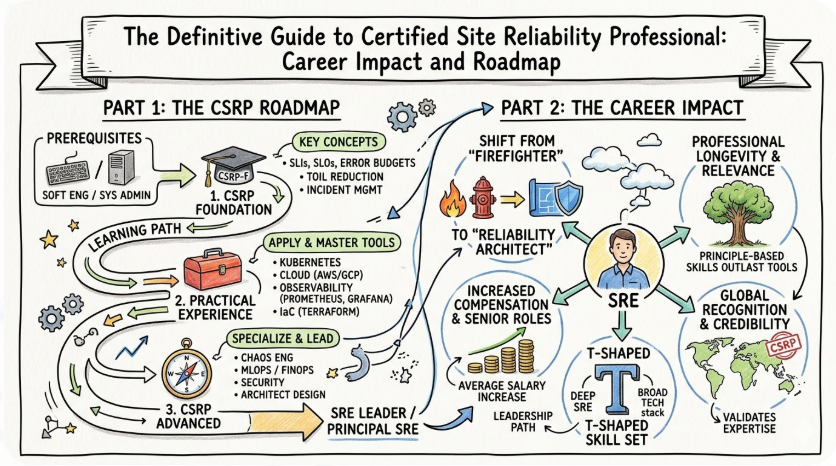
The Certified Site Reliability Professional represents a shift in how the industry views system maintenance and uptime. Rather than treating operations as a reactive task, this program emphasizes an engineering-led approach to reliability. It exists to standardize the practices that Google and other tech giants popularized, making them accessible to the broader enterprise market.
The curriculum is built around the core pillars of SRE, including error budgets, service level objectives, and the elimination of toil. It focuses heavily on real-world production scenarios, ensuring that candidates can handle live incidents and build resilient automation. This certification is not just about passing a test; it is about adopting a mindset that prioritizes long-term system health over short-term fixes.
In modern enterprise practices, this certification aligns perfectly with the move toward self-healing infrastructure and GitOps. It provides a common language for developers and operators to collaborate effectively, ensuring that software is built with operability in mind. By earning this credential, you demonstrate a commitment to modern engineering workflows that reduce downtime and improve deployment frequency.
Who Should Pursue Certified Site Reliability Professional?
This certification is primarily intended for software engineers and systems administrators who want to transition into SRE or Platform Engineering roles. It is also highly beneficial for Cloud Architects and Security professionals who need to understand how reliability impacts their specific domains. Even Data Engineers find value here, as the principles of monitoring and incident response are universal across data pipelines.
For beginners, the program offers a structured entry point into the world of production operations without the confusion of fragmented online tutorials. Experienced engineers use it to formalize their existing knowledge and fill in gaps regarding high-level strategy and organizational reliability. It serves as a bridge, turning tactical operators into strategic engineering assets within their organizations.
Engineering managers and technical leaders should also consider this path to better understand the metrics that drive successful teams. In the context of the global market, and specifically within India’s massive technology hubs, this certification provides a competitive edge. It signals to employers that the candidate understands the fiscal and operational impact of system failures and knows how to prevent them.
Why Certified Site Reliability Professional is Valuable and Beyond
The value of the Certified Site Reliability Professional lies in its focus on evergreen principles rather than fleeting tool sets. While tools like Kubernetes or Terraform may evolve, the need for observability, capacity planning, and incident management remains constant. This certification ensures that your skills remain relevant regardless of which cloud provider or orchestration platform your company uses.
Enterprises are increasingly adopting SRE practices to manage the complexity of microservices and multi-cloud environments. This widespread adoption creates a massive demand for professionals who can maintain stability while the business moves at high velocity. Holding this certification proves you have the discipline to balance feature delivery with the necessary rigor of system reliability.
Furthermore, the return on investment for this certification is seen in accelerated career progression and higher salary benchmarks. Organizations are willing to pay a premium for engineers who can reduce the cost of downtime and improve customer satisfaction through consistent performance. It is a long-term investment in your professional identity as a high-impact contributor to business success.
Certified Site Reliability Professional Certification Overview
The program is delivered via the official portal and is hosted on the SREschool.com website. It is structured to guide a professional from basic principles to advanced architectural strategies through a series of progressive assessments. The ownership of the program lies with industry experts who ensure the content is updated to reflect the latest shifts in cloud-native technology.
The certification approach is heavily weighted toward practical application, often involving hands-on labs or scenario-based questions. It avoids the pitfall of multiple-choice memorization by requiring candidates to demonstrate how they would solve actual production bottlenecks. This makes the credential highly respected by hiring managers who value “on-the-job” readiness.
Structurally, the program is divided into logical modules that cover the entire lifecycle of a production service. From initial design and deployment to monitoring and post-incident analysis, every phase is addressed. This holistic view ensures that a Certified Site Reliability Professional understands the “big picture” of the software delivery pipeline.
Certified Site Reliability Professional Certification Tracks & Levels
The certification is organized into three distinct levels: Foundation, Professional, and Advanced. The Foundation level introduces the core vocabulary and concepts of SRE, making it ideal for those new to the field. It establishes the baseline for all subsequent learning and ensures a solid understanding of why reliability is a shared responsibility.
The Professional level is where the deep technical work begins, focusing on implementation details like service mesh, advanced observability, and automated remediation. This level is designed for active practitioners who are responsible for the day-to-day health of production systems. It maps directly to mid-level and senior SRE roles in most modern technology organizations.
The Advanced level targets architects and technical leads who are responsible for defining the reliability strategy for entire departments or companies. It covers topics like organizational change, cross-team SLIs, and complex disaster recovery planning across multiple regions. These levels allow for a natural career progression from an individual contributor to a strategic leader.
Complete Certified Site Reliability Professional Certification Table
| Track | Level | Who it’s for | Prerequisites | Skills Covered | Recommended Order |
| SRE Core | Foundation | New SREs, Managers | Basic IT knowledge | SLIs, SLOs, Toil, Error Budgets | 1 |
| SRE Core | Professional | Mid-level Engineers | Foundation Cert | Observability, Automation, On-call | 2 |
| SRE Core | Advanced | Architects, Leads | Professional Cert | Strategic Planning, DR, Org Culture | 3 |
| DevOps Track | Professional | DevOps Engineers | CI/CD experience | Infrastructure as Code, GitOps | 1 |
| Platform | Professional | Platform Engineers | Cloud experience | Internal Developer Platforms, API Design | 2 |
| Security | Specialist | SecOps Engineers | Basic Security | DevSecOps, Reliable Security Audits | 1 |
Detailed Guide for Each Certified Site Reliability Professional Certification
Certified Site Reliability Professional – Foundation
What it is
This certification validates a candidate’s understanding of the fundamental principles of Site Reliability Engineering. It ensures the individual can speak the language of SRE and understands the core metrics used to measure system health.
Who should take it
This is suitable for junior developers, system administrators, and project managers who are new to the SRE philosophy. It is also an excellent starting point for those moving from traditional “Ops” to a more modern engineering role.
Skills you’ll gain
- Defining and calculating SLIs and SLOs.
- Understanding the concept of Error Budgets and how they govern releases.
- Identifying and eliminating toil through basic automation.
- Principles of incident response and post-mortem documentation.
Real-world projects you should be able to do
- Create a basic reliability dashboard for a web application.
- Draft a Service Level Agreement (SLA) based on business requirements.
- Conduct a blameless post-mortem for a simulated outage.
Preparation plan
- 14 Days: Focus on reading the core SRE handbooks and understanding the terminology.
- 30 Days: Review case studies of SRE implementations and take practice quizzes.
- 60 Days: Participate in community forums and explain the concepts to peers to solidify knowledge.
Common mistakes
- Focusing too much on specific tools rather than the underlying principles.
- Underestimating the cultural and organizational aspects of the SRE mindset.
- Confusing SLAs with SLOs during the examination.
Best next certification after this
- Same-track option: CSRP Professional
- Cross-track option: Certified DevOps Professional
- Leadership option: Engineering Management Foundation
Certified Site Reliability Professional – Professional
What it is
This certification validates the ability to implement SRE practices in a live, complex environment. It focuses on the technical execution of monitoring, automation, and incident management strategies.
Who should take it
It is designed for working engineers with at least 2 years of experience in cloud or systems engineering. Candidates should be comfortable with coding/scripting and have a solid grasp of containerization.
Skills you’ll gain
- Advanced observability using metrics, logs, and distributed tracing.
- Developing automated self-healing scripts and playbooks.
- Managing complex on-call rotations and escalation paths.
- Performance tuning and capacity planning for distributed systems.
Real-world projects you should be able to do
- Implement a full-stack monitoring solution for a microservices cluster.
- Build an automated “Chaos Engineering” experiment to test system resilience.
- Design an auto-scaling logic based on custom reliability metrics.
Preparation plan
- 14 Days: Review advanced networking and distributed system architecture.
- 30 Days: Hands-on lab work focusing on Prometheus, Grafana, and Kubernetes.
- 60 Days: Deep dive into incident management simulations and script automation.
Common mistakes
- Neglecting the importance of distributed tracing in microservices.
- Over-automating without proper testing, leading to “cascading failures.”
- Failing to align technical SLOs with actual user experience.
Best next certification after this
- Same-track option: CSRP Advanced
- Cross-track option: Certified Cloud Security Professional
- Leadership option: Technical Program Management
Certified Site Reliability Professional – Advanced
What it is
This is the pinnacle of the SRE track, validating the ability to lead high-level reliability initiatives across an entire organization. It focuses on architecture, strategy, and cultural transformation.
Who should take it
This is for Principal Engineers, Architects, and aspiring VPs of Engineering. It requires significant experience in managing large-scale production environments and leading technical teams.
Skills you’ll gain
- Designing multi-region disaster recovery and high-availability architectures.
- Driving cultural change and adopting “Error Budget” policies at scale.
- Managing the total cost of ownership and reliability trade-offs.
- Mentoring and building high-performing SRE teams.
Real-world projects you should be able to do
- Create a multi-year reliability roadmap for a global enterprise.
- Design a “Global Load Balancing” strategy for 99.99% uptime.
- Lead a cross-functional task force to resolve systemic architectural weaknesses.
Preparation plan
- 14 Days: Study enterprise-scale architectural patterns and disaster recovery whitepapers.
- 30 Days: Analyze real-world major outages (like AWS or Facebook) and their remediation.
- 60 Days: Focus on leadership frameworks and organizational psychology for engineering.
Common mistakes
- Losing sight of the business goals in favor of perfect technical reliability.
- Failing to communicate the value of SRE to non-technical stakeholders.
- Over-complicating architectures beyond what the team can realistically support.
Best next certification after this
- Same-track option: Continued Professional Development (CPE)
- Cross-track option: FinOps Certified Practitioner
- Leadership option: CTO/VP of Engineering Leadership Track
Choose Your Learning Path
DevOps Path
The DevOps path focuses on the seamless integration of development and operations through automation. Engineers on this path prioritize the CI/CD pipeline and ensuring that code moves from a developer’s machine to production with minimal friction. The Certified Site Reliability Professional provides the “reliability guardrails” needed to ensure these fast deployments don’t compromise system stability. It is the perfect evolution for a DevOps engineer looking to add more “Engineering” to their “Operations.”
DevSecOps Path
In the DevSecOps path, security is treated as a continuous process rather than a final check. Professionals here integrate security scanning and compliance directly into the automated workflows. The SRE certification complements this by teaching how to maintain security posture without introducing latency or downtime. It helps security engineers understand that a secure system must also be a highly available and performant system.
SRE Path
The SRE path is the most direct application of this certification, focusing purely on the health and scaling of production services. Engineers here spend their time writing code to manage systems, reducing toil, and participating in on-call rotations. This path is ideal for those who enjoy troubleshooting complex distributed systems and building automated solutions to prevent incidents. It leads directly from an Individual Contributor to a Reliability Architect role.
AIOps Path
The AIOps path leverages artificial intelligence and machine learning to enhance IT operations. Professionals in this space use data-driven insights to predict outages and automate complex decision-making processes. The SRE foundation is vital here because one must understand the manual processes and metrics before they can successfully apply AI to them. It ensures that the AI models are focused on the most impactful reliability metrics.
MLOps Path
The MLOps path is specifically tailored for those managing the lifecycle of machine learning models in production. Unlike standard software, ML models require continuous monitoring for data drift and performance degradation. SRE principles are perfectly suited for this, as they provide the framework for monitoring model “health” and automating retraining pipelines. This path bridges the gap between data science and production engineering.
DataOps Path
DataOps focuses on the reliability and speed of data pipelines and analytical processing. As companies become more data-driven, the “uptime” of a data warehouse or a real-time stream becomes as critical as the website itself. Professionals on this path apply CSRP concepts like SLOs to data latency and accuracy. This ensures that the data being served to business leaders is both timely and trustworthy.
FinOps Path
The FinOps path combines finance, engineering, and business to optimize cloud spend. In a world of elastic infrastructure, a “reliable” system is also one that is cost-efficient and doesn’t experience “bill shock.” CSRP training helps FinOps practitioners understand the technical trade-offs between high availability and cost. It allows for more nuanced conversations about whether 99.99% uptime is worth the additional cloud expenditure.
Role → Recommended Certified Site Reliability Professional Certifications
| Role | Recommended Certifications |
| DevOps Engineer | CSRP Foundation, DevOps Professional |
| SRE | CSRP Foundation, Professional, and Advanced |
| Platform Engineer | CSRP Professional, Platform Engineering Spec |
| Cloud Engineer | CSRP Foundation, Cloud Provider Certs |
| Security Engineer | CSRP Foundation, DevSecOps Specialist |
| Data Engineer | CSRP Foundation, DataOps Specialist |
| FinOps Practitioner | CSRP Foundation, FinOps Specialist |
| Engineering Manager | CSRP Foundation, Leadership Track |
Next Certifications to Take After Certified Site Reliability Professional
Same Track Progression
Once you have mastered the Professional level, the most logical step is the Advanced level. This allows you to transition from doing the work to designing the systems that govern the work. You might also consider deep-diving into specific SRE sub-disciplines like Chaos Engineering or Advanced Observability. Staying within this track establishes you as a subject matter expert in the core domain of reliability.
Cross-Track Expansion
If you want to become a “T-shaped” professional, expanding into DevSecOps or FinOps is highly recommended. Understanding the security and financial implications of your SRE decisions makes you a much more valuable asset to the business. You could also look into Cloud-Specific Architect certifications to complement your vendor-neutral SRE knowledge. This breadth of knowledge allows you to lead larger, more complex digital transformation projects.
Leadership & Management Track
For those looking to move away from the keyboard and into people management, the Leadership track is the way to go. This involves certifications in Technical Program Management or Engineering Leadership. These programs teach you how to build SRE teams, manage budgets, and align engineering efforts with corporate strategy. It is the transition from managing systems to managing the people who build and run those systems.
Training & Certification Support Providers for Certified Site Reliability Professional
DevOpsSchool
This provider is well-known for its extensive catalog of technical training and hands-on bootcamps. They offer structured coaching for the CSRP, focusing heavily on the practical tools and scripts needed to succeed in the exam. Their instructors are typically industry veterans who bring real-world scenarios into the classroom, making the learning experience highly relevant for working professionals.
Cotocus
Cotocus focuses on specialized technology training with a boutique approach to professional development. They provide tailored resources for SRE aspirants, ensuring that each student receives the attention needed to master complex topics like distributed tracing. Their curriculum is often updated to reflect the latest trends in the cloud-native ecosystem, making them a reliable choice for current information.
Scmgalaxy
As a community-driven platform, Scmgalaxy offers a wealth of free and paid resources for DevOps and SRE professionals. They provide comprehensive study guides and practice exams that are instrumental for anyone preparing for the CSRP. Their focus on the broader software configuration management landscape provides a unique perspective on how reliability fits into the entire development lifecycle.
BestDevOps
BestDevOps prides itself on delivering high-quality, streamlined training for modern engineering roles. Their CSRP preparation modules are designed to be efficient, focusing on the most critical concepts to help busy engineers get certified quickly. They offer a mix of video content and interactive labs that simulate real production environments for a well-rounded learning experience.
devsecopsschool.com
While specializing in security, this provider understands that reliability and security are two sides of the same coin. They offer integrated courses that show how SRE principles can be applied to secure software delivery. This is an excellent choice for professionals who want to dual-track their learning in both reliability and security domains.
sreschool.com
As the primary host for the CSRP, this site is the definitive source for all certification materials and exam standards. They provide the most direct and accurate information regarding the curriculum and assessment criteria. For those seeking the most official and up-to-date guidance, this should be the first and most frequent stop on their certification journey.
aiopsschool.com
This provider focuses on the future of operations, specifically how AI can be leveraged to maintain system health. Their training integrates CSRP fundamentals with machine learning concepts, preparing engineers for the next wave of operational technology. It is ideal for those who want to stay ahead of the curve in automated system management.
dataopsschool.com
Dataopsschool specializes in the intersection of data engineering and operational excellence. They offer specific tracks that apply CSRP principles to data pipelines, ensuring that data is delivered reliably and at scale. This is a vital resource for Data Engineers who are increasingly being held to the same uptime standards as web developers.
finopsschool.com
This provider focuses on the financial management side of the cloud, helping engineers understand the cost of their architectural choices. By combining SRE principles with financial accountability, they help professionals build systems that are both reliable and profitable. It is a must-visit for any engineer moving into a role with budgetary responsibilities.
Frequently Asked Questions (General)
- How difficult is the CSRP exam compared to other certifications?
The exam is moderately difficult because it focuses on practical application rather than just theory. It requires a solid understanding of how systems behave under stress, which can be challenging for those without production experience. - What is the typical time required to prepare for the Foundation level?
Most professionals find that 4 to 6 weeks of consistent study is sufficient. This allows enough time to read the core materials and get hands-on experience with the basic tools. - Are there any mandatory prerequisites for the CSRP Professional level?
Yes, typically you must hold the Foundation certification or demonstrate equivalent industry experience. This ensures that all candidates have a baseline understanding before moving to advanced topics. - Does this certification help in getting a job in India?
Absolutely. India’s tech sector is rapidly moving toward SRE and Platform Engineering models, and this certification is highly recognized by top-tier service and product companies. - Is the CSRP recognized globally?
Yes, the principles taught are based on industry standards that are applied worldwide. This makes the certification valuable for those looking to work in international markets or for global tech firms. - How often does the certification need to be renewed?
Generally, the certification is valid for two to three years. Renewal usually involves taking an updated exam or demonstrating continued professional development in the field. - Is there a heavy focus on coding in the SRE track?
While you don’t need to be a senior developer, a working knowledge of Python, Go, or Bash is essential. SRE is “engineering-led,” so automation through code is a core requirement. - Can a project manager benefit from the Foundation certification?
Yes, it provides project managers with the vocabulary and metrics needed to talk to engineering teams. It helps them understand why certain “reliability” tasks are prioritized over new features. - What is the Return on Investment (ROI) for this certification?
The ROI is usually seen within the first year through salary increases or promotions. Furthermore, the reduction in stress from better-managed incidents is an invaluable personal benefit. - Does the exam cover specific cloud providers like AWS or Azure?
The core certification is vendor-neutral, focusing on principles. However, specific labs may use common cloud environments to demonstrate how those principles are applied in practice. - Are there any community groups for CSRP candidates?
Yes, there are several active forums and LinkedIn groups where candidates share study tips and job opportunities. Engaging with these communities is highly recommended for success. - What is the passing score for the exams?
While the exact score can vary by level, it generally sits around 70%. The focus is on demonstrating competency across all the core domains of the curriculum.
FAQs on Certified Site Reliability Professional
- What makes CSRP different from a standard DevOps certification?
While DevOps focuses on the “how” of delivery, CSRP focuses on the “what happens next” of production health. It is much more focused on the long-term stability and scaling of systems after they have been deployed. - Can I skip the Foundation level if I have 5 years of experience?
While some providers allow for direct entry into the Professional level based on a resume review, it is often recommended to take the Foundation exam. It ensures you don’t have gaps in the specific SRE terminology used in the program. - How are the practical labs conducted during the assessment?
Labs are typically conducted in a virtualized browser environment where you are given a set of tasks to perform on a live cluster. You might be asked to fix a broken service or configure a specific monitoring alert. - Is the “Error Budget” concept a major part of the exam?
Yes, understanding how to calculate and defend an Error Budget is a cornerstone of the CSRP. You will be expected to know how it influences the balance between feature velocity and system reliability. - Do I need to know Kubernetes to pass the Professional level?
While the certification is vendor-neutral, Kubernetes is the industry standard for orchestration. Therefore, many of the practical examples and labs will assume a basic to intermediate understanding of container management. - Are post-mortems and incident reports part of the curriculum?
Yes, the “human” side of SRE is very important. You will be tested on your ability to write clear, blameless post-mortems that lead to actionable improvements in the system. - How does CSRP address the concept of “Toil”?
The curriculum teaches you how to identify repetitive, manual tasks that provide no long-term value. You will be tested on strategies to automate these tasks and measure the time saved. - Is this certification useful for someone working in a legacy on-premise environment?
Definitely. While the tools might differ, the principles of reliability, monitoring, and incident response are just as important for on-premise servers as they are for the cloud.
Final Thoughts: Is Certified Site Reliability Professional Worth It?
From the perspective of a mentor who has seen the industry transition from tape drives to serverless functions, I can tell you that the shift to SRE is not a fad. It is a necessary evolution born from the sheer complexity of modern software. The Certified Site Reliability Professional is worth the investment because it forces you to stop thinking like a “mechanic” who fixes things when they break and start thinking like an “architect” who prevents them from breaking in the first place.
If you are tired of the constant “firefighting” and want to bring more discipline and predictability to your career, this is the right path. It isn’t just about the certificate on your wall; it’s about the confidence you gain when you know exactly how to handle a massive system failure. It gives you the tools to argue for better engineering practices using data rather than just opinions.
My advice is to start with the Foundation level, even if you think you know it all. Solidify your basics, embrace the culture of blamelessness, and then move aggressively into the technical depths of the Professional track. The market is hungry for engineers who can guarantee uptime in a world that never sleeps. This certification is your ticket to being one of those highly sought-after professionals.



Leave a Reply
You must be logged in to post a comment.