Introduction
Moving to Austria is a dream for many professionals. Whether you are enticed by the pristine alpine landscapes, the rich cultural heritage of cities like Vienna and Salzburg, or the world-class stability of the Austrian economy, this country offers an unmatched quality of life. For skilled professionals, students, and healthcare experts, Austria is more than just a travel destination—it is a pathway to a secure, prosperous future.
However, navigating the immigration landscape can feel overwhelming. The Austrian government uses a sophisticated, points-based system to manage immigration, ensuring that those who contribute to the economy find their footing quickly. This is where the Austria PR Points Calculator becomes your most valuable tool.
Understanding your standing before you apply is the secret to a smooth transition. Eligibility checking isn’t just a formality; it is a strategic step that helps you identify your strengths and address your gaps. This guide breaks down the complex immigration rules into simple, actionable steps, helping you understand exactly how your education, experience, and skills align with Austrian immigration requirements.
What Is an Austria PR Points Calculator?
An Austria PR Points Calculator is an assessment tool designed to provide an estimation of your eligibility for the Austrian immigration system. Think of it as a pre-screening compass. It maps your personal and professional profile—age, education, work history, and language skills—against the official criteria set by the Public Employment Service (AMS).
The Purpose of the System
Austria uses a points-based model to streamline its labor market intake. Rather than relying on arbitrary selection, the government assigns specific point values to attributes that correlate with success in the Austrian labor market. If you meet the minimum threshold, you become eligible to apply for the Red-White-Red (RWR) Card.
Who Should Use the Calculator?
- IT Professionals & Engineers: Those seeking roles in high-demand technical sectors.
- Healthcare Professionals: Nurses, doctors, and specialists needed for the Austrian healthcare system.
- Graduates: Students finishing degrees in Austria who want to transition to a permanent work visa.
- Skilled Workers: Professionals from various industries aiming for European career growth.
Difference Between Eligibility and Approval
It is vital to distinguish between a calculator’s score and official visa approval. The calculator provides an estimate based on the current regulatory framework. However, the official points are always awarded and verified by the AMS during the actual application process. Using a calculator helps you understand your chances, but it is not a legal guarantee of a visa.
How Austria Immigration Points System Works
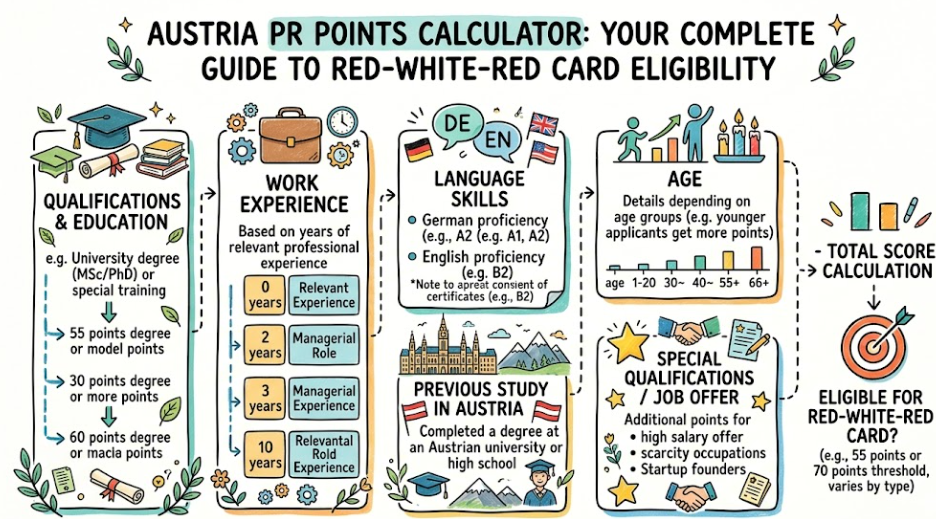
The system operates on a structured scoring framework. While the specific point values vary depending on the stream (e.g., Very Highly Qualified vs. Shortage Occupations), the core factors remain consistent.
Age Points
Austria values a balanced workforce. Points are typically allocated based on your age bracket. Generally, younger professionals receive higher points, as they are viewed as having a longer career trajectory ahead of them within the Austrian economy.
Education Points
Your academic background is a primary driver of your score.
- Diplomas: Vocational training or diplomas relevant to your field.
- Bachelor’s Degree: Standard university degrees.
- Master’s Degree: Advanced education increases your total points significantly.
- PhD: Often the highest tier, demonstrating deep expertise and research capability.
Language Skills
Communication is the bridge to integration.
- German Language: Proficiency in German is highly rewarded. Even basic A1/A2 levels can add meaningful points to your score.
- English Proficiency: In many global IT and corporate sectors, English is the working language, and your fluency here also counts toward your eligibility.
Work Experience
Experience is measured by your track record in your specific field.
- Local Experience: If you have already worked in Austria, your points are maximized because you have proven your ability to adapt.
- International Experience: Your global work history demonstrates your ability to thrive in different environments.
Salary & Job Offer
A formal job offer from an Austrian employer acts as a multiplier. For many streams, having a high-salary job offer not only boosts your points but is a prerequisite for the application.
Austria Red-White-Red Card Explained
The Red-White-Red Card is your primary gateway to working and living in Austria. It is not just a work permit; it is a residence permit for skilled workers.
Types of Pathways
- Very Highly Qualified Workers: For those with exceptional academic and professional achievements.
- Skilled Workers in Shortage Occupations: For professionals in fields where Austria faces labor shortages (like IT or specific engineering niches).
- Other Key Workers: For specialists who do not fall into the first two categories but are essential to a company’s operations.
- Graduates from Austrian Universities: A streamlined path for those who have completed their education within the country.
- Self-Employed Key Workers: For entrepreneurs bringing investment and innovation to the Austrian market.
Visa Validity and Transition
The RWR Card is usually valid for 24 months. After this period, if you have remained employed, you can transition to the “Red-White-Red Card Plus,” which offers unrestricted access to the Austrian labor market. This is the stepping stone to long-term residency.
Austria PR Points Calculator Breakdown
To use the Austria PR Points Calculator effectively, you must understand the weight of each category.
| Factor | Maximum Points |
| Age | Varies by stream (High weight) |
| Education | Up to 30-40 points |
| Language Skills | Up to 25 points |
| Work Experience | Up to 20-25 points |
| Job Offer / Bonus | Salary-dependent |
Understanding the Weights:
- Age: Essential for long-term integration.
- Education: Represents your foundational skill set.
- Language: Your ability to navigate daily life and the workplace.
- Work Experience: Validates your practical contribution to the Austrian economy.
Step-by-Step Example of Austria PR Score Calculation
Let’s look at three realistic profiles to see how the points system applies.
Example 1: Software Engineer
- Profile: 28 years old, Master’s in Computer Science, 5 years of international experience, English fluent, German A2.
- Calculation:
- Age: Maximum points (due to age bracket).
- Education: High points (Master’s level).
- Experience: Strong points for technical background.
- Language: Moderate points for German A2.
- Outcome: Highly likely to qualify under the Shortage Occupation stream.
Example 2: Nurse/Healthcare Worker
- Profile: 35 years old, Diploma in Nursing, 7 years of work experience, German B1.
- Calculation:
- Age: Good points.
- Education: Qualification points + Shortage occupation bonus.
- Language: High points for B1 German proficiency.
- Outcome: Strong eligibility for the Skilled Worker stream.
Example 3: Student Transitioning to Work Visa
- Profile: 25 years old, Master’s from an Austrian University, English and German fluent, job offer in Finance.
- Calculation:
- Age: Maximum points.
- Education: Bonus points for Austrian education.
- Language: Max points for bilingual skills.
- Outcome: Streamlined transition to the Red-White-Red Card.
Austria PR Eligibility Requirements
Meeting the points threshold is only half the battle. You must also satisfy specific legal requirements:
- Education: Degrees must be verified and often need to be comparable to Austrian standards.
- Shortage Occupation Status: Your job title must appear on the official government list of shortage occupations for that year.
- Language Proficiency: You must have recognized certificates (ÖSD, Goethe, or IELTS/TOEFL for English).
- Work Contract: An authentic job offer that meets the minimum salary threshold defined by the AMS.
- Health Insurance & Financials: You must prove you can support yourself and have adequate health coverage.
Benefits of Using an Austria PR Points Calculator
- Fast Eligibility Checking: Save hours of manual research.
- Strategic Planning: Identify exactly which areas you need to improve (e.g., learning German).
- Reduced Rejection Risk: By knowing your score beforehand, you avoid applying when you are unlikely to be approved.
- Visa Stream Selection: Understand if you qualify for “Very Highly Qualified” or if you should target “Skilled Worker” pathways.
Step-by-Step Guide to Calculate Austria PR Points
- Gather Educational Documents: Have your degrees and vocational certificates ready for verification.
- Check Language Proficiency: Take a certified language test to know your exact level (A1, A2, B1, etc.).
- Calculate Work Experience: Tally your months of employment. Ensure you have letters of reference.
- Verify Job Offer Eligibility: Ensure your prospective employer is willing to sponsor the RWR application.
- Calculate Bonus Points: Look for criteria like MINT subjects, research achievements, or Austrian education history.
- Check Final Eligibility: Input all data into the Austria PR Points Calculator to see your estimated total.
How to Increase Austria PR Score
If your score is close but not quite enough, take these proactive steps:
- Learn German: Moving from A1 to B1 can add significant points to your total.
- Gain Targeted Experience: Ensure your work experience is relevant to your job role in Austria.
- Higher Education: Consider certifications or postgraduate diplomas if your points are low.
- Get an Austrian Job Offer: A strong offer with a competitive salary is the single biggest “bonus” in the system.
- Focus on Shortage Occupations: Ensure your job description is aligned with the specific titles on the official shortage list.
Common Mistakes to Avoid
- Wrong Score Calculation: Many applicants over-estimate their points by misunderstanding definitions of “skilled” vs. “other” work.
- Ignoring German: Assuming English is “enough.” While possible in some IT sectors, German is essential for maximum points.
- Outdated Criteria: Immigration rules change yearly. Always use the latest calculator.
- Missing Documents: Incomplete documentation during the AMS check is the most common reason for delay.
- Choosing the Wrong Stream: Applying for “Very Highly Qualified” when you actually fit the “Shortage Occupation” criteria better.
Real-Life Case Studies
1. Young IT Professional Moving to Austria
- Initial Profile: High technical skill, but low German language points.
- Weakness: Insufficient points due to language.
- Improvement: Spent 6 months in an intensive German course (reaching A2).
- Outcome: Score crossed the minimum threshold; received the RWR card.
2. Married Couple Improving Eligibility
- Initial Profile: Main applicant had a job offer, but the total score was borderline.
- Weakness: The partner’s qualifications were not fully integrated.
- Improvement: Main applicant focused on boosting their “Shortage Occupation” proof and secured a higher salary offer.
- Outcome: Successful application as a skilled worker.
3. Healthcare Worker Getting Selected
- Initial Profile: Experienced nurse, but lacked the required official degree equivalence.
- Weakness: Documentation gap.
- Improvement: Went through the formal nostrification (recognition) process for their degree.
- Outcome: Met the requirements for the skilled healthcare worker stream.
FAQs (Frequently Asked Questions)
1. What is the Austria PR points calculator?
It is a tool that estimates your eligibility for the Red-White-Red Card based on official Austrian immigration scoring factors.
2. How many points are needed for Austria PR?
The required minimum varies by stream (e.g., 55 or 70 points). The Austria PR Points Calculator will show you the requirement for your specific pathway.
3. What is the Red-White-Red Card?
It is a residence and work permit for skilled workers from third countries, valid for 24 months, with a path to permanent residency.
4. Is German language mandatory?
While not mandatory for every single stream, it is highly recommended and adds significant points to your score.
5. Can I move to Austria without a job offer?
Some streams, like the “Very Highly Qualified” pathway, allow you to apply for a Job Seeker Visa to look for work, but most require a job offer first.
6. Does age affect eligibility?
Yes, younger professionals generally receive more points for age than those in older brackets.
7. Can students settle permanently in Austria?
Yes, after graduation, students can transition to an RWR card and eventually to permanent residency.
8. How accurate are online calculators?
They are accurate estimates based on official regulations. However, the final decision rests with the Austrian authorities.
9. Can I work in any job with the RWR card?
No, the standard RWR card is tied to a specific employer for the first 24 months.
10. What is a “Shortage Occupation”?
It is a list of professions (like IT, engineering, healthcare) that are in high demand in Austria.
11. Does my experience outside Austria count?
Yes, both local and international experience count toward your points total.
12. How often do the rules change?
Immigration regulations and shortage lists are reviewed regularly. It is important to stay updated.
Conclusion
The path to Austria is attainable for those who approach it with a clear strategy. By using the Austria PR Points Calculator, you take the guesswork out of your immigration plan. Whether you are aiming for a career in IT, healthcare, or engineering, understanding the points system allows you to position yourself as a strong candidate. Start early, focus on improving your language skills and credentials, and you will be well on your way to a new life in Austria.










Leave a Reply
You must be logged in to post a comment.