Introduction
Canada continues to be one of the top immigration destinations in the world for skilled professionals and families. With a massive geography and a booming economy, the country heavily relies on global talent to fill critical gaps in its labor market.
The demand for skilled workers in Canada is higher than ever before. Employers are actively seeking IT professionals, engineers, healthcare workers, and tradespeople. As a result, millions of professionals and families choose Canada to build a stable and prosperous future.
Before you start packing your bags, you need to understand the Canada PR CRS Calculator. This tool is the foundation of your entire immigration journey. It determines whether your profile is strong enough to receive an invitation from the Canadian government.
Checking your eligibility matters before applying because the process takes time, effort, and money. Knowing your score upfront helps you plan better and avoid unexpected rejections.
This guide will walk you through exactly how the Comprehensive Ranking System (CRS) works, step by step. We will break down the points, provide realistic examples, and show you exactly how to improve your score.
Why Move to Canada?
Immigrating to Canada is about securing a better future. The country offers incredible benefits that go far beyond just a new job.
- Better career opportunities: Access to a globally competitive job market with continuous growth in the tech, medical, and engineering sectors.
- High salary potential: Canadian employers offer strong compensation packages and excellent work-life balance.
- Free healthcare & education: Permanent residents enjoy world-class public healthcare and free education for children up to the high school level.
- Safe environment for families: Canada consistently ranks as one of the safest and most politically stable countries in the world.
- High quality of life: Clean cities, diverse communities, and beautiful natural landscapes make it an amazing place to live.
- Pathway to citizenship: Getting Canada PR is the first major step toward obtaining a Canadian passport.
What Is a Canada PR CRS Calculator?
Definition
The Canada PR CRS Calculator is a points-based evaluation tool used by Immigration, Refugees and Citizenship Canada (IRCC). It calculates your Comprehensive Ranking System (CRS) score based on your personal and professional profile.
Purpose
The main purpose of the Canada immigration points calculator is to rank candidates who want to move to Canada as skilled workers. Instead of processing applications on a first-come, first-served basis, the Canadian government uses this score to select the most qualified applicants.
Calculating your CRS points before immigration is crucial. It tells you exactly where you stand in the applicant pool and highlights areas where you need to improve before submitting your official Express Entry profile.
How the Canada Immigration Points System Works
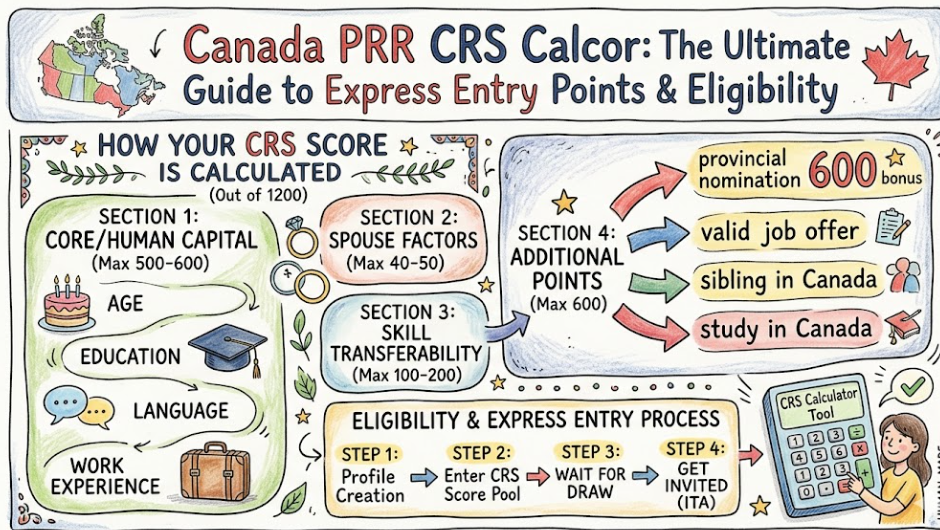
The CRS system gives you a score out of 1,200 total possible points. These points are awarded based on core human capital factors. The system looks at your age, education, language skills, and work experience.
Candidates with the highest scores are regularly selected from the Express Entry pool. They are then issued an Invitation to Apply (ITA) for permanent residency.
Why Canada Uses a CRS-Based Immigration System
Canada uses this point-based system to ensure its immigration policies directly benefit the national economy.
- Skilled labor shortages: The system is designed to target individuals who have the exact skills missing in the local labor market.
- Economic growth: By bringing in highly educated and experienced workers, Canada maintains strong economic productivity.
- Talent-based immigration: The CRS ensures fairness. Your selection is based purely on your qualifications, merit, and language abilities.
Who Should Use the Calculator?
Anyone planning to apply for permanent residency through the economic classes should use a CRS score calculator Canada tool.
Examples of ideal candidates include:
- Software engineers looking for global tech hubs.
- Nurses and doctors seeking better working conditions and pay.
- Student graduates who recently finished a degree and want to settle abroad.
- Mechanical engineers aiming for infrastructure and manufacturing roles.
- IT professionals managing networks, cloud systems, and cybersecurity.
The Role of the Canada Express Entry System
The Express Entry system is the online portal that manages permanent residency applications. It is the engine that actually holds your profile and ranks it using the CRS calculator.
Eligibility Score vs. Final PR Approval
Many beginners confuse eligibility with final approval.
- Eligibility score (CRS points): This is simply your rank in the Express Entry pool. A high score means you are likely to be invited to apply.
- Final PR approval: Even if you have a perfect CRS score, the Canadian government will still conduct thorough background checks. They will verify your medical health, criminal record, and the authenticity of your educational and work documents before granting final PR approval.
How Canada CRS Points System Works
Your total score is a combination of several different factors. Understanding how each category is weighted is the key to mastering the Canada Express Entry points system.
Age Points
Age is a massive factor in the CRS calculator. Canada wants young workers who can contribute to the economy for decades.
The maximum points are awarded to applicants who are between 20 and 29 years old. Once you turn 30, your points start dropping. By the time you reach 45, you receive zero points for the age factor.
- Example: A 29-year-old single applicant gets 110 points for age. When they turn 30, it drops to 105 points.
Education Points
Your highest level of education significantly impacts your CRS score. Your foreign credentials must be evaluated through an Educational Credential Assessment (ECA) to match Canadian standards.
- Diploma: A standard post-secondary diploma provides a solid baseline of points.
- Bachelor’s degree: Offers higher points and unlocks better skill transferability bonuses.
- Master’s degree: Highly preferred. This provides a massive boost to your core human capital score.
- PhD: Offers the maximum possible points for the education category.
Language Skills
Language proficiency is often the easiest area to improve your score. You must prove your abilities in English, French, or both.
- IELTS/CELPIP importance: You are tested on reading, writing, listening, and speaking. Scoring high on the IELTS General Training or CELPIP test is critical.
- French language advantage: If you take the TEF or TCF exams and prove strong French skills, you receive significant bonus points.
- CLB levels: Canada grades your test results using the Canadian Language Benchmark (CLB). A score of CLB 9 or higher triggers massive bonus points across your entire profile.
Work Experience
The system rewards candidates who have proven themselves in the professional world.
- Canadian work experience: Experience gained inside Canada while on a valid work permit yields very high points.
- International work experience: Your foreign work experience is highly valued, especially when paired with strong English or French skills.
- Skilled NOC/TEER jobs: Your work experience only counts if it falls under specific skilled categories (TEER 0, 1, 2, or 3) in the National Occupational Classification (NOC) system.
Job Offer & Provincial Nomination
You do not strictly need a job offer to get Canada PR, but having one helps.
- LMIA-supported job offer: If a Canadian employer offers you a valid, full-time job supported by a Labour Market Impact Assessment (LMIA), you get 50 to 200 extra points.
- Provincial Nominee Program (PNP) bonus points: If a Canadian province nominates you because they need your specific skills, you are awarded an incredible 600 bonus points. This practically guarantees an invitation.
Adaptability Factors
Canada looks at whether you can easily settle into the country.
- Spouse profile: If you apply with a spouse, their education, language skills, and work experience can add points to your overall score.
- Canadian education: Graduating from a Canadian college or university provides a strong point bonus.
- Sibling in Canada: If you or your spouse have a brother or sister who is a Canadian citizen or permanent resident, you get bonus points.
- French language bonus: Bilingual applicants get special adaptability points.
Quick Look at CRS Scoring System Elements
| Factor Category | Why it Matters | Can you improve it? |
| Age | Shows long-term economic value | No, it decreases over time |
| Education | Proves specialized knowledge | Yes, by pursuing a higher degree |
| Language | Ensures seamless workplace integration | Yes, by retaking IELTS or learning French |
| Work Experience | Proves capability in your profession | Yes, by working more years |
Canada Express Entry System Explained
What Is Express Entry?
Express Entry is not a new immigration program. It is simply the online database system used by the Canadian government to manage applications for skilled workers.
It organizes candidates into a pool, ranks them using the Canada PR CRS Calculator, and issues invitations to the best profiles.
Types of Canada Immigration Pathways
Express Entry manages three primary federal programs and connects with various provincial programs.
Federal Skilled Worker Program (FSWP)
This is the most popular pathway for professionals living outside of Canada.
- Eligibility requirements: You need at least one year of continuous full-time skilled work experience and a minimum language score of CLB 7.
- Minimum score requirement: You first need to pass a 67-point eligibility grid just to enter the pool. Then, you compete based on your CRS score.
- Required documents: ECA for education, IELTS/CELPIP results, employer reference letters, and proof of funds.
- Processing time: Typically 6 months from the time you submit your complete application.
- Job offer requirements: Not required, but helpful.
- PR pathway: Direct route to permanent residency upon approval.
Canadian Experience Class (CEC)
This program is specifically designed for international students and temporary foreign workers already living in Canada.
- Eligibility requirements: You need at least one year of skilled work experience gained inside Canada within the last three years.
- Minimum score requirement: Competes based on the general CRS cutoff, but CEC-specific draws often require lower scores.
- Required documents: Proof of Canadian work experience (T4 tax slips, pay stubs), and language test results.
- Processing time: Generally processed faster, often under 6 months.
- Job offer requirements: No job offer is required.
- PR pathway: Seamless transition from temporary resident to permanent resident.
Federal Skilled Trades Program (FSTP)
This pathway targets qualified tradespeople, such as electricians, plumbers, and mechanics.
- Eligibility requirements: Requires at least two years of full-time work experience in a skilled trade.
- Minimum score requirement: Lower CRS cutoffs compared to FSWP, but highly specific to trade occupations.
- Required documents: Proof of trade experience, language results, and either a Canadian job offer or a certificate of qualification from a Canadian province.
- Processing time: Approximately 6 months.
- Job offer requirements: Yes, a valid job offer OR a Canadian trade certificate is mandatory.
- PR pathway: Direct path to permanent residency for essential blue-collar workers.
Provincial Nominee Program (PNP)
Canadian provinces have their own immigration streams aligned with Express Entry to target local labor shortages.
- Eligibility requirements: Varies heavily by province. Some target IT workers, others target healthcare professionals or farmers.
- Minimum score requirement: Provinces can invite candidates with very low CRS scores if their skills are urgently needed.
- Required documents: Standard Express Entry documents plus specific provincial forms.
- Processing time: Adds a few months to the process because the province must approve you before the federal government does.
- Job offer requirements: Many PNPs require a local job offer, though some “human capital” streams do not.
- PR pathway: Receiving a nomination adds 600 CRS points, practically ensuring an Express Entry invitation.
Canada PR CRS Calculator Breakdown
Understanding exactly how the 1,200 points are distributed is essential. Below is the breakdown of the maximum points available for an applicant applying without a spouse (single).
| Factor | Maximum Points |
| Age | 110 |
| Education | 150 |
| Language Skills | 160 |
| Canadian Work Experience | 80 |
| Skill Transferability (Combinations) | 100 |
| Job Offer (Arranged Employment) | 200 |
| Sibling in Canada | 15 |
| French Language Bonus | 50 |
| Provincial Nomination | 600 |
Core Human Capital Factors Explained
- Age: Maximum points are given if you are in your twenties. The system heavily favors youth.
- Education: A Master’s degree yields much higher points than a basic Bachelor’s degree.
- Language Skills: The points skyrocket if you achieve a CLB 9 across reading, writing, listening, and speaking.
- Work Experience: You get points for Canadian experience directly, while foreign experience pairs with language skills to give you “Skill Transferability” points.
- Provincial Nomination: This is the ultimate trump card. Securing 600 points from a province guarantees your success in the Canada PR eligibility calculator.
- Spouse Factors: If you are married, the maximum points for your own age and education decrease slightly, but your spouse can make up those points with their own IELTS scores and education credentials.
Step-by-Step Example of Canada CRS Score Calculation
To make the Canada immigration requirements easy to understand, let’s look at three realistic applicant profiles.
Example 1: Software Engineer
Rahul is an IT professional looking to migrate.
- Age: 28 (Maximum age points).
- Education: Master’s Degree in Computer Science (High education points).
- Work experience: 4 years as a Software Developer outside Canada.
- IELTS score: CLB 9 in all four bands (Maximum language and transferability points).
- Job offer status: No Canadian job offer.
- Final CRS score: Around 469 to 481 points.
- Conclusion: Rahul has a very strong profile. Because tech workers are in high demand, he has an excellent chance of being drawn in a STEM-specific Express Entry draw.
Example 2: Nurse / Healthcare Worker
Sarah is a registered nurse aiming for PR.
- Age: 33 (Loses a few points for age).
- Education: Bachelor’s Degree in Nursing.
- Work experience: 6 years of international hospital experience.
- IELTS score: CLB 8 (Good, but not maximum).
- Job offer status: No job offer.
- Final CRS score: Around 410 to 425 points.
- Conclusion: Sarah’s raw score is lower. However, because Canada frequently runs healthcare-targeted draws with much lower CRS requirements, her chances remain exceptionally high.
Example 3: International Student Transitioning to PR
Ali recently graduated from a college in Toronto.
- Canadian study permit pathway: Completed a 2-year diploma in Canada.
- Post-Graduation Work Permit (PGWP): He secured a PGWP and worked for 1 year in Canada as a marketing coordinator.
- Language: IELTS CLB 8.
- Transition to PR: Ali gets points for his Canadian education, his Canadian work experience, and his young age.
- Final CRS score: Around 450 points, positioning him perfectly for a Canadian Experience Class (CEC) draw.
Canada PR Eligibility Requirements
Before worrying about your Canada CRS calculator score, you must meet the fundamental requirements to enter the Express Entry pool.
- Educational qualifications: You must have your foreign degree assessed by a recognized body (like WES) to prove it matches a Canadian credential.
- Skilled occupation requirements: Your work experience must align with TEER 0, 1, 2, or 3 of the National Occupational Classification. Manual labor or entry-level retail roles do not qualify.
- IELTS/CELPIP requirements: You must take an approved language test. For the FSWP, a strict minimum of CLB 7 in all four bands is mandatory.
- Proof of funds: Unless you have a valid Canadian job offer or apply under the CEC, you must prove you have enough savings to support yourself and your family.
- Medical examination: You must pass a medical exam from an IRCC-approved panel physician to prove you do not pose a danger to public health.
- Police clearance certificate: You must provide clean background checks from every country you have lived in for more than 6 months since turning 18.
- Valid passport: An unexpired passport is mandatory to create your profile.
- Work experience requirements: At least one year of continuous, paid, full-time skilled work experience is the bare minimum to apply.
Benefits of Using a Canada PR CRS Calculator
Why should you bother running your numbers before speaking to a consultant or applying?
- Fast eligibility checking: In less than five minutes, you can figure out if you meet the baseline requirements for immigration.
- Better immigration planning: Knowing your score allows you to map out realistic timelines for your move.
- Reduced rejection risk: If your score is too low, you know not to waste money on application fees until you improve your profile.
- Helps identify weak areas: The calculator explicitly highlights where you are losing points, such as a low IELTS reading score.
- Better Express Entry planning: You can simulate different scenarios. For example, “What happens to my score if I complete my Master’s degree first?”
- Saves time and money: You avoid costly mistakes by applying only when your profile is truly competitive.
Step-by-Step Guide to Calculate Canada PR CRS Points
Here is how you actually calculate your points in the real world.
Step 1 – Gather Educational Documents
Determine your highest completed degree. Ensure you have your Educational Credential Assessment (ECA) ready to prove its Canadian equivalency.
Step 2 – Calculate IELTS/CELPIP Score
Take practice tests to estimate your English levels. Match your test band scores to the official CLB charts to see your exact language points.
Step 3 – Calculate Work Experience
Count only your full-time, skilled work experience. Separate your Canadian work experience from your foreign work experience, as they award points differently.
Step 4 – Check Job Offer Eligibility
Do you have a written offer from a Canadian employer? Ensure it is supported by a Labour Market Impact Assessment (LMIA) or is officially LMIA-exempt before claiming points.
Step 5 – Add Spouse/Bonus Points
If applying as a couple, assess your partner’s IELTS score and degree. Check if you have siblings in Canada or if you speak French for extra bonuses.
Step 6 – Check Final CRS Score
Add all the factors together. Compare your total against the most recent Express Entry draw results to gauge your actual chances.
How to Increase Canada CRS Score
If your score from the CRS calculator for Canada PR is lower than expected, do not panic. Here are proven strategies to boost it.
Improve IELTS Score
This is the fastest and cheapest way to gain massive points. Bumping your score from CLB 8 to CLB 9 across all four bands can jump your total score by up to 50 points due to skill transferability bonuses.
Learn French Language
Canada aggressively targets bilingual immigrants. Achieving a basic level of proficiency in French alongside your English can award you up to 50 bonus points. It also opens the door to French-only immigration draws with much lower cutoffs.
Gain More Work Experience
If you currently have two years of foreign work experience, working for one more year will maximize your foreign work experience points under the skill transferability category.
Get Higher Education Qualification
Completing a postgraduate diploma or a Master’s degree can drastically elevate your human capital score.
Get Provincial Nomination (PNP)
Provinces routinely scan the Express Entry pool. Ensure your profile is opted-in to all provinces. A PNP gives you 600 points, guaranteeing an ITA.
Obtain Canadian Job Offer
Networking with Canadian employers on LinkedIn and job portals can land you an LMIA-supported role, giving you an instant 50 to 200 point boost.
Improve Spouse Profile
If your partner is the secondary applicant, have them sit for the IELTS exam and get their degree evaluated. Their credentials can add up to 40 critical points to your joint application.
Common Mistakes to Avoid
Many highly qualified applicants fail because they misinterpret the Canada PR points calculator.
- Wrong CRS calculation: Overestimating points by claiming work experience that doesn’t fit the skilled NOC/TEER categories.
- Ignoring language score importance: Assuming a “passing” IELTS score is enough. In the modern Express Entry system, you need a highly competitive language score.
- Using outdated CRS criteria: IRCC occasionally changes points structures. Always use a freshly updated Canada PR eligibility calculator.
- Missing documents: Claiming points for a Master’s degree without having the official ECA report in hand when invited.
- Choosing wrong immigration stream: Forcing an application through FSWP when you are actually a better fit for a provincial specific pathway.
- Overestimating eligibility: Confusing the initial 67-point grid to enter the pool with the actual 1,200-point CRS system used for draws.
- Weak profile planning: Entering the pool and just waiting, rather than actively trying to learn French or improve IELTS scores.
Real-Life Case Studies
Case Study 1: Young IT Professional Moving to Canada
- Initial profile: Mark, 26, is a database administrator from India. He has a Bachelor’s degree and 3 years of work experience. His initial IELTS score was CLB 7.
- Weaknesses: His CRS score was stuck at 380. He was losing massive points on language transferability.
- Improvements made: Mark spent three months studying intensely for the IELTS. He rewrote the exam and achieved a perfect CLB 9 in all categories.
- Final outcome: His CRS score shot up to 462. A few months later, he was invited during a targeted STEM-occupations draw.
Case Study 2: Married Couple Improving CRS Score
- Full journey: David and Emma wanted to migrate. David was the main applicant. His score alone was 430. Emma had a Master’s degree but hadn’t taken the IELTS.
- Improvements: Emma took the IELTS and scored CLB 8. She also got her Master’s credential evaluated by WES.
- Final outcome: By adding Emma’s excellent profile to the application, their joint score increased to 475, which eventually secured them an invitation under the general category.
Case Study 3: Healthcare Worker Getting Canada PR
- Complete process: Chloe is a pharmacist with 4 years of experience and moderate English skills. Her CRS score was a very low 390. She thought her Canadian dream was over.
- Improvements: Chloe registered in the Express Entry pool anyway, declaring her specific healthcare NOC code.
- Final outcome: IRCC conducted a targeted category-based draw specifically for healthcare professionals with a cutoff of just 376. Chloe received an ITA without needing to change a single thing about her profile.
FAQs
What is the Canada PR CRS Calculator?
It is a points-based tool used by the Canadian government to rank skilled worker applicants based on age, education, language, and work experience.
What is a good CRS score for Canada PR?
A “good” score fluctuates depending on the draws. Generally, anything above 470 is competitive for general draws, while scores in the 300s or low 400s can succeed in targeted healthcare, tech, or French-language draws.
What is Express Entry?
Express Entry is the online system Canada uses to manage applications for permanent residence from skilled workers.
Is IELTS mandatory for Canada PR?
Yes. You must prove your language proficiency in English or French. IELTS General Training and CELPIP are the accepted English tests.
Can I move to Canada without a job offer?
Absolutely. The vast majority of Express Entry candidates immigrate without having a Canadian job offer prior to arrival.
Does age affect CRS score?
Yes, heavily. You receive maximum points in your twenties. Your points decrease every year after you turn 30.
Can students settle permanently in Canada?
Yes. International students often use the Canadian Experience Class (CEC) pathway to transition from a post-graduation work permit to permanent residency.
How accurate are online CRS calculators?
Official calculators are highly accurate as long as you input honest, verifiable information regarding your test scores and work experience.
Is Canada PR easy to get?
It is a competitive process. It is highly straightforward for young, educated professionals with excellent English skills, but it requires careful planning.
What jobs are in demand in Canada?
There is massive demand for IT professionals, software engineers, nurses, doctors, transport workers, agricultural workers, and skilled tradespeople.
Can family members join me?
Yes. You can include your spouse and dependent children in your Express Entry application. They will receive their PR status at the same time as you.
How long does Canada PR take?
Once you receive an Invitation to Apply (ITA) and submit your complete documents, IRCC typically processes the application within 6 months.
Conclusion
Understanding the Canada PR CRS Calculator is the absolute first step toward making your Canadian dream a reality. The Comprehensive Ranking System is competitive, but it is highly predictable and completely transparent.
By calculating your score early, you unlock the benefits of eligibility planning. You can see exactly what areas of your profile are holding you back. Proper documentation, like getting your ECA and taking your language tests, sets the foundation for your success.
Do not be discouraged if your initial score is low. Improving your CRS score is entirely within your control by retaking exams, gaining more experience, or learning French. The key is to start early, stay patient, and keep pushing your profile forward.










Leave a Reply
You must be logged in to post a comment.