Introduction
In my two decades of experience helping engineering teams build reliable software, one truth has become undeniable: software security is no longer an optional final step. It is the foundation of the architecture. For years, we treated security as a “gatekeeper” at the end of the software development lifecycle (SDLC). Developers would write code, QA would test for bugs, and security teams would run a scan the day before release.
This approach was destined to fail. When you find a critical vulnerability hours before deployment, you are faced with a brutal choice: release with a flaw or delay the business. This is why we have pivoted toward the shift-left approach.
Shift-left security is about moving security testing, practices, and tooling to the earliest possible point in the development cycle. It is not just about tools; it is about culture and shared responsibility. By integrating security into the CI/CD pipeline, we empower developers to fix issues while they are still writing the code.
At DevOpsSchool, we have seen firsthand that organizations that successfully integrate security early do not just ship safer software; they ship faster and with more confidence. In this guide, I will walk you through how shift-left security transforms the DevSecOps landscape, moving security from a bottleneck to an enabler of speed and quality.
What Is Shift-Left Security?
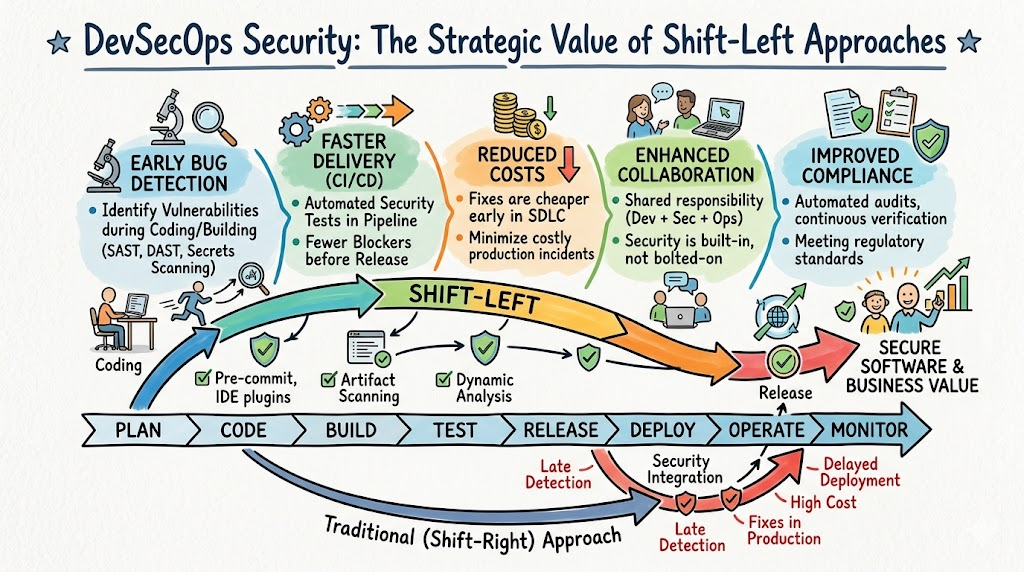
At its core, shift-left security means testing and securing your software throughout the development process rather than at the end. Imagine a timeline representing your SDLC. On the right side is the production environment where the code runs. On the left side is the planning and design phase.
Traditionally, we performed security tests on the far right. Shifting left literally moves those security activities to the left—to the design, coding, and commit stages.
It involves:
- Integrating security checks in the developer’s IDE.
- Running automated security scans on every commit.
- Teaching secure coding practices to engineering teams.
- Treating security policies as code.
This is a proactive mindset. If a developer receives feedback about a SQL injection vulnerability while typing the code, they fix it in seconds. If that same vulnerability reaches production, it requires incident response, emergency patching, and potential reputation damage.
What Is DevSecOps?
DevSecOps is the evolution of DevOps, where security is an integral part of the culture. Traditional DevOps focuses on speed and automation (CI/CD). DevSecOps adds security to that equation.
It is the practice of embedding security decisions, tools, and processes into every stage of the DevOps pipeline. The goal is to make security a shared responsibility. It is no longer “the security team’s problem” but a collective duty shared by developers, operators, and security professionals.
In a DevSecOps model, security is not a silo. It is transparent and continuous. By automating security controls, we ensure that compliance and risk management keep pace with the velocity of modern cloud-native development.
Why Traditional Security Models Struggle
The traditional model of software security is often described as “security as a hurdle.” It creates friction and resentment. Here is why it consistently fails in modern enterprises:
- Delayed Detection: Vulnerabilities discovered late are exponentially more expensive to fix. Refactoring a core component because of a hardcoded credential discovered during a production audit is a massive resource drain.
- The Bottleneck Effect: Security teams become a choke point. If every release must wait for a manual security sign-off, you lose the ability to deploy on demand.
- Lack of Context: By the time a security auditor reviews the code, the original developer has moved on to the next feature. They have lost the context, making the fix more difficult and error-prone.
- Context Switching: When a developer is forced to stop working on new features to fix a security issue from three months ago, it destroys productivity and morale.
Why Shift-Left Security Matters in DevSecOps
Shifting security to the left creates a feedback loop that saves time and money. Below is a breakdown of the benefits.
| Shift-Left Practice | Security Benefit |
| IDE Plugins | Catches syntax errors and insecure libraries in real-time. |
| Pre-commit Hooks | Prevents secrets (API keys) from entering the repository. |
| CI/CD Scanning | Automatically identifies vulnerabilities on every build. |
| Container Scanning | Ensures the underlying OS/library is patched before deployment. |
| Policy-as-Code | Automates compliance checks against industry standards. |
Early Vulnerability Detection
By the time code reaches the main branch, it has already been tested for basic security flaws. This reduces the noise that security teams have to deal with.
Faster Fixes
Developers can fix security bugs in their native environment, which is significantly faster than responding to a ticket generated by a production breach.
Reduced Risks
Fewer vulnerabilities make it into production. This fundamentally lowers your attack surface.
Better Collaboration
Security teams shift their focus from running manual scans to creating the policies, training, and automated frameworks that developers use to secure their own code.
How Shift-Left Security Works in the SDLC
To implement shift-left, you must look at every stage of the SDLC and ask: “How can we secure this now?”
- Planning: Start with threat modeling. Identify the potential risks of the feature you are building before writing a single line of code.
- Coding: Use secure coding standards and IDE extensions that highlight insecure patterns.
- Code Review: Include security checklists in peer code reviews. Ensure that security is a criteria for approval.
- CI/CD Pipeline: This is the heart of shift-left. Every pull request triggers an automated scan. If the scan fails, the build breaks, and the code cannot be merged.
- Testing/Staging: Run deep analysis (DAST) on the running application in a staging environment to catch runtime flaws.
- Deployment: Use infrastructure-as-code (IaC) scanners to ensure your cloud configuration is not exposing ports or S3 buckets.
Security Testing in Shift-Left DevSecOps
There are four primary pillars of automated security testing in a shift-left workflow:
SAST (Static Application Security Testing)
SAST analyzes your source code or compiled binaries without executing them. It looks for insecure coding patterns, such as hardcoded passwords or improper input validation.
- Best Practice: Run this on every developer machine and upon every pull request.
DAST (Dynamic Application Security Testing)
DAST interacts with a running application. It simulates an attacker and sends requests to your API or web application to see if it responds with errors or vulnerabilities.
- Best Practice: Run this in an automated staging environment before production.
SCA (Software Composition Analysis)
Modern applications are 80% open-source libraries. SCA scans your dependencies (e.g., npm packages, Maven artifacts) to ensure none of them have known CVEs (Common Vulnerabilities and Exposures).
- Best Practice: Automate this to block builds that contain libraries with critical vulnerabilities.
Secret Scanning
This prevents developers from accidentally committing API keys, tokens, or database passwords to version control.
- Best Practice: Use pre-commit hooks to stop the commit locally before it even reaches the server.
Role of CI/CD in Shift-Left Security
The CI/CD pipeline is the enforcement mechanism of shift-left security. It is where you move from “asking developers to be secure” to “ensuring the code is secure.”
When a developer pushes code, the pipeline should automatically:
- Build the application.
- Perform unit tests.
- Run SAST/SCA scanners.
- Validate infrastructure code.
If any of these steps fail, the pipeline stops the deployment. This provides instant feedback. The developer knows exactly which commit caused the issue, making the fix trivial compared to finding the bug weeks later in a production environment.
Role of Developers in Shift-Left Security
Developers are the most important part of the shift-left equation. They own the code. By educating developers on common vulnerabilities like OWASP Top 10, they become the first line of defense.
They are not expected to become security experts, but they should be “security-aware.” They need to know how to:
- Sanitize inputs.
- Manage dependencies responsibly.
- Use secrets management tools instead of environment variables or hardcoding.
- Respond to automated security alerts.
When developers are empowered with the right tools, they feel a sense of ownership over the security of their applications.
Role of Security Teams in DevSecOps
If developers own the code, what does the security team do? Their role shifts from “policeman” to “architect and coach.”
Security teams focus on:
- Defining Policy: What does a “secure” build look like? (e.g., “No critical vulnerabilities allowed”).
- Building the Platform: They provide the security tools and configurations that the CI/CD pipeline uses.
- Security Training: They run workshops and lunch-and-learns to keep developers up to date on new threats.
- Incident Response: They handle the complex issues that require deeper investigation.
Security Automation in Shift-Left DevSecOps
Tools facilitate the culture. Here are common examples of how these tools are used:
- SonarQube: Excellent for code quality and SAST. It gives developers a clear view of where their code needs improvement.
- Snyk: A market leader for SCA. It scans dependencies and often suggests the specific version you need to upgrade to in order to fix the issue.
- Checkmarx: Provides comprehensive SAST coverage, ideal for large enterprise codebases.
- OWASP Dependency-Check: An open-source option for identifying project dependencies and checking if there are any known, publicly disclosed vulnerabilities.
Real-World Example: Traditional Security Workflow
Scenario: A company is releasing a new payment portal.
- Development: Developers finish coding, focusing only on features.
- Testing: QA tests functionality.
- Deployment: Code is pushed to production.
- Audit: A manual security audit is scheduled for two weeks after release.
- Discovery: The auditor finds that the payment gateway is vulnerable to an XSS (Cross-Site Scripting) attack.
- Impact: The team must now halt all new feature development, patch the code, re-test everything, and push a hotfix, risking downtime and customer data.
Real-World Example: Shift-Left Security Workflow
Scenario: The same company uses a Shift-Left approach.
- Development: Developers write code using IDE plugins that flag the XSS risk as they type.
- Commit: The developer fixes the issue locally.
- Pipeline: Upon committing to the repository, an automated SAST scan runs. It passes because the code is clean.
- Testing: SCA checks dependencies for the payment library and flags an update. The developer updates it automatically.
- Deployment: The application deploys to production with high confidence.
- Result: The application is secure, the release is on time, and the team moves to the next task without emergency patches.
Benefits of Shift-Left Security in DevSecOps
- Faster Remediation: Issues are fixed in minutes rather than weeks.
- Lower Security Risk: By reducing vulnerabilities, the likelihood of a data breach plummets.
- Better Compliance: Automated security checks provide a continuous audit trail, making compliance reporting much easier.
- Reduced Cost: The cost of fixing a bug in development is roughly 1/10th of the cost of fixing it in production.
- Faster Delivery: Eliminating the “wait time” for security audits allows for continuous deployment.
Common Challenges in Shift-Left Security Adoption
Shifting left is not easy. It requires significant cultural and technical changes.
- Developer Resistance: Developers may feel that security tools slow them down or cause “false positives.”
- Solution: Tune your tools. If a scanner is too noisy, it will be ignored. Focus on critical and high-severity issues first.
- Skill Gaps: Developers may not know how to fix a specific security vulnerability.
- Solution: Invest in training. Use DevOpsSchool to build foundational knowledge in DevSecOps and security automation.
- Tool Complexity: Integrating too many tools can create pipeline bloat.
- Solution: Start small. Pick one tool (like SCA) and get it working perfectly before adding others.
Common Beginner Misunderstandings
- “Shift-Left means the security team is gone.”
- Reality: Security teams are needed more than ever to build the security platform.
- “Security slows down delivery.”
- Reality: Poor security processes slow down delivery. Automated security actually speeds it up by preventing rework.
- “Automation solves everything.”
- Reality: Automation is only as good as the policy behind it. You still need human oversight for architecture and threat modeling.
- “Only large companies need DevSecOps.”
- Reality: Even startups need security. A single breach can bankrupt a small business.
Best Practices for Implementing Shift-Left Security
- Start Small: Don’t try to automate everything at once. Begin with SCA scanning for open-source libraries.
- Educate, Don’t Mandate: Build a culture where security is a shared goal.
- Focus on Feedback: Ensure your security tools provide clear, actionable instructions to developers.
- Iterate: Regularly review your tools and processes to see if they are actually helping the team.
- Measure Success: Track metrics like “time to remediate” and “vulnerability density” to see if your approach is working.
Role of DevOpsSchool in Learning DevSecOps Practices
Learning the theory of shift-left is important, but practical application is where the true value lies. At DevOpsSchool, we emphasize hands-on learning. Understanding how to wire up a Jenkins, GitLab CI, or GitHub Actions pipeline with security scanners is a critical skill for any modern engineer.
We provide a comprehensive learning ecosystem where students can experiment with CI/CD tools, understand container security, and practice cloud-native security automation. Our approach is designed to bridge the gap between abstract concepts and real-world implementation, ensuring that students are not just learning tools, but learning how to build resilient, secure systems.
Career Importance of Shift-Left Security Skills
The market demand for professionals who understand DevSecOps and shift-left security is massive. Companies are desperate for people who can:
- Configure secure CI/CD pipelines.
- Implement “Security as Code.”
- Bridge the gap between Development and Security teams.
Whether you are a DevSecOps Engineer, Cloud Security Engineer, or SRE, these skills make you indispensable. Organizations are realizing that security is not a separate entity; it is a feature. If you can help them ship that feature safely, your career trajectory will be excellent.
Industries Benefiting from Shift-Left Security
- Banking & Finance: Handling sensitive financial data requires strict, automated compliance.
- Healthcare: Protecting patient records (HIPAA compliance) is non-negotiable.
- SaaS Platforms: Constant updates and deployments require continuous security testing.
- E-Commerce: Protecting user credit card data and preventing downtime during high-traffic events.
- Telecom: Managing massive, distributed infrastructures requires automated, secure configuration management.
Future of Shift-Left Security
We are entering an era of “intelligent” security. The future will include:
- AI-Assisted Remediation: Scanners will not only find the vulnerability; they will suggest the exact code patch to fix it, which the developer can apply with one click.
- Automated Policy-as-Code: Governance will be baked into the platform layer, making it impossible to deploy misconfigured infrastructure.
- Secure Platform Engineering: Moving toward platforms that are secure by default, so developers don’t have to worry about the underlying infrastructure security as much.
FAQs (15 Questions)
- What is Shift-Left Security?
It is the practice of performing security testing earlier in the software development lifecycle to prevent vulnerabilities. - Why is Shift-Left Security important in DevSecOps?
It reduces the cost and time of fixing vulnerabilities and prevents security from being a bottleneck. - What tools support Shift-Left Security?
Tools like SonarQube, Snyk, Checkmarx, and OWASP Dependency-Check. - Does Shift-Left replace security teams?
No, it shifts their focus from manual testing to policy, architecture, and guidance. - How does CI/CD improve security?
It automates scanning, ensuring that no code passes without being checked against security standards. - Can beginners learn DevSecOps?
Yes, with structured, hands-on training, beginners can master these concepts. - Is Shift-Left only for enterprises?
No, it is critical for any team building software, regardless of size. - Why is early vulnerability detection important?
Because fixing a bug in code is significantly cheaper and faster than fixing it in production. - What is the difference between SAST and DAST?
SAST scans source code without running it; DAST scans the application while it is running. - What are pre-commit hooks?
Scripts that run locally on a developer’s machine to prevent insecure code from being committed. - How do I handle false positives in security scanning?
Tune your tools, establish clear severity thresholds, and focus on high-impact issues. - Is infrastructure-as-code (IaC) part of Shift-Left?
Yes, scanning IaC templates for misconfigurations is a critical shift-left activity. - How do I convince management to invest in Shift-Left?
Focus on the business value: faster releases, lower risk, and reduced operational costs. - Does Shift-Left mean developers must be security experts?
No, but they must be “security-aware” and understand the basics of secure coding. - Where can I learn more about these practices?
DevOpsSchool offers practical training programs on DevSecOps and security automation.
Final Thoughts
Shift-left security is not a trend; it is the inevitable evolution of software engineering. As we move faster, our safety measures must be faster, too. By integrating security into the CI/CD pipeline and fostering a culture of shared responsibility, we create an environment where speed and security coexist.
Security should be treated as a continuous process, not an event. It begins with the first line of code and continues through deployment. If you are starting your journey, focus on the fundamentals: learn how to secure your build pipeline, understand your dependencies, and prioritize automation. The goal is to make the “secure way” the “easy way.”





Leave a Reply
You must be logged in to post a comment.