Introduction
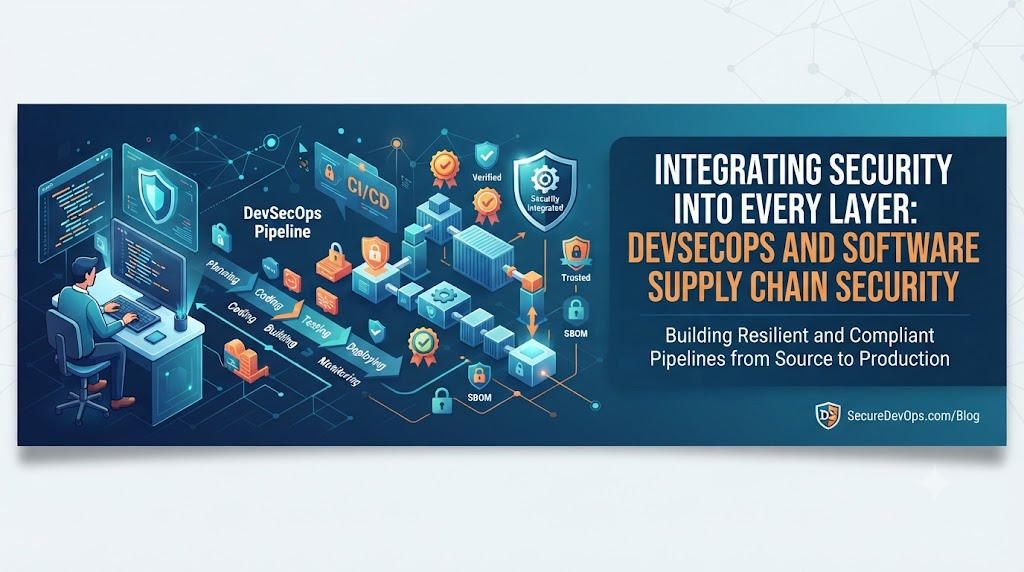
In modern software engineering, speed is currency, yet the relentless push for velocity has created a massive blind spot as applications are increasingly assembled from thousands of third-party open-source libraries, cloud services, and automated CI/CD tools rather than written from scratch. Because traditional perimeter defenses and manual, end-of-cycle audits are completely ineffective against upstream supply chain attacks and compromised dependencies, organizations are turning to DevSecOps and Software Supply Chain Security to embed automated testing, validation mechanisms, and compliance guardrails directly into every phase of the development lifecycle. Through this comprehensive guide, you will learn how DevOpsSchool and the official resources at DevOpsSchool help engineers master the strategies needed to transform vulnerable delivery pipelines into resilient, secure ecosystems.
What Is Software Supply Chain Security?
Definition
Software Supply Chain Security refers to the collective practices, policies, tools, and automated controls used to secure all the components, dependencies, third-party libraries, tools, and infrastructure that go into building, testing, and deploying a software application.
Components of the Software Supply Chain
- Source Code: Proprietary code written by internal developers stored in version control systems like GitHub or GitLab.
- Open-Source Dependencies: Third-party libraries, frameworks, and packages integrated into the application.
- Build Tools and CI/CD Pipelines: Jenkins, GitHub Actions, GitLab CI, and artifact repositories like Nexus or Artifactory.
- Infrastructure as Code (IaC): Terraform, Ansible, and CloudFormation templates defining cloud environments.
- Container Images and Registries: Docker images, base operating system layers, and container runtimes.
Why Software Supply Chains Are Attractive Attack Targets
Attackers realize that compromising a single widely used open-source library or a popular CI/CD tool yields a massive return on investment. Instead of hacking an enterprise firewall directly, a threat actor can inject malicious code upstream into a dependency, allowing the payload to propagate automatically downstream to thousands of unsuspecting enterprise consumers.
Understanding DevSecOps in Software Supply Chain Security
Security Integrated into DevOps
DevOps broke down silos between development and operations to accelerate delivery. DevSecOps takes the next logical step by breaking down the silo between development, operations, and security. DevSecOps and Software Supply Chain Security ensures that security is baked into the development workflow rather than bolted on as an afterthought.
Shift-Left Security
Shift-left security means moving security testing and validation as early in the software development lifecycle as possible. Instead of finding vulnerabilities in production, DevSecOps and Software Supply Chain Security identifies flaws while code is still being written on a developer’s workstation or during early pull request reviews.
Security Automation
Manual security reviews cannot keep pace with modern deployment frequencies. DevSecOps and Software Supply Chain Security relies heavily on automation—integrating Static Application Security Testing (SAST), Dynamic Application Security Testing (DAST), Software Composition Analysis (SCA), and secret scanning directly into automated pipelines.
Why Software Supply Chain Security Matters
Modern software development relies heavily on external leverage. Over 80% to 90% of a modern application’s codebase consists of open-source libraries and third-party dependencies. While this accelerates time-to-market, it introduces profound operational risks.
Open-Source Dependency Risks
Developers frequently import third-party packages without verifying their provenance, maintenance status, or security posture. If an open-source maintainer’s account is compromised, malicious updates can be pushed to public registries.
Third-Party Software Risks
Enterprise software often integrates commercial vendors, APIs, and plugins. A vulnerability in any third-party integration creates an immediate backdoor into the host enterprise system.
Regulatory Compliance
Governments and regulatory bodies worldwide are tightening compliance mandates. Frameworks now require organizations to maintain strict visibility over their software supply chains, mandate Software Bill of Materials (SBOM), and prove accountability for every component in production.
Common Software Supply Chain Threats
| Threat | Risk | Business Impact | Mitigation |
| Dependency Confusion | Attackers publish malicious packages with names matching private internal packages to public registries. | Execution of arbitrary malicious code during enterprise build processes. | Use scope-based package registries and verify package sources rigorously. |
| Malicious Packages | Compromised or rogue open-source libraries containing backdoors or data-exfiltration scripts. | Unauthorized access to internal systems and customer data breaches. | Implement automated Software Composition Analysis (SCA) and trusted internal mirrors. |
| Vulnerable Libraries | Outdated dependencies containing known Common Vulnerabilities and Exposures (CVEs). | Exploitation by external actors leading to system takeover. | Continuous dependency scanning and automated patch management workflows. |
| CI/CD Compromise | Attackers gain unauthorized access to build servers, pipeline runners, or deployment credentials. | Injection of malicious artifacts directly into official enterprise releases. | Least privilege access, secure runners, and immutable build environments. |
| Credential Theft | Hardcoded API keys, passwords, or SSH keys stored insecurely in code repositories. | Complete cloud environment takeover and data exfiltration. | Automated secret scanning tools and centralized secret managers (e.g., Vault). |
| Container Image Attacks | Using insecure base images or pulling compromised images from public registries. | Runtime container escape and host infrastructure compromise. | Cryptographic image signing, vulnerability scanning, and private registries. |
| Infrastructure Compromise | Misconfigured Infrastructure as Code (IaC) exposing databases or cloud storage publicly. | Massive data exposure and regulatory penalties. | Automated Policy as Code (PaC) enforcement and IaC scanning. |
| Insider Threats | Malicious or negligent internal actors tampering with codebases, repositories, or pipelines. | Sabotage, unauthorized data leakage, or intentional backdoor installation. | Multi-factor authentication, code review policies, and immutable audit logs. |
Secure Software Development Lifecycle (Secure SDLC)
Integrating DevSecOps and Software Supply Chain Security requires transforming every phase of the traditional SDLC into a secure workflow.
Planning
Security requirements, threat modeling, and risk assessments are conducted before a single line of code is written. Teams identify potential attack surfaces and define security acceptance criteria.
Secure Coding
Developers follow secure coding standards. Integrated development environment (IDE) plugins provide real-time feedback on vulnerabilities, insecure functions, and potential bugs.
Code Review
Peer code reviews are mandatory. Automated linters and SAST tools scan pull requests, blocking code that fails security gates before it merges into the main branch.
Security Testing
Automated testing suites run continuously. SCA checks third-party dependencies, DAST evaluates running application endpoints, and container scanners verify image layers.
Deployment
Artifacts are signed cryptographically. Deployment pipelines enforce strict access controls, ensuring that only verified, immutable packages reach production environments.
Continuous Monitoring
Once live, applications and infrastructure are monitored continuously for anomalous behavior, new vulnerability disclosures, and runtime threats.
Securing CI/CD Pipelines
The CI/CD pipeline is the central nervous system of modern software delivery. If an attacker compromises the pipeline, they control the entire software supply chain.
Pipeline Security Best Practices
- Isolate Build Runners: Execute builds in ephemeral, isolated containers that are destroyed immediately after execution.
- Strict Access Control: Enforce Principle of Least Privilege across all repository branches, build tools, and deployment environments.
- Secrets Management: Never store credentials in pipeline configuration files or environment variables in plain text. Use dedicated secret managers.
- Build Verification & Artifact Signing: Use cryptographic signing (e.g., Cosign) to sign build artifacts, ensuring integrity from build to deployment.
Managing Open-Source Dependencies
Open-source code is essential, but it demands rigorous governance.
Dependency Scanning
Implement Software Composition Analysis (SCA) tools within your CI/CD pipeline to analyze all direct and transitive dependencies against known vulnerability databases.
Version Management
Establish clear policies for version pinning, automatic dependency updates, and deprecation tracking to prevent drift and unpatched vulnerabilities.
Trusted Repositories
Utilize private artifact proxies and internal registries to cache, vet, and approve external open-source packages before developers import them into projects.
Software Bill of Materials (SBOM)
What Is an SBOM?
A Software Bill of Materials (SBOM) is a formal, structured inventory of software components, libraries, modules, and their hierarchical relationships used to build an application. Think of it as an ingredient list for software.
Why Organizations Need SBOM
- Immediate Visibility: Quickly determine if your applications are affected when a new zero-day vulnerability is discovered in an open-source library.
- Regulatory Compliance: Meet emerging government mandates and enterprise procurement requirements.
- Transparency: Build trust with customers and partners by demonstrating complete supply chain visibility.
Container and Kubernetes Security
Containers package applications with their dependencies, but insecure base images and misconfigured clusters introduce severe security risks.
Container Security Checklist
- Use minimal, hardened base images (e.g., Alpine or distroless images).
- Scan container images for vulnerabilities before pushing them to registries.
- Run containers as non-root users by default.
- Implement Kubernetes admission controllers (e.g., OPA Gatekeeper) to enforce security policies.
- Apply Network Policies to restrict pod-to-pod communication.
Infrastructure as Code Security
Infrastructure defined as code (Terraform, Ansible, CloudFormation) is susceptible to misconfigurations that can expose cloud environments to attackers.
Practical Guidance for IaC Security
- Integrate static analysis tools (e.g., Checkov, Tfsec) into code repositories to scan IaC templates before deployment.
- Enforce Policy as Code (PaC) to automatically reject cloud configurations that violate security baselines (e.g., public S3 buckets).
- Separate infrastructure state files and restrict access to cloud provisioning credentials.
Cloud Security in DevSecOps
Cloud platforms (AWS, Azure, Google Cloud) form the foundation of modern application delivery. DevSecOps and Software Supply Chain Security extends directly into cloud environments through native security tooling and IAM governance.
Core Cloud Security Pillars
- Identity and Access Management (IAM): Enforce multi-factor authentication and fine-grained, role-based access control.
- Encryption: Encrypt data both at rest and in transit using customer-managed encryption keys.
- Network Security: Implement Virtual Private Clouds (VPCs), secure subnets, and cloud firewalls.
- Centralized Logging: Aggregate audit logs and cloud trail events into a centralized Security Information and Event Management (SIEM) platform.
Security Automation
Automation is the cornerstone of scalable security. DevSecOps and Software Supply Chain Security replaces manual bottlenecks with automated gates.
Automated Security Workflow
[Code Commit] ---> [SAST & Secret Scan] ---> [Dependency Check (SCA)]
                                                      |
[Deployment] <--- [Artifact Signing] <--- [Container & IaC Scan]
By embedding these automated checks into the commit and build phases, vulnerabilities are caught and remediated in minutes rather than months.
Compliance and Governance
Meeting compliance standards is no longer a periodic paperwork exercise; it requires continuous verification.
- ISO 27001: Information security management systems governance.
- SOC 2: Trust services criteria for security, availability, and confidentiality.
- PCI DSS: Securing payment card data environments.
- HIPAA: Protecting healthcare data privacy.
- NIST Secure Software Development Framework (SSDF): Guidelines for mitigating supply chain risks.
- CIS Benchmarks: Configuration baselines for secure cloud and operating system hardening.
Real-World Enterprise Implementation Example
To understand how DevSecOps and Software Supply Chain Security operates in practice, consider a global financial technology enterprise:
- Development: A developer writes code in a feature branch and pushes it to GitHub.
- Source Control: Pre-commit hooks instantly scan for hardcoded API keys, blocking the commit if secrets are detected.
- Automated Scanning: Upon opening a pull request, automated SAST tools analyze the source code while SCA tools check all new dependencies.
- Secure Build: The CI/CD pipeline compiles the application, runs unit tests, and builds a container image using a hardened base image.
- Artifact Validation: Container vulnerability scanners inspect the image layers. Once approved, the artifact is cryptographically signed using Cosign.
- Secure Deployment: GitOps operators deploy the signed artifact to a hardened Kubernetes cluster, enforcing strict network and admission policies.
- Continuous Monitoring: Runtime security agents monitor container behavior, alerting security teams to any anomalous process execution.
Common Mistakes Organizations Make
- Ignoring Dependency Security: Assuming open-source libraries are safe without scanning or verification.
- Weak Access Controls: Allowing broad, unmanaged access to CI/CD pipelines and production environments.
- Missing SBOM: Operating without inventory visibility into software components.
- Relying on Manual Security Reviews: Creating massive bottlenecks right before release dates.
- Delayed Patching: Failing to update vulnerable dependencies in a timely manner.
Improvement Checklist
- Implement automated SCA and SAST across all repositories.
- Enforce cryptographic artifact signing in CI/CD pipelines.
- Generate and maintain automated SBOMs for every release.
- Restrict pipeline access using the Principle of Least Privilege.
- Establish rapid patch management SLAs for critical vulnerabilities.
Best Practices for DevSecOps and Software Supply Chain Security
- Automate Security Testing: Embed security checks directly into developer workflows without causing friction.
- Scan Dependencies Continuously: Monitor open-source libraries across their lifecycle, not just at initial import.
- Secure CI/CD Pipelines: Treat your build infrastructure with the same security rigor as your production environment.
- Maintain SBOM: Keep an accurate, machine-readable inventory of every software component.
- Protect Secrets: Eliminate hardcoded credentials using centralized secret management solutions.
- Monitor Continuously: Implement runtime observability to detect and respond to threats in real time.
- Apply Least Privilege: Restrict user and system permissions to the minimum necessary for operation.
- Train Development Teams: Empower developers with continuous security education and secure coding workshops.
Implementation Roadmap
| Phase | Objectives | Expected Outcome |
| Phase 1: Assessment | Audit current repositories, CI/CD tools, dependency usage, and security posture. | Comprehensive visibility report and risk inventory. |
| Phase 2: Security Integration | Introduce automated SAST, SCA, and secret scanning into CI/CD pipelines. | Automated vulnerability detection during code commits. |
| Phase 3: Supply Chain Hardening | Implement artifact signing, SBOM generation, and container image scanning. | Cryptographically verified and fully inventoried releases. |
| Phase 4: Continuous Improvement | Establish runtime monitoring, compliance reporting, and developer security training. | Mature, resilient, and continuously optimized security posture. |
Career Opportunities
Mastering DevSecOps and Software Supply Chain Security opens doors to high-impact, high-demand roles across the global technology sector:
- DevSecOps Engineer: Bridges development, operations, and security by automating security checks in delivery pipelines.
- Application Security Engineer: Focuses on securing application code, identifying software vulnerabilities, and guiding secure architecture.
- Cloud Security Engineer: Secures cloud infrastructure, IAM policies, and cloud-native workloads.
- Site Reliability Engineer (SRE): Ensures high availability and resilience while collaborating closely with security teams.
- Security Architect: Designs enterprise-wide security frameworks, zero trust models, and secure software supply chains.
- Cybersecurity Consultant: Advises enterprises on regulatory compliance, risk mitigation, and security transformation.
Certifications and Learning Roadmap
| Certification | Best For | Skill Level | Focus Area |
| Certified DevSecOps Professional (CDP) | DevOps & Security Engineers | Intermediate / Advanced | Pipeline security, automation, shift-left tools |
| Certified Kubernetes Security Specialist (CKS) | Kubernetes Administrators | Advanced | Cluster hardening, admission control, runtime security |
| AWS Certified Security – Specialty | Cloud Engineers | Advanced | Cloud IAM, encryption, monitoring, network security |
| Microsoft Certified: Azure Security Engineer | Azure Professionals | Intermediate / Advanced | Identity governance, security operations, threat protection |
| Google Cloud Professional Cloud Security Engineer | GCP Specialists | Advanced | Cloud architecture security, compliance, data protection |
| Certified Information Systems Security Professional (CISSP) | Security Architects & Leaders | Expert | Enterprise security governance, risk management |
| Terraform Associate / IaC Security | Infrastructure Engineers | Beginner / Intermediate | Secure infrastructure provisioning and policy enforcement |
To master these technologies and earn industry-recognized credentials, exploring professional certification tracks at DevOpsSchool offers comprehensive guidance tailored for both India and global markets.
Future of Software Supply Chain Security
As technology evolves, DevSecOps and Software Supply Chain Security is adapting to new paradigms:
- AI-Assisted Security: Leveraging generative AI to detect complex supply chain anomalies, suggest secure code fixes, and automate threat modeling.
- Advanced Software Signing: Widespread adoption of cryptographic attestation and provenance frameworks like Sigstore.
- Zero Trust Architecture: Moving beyond perimeter defense to verify every request, component, and user continuously.
- GitOps Security: Securing declarative infrastructure and application delivery driven by Git repositories.
- Continuous Compliance: Automated policy engines that verify regulatory compliance in real time during every build.
FAQs (15 Questions)
1. What is Software Supply Chain Security?
It is the practice of protecting every component—including code, dependencies, tools, and infrastructure—that goes into building and delivering software against tampering and vulnerabilities.
2. Why is it important in DevSecOps?
Because modern applications rely heavily on external components, securing the supply chain prevents attackers from injecting malicious code into automated delivery pipelines.
3. What is an SBOM?
A Software Bill of Materials is a formal inventory detailing all components, libraries, and modules contained within a software application.
4. How does DevSecOps improve software security?
It integrates automated security testing, validation, and compliance checks into every stage of the development lifecycle, shifting security left.
5. Why are open-source libraries risky?
Open-source libraries may contain undiscovered vulnerabilities or be compromised if maintainer accounts are hijacked by threat actors.
6. How do CI/CD pipelines become vulnerable?
Through weak access controls, misconfigured build runners, hardcoded credentials, and lack of artifact verification.
7. What security tools should organizations use?
Organizations should utilize SAST, DAST, SCA tools, secret scanners, container vulnerability scanners, and SBOM generators.
8. Is Kubernetes security necessary?
Yes, because misconfigured clusters and insecure container runtimes expose workloads to container escape and privilege escalation attacks.
9. What role does Infrastructure as Code play?
IaC defines cloud infrastructure programmatically; securing it prevents cloud misconfigurations and data exposure.
10. How can organizations prevent supply chain attacks?
By implementing dependency scanning, artifact signing, least privilege access, and automated security testing in pipelines.
11. Which compliance standards are important?
Key standards include ISO 27001, SOC 2, PCI DSS, HIPAA, NIST SSDF, and CIS Benchmarks.
12. How do beginners learn supply chain security?
By studying DevSecOps principles, practicing with open-source security tools, and taking structured training courses.
13. What certifications are valuable?
Certifications like Certified DevSecOps Professional, CKS, AWS Security Specialty, and CISSP are highly valued by employers.
14. How long does implementation take?
Implementation is an iterative journey that typically takes several months, depending on organizational maturity and pipeline complexity.
15. What are the biggest mistakes organizations make?
Ignoring dependency security, relying on manual reviews, failing to maintain an SBOM, and using weak access controls.
Final Thoughts
Securing modern software delivery is no longer optional; it is a fundamental business requirement. As cyber threats grow increasingly sophisticated, traditional security perimeters are no longer sufficient to protect enterprise assets. DevSecOps and Software Supply Chain Security provides the proactive, continuous protection needed to safeguard applications from inception to production. By automating security testing, maintaining rigorous dependency governance, generating accurate SBOMs, and securing CI/CD pipelines, organizations can eliminate human error and ensure security consistency. Embracing DevSecOps and Software Supply Chain Security transforms security from a restrictive roadblock into a powerful enabler of velocity, trust, and business resilience. Continuous learning and adaptation remain essential as the threat landscape continues to evolve.






Leave a Reply
You must be logged in to post a comment.