Introduction
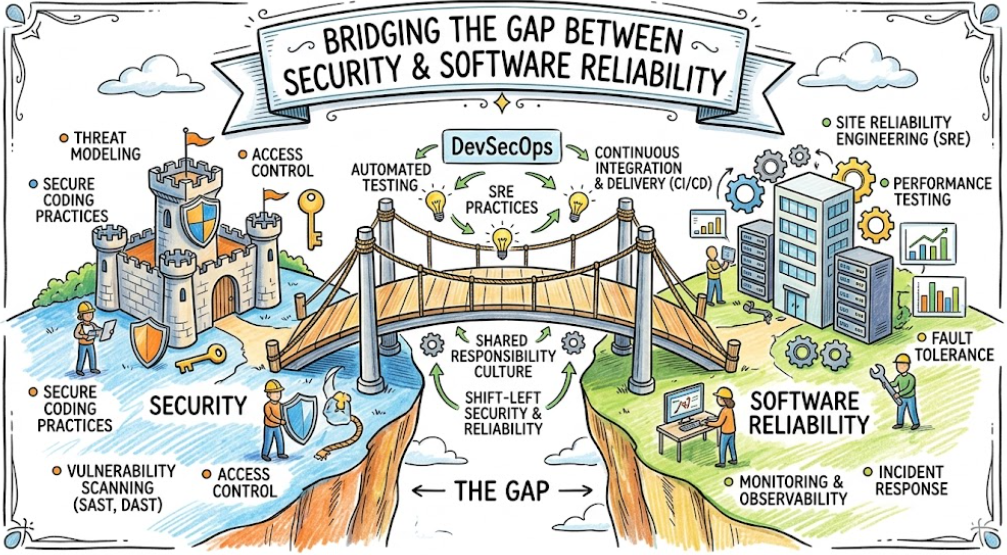
In the modern era of rapid software delivery, the speed at which we deploy code is often heralded as the ultimate metric of success. However, speed without stability is merely a fast track to catastrophe. Many engineering teams find themselves stuck in a cycle of “firefighting”—constantly patching production outages, responding to security breaches, and struggling with unpredictable system behavior. This is where the intersection of security and reliability becomes critical.
Software reliability—the ability of a system to perform its required functions under stated conditions for a specified period—is not an accidental byproduct of good code. It is an engineered outcome. If your system is prone to security vulnerabilities, it is inherently unreliable. A security breach, by definition, is a failure of the system to maintain its integrity, leading to downtime, data loss, and user distrust.
This is why adopting a DevSecOps approach is no longer an optional luxury for enterprise teams; it is a fundamental requirement. By integrating security into the development lifecycle, we move away from reactive “patch-and-pray” methods toward a model of proactive stability.
Whether you are looking to refine your current CI/CD processes or build a secure foundation from scratch, organizations like DevOpsSchool offer the resources and training necessary to master these disciplines. In this guide, we will explore exactly how DevSecOps improves software reliability, providing you with actionable insights to build systems that are both fast and rock-solid.
What Is Software Reliability?
Software reliability is often misunderstood as merely “uptime” or “availability.” While these are vital components, true reliability encompasses a broader spectrum. It is the measure of how consistently a system behaves as expected, maintains its data integrity, and performs its functions without crashing or exposing vulnerabilities, regardless of external pressure or traffic spikes.
Consider a banking application. If the server stays up but the underlying API is vulnerable to SQL injection, the system is technically “available” but functionally unreliable. Reliability means the user can trust that their financial data is secure and that the transaction will complete accurately every single time.
In our field, we measure this using metrics like Mean Time Between Failures (MTBF) and Mean Time To Recovery (MTTR). High reliability means your MTBF is high and your MTTR is low. It is about minimizing the variables that can lead to system degradation.
What Is DevSecOps?
DevSecOps stands for Development, Security, and Operations. It is the practice of integrating security testing and compliance into every phase of the software development lifecycle (SDLC).
Traditionally, security was a “gatekeeper” at the end of the development process. Code was written, tested for functionality, and then thrown over the wall to a security team for a final audit. If a flaw was found—which was common—the entire project was delayed.
DevSecOps changes this by shifting security left, meaning it is considered from the very first line of code. It leverages automation to perform security checks at every stage: from the developer’s workstation to the CI/CD pipeline, and finally into the production environment. It turns security from an obstacle into an enabler of reliability.
Why Security and Reliability Are Connected
It is a common misconception that security and reliability are separate concerns managed by different silos. In reality, they are two sides of the same coin.
Consider this enterprise scenario: A legacy application is running on an outdated server version. The Ops team prioritizes “uptime,” so they refuse to patch the server, fearing that a restart might cause a service disruption. The Security team identifies a critical vulnerability in that server version. Because the teams are not aligned, they remain in a deadlock. Eventually, an attacker exploits the vulnerability, leading to a full system compromise. The result? A massive outage that lasts far longer than a simple server reboot would have.
In this case, the lack of security integration directly destroyed the software’s reliability. A DevSecOps culture would have automated the patching process, enabling rolling updates with zero downtime, thus satisfying both the security requirement and the availability requirement.
How DevSecOps Improves Software Reliability
The following table outlines how specific DevSecOps practices directly contribute to a more reliable software ecosystem.
| DevSecOps Practice | Reliability Benefit |
| Shift-Left Security | Detects bugs before they reach production, preventing outages. |
| Automated Testing | Ensures consistent quality and behavior across every deployment. |
| Vulnerability Scanning | Identifies weak points before they can be exploited. |
| Secure CI/CD Pipelines | Validates code integrity and configuration automatically. |
| Compliance Automation | Ensures the environment matches the secure baseline consistently. |
| Infrastructure as Code (IaC) | Eliminates configuration drift and human error in provisioning. |
Shift-Left Security and Reliability
Shift-left is the practice of moving security testing as early as possible in the development lifecycle. When developers run security scans on their own local machines or within their commit process, they find issues while the code is still fresh in their minds.
Fixing a vulnerability during the coding phase costs significantly less in terms of time and resources than fixing it after it has been deployed to a production environment. By catching these issues early, we prevent flawed code from ever entering the release candidate, thereby maintaining the stability of our production environment.
Secure CI/CD Pipelines Improve Reliability
The Continuous Integration/Continuous Deployment (CI/CD) pipeline is the heartbeat of modern software delivery. A secure pipeline acts as a series of gates. If the code does not meet the security and reliability standards, the pipeline fails, and the deployment is halted.
For example, a pipeline can be configured to run Static Application Security Testing (SAST). If the scanner detects a hardcoded password or an insecure library, the build fails. This ensures that only verified, secure code reaches the staging and production environments, drastically reducing the chances of a failed deployment or a security incident.
Automation in DevSecOps for Reliability
Automation is the key to consistency. When we rely on manual processes, we introduce human error—the number one cause of system outages.
By using automation, we ensure that:
- Security Policies are Enforced: Policies are applied programmatically rather than depending on team memory.
- Auto-Remediation: If a system detects a misconfiguration, it can automatically revert to the last known “good” state.
- Configuration Validation: Infrastructure is scanned to ensure it adheres to security standards before it is allowed to spin up.
Vulnerability Management and Reliability
Vulnerability management is the systematic process of identifying, evaluating, and mitigating security risks. In a DevSecOps environment, this is continuous. We use tools to scan for known vulnerabilities in our dependencies (Software Composition Analysis) and our own code.
By keeping our software stack updated and clean, we prevent “security-induced outages.” For example, an unpatched dependency might not just be a security risk; it could be the source of a memory leak or a performance bottleneck. Proactive management keeps the system lean and stable.
Infrastructure as Code (IaC) Security
Modern infrastructure is defined in code (Terraform, CloudFormation, Kubernetes YAML). This allows us to treat our servers and networks exactly like our application code. By applying security checks to our IaC, we prevent misconfigurations—such as open S3 buckets or overly permissive firewall rules—from reaching production.
This leads to environment consistency. You can guarantee that the staging environment is an identical clone of the production environment, which is vital for testing reliability under load.
Monitoring and Observability in DevSecOps
Reliability is impossible without visibility. We need to know what our systems are doing at any given second. Observability in a DevSecOps context involves more than just CPU and memory metrics. It involves tracking security events, failed login attempts, anomalous API calls, and audit logs.
When we integrate security logs into our observability platform, we can detect an attack in progress and respond before it compromises the stability of the application. This proactive stance is a hallmark of high-reliability organizations.
Incident Prevention Through DevSecOps
Most incidents are not “acts of God”; they are the result of accumulated technical debt and unchecked vulnerabilities. DevSecOps prevents incidents by:
- Reducing complexity: Simplified, standard security controls are easier to manage.
- Improving visibility: You cannot fix what you cannot see.
- Standardizing recovery: With automated deployment tools, “rolling forward” or “rolling back” becomes a routine, non-stressful operation.
DevSecOps and Faster Recovery During Incidents
Even with the best practices, incidents happen. The difference between a minor blip and a major disaster is the speed of recovery. DevSecOps practices improve Mean Time To Recovery (MTTR) by:
- Automated Rollbacks: If a new deployment causes a security alert, the CI/CD pipeline can automatically trigger a rollback to the previous stable version.
- Immutable Infrastructure: We can replace an compromised instance entirely rather than trying to “clean” it.
- Incident Response Automation: Pre-defined security scripts can isolate affected systems automatically, containing the blast radius while the SRE team investigates.
Real-World Example: Poor Reliability Without DevSecOps
The Scenario: A retail company deploys a new feature for their checkout page. They move fast, skipping thorough testing to meet a marketing deadline.
The Failure: The code is deployed to production. Two hours later, a customer realizes that the API endpoint for payment processing is exposed, allowing unauthorized access. The security team realizes the issue and demands the site be taken offline immediately to fix it.
The Result: The company suffers four hours of total downtime. They lose significant revenue and suffer reputational damage. The “fast” deployment ended up being the slowest possible path to a stable product.
The Lesson: Security was treated as a final, external checkpoint. Because it wasn’t integrated, the failure wasn’t discovered until the cost of the outage was already being incurred.
Real-World Example: Reliable Delivery with DevSecOps
The Scenario: The same retail company adopts DevSecOps. Their pipeline includes automated SAST and dependency scanning.
The Process: A developer writes the checkout code. Before they can even commit it to the main branch, their local IDE flags an insecure API configuration. They fix it in five minutes.
The Deployment: The code moves to the CI/CD pipeline. The pipeline runs further security tests. It passes. It deploys to a canary environment (a small subset of production).
The Result: The feature is deployed successfully with no downtime and no security vulnerabilities. If a bug had been introduced, the automated monitoring would have alerted the team, and they would have performed an automated rollback in seconds.
The Lesson: Security automation acted as a safety net, allowing the team to move fast without the risk of breaking production.
Common Challenges in Adopting DevSecOps
- Cultural Resistance: Many developers feel that security slows them down. This is usually due to poor tooling or lack of communication. Solution: Involve security teams early so they can provide self-service tools rather than manual sign-offs.
- Tool Complexity: There are too many security tools. Solution: Start small. Integrate one or two essential scanners into your pipeline and expand as the team matures.
- Skill Gaps: Developers are not security experts. Solution: Provide cross-training. Organizations like DevOpsSchool provide structured pathways to help bridge these knowledge gaps effectively.
Common Beginner Misunderstandings
- “DevSecOps slows down delivery.”
- Reality: It prevents the rework and emergency patching that cause the most significant delays.
- “Security is only for the security team.”
- Reality: Security is a shared responsibility. Everyone who writes code is a security engineer.
- “DevSecOps is just a set of tools.”
- Reality: It is a culture. Tools support the culture; they do not create it.
- “Reliability and security are unrelated.”
- Reality: As discussed, they are inextricably linked. An insecure system is an unreliable system.
Best Practices to Improve Reliability with DevSecOps
- Automate Everything: If you do a task more than once, automate it. This reduces the chance of configuration errors.
- Shift Security Left: Use pre-commit hooks to catch secrets or insecure code patterns before they reach the repository.
- Improve Observability: Collect logs, metrics, and traces. Analyze them for both operational and security anomalies.
- Build Secure CI/CD: Treat your pipeline as production code. It must be as resilient as the application it deploys.
- Conduct Regular Audits: Even with automation, periodic human review of your architecture is essential for catching complex logical flaws.
Role of DevOps and Security Teams in Reliability
In a high-performing organization, the “DevOps team” and “Security team” work as a single unit. They share the same goals: the health, performance, and security of the platform.
- Shared Ownership: When something breaks, it is a shared problem, not a blame game.
- Cross-Team Collaboration: Security engineers should be consulted during the design phase of new features.
- Automation Mindset: Both teams should strive to replace manual processes with code.
Role of DevOpsSchool in Learning DevSecOps
Learning the technical and cultural aspects of DevSecOps requires guidance and hands-on practice. It is not something you can learn just by reading documentation. You need experience with:
- Secure CI/CD Exposure: Learning how to wire security tools into existing pipelines.
- Cloud-Native Security: Understanding the shared responsibility model in AWS, Azure, or GCP.
- Real-World Mentoring: Understanding how to handle production incidents and perform root-cause analysis.
Platforms like DevOpsSchool specialize in bridging the gap between theory and execution, providing the environment necessary to practice these skills safely.
Career Importance of DevSecOps Skills
The demand for professionals who understand both security and reliability is skyrocketing. Companies are realizing that they cannot afford to hire separate teams that don’t communicate.
- DevSecOps Engineer: The bridge builder who designs the secure pipeline.
- Cloud Security Engineer: The specialist who secures the underlying infrastructure.
- SRE Engineer: The reliability expert who uses automation to ensure uptime and security.
Skills such as Infrastructure as Code, container security, automated testing, and compliance-as-code are currently some of the most sought-after competencies in the IT sector.
Industries Benefiting from DevSecOps Reliability
- Banking & Finance: Where data integrity is synonymous with reliability.
- Healthcare: Where uptime can literally be a matter of life and death, and data privacy is strictly regulated.
- SaaS Platforms: Where user trust is the primary competitive advantage.
- E-Commerce: Where even a minute of downtime results in massive revenue loss.
- Telecom: Where massive infrastructure scale makes manual security management impossible.
Future of DevSecOps and Reliability Engineering
We are moving toward self-healing systems. In the near future, we will see increased use of AI-driven security automation. Systems will be able to detect a sophisticated attack, isolate the affected node, patch the vulnerability, and redeploy themselves without human intervention. This is the ultimate goal of reliability engineering: a system that is not only secure but resilient by design.
FAQs
1. What is DevSecOps?
DevSecOps is the integration of security practices into the DevOps process, ensuring that security is a shared responsibility throughout the software development lifecycle.
2. How does DevSecOps improve software reliability?
It improves reliability by automating security testing, preventing vulnerabilities from reaching production, ensuring infrastructure consistency, and enabling faster incident recovery.
3. Is DevSecOps only for large companies?
No. While large companies benefit from the scale, smaller companies benefit from the increased speed and reduced need for dedicated security manpower.
4. Does DevSecOps slow down deployments?
Initial setup may take time, but in the long run, it speeds up deployments by reducing the time spent on rework, debugging, and emergency patching.
5. What tools are used in DevSecOps?
Common tools include SAST/DAST scanners, dependency checkers like Snyk, container scanners like Trivy, and IaC security tools like Checkov or Terraform-compliance.
6. What is shift-left security?
It is the practice of performing security testing earlier in the development lifecycle, rather than waiting until the end.
7. Can beginners learn DevSecOps?
Yes, but it requires a solid foundation in both basic DevOps principles and security fundamentals. Training programs like those at DevOpsSchool are designed for this progression.
8. Why is software reliability important?
Reliability builds user trust, protects revenue, and reduces the operational cost of “firefighting” during outages.
9. What is the difference between DevOps and DevSecOps?
DevOps focuses on speed and collaboration. DevSecOps takes those same principles and explicitly builds security compliance into the workflow.
10. What is infrastructure as code?
IaC is the management of infrastructure (networks, virtual machines, load balancers) using machine-readable definition files, rather than manual hardware configuration.
11. How do you measure reliability?
Common metrics include Mean Time Between Failures (MTBF) and Mean Time To Recovery (MTTR).
12. Is security automation enough to be secure?
Automation is necessary but not sufficient. You also need architectural reviews and a culture of security awareness.
13. What is the hardest part of adopting DevSecOps?
Cultural change. Convincing teams to change their workflows and shared ownership model is harder than installing any tool.
14. Does DevSecOps eliminate all bugs?
No, but it significantly reduces the number of security-related bugs and misconfigurations that reach production.
15. Where can I learn more?
For hands-on, practical guidance and industry-standard training, DevOpsSchool offers comprehensive resources for all levels.
Final Thoughts
Reliability is not an accidental outcome. It is a deliberate architecture. When you integrate security into the heart of your delivery process, you are doing more than just protecting your company from threats; you are building a more stable, predictable, and resilient system.
Prevention is always better than cure. Automating your security gates today will save you from the complex, high-pressure incident response scenarios of tomorrow. Start small, focus on culture, and remember that every line of code you secure is a step toward a more reliable future.






Leave a Reply
You must be logged in to post a comment.