Introduction
In the modern landscape of software delivery, the speed of deployment is often prioritized above all else. We want features out the door, we want updates pushed to production, and we want to keep our users happy. However, I have seen too many engineering teams treat security as an afterthought—a hurdle to clear just before the finish line. This approach, which relies on security teams acting as a gatekeeper at the very end of the development lifecycle, is no longer viable.
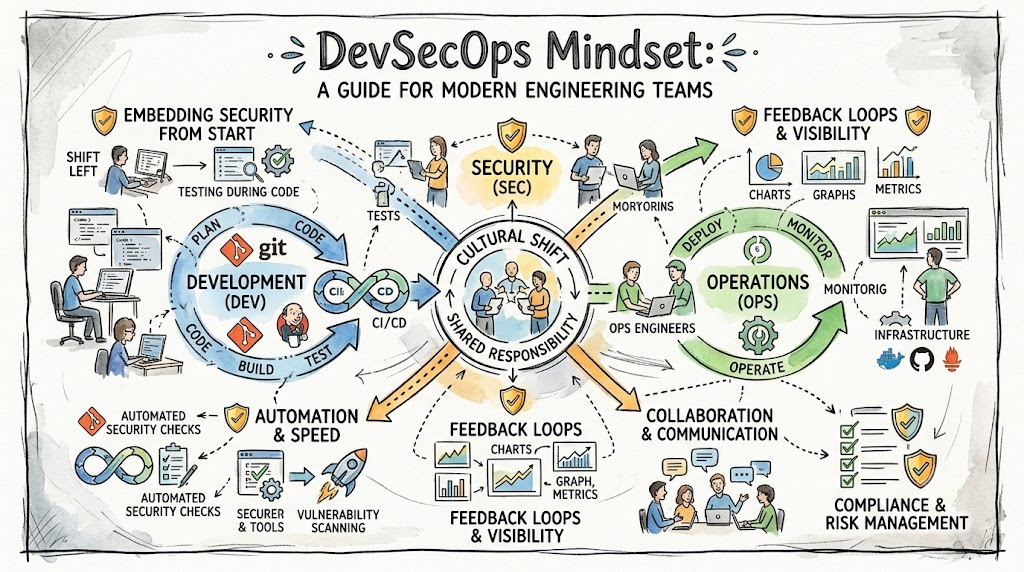
The modern software delivery model requires a fundamental shift. We must move away from the “us versus them” mentality that has plagued the industry for years, where developers write code and security teams try to break it. Instead, we must embrace a DevSecOps mindset. This is not just a marketing term; it is a cultural and operational philosophy that integrates security into the very fabric of the software development lifecycle.
To truly understand how to implement these practices, many professionals turn to resources like DevOpsSchool to bridge the gap between theory and execution. When security becomes a shared responsibility rather than a siloed department, engineering teams become faster, more resilient, and ultimately more capable. In this post, we will explore why this mindset shift is necessary, what it looks like in practice, and how you, as an engineer, can adopt it to build better software.
What Is the DevSecOps Mindset?
At its core, the DevSecOps mindset is the recognition that security is an integral component of software quality. Just as we test for functional bugs, performance bottlenecks, and user experience issues, we must test for and design against security vulnerabilities from the very first line of code.
It is a culture shift. It moves security away from being a “final inspection” phase and into the daily routine of the engineering team. When you adopt this mindset, you stop viewing security as a roadblock that slows you down. Instead, you start viewing it as a core engineering requirement—a non-negotiable standard that makes your applications robust and trustworthy. It is about understanding that a feature is not “done” until it is secure.
Why Every Engineer Needs a DevSecOps Mindset
In the past, organizations were often structured with silos. You had the development team, the operations team, and a separate security team. Developers focused on features, operations focused on uptime, and security focused on compliance. This fragmentation is where vulnerabilities thrive.
When you are an engineer working on a cloud-native architecture or a microservices environment, you have more power and responsibility than ever before. You are provisioning infrastructure, defining network policies, and managing dependencies. If you do not have a security mindset, you might inadvertently expose a database to the public internet or use an outdated library with known vulnerabilities.
Every engineer needs this mindset because the stakes are high. One misconfiguration can lead to a data breach that costs the company its reputation and its revenue. By adopting this mindset, you move from being a reactive engineer—who fixes things when they break—to a proactive engineer who builds systems that are inherently difficult to compromise.
Core Principles of a DevSecOps Mindset
To internalize this mindset, we can break it down into actionable principles. These are the pillars that support a secure engineering culture.
| Principle | Why It Matters |
| Shared Responsibility | Security is not just for the security team; it is for everyone involved in the SDLC. |
| Shift-Left Security | Finding and fixing security flaws early reduces costs and prevents downstream issues. |
| Security Automation | Manual security checks do not scale; automation ensures consistent, repeatable safety. |
| Continuous Monitoring | Security threats change constantly; visibility is required even after deployment. |
| Secure-by-Design | Designing for security from day one is far more effective than adding it later. |
| Continuous Learning | The threat landscape evolves; engineers must stay updated on new vulnerabilities and defenses. |
Principle #1: Shared Responsibility
Imagine a team where the security engineer is the only one who cares about authentication protocols. If that person is on vacation or overloaded with other tasks, the development team continues to build insecure features. This is a single point of failure. Shared responsibility means that the developer, the operator, and the architect all feel ownership of the security posture. It means asking, “How do we protect this data?” during the sprint planning, not after the code is pushed to production.
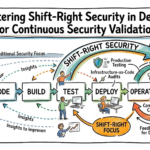
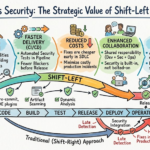
Principle #2: Shift-Left Security
Shift-left is a popular term, but let’s break it down into a practical scenario. Suppose you have a microservice that handles user payments. If you wait until a third-party penetration test runs three weeks after the code is finished, you will find bugs that require weeks of refactoring to fix. Shifting left means using linting tools, static analysis, and unit tests for security within the developer’s local environment or IDE. You catch the flaw while the code is still in your text editor.
Principle #3: Security Automation
Automation is the engine of DevSecOps. We automate unit tests and integration tests, so why not security tests? By integrating automated vulnerability scanners into your CI/CD pipeline, you ensure that every commit is checked against common threats. If a dependency has a known CVE (Common Vulnerabilities and Exposures), the build breaks. This gives the developer immediate feedback, allowing them to fix the issue before it ever moves to a staging environment.
Principle #4: Continuous Monitoring
Production environments are dynamic. You might deploy a secure container, but then a new zero-day vulnerability is discovered for one of its underlying libraries. Continuous monitoring means you have logging, alerting, and observability tools in place that track not just application health, but also potential security incidents. You aren’t just looking for 500-level errors; you are looking for unusual traffic patterns or unauthorized access attempts.
Principle #5: Secure-by-Design Thinking
This principle is about architecture. When you are designing a system, you should think about “least privilege” from the start. Should this service have access to the entire database, or just one table? Does this container need root access? By making these decisions during the design phase, you bake security into the architecture itself, making it significantly harder for an attacker to escalate privileges if they gain a foothold.
Principle #6: Continuous Learning
The world of cybersecurity moves fast. New attack vectors are discovered daily. An engineer with a DevSecOps mindset recognizes that their knowledge has an expiration date. They make time to stay updated, whether through blogs, courses, or experimenting with new security tools. It is about curiosity—the desire to understand how systems are attacked so you can build better defenses.
Real-World Example: Team Without a DevSecOps Mindset
Consider a common workflow in many traditional organizations. The development team works in a vacuum, focusing strictly on shipping features by a deadline. Security audits are scheduled once a quarter.
When the security team finally reviews the code, they find a massive SQL injection vulnerability. The project is already scheduled for launch next week. Now, the team is forced to halt deployment, scramble to rewrite the data access layer, and delay the release. The security team is viewed as the “enemy” who slowed the project down, and the developers are frustrated by the rework. This is a cycle of blame, delays, and poor security outcomes.
Real-World Example: Team With a DevSecOps Mindset
Now, look at a team that has embraced the mindset. During the initial architecture planning, they decide to use a parameterized ORM (Object-Relational Mapping) to prevent SQL injection. During development, their IDE warns them if they use an unsafe function. When they push their code, the CI/CD pipeline automatically runs a security scan.
Because the security check is part of the automated flow, a potential issue is caught in minutes, not weeks. The developer fixes it before the code review even starts. The release proceeds on schedule, with the added benefit of knowing the code is robust. The security team works as consultants, providing guidance on architecture rather than just policing the final product.
Common Security Mistakes Engineers Make
Even with good intentions, engineers often fall into traps. Here is a checklist of common mistakes to avoid:
- Hardcoding Secrets: Committing API keys, database passwords, or SSH keys to version control.
- Ignoring Dependencies: Using outdated libraries that have well-known public vulnerabilities.
- Misconfigured Cloud Resources: Leaving S3 buckets open to the public or using wide-open security groups.
- Delayed Patching: Ignoring security updates for operating systems, frameworks, or containers.
- Trusting User Input: Failing to sanitize or validate data coming from the frontend, API calls, or third-party webhooks.
- Lack of Logging: Failing to log critical events, making it impossible to audit an incident after it happens.
Common Misunderstandings About DevSecOps
There are several myths that hinder the adoption of a DevSecOps mindset. Let’s clear them up:
- “DevSecOps is just a set of tools”: Tools are necessary, but they are not the mindset. You can buy the most expensive security scanner in the world, but if your culture ignores its alerts, you are not doing DevSecOps.
- “Security slows down delivery”: Actually, security rework at the end of a project is what slows delivery. Integrating security early reduces rework, which increases velocity.
- “Developers should not care about security”: Security is a technical quality requirement. If you are a professional engineer, secure code is high-quality code.
- “Security teams alone handle risk”: The security team cannot possibly scale to review every line of code in a large organization. They define the policies; the engineers implement them.
Challenges in Building a DevSecOps Mindset
The journey to a secure culture is rarely smooth. Here are the hurdles you might face:
- Cultural Resistance: Moving from a “silo” mentality to a “shared” mentality can cause friction. People are comfortable in their roles and may resist changing their workflows.
- Tool Complexity: The security tooling landscape is vast and sometimes overwhelming. Choosing the right tools that integrate well into your existing CI/CD pipeline takes effort.
- Knowledge Gaps: Many developers simply were not taught security basics in their formal education. This requires time, training, and a willingness to learn.
- Balancing Speed and Security: The eternal tension between feature velocity and risk management. It requires mature leadership to decide when to pause for security and when to accept a calculated risk.
Best Practices for Building a DevSecOps Mindset
If you want to start building this mindset today, follow these actionable practices:
- Learn Secure Coding Fundamentals: Understand the OWASP Top 10. These are the most critical web application security risks. Learning these will give you a massive advantage.
- Adopt “Security as Code”: Treat security configuration (like firewall rules, IAM policies, and infrastructure settings) as version-controlled code.
- Improve Collaboration: Invite security personnel to your sprint planning or design meetings. Make them part of the team.
- Automate Everything: Use static analysis (SAST) and dynamic analysis (DAST) tools in your pipeline.
- Practice Continuous Learning: Dedicate time each week to learn about new threats and defenses.
Role of DevOpsSchool in Learning DevSecOps
Building this mindset requires guidance and structured learning. Professionals often look for environments that simulate real-world engineering challenges. This is where organizations like DevOpsSchool play a vital role. They provide the necessary curriculum and hands-on labs that allow engineers to practice CI/CD security, cloud-native security, and the integration of automated workflows. By focusing on practical, scenario-based learning, you can gain the confidence to implement these principles in your professional life. Understanding the tooling and the philosophy through such platforms is a significant step toward becoming a well-rounded, security-conscious engineer.
Career Importance of a DevSecOps Mindset
The job market is heavily favoring engineers who understand security. Roles such as DevSecOps Engineer, Cloud Security Engineer, and SRE (Site Reliability Engineering) are in high demand and offer significant career growth.
Even if your title is “Software Engineer” or “DevOps Engineer,” possessing a DevSecOps mindset sets you apart. It demonstrates that you understand the full lifecycle of software—from writing the code to protecting it in production. It makes you a more reliable engineer, a better teammate, and a more strategic thinker. Employers want engineers who can build features that are not only fast but also resilient against the growing number of cyber threats.
Industries Using DevSecOps
This is not just for tech startups. DevSecOps is being adopted across every industry where digital integrity matters:
- SaaS Platforms: Managing customer data requires the highest level of trust and security.
- Banking & Finance: Financial institutions must comply with strict regulations; DevSecOps helps them automate compliance and security audits.
- Healthcare: Protecting patient records is a legal and ethical imperative that benefits from proactive security measures.
- E-Commerce: Securing payment gateways and user profiles is critical to maintaining revenue and customer trust.
- Telecom: Protecting the infrastructure that powers global communication is a high-stakes engineering challenge.
Future of DevSecOps Thinking
Looking ahead, the DevSecOps mindset will continue to evolve alongside AI and cloud-native computing. We are seeing the rise of AI-driven security tools that can identify complex attack patterns in real-time. Platform Engineering is also integrating security defaults directly into developer self-service portals, effectively making the “secure way” the “easy way.”
The future is about abstracting away the complexity. As an engineer, your job will become less about manually hardening every server and more about defining secure patterns and policies that the system enforces automatically. Embracing this mindset now ensures you are prepared for this future.
FAQs
1. What is a DevSecOps mindset?
It is a cultural approach where security is integrated into every phase of the software development lifecycle, treated as a shared responsibility rather than an isolated task.
2. Why should developers learn security?
Developers write the code that creates the surface area for attacks. Understanding security allows you to write cleaner, safer code from the start, reducing the need for costly remediation.
3. Does DevSecOps slow down delivery?
No. While it requires an upfront investment in automation and design, it significantly speeds up delivery by preventing the “bottleneck” effect where security is discovered too late in the process.
4. What is shift-left security?
It is the practice of moving security testing to earlier stages of the development cycle—even to the developer’s local workstation—to catch and fix vulnerabilities as early as possible.
5. Can beginners learn DevSecOps?
Absolutely. Start by learning the basics of secure coding and how modern CI/CD pipelines work. It is a logical progression for any engineer interested in how systems are built and protected.
6. What tools are used in DevSecOps?
Tools include SAST (Static Analysis), DAST (Dynamic Analysis), SCA (Software Composition Analysis for dependencies), and Infrastructure-as-Code scanning tools.
7. Is DevSecOps only for enterprises?
No. Whether you are a solo developer or a team of fifty, building secure software prevents technical debt and protects your reputation from day one.
8. Why is continuous monitoring important?
Threats are constant. Monitoring allows you to detect anomalies in real-time and respond to incidents before they escalate into full-scale breaches.
9. How do I get started with DevSecOps?
Start by identifying one area in your current workflow where security could be automated, such as checking your dependencies for known vulnerabilities.
10. What is “Secure-by-Design”?
It means incorporating security features and considerations during the initial architecture phase, rather than trying to patch security flaws into a finished product.
11. Does DevSecOps require a separate security team?
The security team is still essential for policy and strategy, but the DevSecOps mindset aims to empower developers to handle the day-to-day security tasks.
12. Is DevSecOps a role or a culture?
It is primarily a culture. While there are job titles like “DevSecOps Engineer,” the mindset must exist within the entire engineering organization.
13. What is the role of automation in DevSecOps?
Automation ensures that security checks are consistent, repeatable, and do not rely on human memory, which is critical as systems grow in complexity.
14. What are the biggest barriers to DevSecOps?
Cultural resistance and the misconception that security is someone else’s job are the most significant hurdles to overcome.
15. How does DevSecOps affect the SRE role?
SREs focus on reliability. Since security is a core component of reliability, a DevSecOps mindset is essential for an SRE to manage highly available and resilient systems.
Final Thoughts
The DevSecOps mindset is not about being a security expert overnight. It is about understanding that in our interconnected world, every line of code matters. When you commit to a mindset of shared responsibility, shift-left testing, and continuous improvement, you are not just making your software more secure—you are becoming a better, more thoughtful engineer.
Security is not a final destination or a feature you add at the end of a project. It is a daily practice, a way of looking at your architecture, and a commitment to quality. As you continue your career, let this mindset guide your decisions. Build things that are secure by design, automate your defenses, and always keep learning. The most successful engineers of the future will be those who can build systems that are as secure as they are scalable.



Leave a Reply
You must be logged in to post a comment.